 English
 German
 Korea
Korea Spanish
AI Doesn’t Just Search Your Website. It Reconstructs Your Business.
- On September 2, 2026
- AI reconstruct business
What one unexpected AI recommendation reveals about the next era of digital visibility
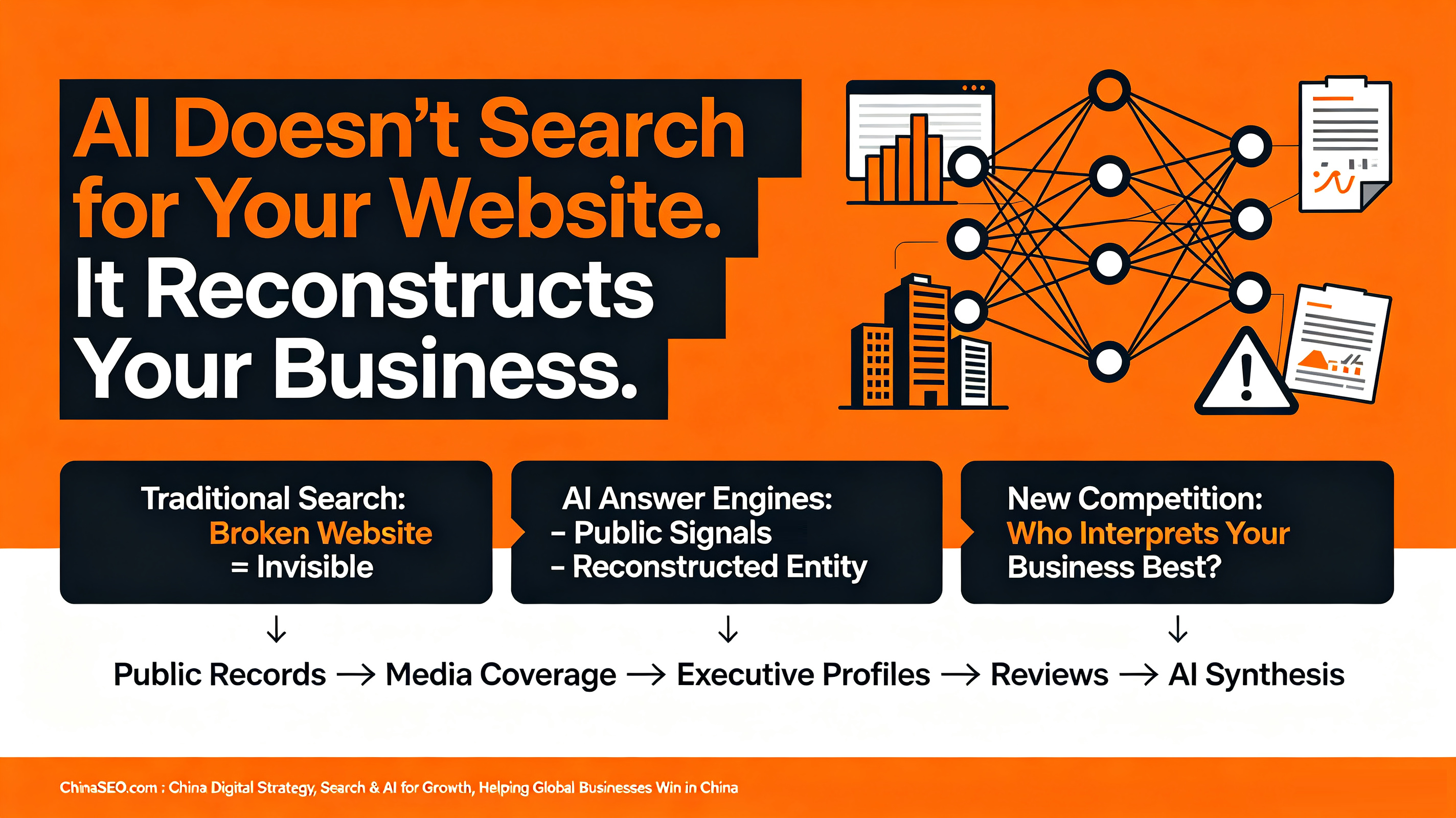
01 | A Parent Called Us With a Surprisingly Simple Question
Yesterday, a parent from Wenzhou called our team with a question that sounded straightforward on the surface.
“I asked an AI which agencies in Wenzhou handle U.S. study-abroad applications, and it recommended New Future. Are they good?”
Out of habit, our technical team immediately checked New Future’s digital presence. What we found was startling: their primary website was functionally broken. The SSL security certificate had expired, triggering glaring browser warnings. By traditional web standards, the site was dead in the water.
Yet, when queried by a high-intent user, the AI engine bypassed the technical wall, recognized the business, and served it up as a primary recommendation.
This creates an immediate cognitive conflict for any executive trained on two decades of digital marketing: The website was technically broken, but the business remained fully visible to AI.
Traditional Search (SEO):
Broken Website/Expired SSL ──> Rankings Tank ──> Invisible to Customers
AI Answer Engines (GEO):
Broken Website ──> AI Reconstructs Public Signals ──> Business Rerecommended
02 | AI Did Something Search Engines Traditionally Couldn’t
When we investigated further, the mechanism became clear. The AI had not simply failed to check HTTP status codes; it had performed a synthesis that traditional search algorithms were never designed to execute.
The system retrieved text fragments from historical web crawls of New Future’s site. Simultaneously, it gathered publicly available corporate registry details, regional media mentions, and shareholder backgrounds, cross-referencing these with municipal business records tying the founders to Wenzhou.
[ Public Corporate Records ]
│
├──> Entity: New Future (新未来)
│ ├── Service: U.S. Education Consulting
├──> Regional Hub: Wenzhou Connection
│ └── Digital Evidence: Shareholder & Local Context
│
[ User Intent: “Wenzhou U.S. Study Abroad” ] ──> [ AI Synthesis Engine ] ──> Recommendation
We cannot observe a commercial model’s internal weights. However, the observable outcome points to a fundamental shift in information processing: AI was not matching a keyword to a webpage; it was synthesizing multiple independent public signals around a single real-world entity to satisfy complex user intent.
03 | The Fundamental Shift: From Search Results to Business Understanding
For twenty years, digital strategy relied on a linear pipeline. An user typed a query, a search engine matched keywords to indexed pages, and an algorithm ranked those pages based on domain authority and backlinks.
AI answer engines operate on an entirely different architecture:
| Axis | Traditional Search Engine (SEO) | AI Answer Engine (GEO) |
|---|---|---|
| Primary Input | Keyword Query | Complex User Intent |
| Core Mechanism | Indexing Webpages | Mapping Real-World Entities |
| Validation | Backlinks & Technical Health | Cross-Referenced Public Signals & Evidence |
| Output | List of Ranked Links (SERP) | Synthesized Contextual Recommendation |
Search engines index pages. AI constructs models of reality.
04 | Your Website Is No Longer Your Business Identity
For years, C-suite executives operated under a comfortable assumption: Our homepage is our digital flagship. If we control the website, we control our brand narrative.
In an AI-mediated economy, that assumption is dead. A company is no longer defined by its URL; it is evaluated as a distributed network of digital evidence.
THE DIGITAL EVIDENCE GRAPH
- [ Exec & Founder ] Profiles
- [ Corporate ] Registries
- [ Product ] Docs
- [ Media & PR ] Coverage
- [ Third-Party ] Reviews
When an enterprise is parsed by an AI system, the model evaluates a broad Web graph:
- Corporate registry filings and shareholder structures
- Executive digital footprints and published commentary
- Cross-platform media coverage and industry association registries
- Third-party reviews, customer discussions, and historical citations
- First-party site architecture and structured metadata
The strategic question for boardrooms is no longer, “What does our homepage say about us?”
It is: “What does the open web collectively establish as fact about our business?”
05 | The New Competition Is Not for Rankings. It Is for Interpretation
When a prospective client asks an AI, “Who are the best B2B enterprise software consultants for supply chain integration in Eastern China?” the AI does not check who paid for a keyword or who published a blog post yesterday.
It interprets the market. It maps who the players are, evaluates their regional presence, verifies their domain expertise, and determines which organization best fits the user’s explicit and implicit constraints.
Traditional Competition: “Who ranks #1 on the page?”
│
▼
AI Competition: “How does AI interpret our role in the market graph?”
This introduces a new competitive metric for executive teams: Interpretability.
How easily can an AI system parse your corporate structure, offerings, and credibility without encountering contradictory, fragmented, or ambiguous signals? If your enterprise is difficult to interpret, it becomes invisible to the synthesis layer.
06 | The Hidden Asset: Your Business Evidence Graph
To manage interpretability, enterprises must move beyond “content marketing” and begin managing their Business Evidence Graph—the structured network of verified facts that define the company across the web.
[ Company ]
- (provides)──> [ Specialized Services ]
- (operates in)─────> [ Geographic Markets ]
- (associated with)─> [ Verified Key Personnel ]
- (validated by)────> [ Media, Clients, Registries ]
When an AI engine processes this graph, it isn’t evaluating design or copywriting. It is calculating probability vectors: Is this a real, capable, and topically relevant entity for this specific inquiry?
This marks the transition from content creation to Entity Architecture.
07 | The Dangerous Side: AI Can Also Reconstruct the Wrong Business
Because AI models synthesize disparate data streams, they are equally capable of constructing an accurate representation or a completely distorted one.
Fragmented Signals (Legacy Filings, Conflicting Media) ──> AI Hallucinated Entity (Model) ──> Wrong Value Proposition (Delivered to High-Value Prospect)
Consider what happens when an AI model reconstructs your enterprise using:
- Outdated corporate addresses or legacy subsidiary structures
- Discontinued product lines or deprecated pricing models
- Conflicting executive lists from unverified third-party databases
- Mismatched category definitions across regional press releases
Being omitted by AI is a distribution problem. Being inaccurately synthesized by AI is an enterprise risk problem. The AI presents a hallucinated version of your company to high-intent buyers before your sales team ever enters the room.
08 | The New Management Question: “What Does AI Think We Are?”
This shift demands an immediate, practical diagnostic at the C-suite level.
Instruct your strategy or marketing leadership to run a standardized prompt suite across ChatGPT, Gemini, Claude, Perplexity, and local engines like DeepSeek or Baidu ERNIE:
- “Who is [Company Name], and what are their primary capabilities?”
- “Who are the top 3 competitors to [Company Name] in [Target Market]?”
- “For an enterprise seeking [Specific Capability], why should they choose or avoid [Company Name]?”
- “Who owns, leads, and operates [Company Name]?”
Compare the AI-synthesized responses against your actual strategic positioning, market realities, and operational focus.
[ Executive Strategic Positioning ] vs. [ AI-Synthesized Market Reality ]
──> The AI Trust Gap
The delta between what your board believes the company is and what AI engines synthesize for buyers is your AI Trust Gap.
09 | The Evolutionary Shift: SEO → GEO → Entity & Trust Engineering
Digital strategy is undergoing its third structural shift in thirty years:
- SEO Era (2000–2022), Help search engines index and rank your web pages.
SEO was about tactical mechanical visibility (keywords, site speed, backlinks). - GEO Era (2023–2025), Help AI engines discover and cite your content.
GEO focused on citation optimization for generative engines. - Entity & Trust Engineering (2026+), Engineering accurate, verifiable, and structured business truth.
Entity & Trust Engineering governs whether an AI system can reliably verify, contextualize, and recommend your business infrastructure across global markets.
10 | The Next Digital Battlefield Is Not Visibility. It Is Meaning.
In an AI-mediated economy, visibility is no longer the final objective. Being correctly understood is.
The enterprises that win market share over the next decade will not necessarily be those with the largest ad spend, the highest volume of blog posts, or the slickest web design. They will be the companies whose underlying business evidence is sufficiently structured, consistent, and authoritative for AI engines to synthesize who they are, what they do, and why they matter.
A broken SSL certificate did not erase New Future from the AI’s understanding of Wenzhou’s market. The agency did not exist as a single website. It existed as a durable, cross-referenced network of evidence.
Your website is just one node in that network. It is time to manage the whole graph.
 Unlock 2026's China Digital Marketing Mastery!