 English
 German
 Korea
Korea Spanish
When AI Tech Giants Enter GEO: The Battle for the Next Commercial Gateway
- On September 3, 2026
- AI GEO, Commercial Gateway
Why the shift toward Generative Engine Optimization is not a search update—it is a fundamental restructuring of how businesses connect with buyers.
The Signal Leaders Cannot Ignore
Technology ecosystems in East Asia have quietly shifted their stance on artificial intelligence. major platform providers—from Tencent launching dedicated AI visibility analytics suites like AnswerBit, to ByteDance and Baidu formalizing infrastructure for Generative Engine Optimization (GEO)—have begun standardizing how brand entities are recognized by large language models.
When agency marketers look at these developments, they typically frame them in familiar language: “SEO is evolving into GEO, so we need new software and updated keywords.”
That framing misses the underlying reality. Executive leaders should be asking a far more consequential question: Why are primary platform architects taking direct responsibility for how businesses get discovered by AI?
The reason is simple. Platform developers are no longer content acting as passive indexers or neutral answer engines. They are actively stepping into the space between buyer intent and market supply. By standardizing visibility metrics, data-scraping parameters, and recommendation structures, platform architects are writing the governance model for commercial discovery in an AI-first economy.
From Answer Engines to Commercial Gateways
To understand why platforms are engineering GEO infrastructure, it helps to track how AI’s role in buyer behavior has shifted over time:
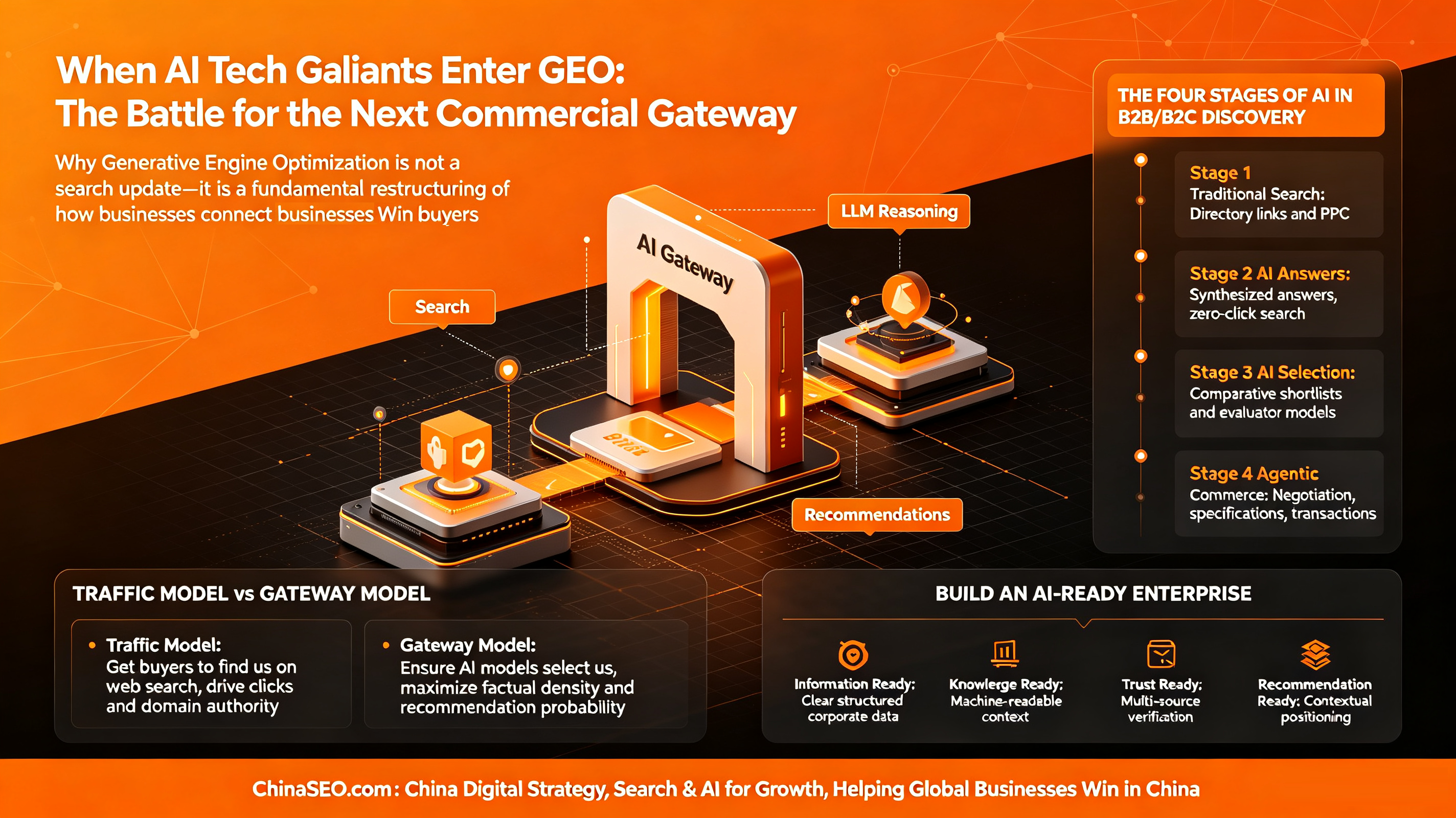
THE FOUR STAGES OF AI IN B2B/B2C DISCOVERY
- Stage 1 (Traditional Search): Search engines operated as directory services. Their financial model relied on directing users toward third-party websites while monetizing intent through paid positions (PPC).
- Stage 2 (AI Answers): Generative models became summarizers. Users obtained synthesized answers directly inside the interface, driving the rise of “Zero-Click Search” and reducing referral traffic.
- Stage 3 (AI Selection): Today, when a decision-maker asks, “Which enterprise ERP offers the best deployment timeline for mid-market manufacturing?” or “What are the most reliable cold-chain logistics providers in EMEA?”, the system bypasses directory links entirely. It presents a reasoned, comparative shortlist. The model has become an evaluator.
- Stage 4 (Agentic Commerce): Autonomous agents will soon negotiate terms, review specifications, and complete transactions on behalf of users.
The long-term play for generative models is not search—it is control over the primary commercial gateway. Whichever platform shapes how AI reasoning functions ultimately holds the keys to market selection.
Why GEO Is Strategic High Ground
Viewed strictly through a marketing lens, GEO sounds like another tactical playbook for getting cited in generated text. From an enterprise platform perspective, it solves a much larger challenge: How does an AI model map, verify, and understand the real-world business landscape?
For generative systems to route commercial intent accurately, they require structured, high-density, and verifiably true data. The open web, however, remains saturated with generic marketing copy, outdated press releases, and low-value SEO text. Relying on unstructured data creates hallucinations, inaccurate comparisons, and poor user experiences.
By establishing GEO frameworks and visibility standards, platforms are building a new commercial layer.
Control over this infrastructure determines:
- Entity Definition: How a company and its capabilities are categorized.
- Product Specifications: How parameters, pricing tiers, and use cases are parsed.
- Domain Context: How supply chains and industry ecosystems interact.
- Evaluation Frameworks: Why one vendor is weighted over another during comparative prompts.
- Trust Verification: How third-party consensus is measured across digital channels.
Whoever codifies these standards shapes how market access is granted across the AI ecosystem.
China as an Early Preview of Global Trends
Western observers often view Asian digital ecosystems as distinct, insulated markets. Yet the speed with which AI commerce is being formalized there offers a clear look at where Western markets are headed.
Digital ecosystems across East Asia feature unique structural characteristics: deeply integrated super-apps, unified payment rails, embedded e-commerce networks, and high-frequency digital services.
This level of integration makes the transition from AI Search to Automated Recommendation to Direct Commerce exceptionally fast.
The current convergence of AI search tools, GEO standards, and platform-driven monetization is not an anomaly. It is a live preview. As Western technology providers—such as OpenAI, Google, Microsoft, and Anthropic—expand native agent capabilities, shopping integrations, and B2B workflow connectors, Western markets will follow a remarkably similar trajectory.
Will History Repeat Itself?
Commercial web history rarely repeats word-for-word, but it follows recognizable patterns:
Search Engine Era:
Basic Indexing ➔ SEO Tactics ➔ Paid Search (PPC) ➔ SEM Strategy ➔ Search-Driven Commerce
Generative AI Era:
Generative Responses ➔ GEO Optimization ➔ Algorithmic Recommendations ➔ Agentic Commerce
When web search first emerged, leadership teams viewed it as a technical directory. Within a decade, organic optimization, paid search, and digital media buying became central to corporate strategy.
The formalization of GEO by major technology platforms indicates that generative AI is entering a similar stage of commercial maturation. The strategic question for executive leadership is not whether to buy another optimization tool, but rather: Is AI quietly consolidating into the primary commercial gatekeeper for your industry?
When that shift occurs, traditional web traffic, domain authority, and social follower counts will be re-evaluated under a completely different set of machine-driven criteria.
What This Means for Business Leaders
The most critical transition facing leadership is not moving dollars from SEO budgets into GEO tactics. It is shifting company mindset from a “Traffic Model” to a “Gateway Model.”
THE EXECUTIVE SHIFT
| TRAFFIC MODEL (Legacy) | GATEWAY MODEL (AI-First) |
|---|---|
| “How do we get buyers to find us on web search?” | “How do we ensure AI models select us when buyers state a need?” |
| “How do we drive prospects to our landing pages?” | “How do we make our value verifiable inside the model’s interface?” |
| Goal: Maximizing clicks, impression share, and domain authority. | Goal: Maximizing factual density, entity trust, and recommendation probability. |
Under the traffic model, your brand competes for human visual attention against rival web pages. Under the gateway model, your organization competes for placement within the reasoning framework of an intelligent system.
The Strategic Path: Building an “AI-Ready” Enterprise
Chasing short-term GEO hacks—such as generating thousands of synthetic articles or attempting to artificially pad prompt responses—is a mistake. Generative models utilize multi-source verification and anomaly detection that flag and discount low-quality content.
A durable strategy requires structuring your enterprise knowledge so that machines can easily parse, evaluate, and trust it.
1. Information Ready (Data Hygiene)
Core corporate data—product specs, operational capabilities, service regions, and compliance standards—must be clear, consistent, and structured. If a model encounters conflicting pricing data or vague operational claims, it will bypass your business to avoid generating inaccurate answers.
2. Knowledge Ready (Machine-Readable Context)
Proprietary methodology, white papers, technical documentation, and case studies should move beyond marketing jargon. Information must be structured using clear semantic formatting (such as Markdown and Schema markup) with high factual density so language models can parse key claims accurately.
3. Trust Ready (Multi-Source Verification)
Models do not evaluate reputation based on what a company says about itself; they cross-reference information across independent sources. Your claims must be corroborated across trade publications, industry databases, technical forums, patent filings, and verified customer evaluations.
4. Recommendation Ready (Contextual Positioning)
Analyze how your offerings compare when evaluated in side-by-side scenarios (e.g., “Platform A vs. Platform B for enterprise security”). Ensure your technical strengths and structural advantages are documented in ways that fit directly into an AI system’s comparative framework.
Once these foundations are set, leadership can focus on active execution:
GEO Monitoring ➔ Knowledge Optimization ➔ AI Visibility Management
Allocating Capital Over the Next 36 Months
When reviewing long-term strategic plans and digital investments, executives should avoid asking short-term tactical questions:
“What immediate lead volume can we attribute to GEO this quarter?”
Instead, focus on the structural question:
“If generative systems become the main filter for enterprise purchasing over the next three years, do we have the digital infrastructure required to be recognized and recommended?”
To balance near-term execution with long-term positioning, consider the following allocation framework:
AVOID (Short-Term Pitfalls)
├─ Abandoning functional web search channels prematurely
├─ Spreading capital across every emerging niche AI platform
├─ Publishing high-volume, low-density synthetic content
└─ Treating GEO as an agency trick rather than an information architecture task
PRIORITIZE (Strategic Infrastructure)
├─ Maintaining performance in proven acquisition channels
├─ Converting corporate knowledge into structured digital assets
├─ Building verifiable third-party authority across industry channels
└─ Implementing ongoing AI visibility monitoring for core business queries
Looking Ahead: The Battle for Next-Generation Connectivity
Evaluating GEO simply as a digital marketing tactic underestimates its broader impact.
While platforms present GEO as a visibility utility today, the longer-term competition is over who controls the primary link between businesses and buyers.
- Two decades ago, Search Engines organized web information and defined how buyers discovered vendor lists.
- One decade ago, Social Networks and Mobile Platforms centralized human attention and shaped how brands communicated value.
- Today, Generative AI is becoming the primary filter through which buyers evaluate options and make purchasing decisions.
The platform initiatives we see unfolding globally are the opening moves in a broader restructuring of commercial access. For executive teams, the primary strategic priority is not finding a vendor to manage GEO rankings.
The priority is answering a more fundamental question: When AI systems become the primary gateway for how customers discover, evaluate, and select partners, will your enterprise be ready to be chosen?
 Unlock 2026's China Digital Marketing Mastery!