 English
 German
 Korea
Korea Spanish
From Attention to Intent: What China’s AI-Driven Platforms Are Teaching the World About the Future of Digital Marketing
- On September 4, 2026
- Attention to Intent, China AI-Driven Platforms
For two decades, corporate marketing budgets have chased a single scarce asset: human attention.
Search captured explicit intent. Social networks monetized idle attention.
AI prediction engines are now attempting something vastly more consequential: calculating intent before a consumer puts it into words.
This is not another localized iteration of digital marketing. It represents a fundamental inflection point. While Western boardrooms remain fixated on how generative AI might alter traditional search rankings, China’s digital ecosystems have quietly dismantled the old mechanics of customer discovery. For global executives, observing China today is less about managing a regional market and more about previewing the structural realities that will govern enterprise competition worldwide.
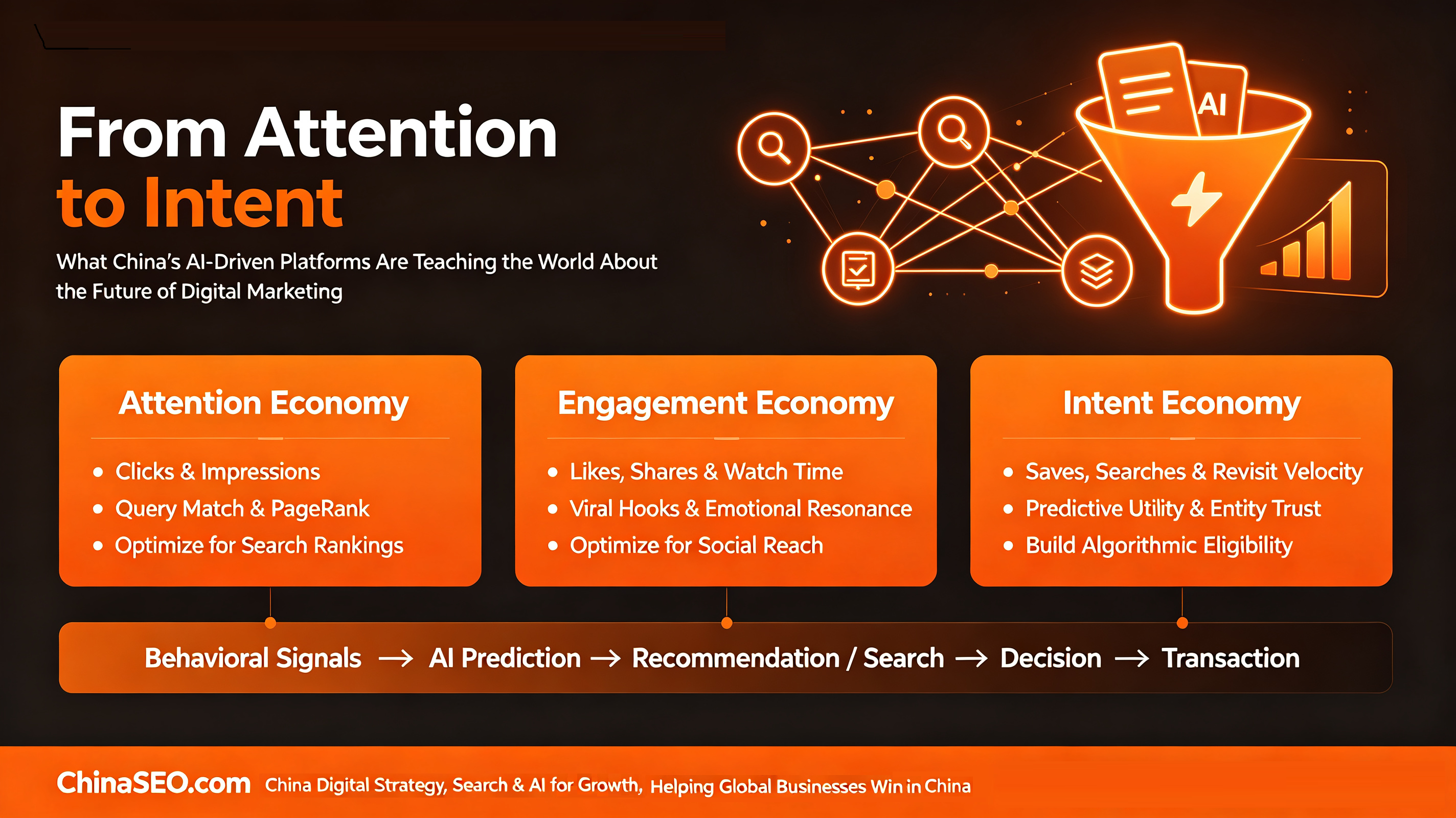
01 — From Attention Economy to Intent Economy
The underlying architecture of digital discovery has evolved across three non-linear eras. Each was defined by a distinct currency, a dominant algorithmic logic, and a unique strategic focus for the enterprise.
| Era | Primary Platform Currency | Core Algorithmic Driver | Strategic Imperative |
|---|---|---|---|
| Attention Economy | Clicks & Impression Volume | Query Match & PageRank | Search Engine Optimization (SEO) |
| Engagement Economy | Likes, Shares & Watch Time | Viral Hooks & Emotional Resonance | Content Volume & Social Reach |
| Intent Economy | Saves, Searches & Revisit Velocity | Predictive Utility & Entity Trust | Algorithmic Eligibility |
During the Attention Economy, brands bought visibility at the precise moment a user typed a keyword. In the Engagement Economy, algorithms favored material that triggered rapid emotional reactions—maximizing transient scroll time.
In today’s Intent Economy, surface metrics are actively devalued. The most telling behavioral signal is no longer a passive “I like this.” It is an action that communicates “I will need this again.”
Platform valuation of user behavior now follows a clear hierarchy:
- Likes: A friction-free 0.1-second reaction signaling superficial approval. Low intent.
- Comments: Conversational engagement. Variable intent.
- Saves / Bookmarks: Intentional curation of utility. High intent.
- Searches: Direct expression of immediate demand. High intent.
- Repeat Visits: Verified long-term affinity and retention. Highest intent.
Algorithms now prioritize entities that supply sustained operational value over those that merely capture transient interest.
02 — China Is Not Just Ahead. It Is Structurally Different.
China’s role as the testbed for intent-driven commerce is not an accident of adoption speed. It stems from structural conditions that do not exist in traditional Western web architecture:
- Ecosystem Consolidation: Super-apps seamlessly merge social messaging, payments, search engines, and marketplaces within unified digital environments.
- Closed-Loop Behavioral Graphs: Platforms cross-reference user signals in real time—tracking whether someone engaging with a product post also participates in a brand’s private chat group or holds a verified purchase history.
- Zero-Friction Conversion: Discovery, research, validation, and checkout happen inside a single interface without redirection.
These conditions have fundamentally altered consumer behavior: China has compressed the decision journey. The traditional multi-step funnel—moving predictably from awareness to consideration to purchase—has collapsed into a single, predictive loop governed by real-time behavioral data.
03 — The Feed Is Becoming an Intent Engine
Social feeds on platforms like Douyin and Xiaohongshu are moving away from pure entertainment delivery. They now function as predictive engines designed to resolve specific user needs.
[ Ephemeral Signal ]
Likes / CTR
-> Low Algorithmic Weight Demoted by Prediction Models
[ High-Value Intent ]
Save / Bookmark
-> High Algorithmic Weight Favored for Distribution
The pivot toward prioritizing Saves, Searches, and Repeat Visits is driven by platform economics:
- Likes measure immediate emotional reaction.
- Saves capture perceived future utility.
- Searches reveal active commercial research.
- Purchases prove validated intent.
When a consumer bookmarks an instructional guide or returns to a product review, the neural network registers a high-probability event: this user is moving closer to a transaction. Algorithms naturally route traffic toward structured, high-utility material while quietly throttling superficial, click-driven content.
04 — Search and Recommendation Are Converging
Historically, digital marketing relied on two separate channels:
- Search (Pull): The user defines their intent and initiates a request.
- Feed (Push): The platform guesses consumer interests and injects sponsored media.
In predictive ecosystems, this distinction disappears: AI = Predictive Pull + Predictive Push.
Search and recommendation are no longer separate channels. They are two distinct user interfaces powered by the same underlying prediction engine.
Unified Prediction Engine
- Predictive Push: Contextual feed delivery driven by behavioral history
- Predictive Pull: Personalized search answers tailored to real-time intent
When a user opens an application, the system anticipates their immediate problem based on recent account history before a single word is typed. When that user eventually uses a search bar, the engine delivers tailored solutions rather than a generic index of links. This convergence forms the baseline for modern Generative Engine Optimization (GEO).
05 — The New Competition Is Algorithmic Eligibility
As predictive models dictate discovery, the mechanics of enterprise competition change:
- Brands once competed for rankings (SEO).
- They later competed for reach (Paid Social).
- They must now compete for algorithmic eligibility.
Algorithmic eligibility dictates whether a machine model considers a brand qualified to serve as the definitive solution to a user’s explicit or implicit need.
What Prediction Systems Look For:
- Relevance: Does the brand directly solve the precise domain problem?
- Credibility: Is the brand validated by independent third-party sources?
- Utility: Is the information structured for immediate real-world use?
- Evidence: Are there clear purchase and usage signals tied to the entity?
- Retention: Do users routinely bookmark, reference, or return to this source?
Under this paradigm, trust becomes machine-readable. An AI model scans unstructured content, verified customer actions, and cross-platform footprints to decide whether a brand deserves a spot in its generated recommendations.
06 — What This Means for Western Companies
Adapting to an intent-driven landscape requires C-suite executives to confront five core questions:
- What signals does your brand actually generate? Are your consumer interactions producing verified behavioral data, or merely vanity click volume?
- Which of those signals indicate real intent? Are you celebrating social likes, or tracking actions that signal future purchases—such as bookmarks, downloads, and search queries?
- Is your content designed to be consumed or reused? Does your media spend fund transient entertainment, or reference-grade assets that users save and revisit?
- Can your channels share a coherent customer signal? Is your customer data trapped inside isolated department silos, or connected in an architecture that reinforces algorithmic credibility?
- If an AI had to recommend three companies in your space, what evidence would it rely on? Does your corporate footprint provide the structured evidence an AI system needs to validate your authority?
07 — From Content Production to Decision Infrastructure
Building algorithmic eligibility requires moving away from the traditional Content Factory in favor of a Decision Asset Factory.
Traditional Content Factory
- High-volume social posts
- Ephemeral, trend-chasing media
- Designed for passive scrolling
Decision Asset Factory
- Structured product comparisons
- Decision trees & technical guides
- Machine-readable specifications
- Verified customer evidence & FAQs
Decision assets are dense, structured resources built for two distinct audiences: human decision-makers evaluating a complex purchase, and AI models parsing data for trusted answers.
By organizing brand knowledge into clear comparison matrices, technical specifications, expert validations, and troubleshooting guides, an enterprise creates a persistent Trust Infrastructure that continuously feeds predictive algorithms.
08 — What Western Platforms Will Eventually Have to Solve
This transition is not a localized trend confined to Asia. Western technology companies—from Meta and Google to TikTok and Amazon—are navigating identical headwinds:
- Generative AI search eroding traditional organic web traffic.
- Saturated feed ads driving up Customer Acquisition Costs (CAC).
- Cookie deprecation limiting traditional cross-site tracking.
- An explosion of synthetic, low-quality AI content polluting social feeds.
Western platforms will inevitably face the same fundamental challenge: How do we separate surface attention from genuine commercial intent?
China’s digital ecosystem is not an anomaly. It is an early demonstration of the exact structural operational problems every major digital platform will eventually have to solve.
09 — The C-Suite Playbook
To navigate this transition, executive leadership must execute four shifts:
1. Rebuild Core Metrics
Shift enterprise KPIs away from top-of-funnel reach and superficial engagement toward intent indicators: Save Rates, Search Volume, Return Rates, and Conversion Velocity.
2. Unify Channel Signal Architecture
Consolidate data flows across social accounts, messaging channels, and sales channels. Build an integrated signal architecture that demonstrates cross-platform momentum directly to platform recommendation models.
3. Build High-Utility Decision Assets
Reallocate creative budgets from short-lived promotional campaigns toward reference-grade assets—developing technical documentation, interactive guides, and detailed comparison matrices that drive bookmarks and machine citations.
4. Establish AI-Readable Brand Trust
Standardize enterprise entity records across all digital touchpoints. Clean, structured product metadata, third-party validation, expert inputs, and customer evidence must be formatted so AI search engines can easily parse and verify them.
10 — The Strategic Shift
The trajectory of modern digital marketing resolves into three distinct phases:
OLD DIGITAL ECONOMY
Search -> Attention -> Click -> Website -> Conversion
SOCIAL ENGAGEMENT ECONOMY
Feed -> Engagement -> Recommendation -> Conversion
AI / INTENT ECONOMY
Behavioral Signals -> AI Prediction -> Recommendation / Search -> Decision -> Transaction
As market dynamics shift toward the Intent Economy, the overarching mandate for enterprise strategy evolves:
- Yesterday: Optimize for Humans.
- Today: Optimize for Platforms.
- Tomorrow: Become Legible, Trustworthy, and Recommendable to AI.
The next competitive advantage may not belong to the brand that generates the most attention. It may belong to the brand whose signals make the right AI believe it is the right answer.
That is the real lesson China is beginning to offer the world.
 Unlock 2026's China Digital Marketing Mastery!