 English
 German
 Korea
Korea Spanish
China Is Experimenting With the Next Commerce Interface: From Search and Social to Story
- On October 8, 2026
- china ecommerce, Next Commerce Interface
Imagine a viewer watching a drama. The protagonist walks into a dimly lit boardroom, wearing an unbranded, structured wool coat.
The viewer does not open Google to describe the coat. They do not pause the video to take a screenshot for an image search. They do not visit Amazon or Tmall. They simply ask the media player: “Show me this.”
Before the character finishes walking across the room, the coat—along with precise sizing matched to the viewer’s personal profile—appears directly on screen. Transaction complete. No tab switching, no intent decay, no friction.
What ByteDance is building in China—most visibly through its short-drama platform Red Fruit (Hongguo) and its integration across Douyin—is not merely another entertainment vertical or media play. It is an aggressive compression of the distance between human desire and transaction toward zero.
For Western executives, treating this phenomenon as a localized Chinese entertainment trend is a mistake. China has spent the past decade operating as a high-speed sandbox for digital commerce paradigms that eventually migrate globally. Understanding what happens when commerce embeds directly inside narrative immersion provides a critical lens for anticipating the next global interface for brand discovery.
The Strategic Shift: Moving the Purchase Entrance
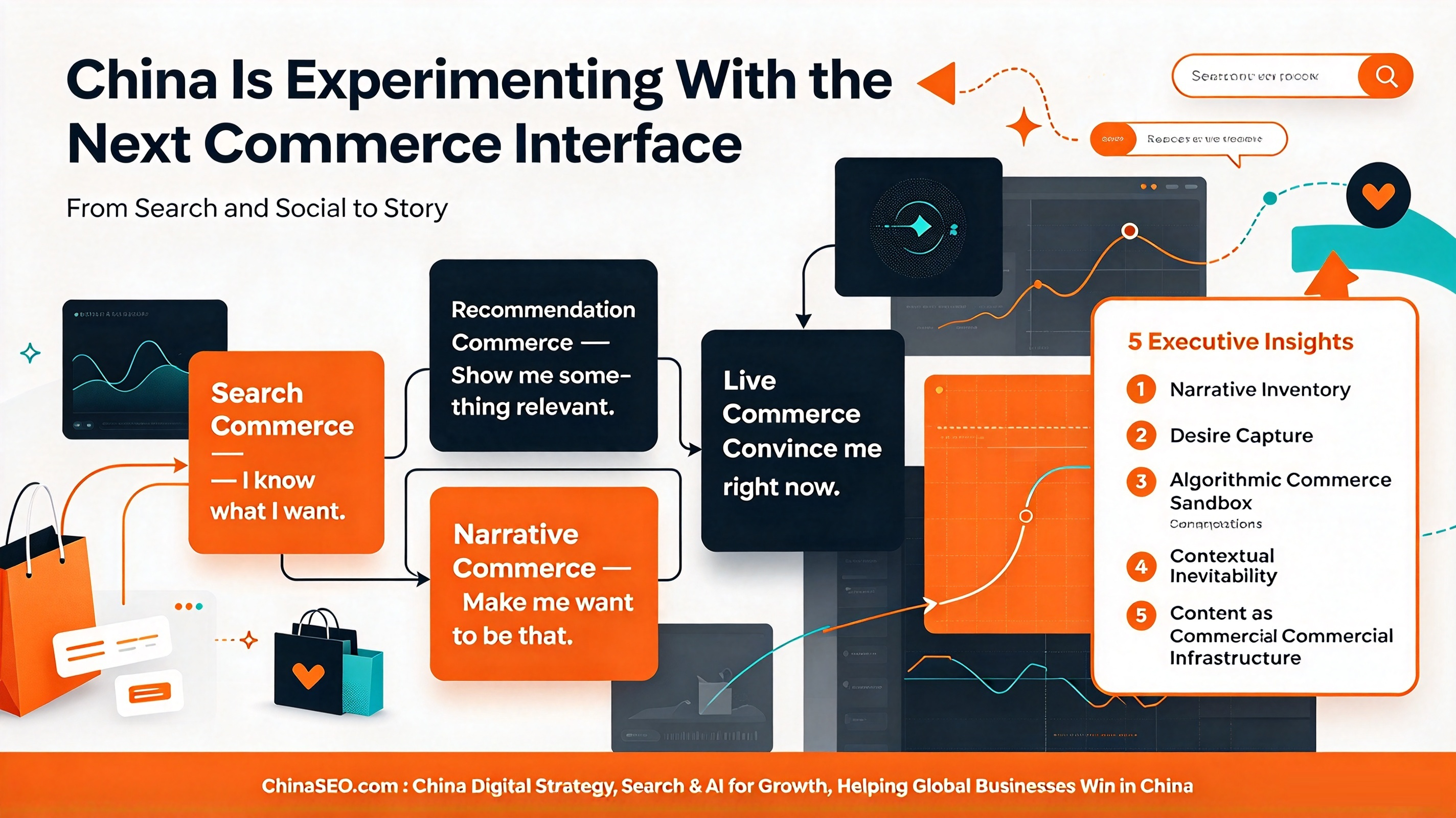
Global e-commerce has historically developed across four distinct phases, each moving the transaction point structurally closer to the moment intent or desire forms.
| Era | Primary Consumer Behavior | Platform Logic | Core Metric | Global Equivalent |
|---|---|---|---|---|
| Search Commerce | “I know what I want.” | Indexing & Retrieval | Keyword Intent / Cost-per-Click | Google, Amazon Search |
| Recommendation Commerce | “Show me something relevant.” | Algorithmic Discovery | Click-Through Rate / Feed Attention | Meta Feed, TikTok, Instagram |
| Live Commerce | “Convince me right now.” | Real-time Urgency & Host Trust | Gross Merchandise Value / Convert-on-Stream | TikTok Shop, Taobao Live |
| Narrative Commerce | “Make me want to be that.” | Emotional Identity & Contextual Integration | Desire Capture / Moment Ownership | Red Fruit, Douyin Drama |
In traditional search and discovery models, a consumer experiences an impulse, opens an app, types a query, browses options, compares prices, and eventually checks out. Each step in that chain represents drop-off risk.
Narrative commerce removes the intent-to-search phase entirely. The moment of emotional response is the moment of purchase.
5 Executive Insights on the Future of Commerce
1. The Primary Unit of Competition Is Shifting from Product Catalog to “Narrative Inventory”
Historically, platform dominance depended on product variety (SKUs), merchant density, price transparency, and fulfillment logistics. In a hyper-frictionless digital environment, product supply is commoditized. The scarce resource is the emotional context in which a product becomes meaningful. Platforms that own the situational moments—the precise scenes, identities, and emotional states that trigger purchasing behavior—will control the top of the commercial funnel.
2. Marketing Metrics Are Transitioning from “Traffic Reach” to “Desire Capture”
Traditional metrics like impressions, click-through rates, and follower growth measure passive distribution rather than commercial velocity. “Desire Capture” measures the exact conversion rate at the precise point an emotional state is triggered. Brands that optimize for impression volume will suffer diminishing returns compared to brands that engineer content to fit specific psychological triggers.
3. China Is Operating as the World’s First Algorithmic Commerce Sandbox
Developments in China’s platform ecosystem are not isolated anomalies; they represent structural precursors. Live commerce, social search, and short-form video algorithms originated in China before reshaping global ad spend via TikTok, Instagram Reels, and YouTube Shorts. Narrative commerce represents the next iteration of this migration pattern.
4. Enterprise Value in the AI Era Will Depend on “Contextual Inevitability”
As generative search and AI recommendation engines replace traditional browsing, products will no longer be selected via explicit searching. Instead, systems will surface products when they represent the most logical, natural solution within a user’s current context. Brands that fail to integrate their products into clear usage scenarios will become invisible to AI discovery engines.
5. Content Quality Is Now Pure Commercial Infrastructure
ByteDance’s RMB 500 million ($70 million) fund for short-drama creators is not a venture into entertainment production. It is an investment in commerce infrastructure. High-quality narrative inventory generates stable, highly targeted user attention, which serves as the underlying real estate for instantaneous transactions.
The Economics of Narrative Inventory: Why Stories Convert Better Than Ads
Advertising operates through explicit instruction: “This product is superior.” Influencer marketing relies on personal endorsement: “I use this product.” Narrative commerce relies on psychological identity: “This is who I want to become.”
When a product enters a story seamlessly, it gains three structural advantages that standard performance advertising cannot replicate:
- Identity Alignment: The viewer identifies with the character’s status, choices, or trajectory.
- Contextual Proof: The viewer observes the product solving a problem or signifying status within a realistic scenario, eliminating the need for explanatory copy.
- Emotional Transfer: The emotional satisfaction experienced during the narrative peak transfers directly to the product associated with that moment.
The product inherits its valuation directly from the narrative context rather than its feature list.
The Monetization Trap: Commercial Over-saturation vs. Attention Decay
Integrating commerce directly into narrative content presents a distinct operational risk: aggressive commercialization degrades the user experience.
If a viewer is subjected to explicit purchase pop-ups every three minutes, the psychological state shifts instantly from narrative immersion to consumer skepticism. The moment the user realizes they are watching a commercial catalog rather than a story, retention collapses.
High Commercial Interruption ─►
Reduced Narrative Immersion ─► User Churn ─► Destruction of Attention Inventory
The structural challenge for platforms and brands is moving from crude product placement (interrupting the narrative to present an item) to product integration (where the product is essential to advancing the plot or character identity).
If the product can be removed from the scene without altering the narrative logic, the integration will fail to achieve high conversion.
Translating Narrative Commerce to B2B Strategy
Narrative commerce is not restricted to fast-moving consumer goods (FMCG) or fashion. While B2C transactions may be driven by personal aspiration or instant gratification, B2B purchasing decisions are driven by professional risk management.
The underlying structural logic remains identical:
Traditional B2B Funnel:
Specifications ─► Datasheet ─► Product Page ─► Inquiry
Narrative B2B Funnel:
Operational Problem ─► Scenario Context ─► Business Impact ─► Integrated Solution ─► Executive Trust
When an enterprise client evaluates complex software, industrial machinery, or supply chain services, they are not buying specifications; they are buying operational certainty, regulatory compliance, and risk reduction.
B2B brands that construct detailed, scenario-based narratives around critical business pain points capture buyer intent far earlier than competitors relying on passive search indexing or technical documentation.
The central strategic objective is now: Which consumer moments must our brand own, and how seamlessly can we enter those moments when intent is formed?
China’s rapid integration of short-form narrative and instant commerce is not an isolated local trend. It is an active laboratory testing where digital commerce is heading globally. Companies that view these developments merely as Chinese consumer quirks will find themselves unprepared as these underlying dynamics reshape global channels over the next three to five years.
 Unlock 2026's China Digital Marketing Mastery!