 English
 German
 Korea
 Spanish

The Platforms Banning Your AI Content Farms Are Becoming the Biggest AI Content Producers
- On November 11, 2026
- AI content, ai platforms
Last year, agencies were still selling playbooks on running a hundred accounts with one person. This year, those accounts are dying in batches.
YouTube rewrote its monetization policy around “inauthentic content,” and in January 2026 pulled monetization from a channel network that had racked up 4.7 billion lifetime views. Pinterest went further than labeling — it handed users a switch to actively suppress AI content in their feeds, outsourcing the judgment to the audience rather than the algorithm.
Here’s the part that should make you pause. The same industry executing this purge is betting its balance sheet on AI-generated content. OpenAI’s Sora standalone app hit the top of the App Store within 48 hours — 56,000 downloads on day one, tripling the next. Meta launched Vibes almost simultaneously: a video feed generated by AI from first frame to last.
Banning accounts with one hand. Building content factories with the other. That’s not hypocrisy — it’s accounting. And if you understand the ledger, you understand the next three years of content competition.
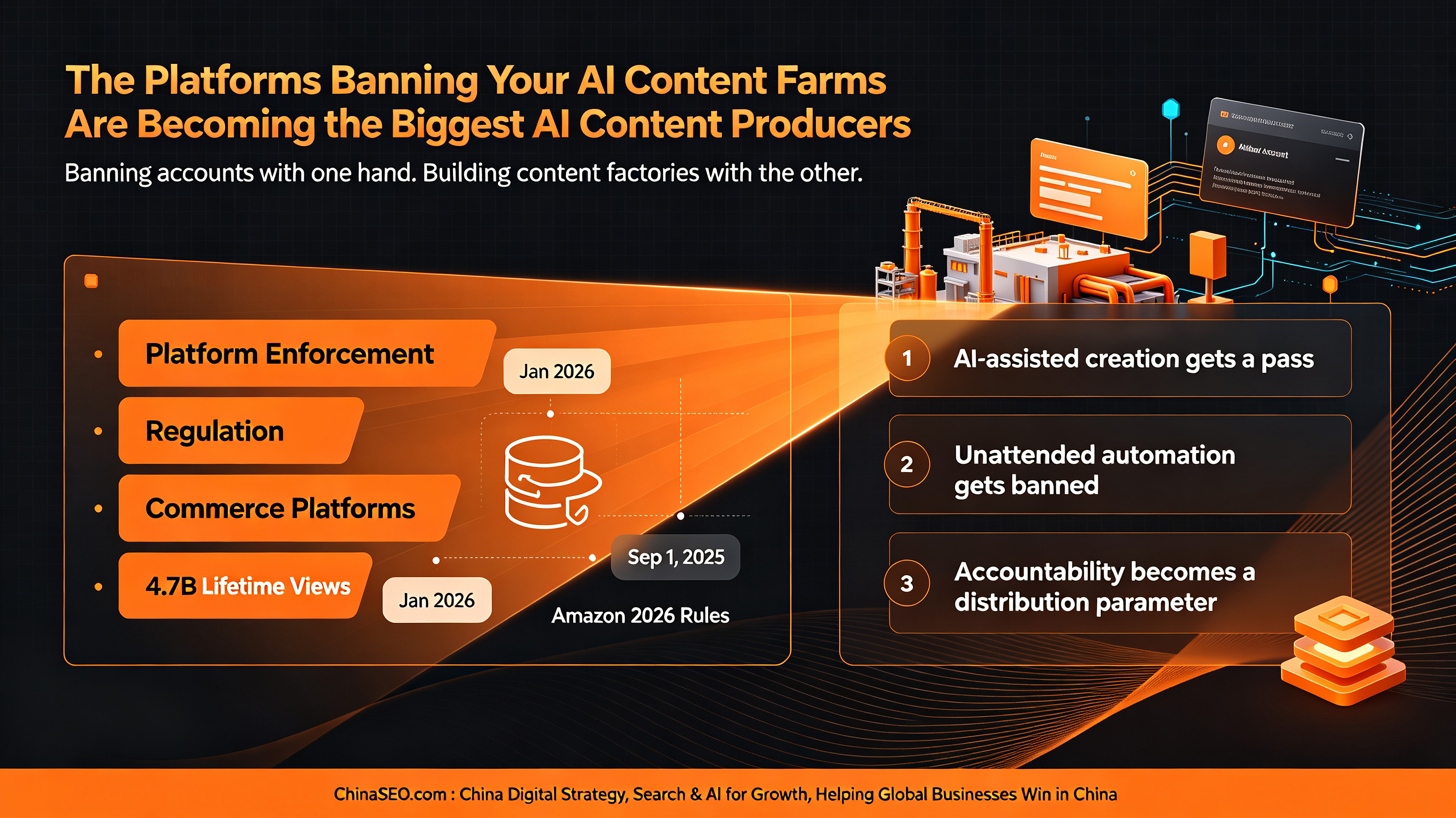
One crackdown, three layers of signal
Most executives only registered the first layer. Let’s stack all three.
Platform enforcement. Beyond YouTube and Pinterest, the pattern is consistent across every major network: AI-assisted creation gets a pass; unattended automation gets banned. The line isn’t about content quality. It’s about whether a human being stands behind the output.
Regulation. China fired the starting gun. On September 1, 2025, its AI labeling rules took effect, backed by a mandatory national standard — every piece of AI-generated text, image, audio and video must carry both a visible mark and embedded metadata. Article 10 spells it out: declaring AI involvement is the publisher’s obligation, and stripping or hiding those labels is a violation. If you think this stays in China, look at the EU AI Act’s transparency provisions on the same trajectory. Western regulators are drafting from the same playbook, eighteen months behind.
Commerce platforms. Amazon’s 2026 rules treat unlabeled AI main images like prohibited content — the system swaps them out automatically, without notice, and your listing weight craters. No warning email. No appeal window.
Three layers, one conclusion: this isn’t a content cleanup. It’s a supply-side reform of the entire attention economy.
Why now? Because the cost of content hit zero
Content farms survived for years on simple arithmetic: production cost below traffic revenue, pocket the spread. AI pushed that arithmetic to its limit. When the marginal cost of one more article, one more video, one more post approaches zero, any company can supply infinitely.
Distribution slots, however, are finite. Infinite supply meeting finite distribution produces exactly one outcome: content inflation. Users scroll past more garbage per session, watch time erodes, and advertiser budgets get nervous. The platforms aren’t facing a moderation problem. They’re watching their currency — attention — depreciate.
So the bans aren’t moral judgments. They’re interest-rate hikes. Drain the excess liquidity, defend the purchasing power of attention.
Except the central bank is printing money while it tightens. Sora and Vibes contain not a single human creator; users type a prompt, the model produces the content, and “the line between creator and consumer disappears.” The platforms aren’t purging content farms because they used AI.
What actually changed: the unit of account in distribution
Let me be blunt about what the purge really targeted. Platforms never opposed AI content. They opposed AI content whose rent doesn’t flow through them.
Farm operators used third-party tools to mass-produce and auto-publish — bypassing the platform’s creation tools, its ad system, and its accountability structure. They extracted value from the ecosystem without paying any “tax” into it, while degrading the user experience the platform sells to advertisers. Of course that supply gets cleared. Meanwhile, content made with the platform’s own AI tools feeds its data, burns its compute subscriptions, and fills its ad inventory. That supply, platforms will happily amplify.
The deeper shift is in ranking logic. For a decade, algorithms sorted on content quality signals — watch time, engagement, completion rates. AI has broken every one of those signals, because AI optimizes them better than humans ever could. Platforms are being forced to rebuild ranking on a different foundation: the accountability of the entity behind the content. Is there a real person, a real company, behind this account? Who do you call when it goes wrong? What has this entity’s track record looked like for three years?
China’s labeling mandate encodes this directly: hidden metadata must record content identifiers and provider codes for traceability. Translated into strategy: every piece of content will soon have to answer “who made this,” and the who becomes a harder distribution currency than the what.
That’s the crackdown’s real legacy: trust has become, for the first time, a computable, rankable, compoundable distribution parameter.
Five judgments for the people who sign the checks
One: the content farm’s death is institutional, not technical. Don’t bet on “more human-like AI” evading detection. When regulation mandates end-to-end labeling, platforms control metadata read/write, and users hold a veto switch, this is no longer an escalation of cat-and-mouse. The rules of the game themselves changed. Betting technical workarounds against institutional change is the most expensive misjudgment in corporate strategy.
Two: after content inflation, scarcity lives in endorsement, not content. AI made “sounding smart” worthless. What’s valuable now is a named human willing to be held responsible for the statement. Brand is reverting to its original definition — collateral against credibility.
Three: platforms are turning from channels into content houses, which makes your owned properties strategic again. As feeds fill with content the platforms’ own models hallucinate into existence, third-party content competes for a structurally shrinking slice of attention. Your website, your knowledge base, your founder’s voice — assets you fully control — move from the marketing periphery back to the strategic center.
Four: the volume-play dividend is permanently zero, but the trust-accumulation play just opened. Every platform’s new rules leave the same door ajar: AI-assisted creation is fine; unaccountable automation is not. AI isn’t banned from your workflow. It must live inside a named, traceable, track-record-carrying entity.
Five: this war doesn’t end with “detecting AI.” It ends with “attributing responsibility.” Detection versus evasion is an arms race with no winner. The only sustainable equilibrium: stop asking whether content was made by AI, start asking whether someone can be held accountable for it. Accountability is the one scarcity in the AI content era that never depreciates.
What to do this now
First, run an AI usage audit this quarter. Map every point in your marketing chain where AI touches output — copy, images, voice, avatars, video. Under China’s rules — the template Western regulators are following — the declaration obligation sits with the publisher, not the tool vendor. Selling on Amazon? Check your main images and A+ content first. Automatic replacement with a ranking penalty requires no notification.
Second, kill every unattended content automation. If no specific human is accountable for what a workflow produces, that workflow is now a liability, not an asset. Redirect the saved budget into attributed content: your engineers publishing technical judgment, your founder publishing industry conviction, your customers telling their own stories. AI handles the efficiency. Humans sign the work.
Third, rebuild your content team’s scorecard. Stop measuring volume and impressions — both are meaningless in an inflationary environment. Measure three things instead: citation frequency (including citations by AI search engines), engagement quality on attributed content, and the reusable lifespan of content assets. Reorganize the team from a newsroom into a trust production line.
Fourth, migrate budget from traffic arbitrage to credibility assets. Cut the volume spend in half. Move it into three places: first-party data, a structured knowledge base that AI search can retrieve and cite, and long-horizon founder and expert voices. One is an expense line. The other is an asset. Your balance sheet knows which one survives a downturn.
The cost of inaction is equally concrete: account assets that can be zeroed overnight, regulatory exposure as labeling mandates spread westward, and the most expensive item of all — watching competitors compound “accountable credibility” while you keep paying tuition to an arbitrage window that already closed.
Three years out: compliance in the short run, credit in the long run
In the next twelve to twenty-four months, three things are near-certainties. Labeling compliance becomes the driver’s license of content — no license, no road, and the fines keep rising. Platforms will start a subsidy war over their own AI creation tools, because they need legitimate AI supply to fill feeds; expect tools to go free, then better than free. And the detection arms race continues, but the battlefield shrinks from “detecting AI” to “detecting undeclared AI.” The gray zone narrows every quarter.
Over three to five years, the picture sharpens. Content credentials — C2PA-style provenance certification — become internet plumbing, the way HTTPS did. Ranking algorithms evolve into something resembling credit ratings for content entities: the track record of the person and company behind the account determines your starting distribution pool. And AI content itself gets fully laundered into legitimacy. Nobody will ask “was this made by AI?” the way nobody today asks “was this photo retouched?” They’ll ask one thing: who said this, and have their past statements held up?
Looking back from there, the 2025–2026 purge of AI content farms will be recorded as the industry’s Bretton Woods moment: the old currency — volume — was demonetized, and a new currency — credibility — was pegged.
Which currency is your company holding right now? That question deserves more time at your next operating review than any single platform policy update ever will.
 Unlock 2026's China Digital Marketing Mastery!