 English
 German
 Korea
 Spanish

The Storefront Is Now a Sentence: China Just Built the World’s First AI-Mediated Consumer Market
- On November 3, 2026
- Agentic commerce, AI recommendation systems, AI-mediated commerce
The most valuable retail real estate in China is no longer a place. It’s a reply.
For thirty years, the geography of Chinese commerce was easy to map. First it was the department store shelf. Then the Tmall flagship. Then the Douyin livestream. Each shift moved spending, and each time, the brands that moved early — L’Oréal on Tmall, Perfect Diary on Douyin — captured a decade of disproportionate growth.
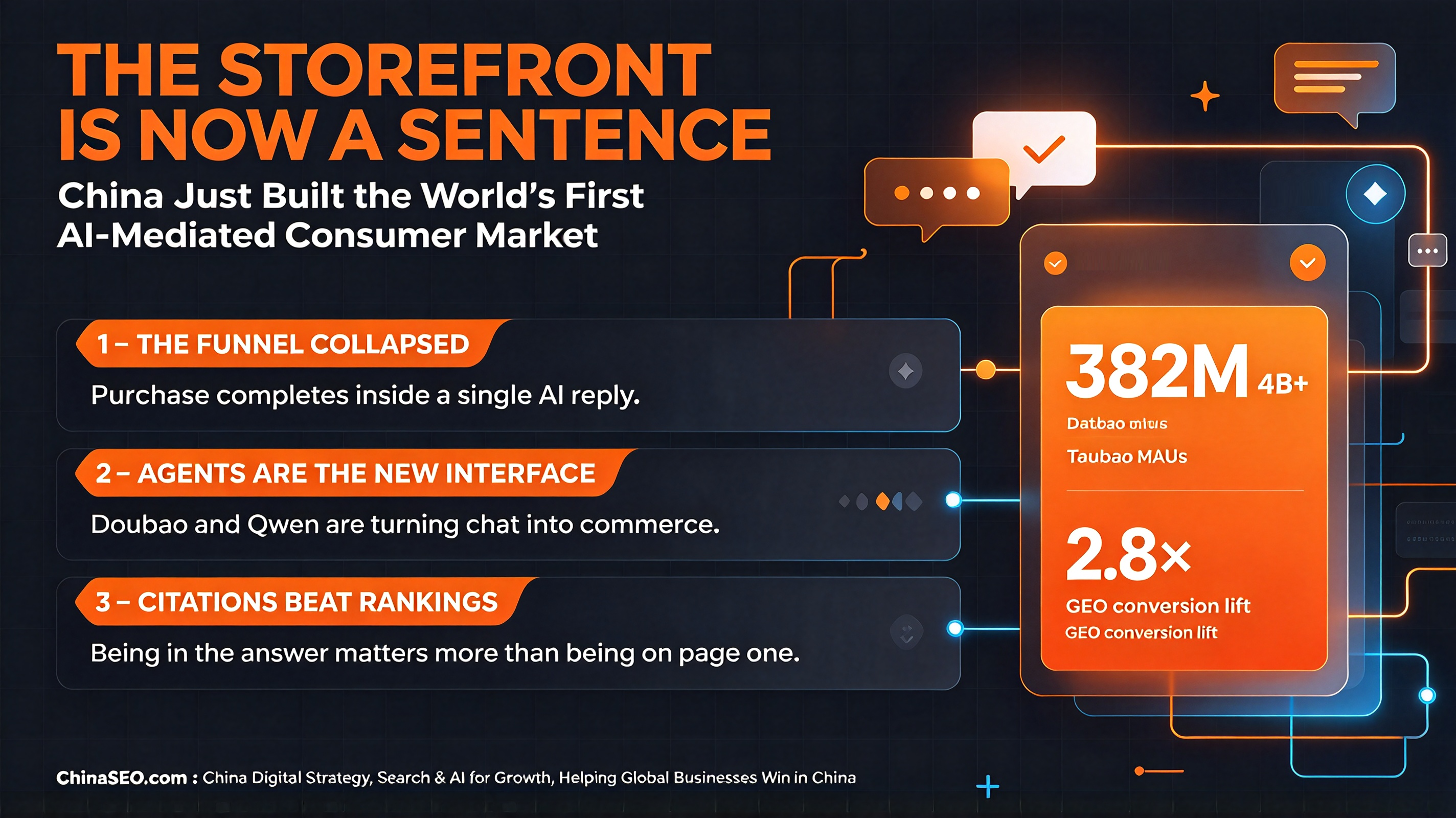
The next shift has already happened, and most Western boardrooms haven’t registered it. There is no storefront at all this time. No shelf, no page, no ranking. A consumer asks a question in a chat window, an AI answers in one or two sentences, and — this is the part that should command your attention — the purchase now completes inside that same window. The funnel didn’t get shorter. It collapsed into a single sentence.
If your brand is in that sentence, you win the sale without the consumer ever seeing a competitor. If it isn’t, you don’t rank lower. You don’t exist.
What actually changed in the last few weeks
Strip away the AI hype and look at the plumbing. In October 2026, ByteDance’s Doubao — China’s most-used AI assistant, with 382 million monthly active users as of June, more than Qwen and DeepSeek combined — crossed the line from recommending products to transacting them: users can now select a product inside the chat, enter an address, and pay, without leaving the app. The launch batch is limited to Douyin stores rated 4.8 or higher, which tells you exactly where this is heading.
Alibaba moved first and arguably further. In May 2026 it connected its Qwen assistant to Taobao’s entire catalog — more than 4 billion products — searchable and purchasable by natural language, with a Qwen assistant embedded inside Taobao itself doing virtual try-on and deal-hunting. Then in June it opened Qwen to outside businesses, letting companies deploy their own AI agents inside the platform so consumers can browse, order, and pay by conversation. KFC (Yum China), Luckin Coffee, and Mixue were among the first to sign on.
Read those two moves together. ByteDance and Alibaba — the two fiercest rivals in Chinese tech — just made the same bet with their crown jewels: that the next interface of commerce is not an app. It’s an agent.
The scale behind that bet is not speculative. China had 602 million generative-AI users in CNNIC’s 2025 survey; 72.2% of them named Doubao as a tool they use. Qwen reached 167 million monthly users within months of launch, and during the 2026 Lunar New Year, Alibaba’s connected assistant stack — Taobao, Alipay, Fliggy, Amap in one chat — drove more than 120 million orders in six days. And the behavioral data is unambiguous: the share of Chinese consumers using AI tools at least weekly climbed from 77% in August 2025 to 86% by January 2026, while China’s Academy of Information and Communications Technology found brands with a working GEO (Generative Engine Optimization) presence converting at 2.8 times the rate of traditional search, with decision cycles roughly 40% shorter.
Why China, and why first
Western executives often file this under “China is different.” That framing is comforting and wrong. China is not on a different road; it is further down the same road, for four structural reasons.
The super-app was the training ground. Chinese consumers spent a decade living inside WeChat and Alipay, where messaging, payment, and shopping already shared one interface. Asking an AI to buy something feels like a feature update, not a leap of faith. Western consumers are being asked to make two jumps at once — trust the AI, and trust the transaction. Chinese consumers only had to make one.
Payment rails were already conversational. In the West, “agentic commerce” collides with card networks, fraud systems, and checkout flows built for browsers. In China, Alipay and Douyin Pay were designed for in-chat, in-video, in-anything transactions. The agent plugged into rails that were already there.
The platforms can afford to buy the future. Serving Doubao for free reportedly costs ByteDance tens of millions of yuan a day against daily revenue under a million — and ByteDance’s response was to raise its 2026 AI capex past ¥200 billion and start charging ¥68–500 a month for premium tiers, while treating commerce, not subscriptions, as the payback engine.
No Western startup can subsidize inference at that scale while wiring it to a 3.5-trillion-yuan e-commerce engine. Only a platform that owns the content, the model, the mall, and the payment system can close the loop — and in China, three companies do.
There is no incumbent search economy to protect. Google’s deliberate pace on AI answers is rational: it has a $200-billion advertising machine built on ten blue links. Baidu’s search ad business was already eroding, so China’s platforms had far less to lose by letting the agent eat the search box.
The part nobody is pricing in: the new gatekeepers
Here is where the story turns from “interesting channel shift” to “structural power realignment.”
When an AI gives one answer instead of ten links, who it cites becomes the whole game. A Fudan University study of 17,211 AI-search citations found that 25.9% of everything Doubao cites points to ByteDance-owned domains — 13.5 times the share those domains receive on other engines. Baidu’s Wenxin cited Baidu-owned domains 24.4% of the time; Tencent’s Yuanbao cited Tencent-owned domains 14.2%. Each assistant is quietly becoming a toll booth on its owner’s content ecosystem. Your brand’s visibility now depends less on your website and more on whether you exist — credibly, consistently, in Chinese — inside the content each engine trusts: Douyin and Toutiao for Doubao, WeChat for Yuanbao, Taobao’s own signals for Qwen.
And the trust layer is fragile in ways that should worry you. In the same Fudan measurement, Doubao cited a paid placement within an hour of delivery — 88 minutes after payment. That cuts both ways: it means influence can be bought fast, and it means your competitors can buy it too, today, before any rules exist.
The platforms themselves understand what’s at stake — which is why the year’s most revealing event was a blockade. When ByteDance and ZTE shipped a phone whose system-level Doubao agent could read the screen and operate any app as if it were the user, Taobao, Alipay, and WeChat cut it off within days, citing security. Banks admitted they couldn’t tell agent actions from human ones. The dispute has already produced proposals to classify AI agents as digital gatekeepers under China’s Anti-Monopoly Law — regulation designed to stop an assistant from steering users to its owner’s mall. That fight is not about privacy. It is about who owns the customer’s first mile.
Meanwhile the interface is escaping the phone entirely: at the 2026 Beijing Auto Show, BYD, Geely, Li Auto, Changan and others announced Qwen integrated into their cockpits, so drivers can book hotels, order food, and pay by voice from the driver’s seat. The agent is becoming ambient. The battleground is every surface where a need can be expressed in words.
Five insights worth taking to your board
1. China is now the world’s first AI-mediated consumer market — treat it as a preview, not an outlier. The combination of 600 million AI users, conversational payment rails, and platforms willing to lose money on inference to own the transaction layer does not exist anywhere else. What works in this market in 2026 is the template Western platforms will converge on by 2028.
2. The unit of competition has changed from ranking to recommendation. Search optimized for position on a page. Agents optimize for inclusion in a single synthesized answer. A brand can hold page one on Baidu and be completely absent from the answer that actually closes the sale. Gartner’s forecast of a 25% decline in traditional search volume is, if anything, conservative about China.
3. Winning Chinese consumers increasingly means winning the citation graph. Visibility is now earned inside platform-owned content ecosystems — Douyin videos, Xiaohongshu reviews, Zhihu answers, Baidu Baike entries — because that is what the models retrieve. Brand building and GEO have become the same discipline.
4. Agentic commerce rewrites the economics of marketing spend. Budgets will migrate from impression-buying toward three new line items: entity infrastructure (being machine-legible), source seeding (being cited), and agent operations (running your own brand agent inside Qwen or Douyin, as KFC and Luckin already do).
Companies still optimizing Tmall keyword stuffing are defending the last war.
5. The gatekeeper war is a risk event, not a headline. If agents are regulated as gatekeepers, the rules governing which assistant can access which marketplace will be written in Beijing first. Foreign brands have no seat at that table — which makes early, diversified presence across all three ecosystems (ByteDance, Alibaba, Tencent) the only hedge.
The executive playbook
Audit your Share of Model, this quarter. Have your China team — or an outside firm — query Doubao, Qwen, DeepSeek, Yuanbao and Kimi with the fifty questions your buyers actually ask (“best industrial sensor for high-humidity environments,” “which premium stroller do Shanghai mothers trust”). Count how often you appear, how you’re described, and who appears instead. You cannot fix what you haven’t measured, and right now most Western brands would score zero.
Rebuild your entity infrastructure. Consistent Chinese naming, a current Baidu Baike entry, crawlable Chinese-language product facts, structured specifications. Agents reward clarity and punish ambiguity; they recommend what they can verify.
Seed the sources each engine trusts. Doubao leans on Douyin and Toutiao; Yuanbao on WeChat; Qwen on Taobao signals and Baidu-sourced pages. Map your content investment to the citation graph, not to where your marketing team happens to have accounts.
Pilot a brand agent where the platform allows it. Alibaba has opened the door; KFC, Luckin and Mixue walked through it. A branded agent that remembers preferences and reorders proactively is the loyalty program of the agentic era.
Watch the 4.8-store-rating gate. Doubao’s first in-chat checkout batch admits only Douyin stores rated 4.8 or above. Review velocity and service quality are now algorithmic gatekeeping criteria. Operations, not just marketing, determines visibility.
Assign this to the C-suite, not the social team. The reporting line reveals whether a company thinks this is a channel experiment or a market-structure shift. It is the latter.
Looking ahead
The next 12–18 months. Paid placement inside AI answers is the inevitable next monetization layer — ByteDance has already tested hard advertising inside Doubao once and pulled it for user-experience reasons; it will return in a more native form, because the economics of free inference demand it.
Expect a scramble reminiscent of early search ads: cheap inventory, no standards, outsized returns for early movers. Simultaneously, expect regulators to formalize agent-access rules — the Anti-Monopoly Law gatekeeper proposals are the leading edge — which will shape whether assistants must offer neutral recommendations or may favor their owners’ commerce.
The next 3–5 years. Agent-to-agent commerce: your customer’s assistant negotiating directly with your brand’s agent on price, availability, and terms, with no human in the loop until confirmation. When that matures, brand equity expresses itself through machine-trust signals — verified quality data, fulfillment reliability, review authenticity — more than through emotional advertising. The companies that will win are those building both assets now: the human brand that earns the query, and the machine legibility that wins the answer.
The pattern to internalize is simple. Every previous interface shift in Chinese commerce — shelf to search, search to feed, feed to livestream — rewarded the incumbents who treated it as a structural change and punished those who treated it as a channel. This shift is larger than all of them, because the interface is no longer a place you can rent. It is a judgment made by a machine your customer trusts.
The storefront is a sentence now. The only question that matters is whether you’re in it.
 Unlock 2026's China Digital Marketing Mastery!