 English
 German
 Korea
Korea Spanish
The Vendor You Don’t See Is Becoming Part of Your Brand
- On September 29, 2026
- Digital Liability Chain, Digital Trust Infrastructure, Institutional Reliability
Why China’s New Content Distribution Rules Force Global C-Suites to Redefine Enterprise Risk
For decades, foreign multinationals entering China followed a comfortable operational template. Corporate headquarters in Frankfurt, Paris, or Chicago retained ownership over brand identity, product integrity, global compliance, and core messaging. Local execution—traversing the complex, fast-moving terrain of Xiaohongshu (RED), Douyin, WeChat, Zhihu, and live e-commerce—was delegated to a network of local agencies, MCNs (Multi-Channel Networks), and third-party operators (TPs). The implicit consensus across Western boardrooms was simple: We own the brand; the agency handles the execution.
On September 1, 2026, China’s Cyberspace Administration (CAC), alongside four joint regulatory bodies, formally implemented the Provisions on the Administration of Internet Information Content Multi-Channel Distribution Services. This framework fundamentally dismantles that traditional arm’s-length arrangement.
By codifying legal registration, institutional licensing, mandatory content governance teams, real-name corporate tagging on public account headers, and platform-level cross-liability, the Chinese government did not merely introduce a new compliance checklist for local marketing vendors. It institutionalized a fully traceable digital liability chain.
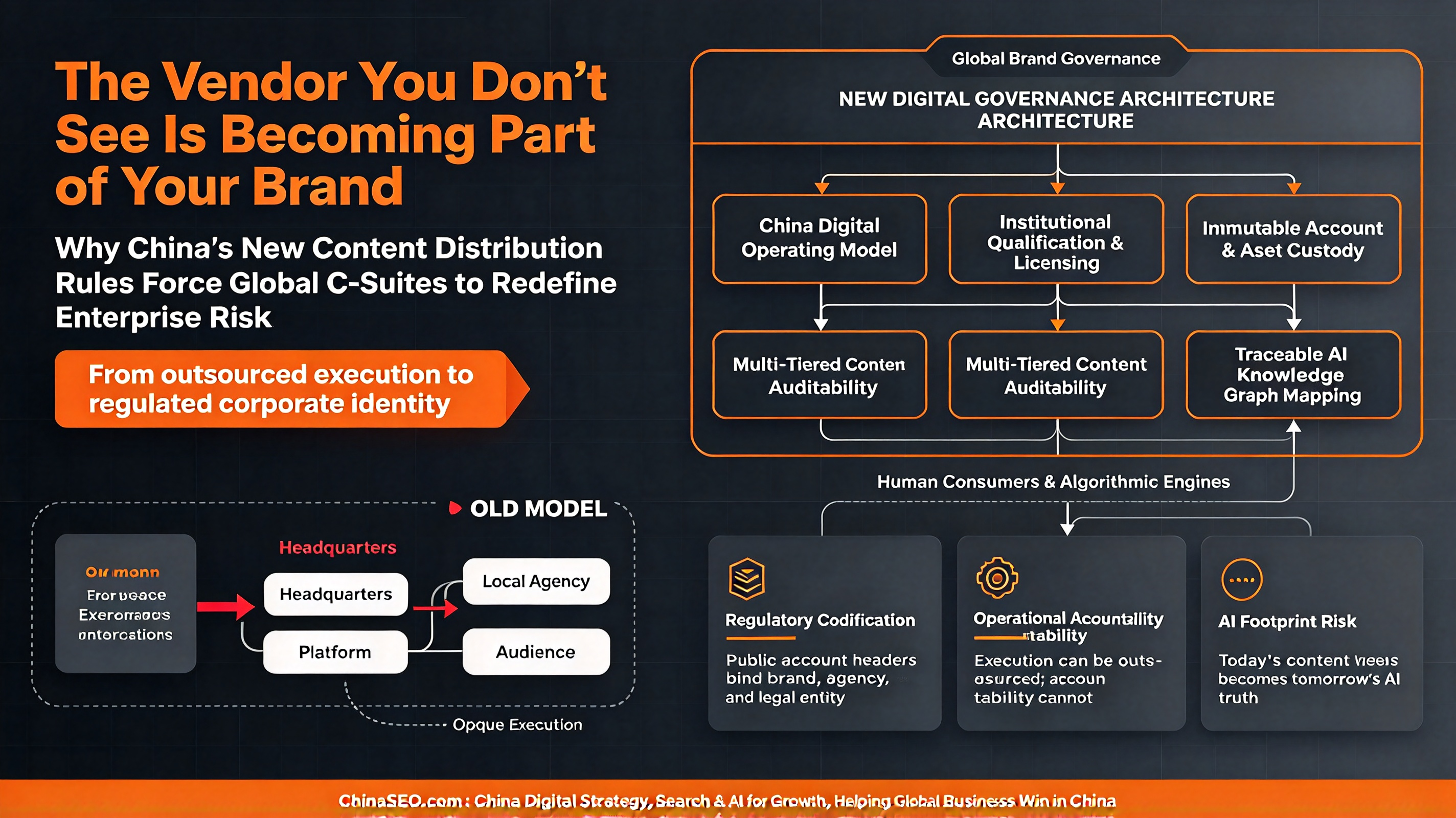
OLD AGENCY-BRAND MODEL
Headquarters ─> Local Agency ─> Platform ─> Audience
(Opaque Execution)
NEW DIGITAL GOVERNANCE ARCHITECTURE
Global Brand Governance
└─ China Digital Operating Model
├─ Institutional Qualification & Licensing
├─ Immutable Account & Asset Custody
├─ Multi-Tiered Content Auditability
└─ Traceable AI Knowledge Graph Mapping
└─ Human Consumers & Algorithmic Engines
When an external agency speaks for your brand in China today, they are no longer an invisible execution vendor operating in the shadows of media buying. They are a regulated extension of your market-facing corporate identity.
1. Regulatory Codification: Moving from MCN Oversight to Institutionalized Digital Risk
To view this development through the narrow lens of “increased MCN regulation” is to miss its structural impact on corporate governance. What China has constructed is the world’s first mandatory, end-to-end identity and accountability framework for content distribution platforms.
Under the new regulations, any entity involved in planning, producing, distributing, marketing, or managing digital content across platforms must maintain specific legal registration, hold statutory administrative permits for specialized media activities, and establish dedicated internal content security teams. Platforms are legally required to verify these qualifications, register the agency relationships with provincial regulators, and publicly display the agency’s registered corporate name directly on the user-facing account headers of every account they manage.
The historical buffer between brand owner and third-party distributor has vanished. In the legacy model, an agency’s mistake, unauthorized product claim, or regulatory infraction could be isolated through contractual indemnity clauses and public relations disclaimers. Today, because platform headers explicitly bind the brand account, the agency, and the legal entity in a public, platform-verified ledger, operational errors instantly become top-tier corporate governance events.
2. The Management Paradox: Operational Outsourcing vs. Non-Delegable Accountability
A core principle of modern business architecture is that while execution can be outsourced, ultimate accountability cannot. In China’s unified digital ecosystem, this principle has transformed from a management philosophy into an operational reality.
In Western markets, marketing channels remain relatively compartmentalized: an ad agency manages Google Ads, a PR firm handles media outreach, and a social agency manages Instagram. China’s hyper-integrated super-app landscape operates differently:
- A single Xiaohongshu post functions simultaneously as brand narrative, organic recommendation, direct lead capture, and private-traffic gateway to WeChat.
- A single Douyin live broadcast combines brand positioning, influencer endorsement, programmatic ad delivery, immediate commerce execution, and post-sale service.
When execution across these high-velocity touchpoints is completely turned over to third-party vendors without deep corporate oversight, a company isn’t just outsourcing media execution. It is surrendering direct operational control over its commercial and regulatory footprint.
3. The Structural Shift: From Unchecked Traffic Acquisition to Verifiable Provenance
For the past fifteen years, digital competition in China progressed through distinct evolutionary phases:
- Volume Era (2010–2016): Maximizing reach and acquiring cheap traffic.
- Efficiency Era (2017–2021): Optimizing customer acquisition cost (CAC) and return on ad spend (ROAS).
- Conversion Era (2022–2025): Driving private-domain retention (Siyu) and live-stream conversion.
- Provenance Era (2026 Onward): Ensuring distribution authenticity, verifiable origins, and institutional trust.
The statutory prohibition of fraudulent engagement—fake follower counts, inflated views, fabricated user reviews, automated account farming, and astroturfing—marks a decisive shift. Growth strategies built on artificial volume metrics or grey-market execution now introduce severe structural liabilities.
THE PROVENANCE ERA
- Verified Entity Qualification
- Anti-Astroturfing Enforcements
- Audited Campaign Metadata
- Immutable Asset Ownership
The defining competitive question for global executives is no longer “How cheaply can our agency buy traffic?” but rather “Can our digital footprint withstand rigorous platform, legal, and consumer scrutiny?”
4. Vendor Selection Reimagined: From Performance Metrics to Institutional Governance
Historically, C-suite discussions around selecting Chinese digital agencies centered almost exclusively on commercial KPIs: follower growth, engagement rates, cost-per-lead (CPL), and gross merchandise value (GMV).
While those metrics remain operationally relevant, the new regulatory climate demands that enterprise procurement frameworks prioritize Institutional Reliability.
| Evaluation Vector | Legacy Procurement Approach | Modern C-Suite Due Diligence Standard |
|---|---|---|
| Legal & Regulatory | Valid business license; standard service contract. | Verified Multi-Channel Distribution licensing; cross-platform state filing records; active regulatory compliance standing. |
| Asset Ownership | Agency sets up social accounts; brand holds administrative logins. | Enterprise custody of main account administrative credentials, platform enterprise verifications, and user databases. |
| Governance & Control | Periodic performance reports; quarterly strategy reviews. | Multi-stage content approval workflows, defined emergency kill-switch protocols (<30 min), and immutable content logging. |
| Data & Access Control | Shared password sheets across local team members. | Enterprise-grade Identity and Access Management (IAM), role-based permissions, and zero-trust access architecture. |
| Auditability | End-of-month campaign summaries and invoices. | Complete operational traceability: Who authored, approved, distributed, sponsored, and controlled every published asset? |
Reframing vendor selection as digital partner due diligence ensures that marketing operations match the enterprise risk management standards applied to finance, legal, and supply chain functions.
5. Concentrated Control Risks: The Fragmented Digital Footprint
A common liability for foreign brands operating in China is operational fragmentation. A European luxury or B2B industrial brand might hire Agency A for Xiaohongshu, Agency B for Douyin live-streaming, Agency C for WeChat CRM, Agency D for influencer brokerage, and Agency E for Baidu search.
This siloed model creates a dangerous Fragmented Control System:
Global Brand HQ │Limited Visibility
- Agency A (RED), Isolated Accounts
- Agency B (Douyin), Isolated Data
- Agency C (WeChat), Unmonitored Claims
In this environment, corporate headquarters often lacks baseline answers to critical operational questions:
- Which legal entity holds master administrative ownership of our enterprise social accounts?
- Who owns the historic customer interaction data and private-traffic databases accumulated over the last three years?
- If an agency’s license is suspended or revoked by platform regulators, can internal teams assume control of brand channels within minutes?
The risk isn’t just rising vendor fees; it’s the potential loss of corporate control over your brand’s core digital infrastructure in its second-largest market.
6. Generative Engine Optimization (GEO): Today’s Social Content is Tomorrow’s AI Truth
The strategic impact of strict content distribution traceability extends well beyond current social media compliance—it directly shapes how Artificial Intelligence understands your company.
As Search Engine Optimization (SEO) evolves into Generative Engine Optimization (GEO) across both Chinese platforms (Baidu Ernie Bot, Kimi, Tencent Yuanbao, Douyin Search) and Western AI engines (ChatGPT, Claude, Perplexity), AI systems rely heavily on public digital content to construct real-time knowledge graphs of corporate identity, product specifications, brand reputation, and market positioning.
HUMAN CONTENT LAYER (Today)
Outsourced Agency Content ─> Social Distribution ─> Public Regulatory Ledger
│
▼ Indexing & Ingestion
AI KNOWLEDGE LAYER (Tomorrow)
Generative AI Engines ─> Corporate Knowledge Graph ─> Automated Buying Recommendations
If a local agency publishes unverified claims, inconsistent product specifications, or compliance-violating statements today, those entries do not simply fade down a social feed. They are crawled, parsed, and permanently embedded into the training data and live retrieval context of enterprise AI engines.
Strategic Reality: The social content an enterprise outsources to a third-party vendor today becomes the core knowledge infrastructure AI uses to recommend—or reject—your products tomorrow.
7. Operational Blueprint: Moving to a Digital Trust Partnership Model
To secure digital operations in China, global leadership must transition from legacy marketing outsourcing to an integrated Global Digital Trust Model.
5 Imperative Audit Questions for the C-Suite
- Identity & Authorization: Which specific legal entities are officially registered as the operating owners of our Chinese digital channels, and are these relationships compliant with platform-level filings?
- Account Custody: Does our enterprise hold direct ownership of all primary credentials, API integrations, and admin permissions across every platform?
- Kill-Switch Readiness: If an unapproved or non-compliant statement is published, do internal compliance teams have the technical and contractual authority to take down the content within 30 minutes?
- Data Continuity: If our primary local agency relationship ends unexpectedly, can internal teams transition operations without disrupting business continuity or losing historical customer data?
- AI Footprint Audit: How does our current distributed content strategy shape our brand’s representation across major generative AI search engines?
The critical question for global business leaders is not whether China’s digital environment is becoming more regulated. It is whether your organization views its Chinese digital presence as an outsourced tactical sales channel—or as vital corporate infrastructure.
 Unlock 2026's China Digital Marketing Mastery!