 English
 German
 Korea
Korea Spanish
Why Your Western Marketing Strategy in China Is Failing in Plain Sight
- On October 13, 2026
- baidu marketing, marketing strategy
The real takeaway from China’s digital evolution isn’t that Western brands need to master a new set of foreign apps.
It’s that most companies are organizing their entire marketing apparatus around the wrong unit of competition.
You can rank at the top of Google, pump budget into high-performing paid ads, push weekly updates on LinkedIn, and keep your corporate website polished to a sheen—and still become entirely invisible to your next buyer.
When growth stalls, the corporate reflex is predictable: tweak the ad spend, juice the conversion rate, test a new platform, or hire an agency to “optimize for AI search.”
But what if the performance of your individual channels isn’t the bottleneck at all?
What if the way your customers actually buy has fundamentally shifted, while your go-to-market strategy is stuck in 2015?
China’s market offers a harsh, unfiltered lens on this exact trap. Its digital ecosystem evolved past the Western playbook years ago—intertwining search, social, peer reviews, commerce, and AI synthesis into an integrated grid.
The lesson for Western executives isn’t about copying WeChat or Xiaohongshu. It’s about recognizing the fragile assumptions underpinning conventional digital marketing.
The battlefield has expanded. Winning visibility inside isolated channels no longer matters if you fail to earn a seat at the table when the customer is quietly making up their mind.
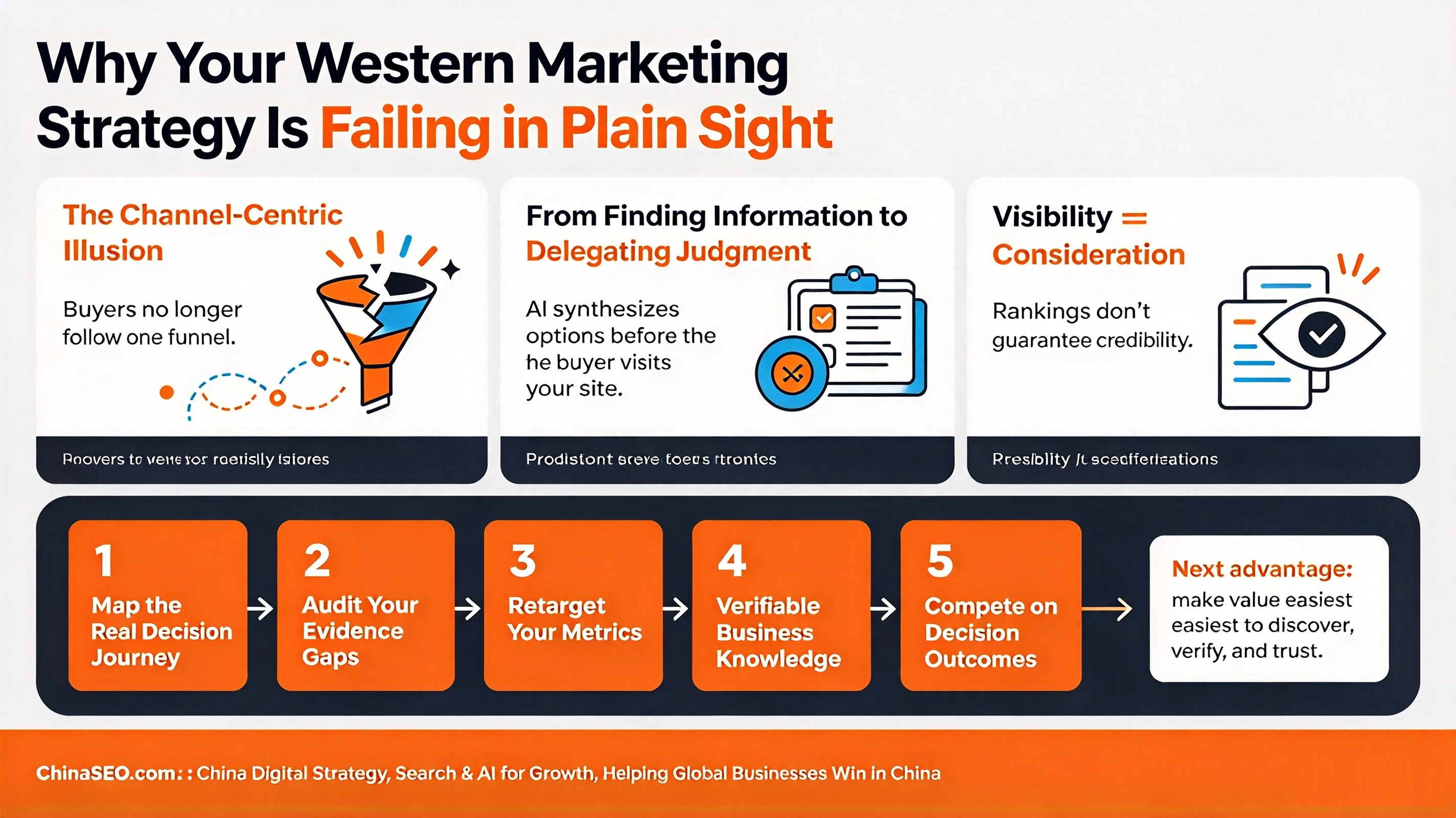
1. The Channel-Centric Illusion: Why Your Funnel Is a Dead End
For twenty years, digital marketing operated like a clean factory assembly line.
Customers searched. Engines spat out links. Companies fought for ad space. Prospects clicked through to a corporate landing page, where lead forms and eager sales reps ushered them toward a deal.
Social media eventually joined the mix, but the underlying corporate logic remained stubbornly siloed: every channel kept its own budget, its own specialists, its own metrics, and its own reporting deck.
Search generated leads. Social drove engagement. The website closed visitors. CRM nurtured the pipeline.
This neat division made management comfortable. It also bred a dangerous complacency: if a channel underperforms, fix the channel.
That logic shatters the moment buyers stop walking your pre-arranged path.
Picture an industrial procurement manager evaluating heavy machinery.
- The spark might start with an operational headache muttered over coffee with a colleague.
- A technical teardown video on YouTube introduces a potential fix.
- A search engine helps narrow down regional suppliers.
- Industry forums and peer case studies establish baseline credibility.
- An AI assistant gets looped in to compare technical specifications and weed out vendors.
- Finally, the buyer visits two or three corporate websites—just before they ever speak to sales.
The customer hasn’t abandoned search. Search has simply been demoted to a single background component in a messy, non-linear decision loop.
Different touchpoints do different jobs: discovery, education, peer validation, risk mitigation, or final execution. Their value depends entirely on the buyer, the product, and the stage of thought.
For channel-obsessed organizations, this is a blind spot.
Your SEO team optimizes its own traffic metrics while completely ignoring what happened before the prospect landed—or what convinced them to hand the deal to a competitor afterward.
You can hit every single KPI on every dashboard and still lose the market.
The real strategic question isn’t “Which channel gets more budget next quarter?” It’s: “How does our buyer actually reach a verdict, and at what points in that journey are we completely missing?”
2. From “Finding Information” to “Delegating Judgment”
The rise of AI search and LLM synthesis is pouring gasoline on this fire.
Traditional search engines acted like digital librarians—dumping a pile of links on your desk and leaving you to read, cross-examine, and judge them yourself.
Recommendation systems and AI assistants operate more like an executive assistant. They don’t just fetch links; they synthesize options and structure decisions before the buyer ever visits a supplier’s website.
Imagine a technical buyer throwing these prompts at an AI:
- Which suppliers can guarantee a 0.01mm tolerance under high thermal stress?
- What are the failure modes of Technologies A versus B in Southeast Asian climates?
- Which vendors have proven deployment records in my specific industry—and show me the receipts.
The buyer isn’t asking for a list of homepages anymore. They are asking for a pre-vetted shortlist.
The AI summarizes the evidence, flags potential vendors, weighs trade-offs, and drafts the next set of questions. Its output dictates what the buyer looks at next.
Does this mean AI dictates the final shortlist? Rarely. Buyers still double-check facts, consult colleagues, and run rigorous internal trials.
But a new danger has emerged: you can be disqualified before you even know the race has started.
Your website never gets the visit. Your sales reps never get the inbound ping. Your marketing analytics show zero trace of the lost opportunity.
You can maintain pristine rankings on conventional search while going completely blind in the rooms where decisions are actually made.
Stop obsessing over whether AI-referred traffic converts a fraction higher than organic search. Conversion rates only measure the behavior of people who actually showed up. They tell you nothing about the buyers who wrote you off on day one.
3. The Hidden Trap: Confusing Visibility with Consideration
Visibility is table stakes for digital acquisition. It is not the same as being taken seriously.
You can buy massive amounts of attention without ever being viewed as a credible vendor. You can rank for high-volume keywords without proving your product survives actual operating constraints. You can publish a mountain of content without giving a buyer a single hard fact to justify a purchase.
This gap is fatal in complex B2B markets.
Consider a European manufacturer trying to sell specialized engineering equipment into Asia.
Their home-market website looks immaculate. The English copy is polished; the brand heritage is front and center. But when an overseas engineering lead digs in, the critical answers are nowhere to be found:
- Does this rig handle local power grids and humidity levels?
- Where are the third-party stress test reports?
- What do current operators say about maintenance downtime?
- How does field support actually work on the ground?
If your digital footprint leaves those questions unanswered, your engineering excellence is commercially invisible.
The problem isn’t that your product lacks merit. It’s that your expertise is locked inside your engineers’ heads instead of translated into discoverable evidence.
AI exposes this weakness ruthlessly. An algorithm cannot synthesize advantages that are absent, ambiguous, or buried in marketing fluff. If the data isn’t clean, structured, and verifiable, the AI skips you.
4. Stop Producing Content. Start Building Verifiable Business Knowledge.
Most companies respond to digital fragmentation by turning up the content volume.
More blog posts. More AI-generated landing pages. More social clips. More whitepapers repeating generic claims about “industry-leading quality.”
Volume is not authority. A hundred articles echoing empty slogans carry less weight than one brutally honest, technically rigorous case study detailing performance under stress.
The shift is simple: stop publishing marketing materials; start building a verifiable body of business knowledge.
Ask yourself if your digital channels can instantly prove, with evidence:
- Exactly what you do, and precisely who it is not for.
- The exact technical and commercial standards your solutions satisfy.
- Your operating boundaries, trade-offs, and known limitations.
- Independent proof, field data, and metrics that validate your claims.
For manufacturers, this means application-specific engineering docs, testing standards, and compliance certifications. For professional firms, it means transparent methodologies and measurable client outcomes.
Generative Engine Optimization (GEO) isn’t about gaming AI algorithms with keyword tricks. It’s about making your real-world capabilities legible to both human experts and machine scrapers.
If your business isn’t clear, understandable, and backed by hard evidence, no optimization tactic in the world will save you.
The future of marketing isn’t channel-free; it is customer-decision-centric.
Search engines will stay. Social channels will evolve. Corporate websites will remain core. AI will add a new layer of automated synthesis.
Organizations treating marketing as a set of isolated silos will keep optimizing metrics that matter less and less, while missing the decisions happening right past their field of view.
The next competitive advantage won’t belong to the loudest brand, the highest traffic volume, or the most AI mentions.
It will belong to the company that makes its value easiest to discover, hardest to misunderstand, and simplest to verify.
That demands a different starting point for your next strategy meeting:
Not: “Which channel should we buy more attention from?”
Instead: “What does our buyer need to know, believe, and verify before choosing us—and are our digital assets actually helping them get there?”
 Unlock 2026's China Digital Marketing Mastery!