 English
 German
 Korea
 Spanish

Your Competitors Are No Longer Outranking You. They’re Rewriting What AI Says About You.
- On November 6, 2026
- AI visibility, GEO vs SEO, zero-click search
GEO vs. SEO: what actually separates them, why they can’t be separated, and a working playbook for the CEO
Let me start with a counterintuitive claim: SEO is not dying. It is being demoted from a front-stage channel to back-stage infrastructure — the power grid beneath the lightbulb. What’s genuinely being disrupted isn’t an optimization technique. It’s how trust gets distributed.
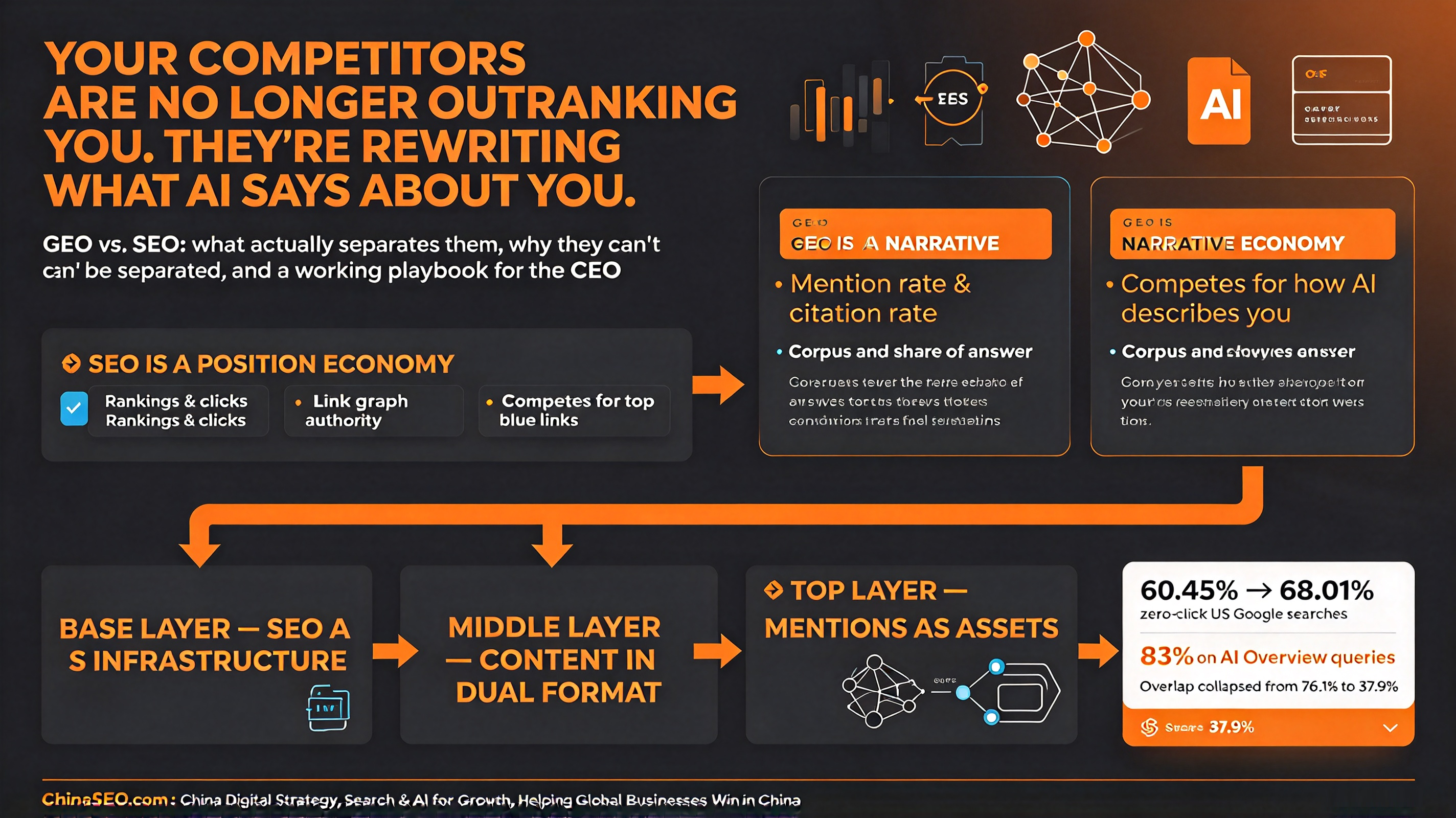
For twenty years, the chain of customer trust ran like this: produce content, get ranked by Google, earn the click, let the user judge. The referee in that chain was the user; the company only had to win position. Today the referee is an intermediary that never clicks — an AI. It reads the whole internet, then tells your customer who you are. Clickstream data from SparkToro and Similarweb shows the zero-click share of US Google searches climbing from 60.45% in 2024 to 68.01% in early 2026 — and hitting 83% on queries that trigger an AI Overview. Users aren’t refusing to click. They no longer need to.
This isn’t a traffic problem. It’s a strategy problem.
First, get the facts right: two systems, two different physics
The most common CEO-level mistake is treating SEO and GEO as an old channel and a new one. The difference isn’t a platform migration. It’s a difference in mechanism.
SEO is a position economy. It competes for “where do you rank among ten blue links,” measured in rankings and clicks, built on the link graph — whoever has the most authoritative backlinks wins.
GEO is a narrative economy. It competes for “how does the AI describe you — does it mention you at all, and is what it says accurate,” measured in mention rate, citation rate, and share of answer. Its raw material isn’t links. It’s corpus — the probability distribution an AI has learned about you from text across the entire web.
The data already proves these are two separate games. Ahrefs’ analysis of 863,000 keywords found that the overlap between AI Overview citations and Google’s top-10 results collapsed from 76.1% to 37.9% in eight months. Read that again: more than six in ten AI citations now come from pages traditional SEO would never surface. You can rank first and never be cited. You can rank below the hundredth result and be quoted as the definitive answer.
The power signals have been reshuffled too. In Ahrefs’ correlation study across 75,000 brands, brand mentions across the web correlate with AI visibility at 0.664 — roughly three times the 0.218 of backlinks. YouTube mentions top the list at 0.737. Links were the currency of the SEO era. Mentions are the currency of the AI era. How often you’re discussed elsewhere matters far more than what you optimize on your own site.
Why this is happening: three forces compounding
Technology. Large models drove the cost of “read first, then answer” toward zero. The search engine stopped being a library catalog and became a research assistant that reads the book for you.
Platform economics. Google’s incentive structure flipped. AI Overviews keep answers — and users — inside Google’s own page, a moat built just in time against ChatGPT. Publishers pay the toll. A randomized controlled study of 1,065 real users, published on SSRN, delivered the first causal evidence: when an AI Overview appears, outbound organic clicks drop 39.8% and zero-click searches rise 34.5%. Even Google can’t argue with the direction; it can only insist the remaining clicks are “higher quality.”
User behavior — the irreversible layer. People have internalized “conversation is the answer.” ChatGPT is approaching 900 million weekly users; Google’s AI Mode has passed a billion monthly actives. What drained Google’s traffic wasn’t a competitor. It was a migration of habit — users no longer search and sift; they ask and accept.
What has actually changed: five judgments a CEO must internalize
One: SEO is moving backstage to become GEO’s foundation — not being replaced by it.
Keep the scale honest. Similarweb counts roughly 770 million AI-referred visits per month globally, up 117% year over year — spectacular growth, yet Google organic still sends about 80 times more traffic. And here’s the structural truth: AI engines lean heavily on traditional search indexes for retrieval and grounding. Bad SEO makes GEO impossible. The relationship isn’t substitution, it’s layering — SEO determines whether machines can read you; GEO determines what machines say about you.
Two: GEO is not a marketing trick. It’s enterprise knowledge engineering.
Princeton’s original GEO paper reported visibility gains of up to 40% from optimization tactics — but an independent replication (C-SEO Bench, NeurIPS 2025) found significance in only 3 of 54 tested scenarios, with exactly one replicated conclusion: keyword stuffing hurts. Most of the “GEO playbooks” flooding your LinkedIn feed are pseudo-technique. What actually works is the systematic stewardship of knowledge assets: your website is quietly mutating from a customer-acquisition tool into an AI knowledge base, and your content from marketing collateral into cognitive infrastructure.
Three: a brand is increasingly a probability distribution trained into a model.
Muck Rack’s analysis of 25 million AI citation links found 84% point to earned media — third-party coverage, reviews, community discussion. Brand-owned sites account for just 5–10%. The AI doesn’t trust what you say about yourself. It trusts what everyone else says about you. Which means the object of brand-building has changed: you’re no longer managing only associations in customer minds, but a distribution inside training corpora. Reddit understood this first — it is now the most-cited domain across major AI engines and collects roughly $130 million a year in content licensing from Google and OpenAI, about 10% of its revenue, and is renegotiating toward dynamic pricing on the argument that models degrade without it.
Four: GEO introduces a brand-new risk — being described wrongly, at scale, with authority.
In the SEO era, the worst outcome was invisibility. In the GEO era, the worst outcome is an AI stating falsehoods about you with total confidence — wrong pricing, outdated specs, fabricated complaints — while you remain unaware. Brand safety now extends from social sentiment into model output. That demands a function that didn’t exist three years ago: continuously monitoring how major AIs describe your company, the way you once monitored press clippings.
Five: don’t let platform promises set your tempo — the Shopify–ChatGPT Instant Checkout saga is the latest lesson.
In September 2025, OpenAI and Stripe launched in-chat purchasing to great fanfare; Shopify called it a new frontier, with a million merchants “coming soon.” Six months later, Forrester counted roughly 30 live Shopify merchants, and by March 2026 OpenAI quietly abandoned the standalone product. But note: that doesn’t make AI commerce a bubble — ChatGPT sessions convert at roughly 15.9%, against 1.8% for Google organic. The lesson is sharper: invest in how AI discovers and evaluates you; don’t bet on AI closing the transaction for you. The first is an asset you build. The second is a promise platforms can withdraw on six months’ notice.
How to combine them in practice: one pipeline, two outputs
The right way to fuse GEO and SEO is not two teams with two budgets. It’s a single knowledge-asset production line, consumed two ways:
The base layer — SEO as infrastructure. Crawlability, information architecture, domain authority: these are your admission ticket to AI retrieval systems. Cloudflare has turned “do you allow AI crawlers” into a default strategic decision for every domain, blocking training-classified bots by default while letting search crawlers through. First action this quarter: audit your crawler policy. Don’t let a robots.txt file written a year ago make today’s strategy for you.
The middle layer — content in dual format. Every core asset ships in two shapes: narrative for humans, and “citable units” for machines. The latter has its own craft: the conclusion lands in the first paragraph; every paragraph survives being quoted out of context; specific numbers replace adjectives. The data backs the discipline — 53% of AI-cited pages are under 1,000 words, and word count’s correlation with citation position is essentially zero. Answer-first beats build-up.
The top layer — mentions as assets. Shift the center of gravity of your budget from owned channels toward earned ones: trade-press reviews, genuine Reddit threads, third-party YouTube coverage. That’s where the AI’s citation pool actually lives. This isn’t a PR revival; it’s a structural rebalancing of spend.
The measurement stack changes too. SEO tracks rankings and sessions. GEO tracks mention rate, citation rate, share of answer, and sentiment across a fixed prompt set — monitored engine by engine. Pick 50–200 prompts that map to your sales funnel and run them monthly to build your own trendline; the industry has no accepted benchmark yet, and meaningful movement takes three to six months. And stand up an “AI brand accuracy” guardrail: models will hallucinate your facts, and every error you find traces back to source material you can correct.
The next three years: who wins, who loses
The next twelve months favor early movers. AI-referred traffic keeps compounding at triple digits — US retail sites saw AI traffic jump 393% year over year in Q1 2026, converting 42% better and generating 37% more revenue per visit than non-AI traffic. Small volume, exceptional quality: the cheapest window to build position that this market will ever offer. Tooling is maturing fast — Semrush, Ahrefs, and Adobe all ship AI-visibility products now, and monitoring costs will keep falling.
Years one to three bring a supply-side fight over content. Cloudflare’s crawl data shows OpenAI crawls roughly 1,091 pages for every visitor it refers back; Anthropic’s ratio is a staggering 38,066:1. That asymmetry is pushing content owners toward licensing deals and technical lockouts. The winner’s profile: companies with proprietary first-party data and genuine user communities. The loser’s: SEO content farms and traffic middlemen whose business was aggregating information asymmetry.
Three to five years out, AI agents will do the comparing, shortlisting, and negotiating on the customer’s behalf. Marketing’s ultimate audience splits in two: the customer’s machine, and the customer. The machine wants structured, verifiable, high-signal knowledge. The human still wants a brand worth remembering. Being cited accurately and favorably by AI will become as standard as having a website. The only question is whether you built that position three years early — or you’re cramming for it.
The last word for the CEO: stop asking “should we do GEO.” That question expired in 2026. Ask this instead — when a customer asks an AI about your category, is the answer it gives… you?
 Unlock 2026's China Digital Marketing Mastery!