 English
 German
 Korea
 Spanish

Borrowed Authority: Winning Reddit and YouTube Without a Brand
- On November 28, 2026
- small-middle business geo
The GEO Playbook for Brandless B2B Companies — Part 4
Part 3 poured the foundation: one consistent entity everywhere, and a fact base AI can actually quote. All of that happened in your own backyard.
Now we step outside — onto the ground Part 2 mapped: Reddit and YouTube. Together with Wikipedia and the review platforms, they dominate AI citations. Their authority belongs to the platform, and any account that contributes seriously gets to borrow it. For a company without a brand, this is the main battlefield.
Fair warning before tactics: this layer punishes shortcuts harder than any other. Communities reward contribution and exterminate marketing. Done wrong, you don’t get zero results — you get banned, and the ban leaves a public record.
The 90/10 rule, and what it buys you
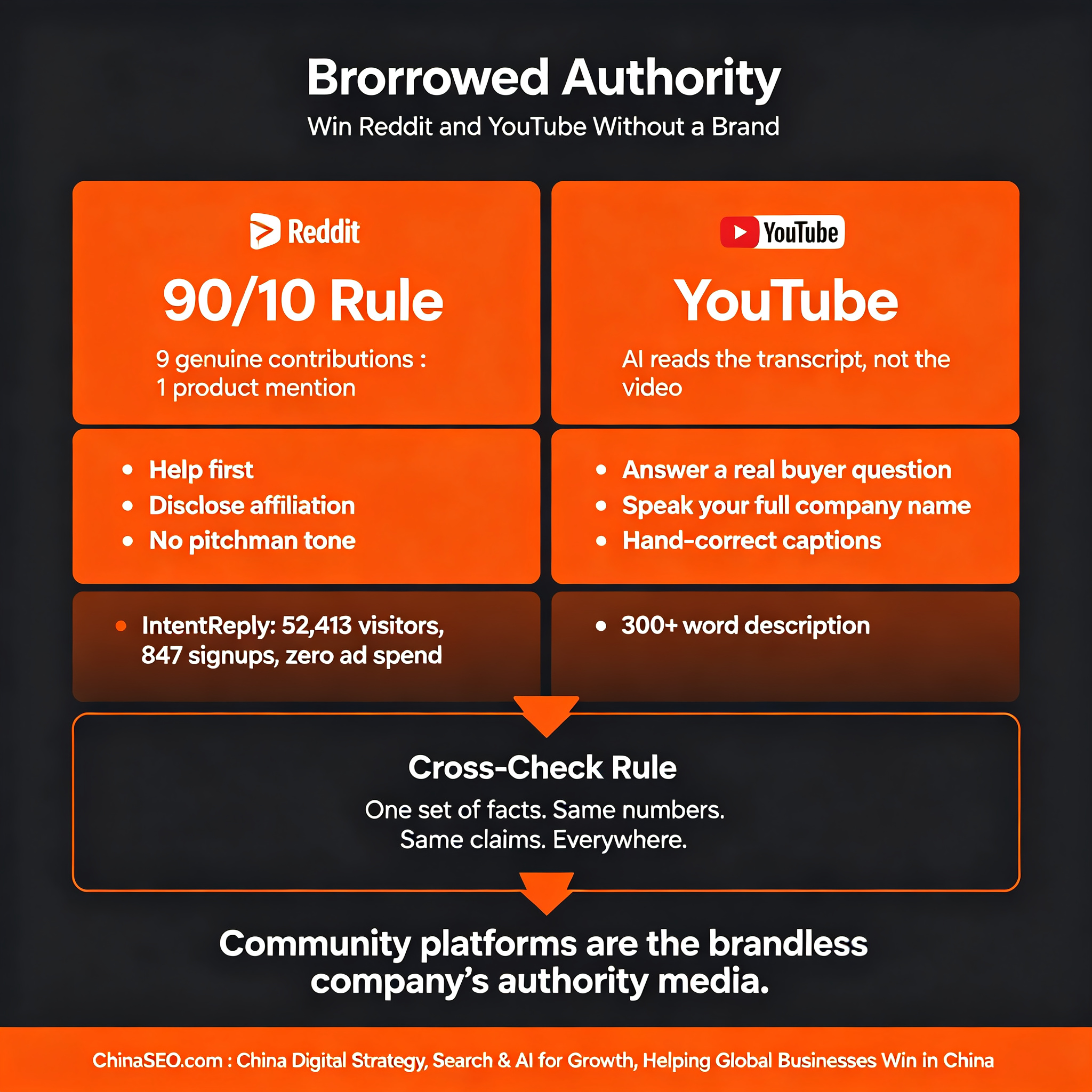
Reddit culture runs on a simple ratio: for every one mention of your own product, contribute at least nine pieces of content that purely help other people.
Treat this as survival mechanics, not etiquette. Accounts that arrive with obvious commercial intent get banned within 48 hours — moderators and veteran users have seen every trick, and they coordinate. The working sequence looks like this: register, spend two to three weeks in loosely moderated communities leaving three to five genuine comments a day, build karma; then move into the subreddits where your buyers gather and keep answering as a practitioner, not a pitchman; when you finally reference your own product, disclose the affiliation openly and keep it to one line.
Is the restraint worth it? IntentReply, a small tool vendor, worked 23 relevant subreddits this way. Thirty days: 52,413 unique visitors, 847 signups, 23 paying conversions. Ad spend: zero.
Zoom out and the stakes are larger than traffic. B2B buyers research vendors on Reddit before they ever talk to your sales team — threads titled “best CRM for a small team” or “alternatives to [incumbent]” later become the raw material AI summarizes into answers. Reddit supplies roughly 40% of all AI citations, and community threads show up in AI answers to practical questions two to three times more often than classic SEO articles. If your expertise lives inside those threads, you appear in AI answers without paying for a single click.
There’s also a measurable reason to keep your tone honest: promotional language cuts citation probability by about 26%. Skip “our revolutionary platform.” Write “we ran this for three months; failure rates dropped from 8% to 3%, at the cost of an extra week of lead time.” The second version contains something a model — and a buyer — can actually use.
YouTube: the citation source hiding in plain sight
Most B2B owners file video under “consumer brands, big budgets.” Two facts should change that.
Fact one: YouTube is the fourth-largest citation source across AI engines, appearing in 8.55% of answers. And in the Ahrefs research from Part 1, YouTube mentions were the single strongest correlate of AI visibility — 0.737, ahead of everything else measured.
Fact two: AI doesn’t watch video. It reads. What the models ingest is your transcript, title, description and chapter markers. Production quality barely matters. The text layer matters completely.
So the workflow writes itself. Record a talking-head video answering a question a real buyer has asked you — “the three mistakes people make speccing this class of equipment.” Deliver the conclusion in the first fifteen seconds, drop a concrete number every couple of minutes, and say your company’s full name out loud — models work through named entities, and “our shop” identifies nobody. Then the step almost everyone skips: hand-correct the captions. Auto-generated subtitles mangle brand names and technical terms at error rates above 10%, and a single mangled name makes you unrecognizable to the machine. Add question-form chapter titles, write a 300-plus-word description that links back to the matching page on your site, and embed the video on that page with proper structured markup and the full transcript.
Equipment? A phone and a ring light. What matters is cadence — two to four videos a month, sustained for half a year. Video citations have a long shelf life; this is a compounding asset.
If you’re manufacturing-adjacent, resist the instinct that “our product isn’t video-friendly.” Machines running, processes on the shop floor, installations at customer sites — that’s exactly the first-hand footage AI’s training pipeline is starved for.
The cross-check rule, applied
Part 2 introduced the triangulation mechanic: AI verifies you across sources. This is where it becomes operational doctrine.
Take one set of facts and adapt it per platform — a long-form answer here, a video there, a review-platform profile elsewhere — while keeping every number and every claim identical across all of them. Contradictions get caught. Models are better than humans at spotting that your site says “two-week delivery” while a forum post from your team says “about a month.”
Consistency isn’t cosmetic. It’s the substance of what AI calls trust.
The takeaway
Community platforms are the poor company’s authority media: no brand requirement, strict contribution discipline. Live by 90/10 — nine gifts for every ask. Video is the underrated play: AI reads captions and descriptions, so hand-corrected transcripts are the cheapest high-leverage edit you’ll ever make. And keep one set of facts everywhere, because the model cross-checks.
Community presence earns you entry to the next circle: trade media, third-party lists, and journalists’ inboxes — the layers most owners assume are closed to the brandless. Part 5 shows what the gatekeepers there actually want. Spoiler: you already have it.
Previous: Part 3 — The Zero-Budget Foundation | Next: Part 5 — Earned, Not Bought: Data PR and the Listicle Game
 Unlock 2026's China Digital Marketing Mastery!