 English
 German
 Korea
 Spanish

The Zero-Budget Foundation: Entity Hygiene and Citable Facts
- On November 27, 2026
- small-middle business geo
The GEO Playbook for Brandless B2B Companies — Part 3
Parts 1 and 2 covered the why and the where. From here on, we build.
The framework is a five-layer source ladder. The bottom two layers — entity hygiene and your own fact base — cost almost nothing and sit entirely under your control. They’re also the two layers most companies skip, jumping straight to press releases and paid placements. Then the wires go silent, because when AI cross-checks the company it finds fragments instead of an entity, and marketing copy instead of facts.
Let’s fix that, in order.
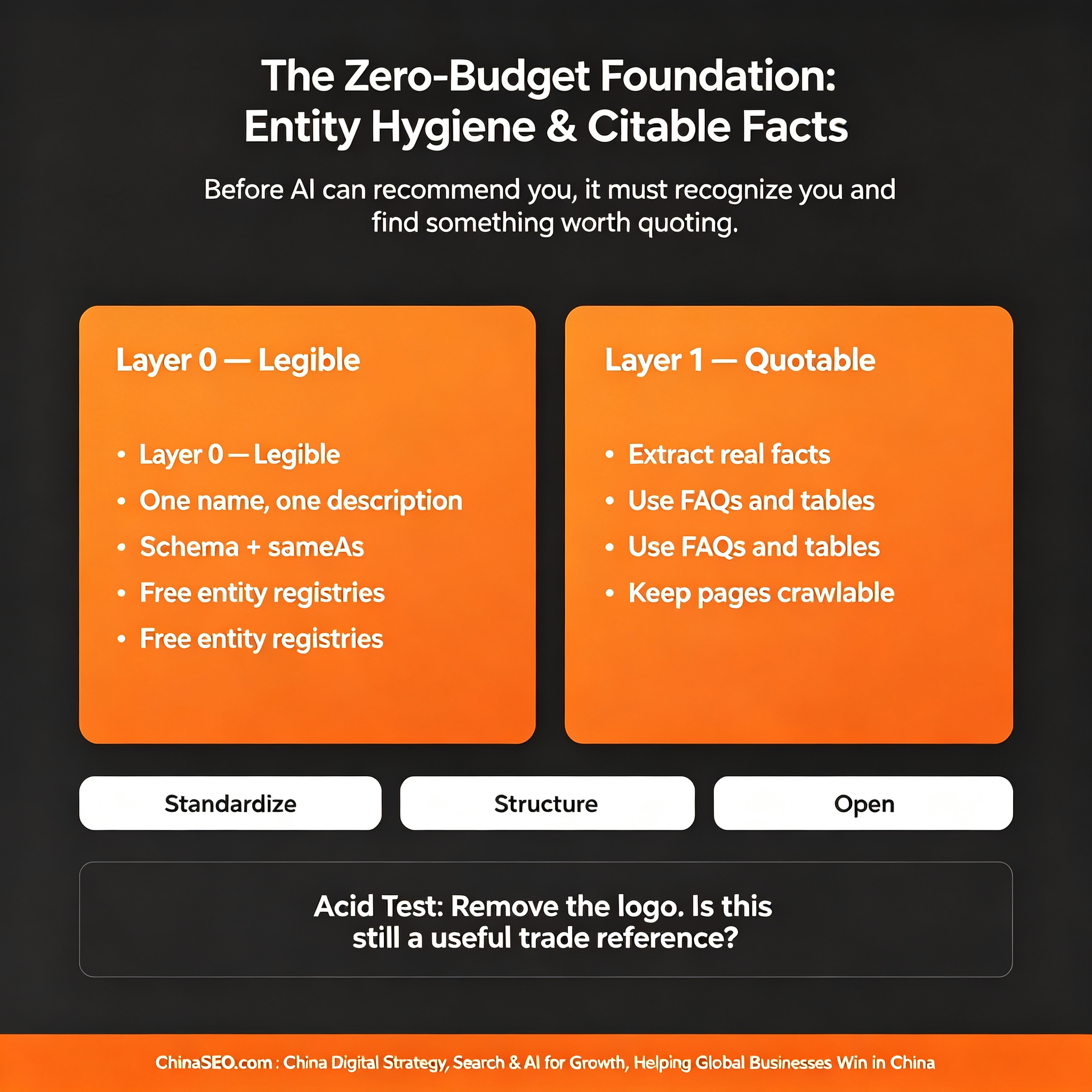
Layer 0: Before AI can recommend you, it has to recognize you
Start with a test you can run in five minutes. Pull up your website, your LinkedIn page, your Crunchbase profile, your directory listings, your job postings. Does the company name read identically on every one?
Many businesses fail right here. The homepage says “Meridian Precision Machines, Inc.” LinkedIn says “Meridian Precision.” A two-year-old job ad says “Meridian Machine Works.” Humans shrug; machines don’t. To a model stitching the web together, those are three fragments it cannot safely merge — and fragmented signals never accumulate into a trusted entity.
The repair is unglamorous and cheap.
Align every public mention of your name, description and scope, character for character. Then have your developer add Organization schema to your site with sameAs fields pointing to your LinkedIn, Crunchbase and other profiles — a machine-readable way of saying “all these pages are the same us.”
After that, get into the free entity registries, in this order: Crunchbase (an hour or two), a complete LinkedIn company page (an afternoon), Wikidata (half a day), Wikipedia (not yet — we’ll come back to it).
Wikidata deserves emphasis because it’s the most underused institutional doorway available to unknown companies. Its notability bar sits far below Wikipedia’s: legal existence plus two or three third-party sources usually suffices, which describes nearly every SMB older than five years. The payoff is measurable — brands with verified Wikidata entries are 3.2 times more likely to earn a Google Knowledge Panel and 2.7 times more likely to appear in AI Overview citations. One B2B software firm’s six-month entity project — Wikidata entry, schema wiring, a sprinkle of earned media, about $45k all-in — produced a 34% lift in branded click-through and 47% organic traffic growth, and noticeably shortened the trust phase of enterprise sales cycles.
And Wikipedia? Set it aside. Notability demands independent, reliable, in-depth third-party coverage; paid placements count for nothing. The sequence runs the other way: earn the coverage first, build the article later. Agencies that promise to “get you a Wikipedia page” for a fee are selling you a deletion discussion.
Layer 1: Give AI something worth quoting
Recognition is necessary; it isn’t sufficient. The next question: when AI wants to cite you, is there anything to cite?
Remember the unit of citation. Not articles — facts. A parameter. A statistic. A conclusion. A definition.
And here’s the asymmetry small companies rarely appreciate: big brands have budgets, you have the shop floor. Your equipment’s measured tolerances, the real implementation timelines across your last fifty customers, the failure modes your service tickets reveal — that’s first-hand fact nobody else can produce. The problem is that today it lives in the founder’s head and in sales reps’ email threads.
Extract it in three moves.
Make tacit knowledge explicit. Write down the specs, certifications, lead times, service coverage and application scenarios as structured text. The test: when someone asks AI “how do I spec this class of equipment” or “who supplies this process,” can the model lift an answer straight from your material?
Format for extraction. Layered questions broken into sub-questions. Claims backed by numbers. Sources that trace to standards bodies and primary documents. FAQ blocks and tables are the most quotable shapes — monitoring data shows FAQ formatting gets cited at triple the rate of ordinary prose.
Open the technical doors. Check robots.txt and confirm you aren’t blocking AI search crawlers (blocking the training bot GPTBot doesn’t affect being cited by ChatGPT search, but blocking OAI-SearchBot does). Keep key pages free of login walls. Put a 40-to-60-word direct answer directly beneath each H1. And know that most AI crawlers don’t execute JavaScript — if your key content only appears after scripts run, it doesn’t exist.
The acid test: remove the logo
How do you know this layer is done? Take your best page, black out every mention of your company name, and hand it to a peer in your industry. Ask one question: “Is this worth keeping as a reference for our trade?”
If the answer is “it’s a brochure,” AI has no reason to quote it. If the answer is “this is the clearest selection table I’ve seen” or “nobody else publishes this benchmark,” the model has no reason to route around you.
The most durable asset in this layer is original data. Every B2B company sits on numbers competitors cannot replicate: implementation durations, utilization patterns, support-ticket distributions, purchasing behavior in your niche. Shape it into a ten-to-twenty-page “State of the Industry” report or a “We analyzed 87 customer deployments and found five things” piece — charts, methodology, honest limitations. That kind of artifact forces attribution: journalists citing the number must name you, AI citing the number must name you, competitors repeating the number still carry your brand. Part 5 covers how to turn such a report into press coverage. For now, build the asset.
The takeaway
Two foundation layers, both near-zero budget. Layer 0 makes you legible: one consistent name everywhere, schema markup, free registry entries — a week of focused work. Layer 1 makes you quotable: your real specs, data and cases restructured into Q&A and tables, with crawlers allowed in.
Foundation poured. Next we borrow authority — Reddit and YouTube, the platforms that don’t care about your brand but police their communities hard. Part 4 lays out the discipline: do it wrong and you’re banned in 48 hours; do it right and it compounds for years.
Previous: Part 2 — Where AI Actually Looks | Next: Part 4 — Borrowed Authority: Winning Reddit and YouTube Without a Brand
 Unlock 2026's China Digital Marketing Mastery!