 English
 German
 Korea
 Spanish
Where AI Actually Looks: The Citation Map Every B2B Owner Needs
- On November 26, 2026
- small-middle business geo
The GEO Playbook for Brandless B2B Companies — Part 2
Part 1 established the new rule: AI judges your company by how many independent sources mention you, not by who links to you.
Which raises the obvious follow-up: mention you where, exactly?
Answer this question wrong and everything downstream fails. I’ve watched companies pour months of content effort into channels their target AI never reads. Different engines eat from different kitchens. Know the kitchen before you cook.
The Western map: three platforms swallow most of the citations
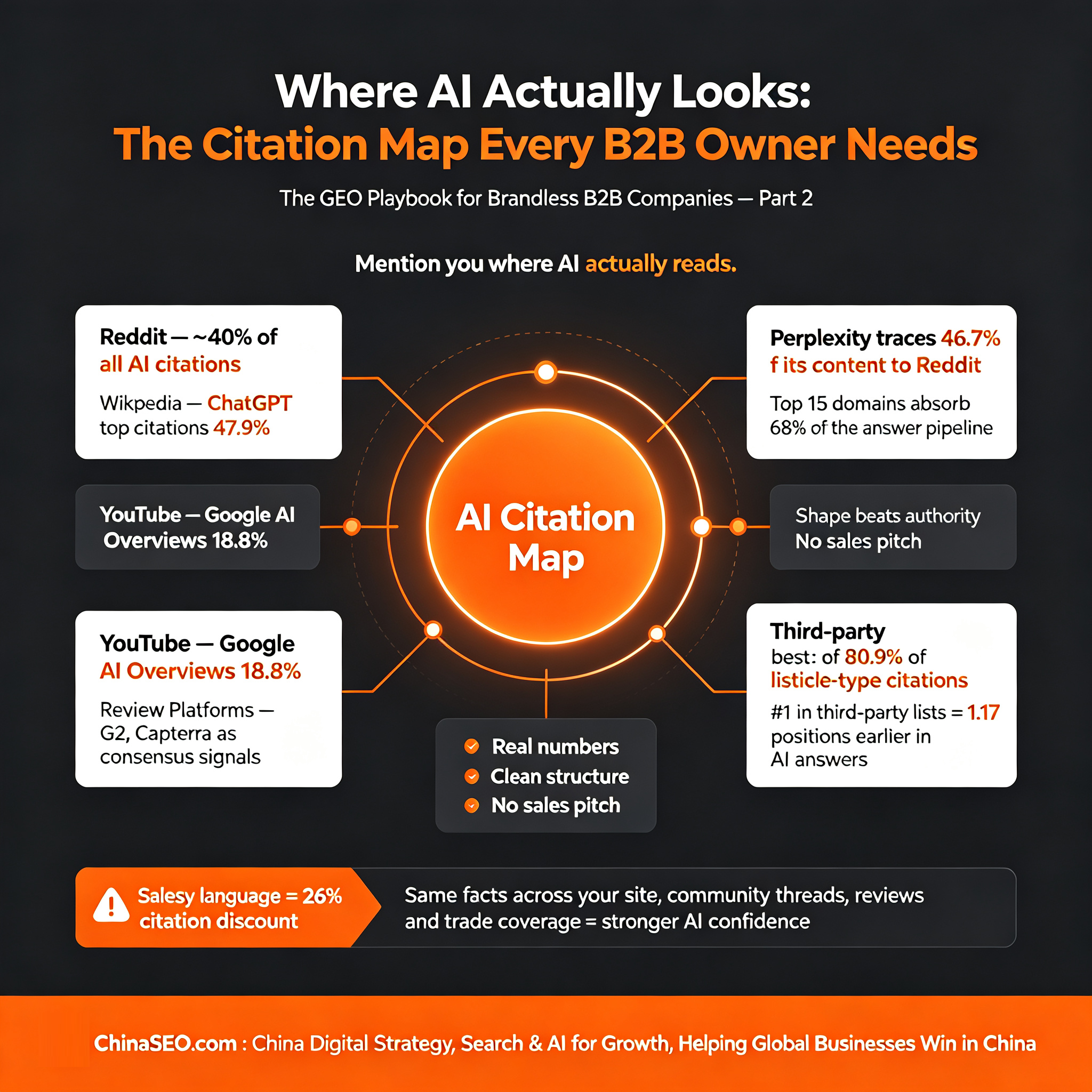
Profound analyzed 30 million AI citations and ranked what ChatGPT, Perplexity and Google AI Overviews actually rely on. The concentration is startling.
In ChatGPT’s top citations, Wikipedia accounts for 47.9%, Reddit for 11.3%. Perplexity goes further — 46.7% of its content traces back to Reddit. Google AI Overviews lean on Reddit for 21% and YouTube for 18.8%.
Zoom out with the 5WPR Citation Source Index, which aggregated 680 million citations across six major studies: Reddit alone supplies roughly 40% of all AI citations, and the top 15 domains absorb 68% of the entire answer pipeline.
Notice what these sources are. A community forum. An encyclopedia anyone can edit. A video platform with no upload fee. And for B2B specifically, a fourth category: review aggregators like G2 and Capterra, which AI models read as consensus signals — dozens of verified user reviews look like third-party validation, while your own product page reads as marketing and gets discounted.
Now the part that should make every no-name company sit up: the biggest doors into the AI citation pool don’t check your brand. A Reddit account costs nothing. A YouTube channel costs nothing. Listing your product on G2 costs nothing. What these platforms demand instead is the one thing a good B2B operator already has — genuine expertise, offered consistently.
And your own website? Only about 2% of AI Mode citations point to recognizable commercial brand sites. Your site is where conversions happen. It is not where AI goes looking for answers.
B2B buyers ask comparison questions. AI answers them with other people’s lists.
Here’s a pattern specific to B2B that changes your priorities.
Buyers ask AI things like “best CRM for a 20-person team,” “Vendor A vs. Vendor B,” “who handles cold-chain logistics for pharma.” Comparison questions. And when AI answers comparison questions, it reaches for an outside perspective — somebody else’s ranked list.
The numbers are lopsided. Wix Studio’s AI Search Lab found that in professional services, third-party “best of” lists capture 80.9% of listicle-type citations. Lists companies write about themselves get 19.1%. Peec AI then quantified what ranking inside those lists is worth: across 8 AI engines and nearly 200,000 responses, brands ranked #1 in heavily cited third-party lists appeared an average of 1.17 positions earlier in AI answers — enough to move a brand buried at position six into the top five.
So the priority order writes itself: get into the lists and reviews other people publish, then tune the comparison content on your own site. The first is external proof AI trusts. The second is the landing page that catches the lead.
A nuance most “GEO advice” misses: shape beats authority
Before you sprint off to create accounts, one more finding worth internalizing.
AI selects content the way a researcher selects sources, not the way a consumer selects brands. It asks: can I lift this passage directly into an answer? Long monitoring runs of Chinese AI engines — where the same mechanics apply — found that FAQ-formatted content was cited at three times the rate of ordinary prose, and that question-matching headlines plus clean structure beat publisher authority as predictors of repeated citation.
In practice: a tight 60-word answer under a clear H2, a comparison table, a parameter list with real numbers — these get quoted. A lyrical 2,000-word brand essay doesn’t, no matter whose domain it sits on.
There’s a penalty flag too. Promotional tone measurably hurts: one analysis put the citation discount for salesy language at 26%. “Our revolutionary platform” loses to “we tested this for three months; failure rates dropped from 8% to 3%, at the cost of an extra week of lead time.” The second sentence contains something a model can use. The first contains nothing.
Don’t ignore the cross-check
One mechanic ties the whole map together: AI doesn’t trust a single source. It triangulates.
When the same facts about your company — what you do, who you serve, what you charge, how long delivery takes — show up consistently on your site, in community threads, on review platforms and in trade coverage, the model’s confidence in you compounds. When those sources contradict each other, or when you exist in only one place, the model hedges or skips you entirely.
That’s why “where” is only half the question. The other half is “how consistently.” We’ll come back to this when we build the ladder.
The takeaway
In Western markets, AI’s citation diet runs through Reddit, Wikipedia, YouTube and review platforms — all low-barrier doors. Comparison questions get answered with third-party lists, so getting listed beats self-promotion by a wide margin. Content shape — direct answers, real numbers, no sales pitch — matters more than publisher pedigree. And everything you publish anywhere gets cross-checked against everything else.
The map is in hand. So where does a company with no brand and no budget place its first stone?
Not on any platform. On something you already own. Part 3 covers the bottom two layers of the five-layer source ladder — work that costs almost nothing, which nine out of ten companies have never done.
Sources: Profound 30M-citation analysis; 5WPR AI Platform Citation Source Index 2026; Wix Studio AI Search Lab; Peec AI listicle study across 8 engines.
Previous: Part 1 — Your Buyers Are Asking AI. AI Has Never Heard of You. | Next: Part 3 — The Zero-Budget Foundation: Entity Hygiene and Citable Facts
 Unlock 2026's China Digital Marketing Mastery!