 English
 German
 Korea
 Spanish
Your Buyers Are Asking AI for Recommendations. AI Has Never Heard of You.
- On November 25, 2026
- small-middle business geo
The GEO Playbook for Brandless B2B Companies — Part 1
Picture this.
A procurement manager needs a new supplier. Two years ago she would have opened Google, scanned the first page, shortlisted five names. Today she types into ChatGPT: “Who are the most reliable precision molding suppliers in the Midwest?”
The model returns five names, with reasons. Your plant has been running for fifteen years. Your equipment is newer than the company at the top of that list. You’re not on it.
Not because you’re worse. Because the machine has never encountered you.
This isn’t a thought experiment. Gartner projects that by the end of 2026, a quarter of enterprise search queries will run through AI assistants. The first step of B2B research is migrating from the search box to the chat window — and most small and mid-sized companies are, in that new world, invisible.
Why the old playbook stopped working
For fifteen years, the logic of being found online was brutally simple: backlinks. And the backlink game was never kind to small companies. Links from ordinary sites were worth almost nothing; links from authoritative media required either money or a brand name worth associating with. Bigger brands attracted more links, more links produced higher rankings, higher rankings built bigger brands. A closed loop, and you weren’t in it.
Most owners I talk to assume AI search simply re-runs the same loop with different players: to get recommended by AI, you need coverage in authoritative outlets; to get that coverage, you need a brand. No brand, no entry ticket.
That assumption is wrong. And the evidence is unusually solid.
AI doesn’t count your links. It counts your mentions.
Ahrefs ran the numbers on 75,000 brands and their visibility in Google’s AI Overviews. The result should be pinned above every marketing desk in the SMB world.
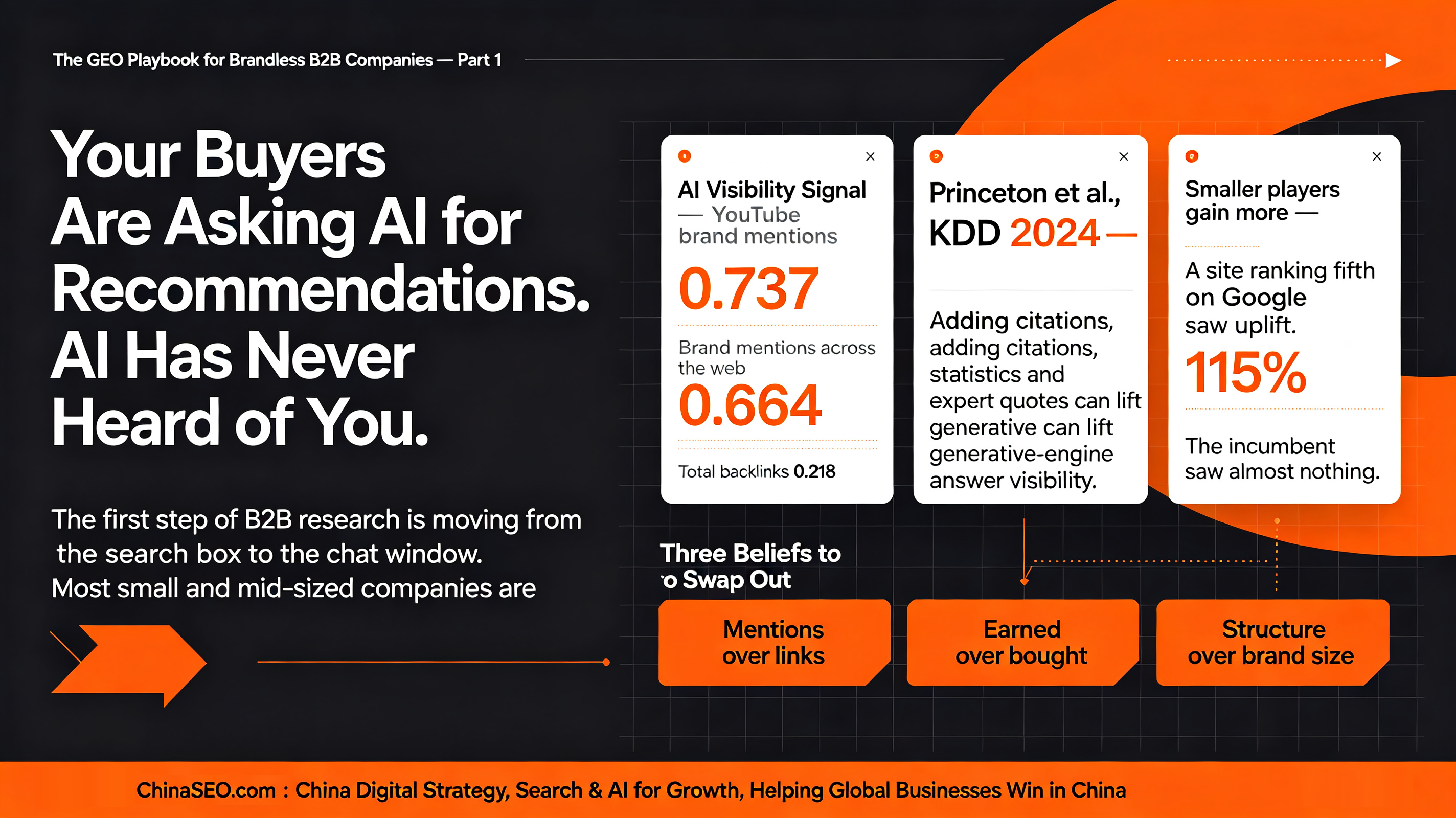
The signal that correlates most strongly with AI visibility is YouTube brand mentions — a correlation of 0.737. Right behind it sits brand mentions across the web at 0.664. And the old religion? Total backlinks correlate at 0.218. Domain rating, 0.326.
Read those numbers again. AI decides whether you’re worth recommending largely by how many independent sources talk about you — not by who links to you. A detailed Reddit answer, a passing mention in a YouTube video, your name in a comparison article: no hyperlink required. The model reads it, registers it, weighs it.
Seer Interactive tested the same hypothesis from a different angle in early 2025 and landed in the same place: brand mentions correlate with appearing in ChatGPT answers at roughly 0.65, while backlink influence was “weak to neutral.” Two independent research shops, one conclusion.
For a company without a brand, this is the best news in a decade. A backlink needs an editor’s permission. A mention doesn’t. You can write the definitive answer on a niche subreddit. Your customers can leave real reviews on G2. You can publish a video that explains the thing nobody in your industry bothers to explain. None of these doors check your brand at the entrance.
One honest caveat: these are correlations, not proof of causation, and the Ahrefs sample skewed toward domains with DR above 40. But when academic experiments, commercial studies, and field cases all point the same direction, the strategy question is settled even if the causal arrow isn’t.
The finding from Princeton that nobody quotes
There’s a second layer of evidence, and it comes from academia.
Researchers at Princeton, Georgia Tech, the Allen Institute and IIT Delhi tested nine content-optimization methods across 10,000 real queries. Their paper — the only peer-reviewed, large-scale experiment in this field — was presented at KDD 2024. The headline number that made the rounds: adding citations, statistics and expert quotes to content can lift visibility in generative-engine answers by up to 40%.
Buried deeper in the paper is the finding that actually matters to you. The same optimization techniques lifted visibility for a site ranking fifth on Google by 115%. For the site ranked first, they did almost nothing — visibility even dipped slightly.
Think about what that means. The incumbents have already maxed out the old game. The new game redistributes visibility, and it redistributes downward, toward whoever was locked out before.
Fairness requires the fine print: the study’s test subjects were already top-five pages, the 40% figure is a laboratory ceiling rather than a promise, and the visibility metric was the authors’ own construction. What the paper proves is direction — smaller players gain more — not that any single tactic is a guarantee.
Three beliefs to swap out before you spend a dollar
Mentions over links. AI doesn’t need a hyperlink to learn your name. Podcast transcripts, listicle inclusions, comparison posts, community threads — each unlinked mention is another vote the model can count.
Earned over bought. One study examined what AI actually cites in news-style answers: syndicated press releases accounted for 6.2% of citations, while original editorial content took 81%. Blasting a hundred press releases across wire services buys you almost nothing. The flip side, measured by Stacker across 8 AI platforms: content distributed through earned media saw a median 239% lift in AI citations.
Structure over brand size. An analysis of 200,000 press releases against 13 million AI citations found that releases with structured data, original quotes and clear timestamps were 3.4 times more likely to be cited. One obscure B2B battery company, purely on the strength of content structure, out-cited a nationally known retail brand by a factor of 3.4. The model quotes the shape of the fact, not the size of the logo.
What the rest of this series covers
The rules have changed; the game still has to be played move by move. The next five articles work through three questions in sequence.
Where does AI actually look? Part 2 maps the citation sources of ChatGPT, Perplexity and Google AI Overviews — you’ll see why Reddit, Wikipedia, YouTube and review platforms dominate, and why that’s an opening rather than a wall.
Where do you start with no brand and no budget? Parts 3 through 5 walk up a five-layer source ladder, from free entity hygiene to data-driven PR that gets journalists calling you.
What does it cost, and how fast does it work? Part 6 closes with a 90-day operating plan, real case numbers, and the six traps that burn most first-timers.
This is a six-part series for owners and operators of B2B companies without brand recognition or PR budgets. Research referenced: Ahrefs 75,000-brand study (2025), Princeton et al., “GEO: Generative Engine Optimization” (KDD 2024), Seer Interactive (2025), Stacker earned-media study (2026).
Next: Part 2 — Where AI Actually Looks: The Citation Map Every B2B Owner Needs
 Unlock 2026's China Digital Marketing Mastery!