 English
 German
 Korea
 Spanish

Tencent’s Anxiety Reveals a Much Bigger Shift: The Battle for Business Value Is Moving Beyond Traffic
- On November 23, 2026
- ai decision marketing, geo
Why AI is changing who controls customer decisions, how companies compete, and what digital marketing must become.
Tencent’s recent warning about the AI revolution deserves attention far beyond China’s technology industry.
When Pony Ma describes the current moment as a matter of survival, he is not suggesting that Tencent is suddenly running out of money or customers. The company still has enormous strengths in gaming, advertising, payments, social networking, and cloud services.
The deeper concern is that the commercial logic that made Tencent successful may no longer be sufficient to secure its future.
For more than two decades, Tencent built an extraordinarily powerful business around controlling digital relationships. WeChat connected people, organized communication, distributed content, facilitated payments, and created commercial opportunities. Its scale made the ecosystem increasingly valuable.
But AI introduces a different kind of competition.
It does not simply offer another platform where people spend their time. It potentially changes how people discover information, evaluate alternatives, make decisions, and execute transactions.
That distinction matters enormously.
The next battle in digital business may not be about who owns the most traffic. It may be about who influences the decisions that traffic used to produce.
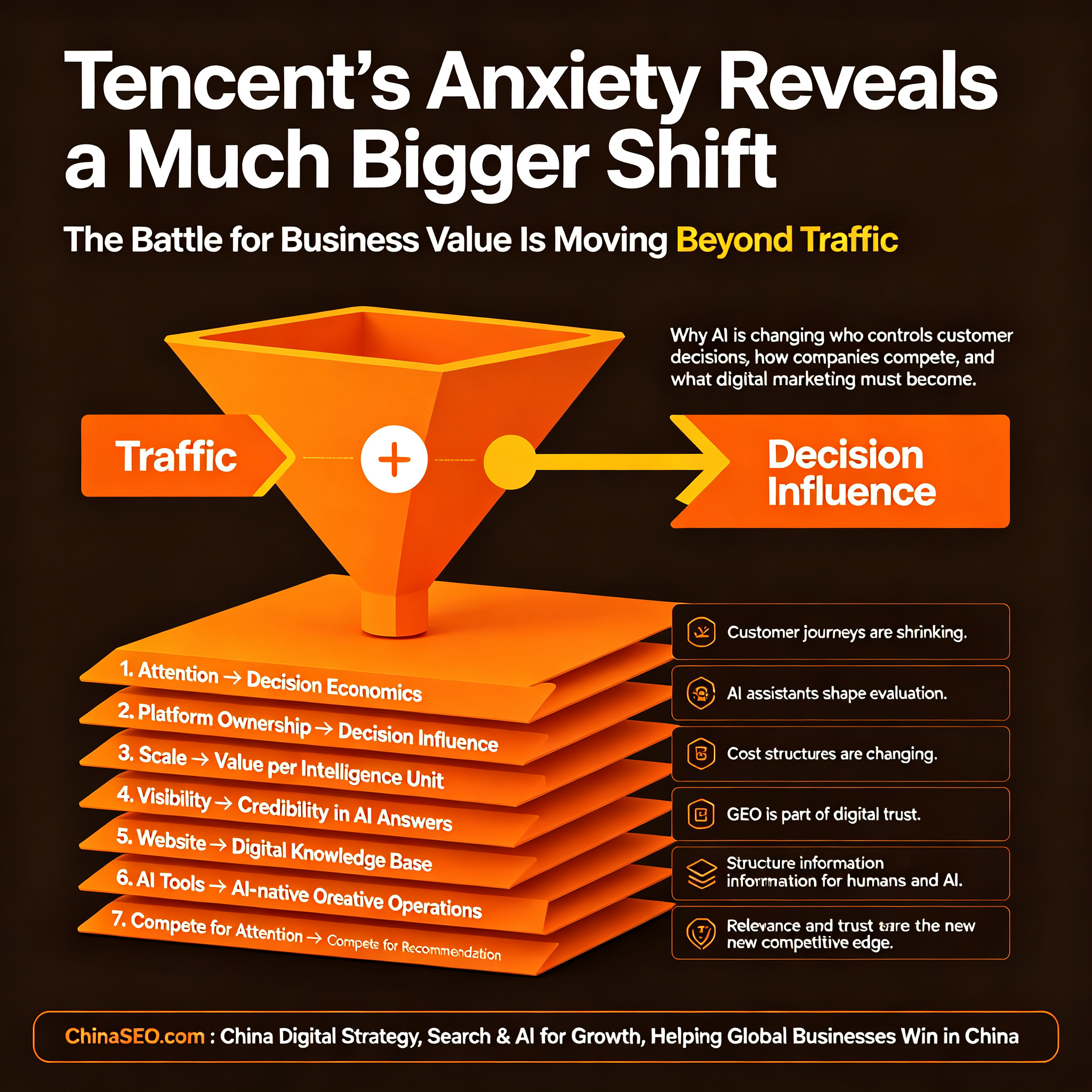
1. The Internet Is Moving From Attention Economics to Decision Economics
The commercial Internet has passed through several distinct phases.
In the early Internet, value came from organizing information. Search engines and portals helped people find what they were looking for.
Then came the mobile and social Internet. Value increasingly came from capturing attention, building user relationships, and distributing content. Platforms monetized their audiences through advertising, subscriptions, commerce, and other services.
AI introduces another layer.
Instead of searching through dozens of websites, a customer can describe a problem and ask an AI assistant to research possible solutions. Instead of manually comparing suppliers, the customer may ask an agent to identify suitable providers, evaluate their capabilities, and prepare a shortlist.
The journey from question to decision becomes shorter.
This is more than a change in user interface.
It changes where commercial influence resides.
Consider an industrial procurement manager looking for a drainage solution for a food-processing facility.
Previously, the process might involve searching Google, visiting supplier websites, reading technical documents, contacting several manufacturers, and comparing specifications.
An AI assistant could increasingly perform much of this preliminary work.
It might identify relevant manufacturers, compare corrosion resistance, evaluate customization capabilities, examine application experience, and summarize the differences.
The supplier that wins is no longer necessarily the one with the strongest search ranking or the largest advertising budget.
It may be the one whose capabilities are best understood, most convincingly demonstrated, and most relevant to the customer’s actual requirements.
The commercial question has changed.
It is no longer simply:
How do we attract more visitors?
It is increasingly:
How do we become a credible choice when a customer—or an AI acting on the customer’s behalf—evaluates available solutions?
2. The Most Valuable Asset May No Longer Be the Platform, but the Power to Influence Decisions
Tencent’s predicament illustrates a fundamental issue facing digital platforms.
Historically, platforms were valuable because they controlled the environment in which commercial activity took place.
Google controlled a major gateway to information. WeChat controlled an extraordinary social and communication ecosystem. TikTok built a powerful recommendation and content-distribution system.
Businesses needed these platforms to reach customers.
This created enormous economic power.
Advertising, recommendations, transactions, and customer relationships could all be organized within the platform’s environment.
AI potentially weakens this arrangement.
A customer might use an independent AI assistant to research a product, compare suppliers, and prepare a purchasing recommendation. That assistant may draw information from multiple platforms, websites, databases, and service providers.
The customer may still use WeChat to communicate and Tencent Pay to transact.
But the decision itself could have been shaped elsewhere.
This creates a difficult strategic question for platform owners:
If someone else controls the customer’s decision-making process, how much of the economic value can the original platform continue to capture?
This is not necessarily the end of platforms. Established ecosystems retain powerful advantages in distribution, identity, payments, data, and services.
However, the relationship between platforms and commercial value is changing.
Owning the infrastructure does not automatically mean owning the decision.
For businesses that depend heavily on third-party platforms, this is an important warning.
A company may have thousands of followers, substantial website traffic, and a large advertising budget, yet remain vulnerable if it has no independent relationship with customers and little control over how its value is understood.
3. The Economics of Scale Are Being Rewritten
There is another reason Tencent’s AI spending is significant.
Traditional digital platforms benefited from powerful economies of scale.
Once the infrastructure was established, additional users could often be served at relatively low marginal cost.
More users meant more data, more advertising opportunities, more transactions, and potentially higher margins.
AI changes the cost structure.
Every inference request consumes computing resources. More complex tasks require more computation. Continuous agent activity creates recurring infrastructure costs.
This does not mean AI businesses cannot achieve strong economies of scale. Hardware efficiency, model compression, caching, specialized inference, and falling computing costs will continue to improve unit economics.
But it does mean that user growth alone is no longer a sufficient measure of commercial success.
The more important question becomes:
How much economic value does each unit of intelligence create relative to its cost?
This has implications far beyond technology companies.
Businesses should also reconsider their own cost structures.
If competitors can use AI to deliver comparable services at substantially lower costs, existing pricing models may come under pressure.
If a company’s value consists mainly of information retrieval, standard content production, routine analysis, or repetitive execution, its margins may become increasingly difficult to defend.
The companies most likely to maintain pricing power will be those that combine AI efficiency with proprietary knowledge, specialized expertise, accountability, and the ability to solve complex customer problems.
AI does not eliminate the importance of scale.
It changes what must scale.
4. Digital Marketing Is Facing a More Fundamental Disruption Than the Transition From Traditional to Digital Media
Many discussions of AI in marketing focus on automation, content generation, advertising optimization, and productivity.
These are important developments, but they are not the central issue.
The deeper change is that marketing must increasingly operate in an environment where AI participates in the customer’s information and decision process.
This creates four structural changes.
From search visibility to decision visibility
SEO has traditionally helped businesses become visible when customers search for relevant information.
Generative Engine Optimization, or GEO, extends the challenge into AI-mediated discovery.
Businesses now need their information to be discoverable, understandable, and sufficiently credible to be incorporated into AI-generated answers.
But appearing in an AI answer is not the ultimate objective.
Being cited is not the same as being recommended. Being recommended is not the same as being selected.
The real objective is to become a credible option when a customer evaluates solutions.
This requires businesses to establish a much stronger digital evidence base: accurate product information, technical documentation, real customer cases, verifiable capabilities, independent references, and clear differentiation.
GEO should therefore be understood as part of a broader investment in digital trust infrastructure, not simply another collection of optimization techniques.
From audience targeting to demand understanding
Traditional advertising platforms became powerful by identifying audiences and delivering messages to people likely to respond.
AI can move this process closer to the underlying customer need.
A business buyer does not simply belong to an industry or demographic segment. The buyer has a specific problem, operating environment, technical requirement, budget, and purchasing context.
AI can help businesses identify and understand these dimensions more effectively.
Marketing performance will increasingly depend on the quality of demand identification and solution matching, rather than the sheer volume of impressions and clicks.
The important question is not how many people saw a campaign.
It is how many relevant customers were identified, understood, engaged, and converted.
From content production to proprietary knowledge
Generative AI has dramatically reduced the cost of producing content.
This creates a paradox.
As more businesses publish more material, the overall supply of content increases, but the scarcity of genuinely useful information becomes more pronounced.
Generic articles, repetitive product descriptions, and superficial thought leadership will become increasingly interchangeable.
What remains valuable is information that cannot easily be fabricated or replicated:
- Real implementation experience.
- Technical expertise supported by evidence.
- Original research and industry observations.
- Documented customer outcomes.
- Detailed explanations of complex problems.
- Proprietary knowledge accumulated through years of operation.
The competitive advantage is shifting from the ability to produce content to the ability to produce knowledge worth trusting.
From lead generation to intelligent customer management
Traditional digital marketing often treats a lead as its primary output.
AI agents create opportunities to connect the entire customer journey.
Market research, customer identification, needs analysis, product matching, personalized communication, sales follow-up, and customer service can increasingly operate as connected workflows.
Marketing, sales, and customer operations will become less isolated.
The objective is no longer simply to generate more inquiries.
It is to improve the economics of acquiring, converting, serving, and retaining customers.
5. The Website Must Become More Than a Digital Brochure
One implication deserves particular attention.
Many companies still regard their websites primarily as online presentation tools.
They display company information, product categories, service descriptions, and contact details. Traffic is then generated through search engines, advertising, and social media.
This approach is becoming insufficient.
In an AI-mediated information environment, a corporate website must serve two audiences.
Human visitors need to understand the company’s value proposition, assess its credibility, and determine whether it can solve their problems.
AI systems need sufficiently clear, consistent, structured, and verifiable information to understand what the company actually does.
A serious industrial manufacturer, for example, should not simply claim to provide advanced drainage solutions.
It should explain the engineering principles, materials, operating environments, installation requirements, application limitations, and actual project experience behind those solutions.
A consulting company should not merely claim to understand a market.
It should demonstrate its analytical framework, research experience, methodology, and evidence of successful implementation.
A website built around generic marketing language may look impressive to a human visitor but provide very little reliable information for deeper evaluation.
The strategic role of a website is therefore changing.
It is becoming part of a company’s digital knowledge infrastructure and an important foundation for its visibility and credibility across search engines and AI systems.
6. The Next Competitive Divide Will Be Between Companies That Use AI and Companies That Redesign Their Businesses Around AI
There is a significant difference between adopting AI tools and developing an AI-native operating model.
The first approach improves existing processes.
Employees use AI to write articles, prepare presentations, translate documents, analyze data, and respond to inquiries.
These applications can generate immediate productivity gains.
The second approach questions the underlying structure of the business.
Can market research and customer acquisition operate as a connected intelligence process?
Can customer information be accumulated and used across departments?
Can AI identify opportunities, match products to requirements, prepare proposals, and support sales teams?
Can the company reduce unnecessary handoffs between departments?
Can employees be reorganized around higher-value responsibilities rather than repetitive tasks?
This is a much more significant transformation.
The lesson from Tencent is not that every company should spend billions on AI infrastructure.
It is that even a highly successful business can become strategically vulnerable when its existing organizational structure and revenue model are no longer aligned with the emerging technological environment.
For most businesses, the practical response should be much more focused.
First, identify which parts of the existing value proposition are becoming commoditized by AI.
Second, redesign the workflows where AI can produce measurable improvements.
Third, consolidate proprietary business knowledge into reliable, reusable digital assets.
Fourth, build independent customer relationships instead of depending entirely on third-party platforms.
Finally, measure the commercial impact of AI through margins, customer acquisition costs, conversion rates, retention, and customer lifetime value.
The objective is not to maximize AI adoption.
It is to increase the company’s ability to create and capture economic value.
7. The Real Question Is No Longer Whether AI Will Change Your Industry
Tencent’s anxiety is understandable.
The company is confronting a technology that could challenge the very foundations of its historical success.
But its situation also reveals something important about the wider business environment.
The next competitive landscape will not necessarily reward the companies with the largest audiences, the most content, the highest advertising expenditure, or even the most sophisticated technology.
It will increasingly reward companies that can combine three capabilities:
The ability to understand real customer needs.
The ability to demonstrate why their solutions deserve trust.
And the ability to deliver value efficiently through intelligent systems.
These capabilities are interconnected.
A company that understands customers but cannot demonstrate its credibility will struggle to earn consideration.
A company that is visible but has no meaningful differentiation will struggle to justify its price.
A company that has excellent products but cannot make its expertise understandable to customers and AI systems may increasingly become invisible during the early stages of purchasing decisions.
This is why the AI transition should not be treated as another technology adoption cycle.
It is a redistribution of commercial influence.
For years, businesses competed to attract attention.
Now they must compete to become relevant.
Tomorrow, they may have to compete to remain worthy of recommendation by intelligent systems that increasingly participate in human decisions.
The companies that prepare for this shift will not simply become more efficient versions of their old selves. They will build a different kind of competitive advantage—one based on knowledge, trust, customer understanding, and the ability to turn intelligence into economic value.
Tencent is trying to find its next high ground.
Every business should be asking whether its own high ground still exists.
 Unlock 2026's China Digital Marketing Mastery!