 English
 German
 Korea
Korea Spanish
China’s AI Model Landscape 2026: Market Share, Algorithmic Architectures, and Strategic Blueprint for Western Enterprises
- On July 29, 2026
- China AI Model, China AI Model Landscape
The Chinese artificial intelligence market has undergone a dramatic structural shift. The period between 2024 and 2026 marked China’s transition from rapid model imitation to establishing global standards in open-source efficiency, ultra-low token economics, and hyper-specialized vertical deployment.
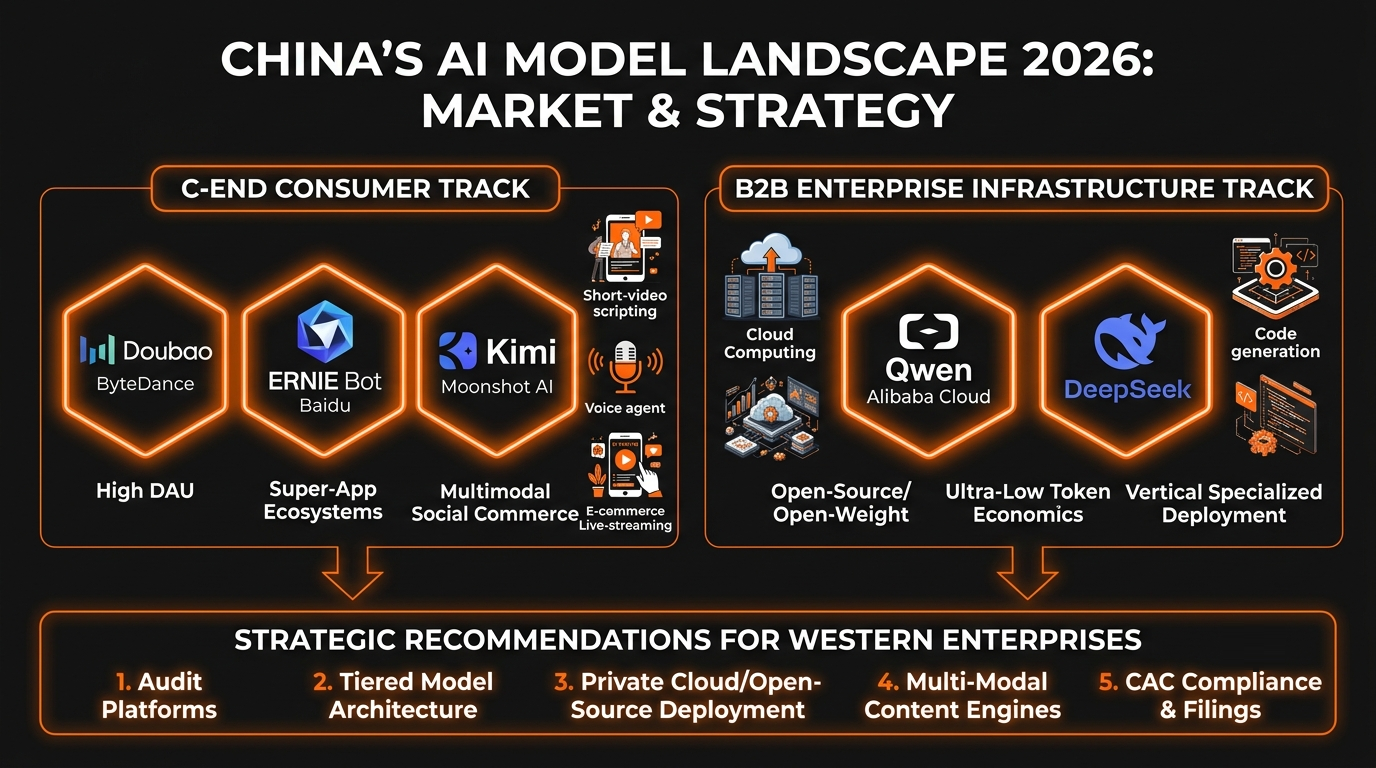
For Western executives, CMOs, and digital strategists, navigating China’s AI ecosystem is no longer about identifying a single “ChatGPT equivalent”. Instead, China has developed a highly bifurcated “Dual-Track” AI ecosystem:
- The C-End Consumer Track: Dominated by super-app ecosystems and daily active user (DAU) drivers like ByteDance’s Doubao and Moonshot AI’s Kimi.
- The B2B Enterprise Infrastructure Track: Led by cloud-native open-weight titans like Alibaba’s Qwen and architectural efficiency disrupters like DeepSeek.
Understanding the nuances of market share, underlying algorithmic strengths, and platform mechanics is critical for any international brand seeking to optimize local marketing, streamline cross-border operations, or build compliant enterprise agent workflows inside Mainland China.
1. Market Share Dynamics (2025–2026)
According to data from Chinese research institutions—including iiMedia Research, Frost & Sullivan, and IDC—the market is defined by a clear division between individual consumer penetration and enterprise cloud API consumption.
Market Penetration vs. Enterprise Token Share
- Consumer Penetration: ByteDance’s Doubao leads Chinese consumer adoption with a 53.13% user usage rate. Baidu’s ERNIE Bot (30.88%) and DeepSeek (29.96%) follow, while Qwen (16.73%) and Kimi (13.97%) capture specialized professional and developer segments.
- Enterprise API Token Volume: In enterprise public cloud and API call volume, Alibaba’s Qwen holds the top position with 17.7% of China’s daily enterprise token consumption (exceeding 10 trillion tokens/day market-wide). ByteDance’s Doubao Cloud (14.1%) and DeepSeek (10.3%) round out the top three enterprise choices.
| AI Model / Vendor | C-End User Penetration | Enterprise API Share | Core Strategic Positioning | Architectural Focus |
|---|---|---|---|---|
| Doubao (ByteDance) | 53.13% (#1) | 14.1% (#2) | Mass Consumer & Multimodal Social Commerce | Ultra-low latent MoE, Native Speech/UI Agent |
| Qwen (Alibaba Cloud) | 16.73% | 17.70% (#1) | Enterprise Cloud, Open-Source & E-commerce | Hybrid MoE, Qwen-Coder, Vision-Language (VL) |
| DeepSeek (High-Flyer) | 29.96% | 10.30% (#3) | Cost Disrupter, Open-Weights & Code/Logic | Multi-Head Latent Attention (MLA), DeepSeek MoE |
| Kimi (Moonshot AI) | 13.97% | ~6.5% | Knowledge Worker Productivity & Long-Context | Lossless Long-Context Window (2M+ Tokens), K2.5/K3 |
| ERNIE Bot (Baidu) | 30.88% (#2) | ~8.2% | Search Synergies & Legacy Enterprise Integration | Knowledge Graph Fusion, Native Search RAG |
2. In-Depth Architectural & Algorithmic Analysis of Mainstream Models
1. ByteDance — Doubao
- The Strategy: Omnipresent Consumer Ecosystem & Hyper-Scale Monetization.
Algorithmic & Architectural Characteristics
Doubao operates on ByteDance’s proprietary Mixture-of-Experts (MoE) architecture. Rather than competing purely on mathematical reasoning benchmarks, ByteDance engineered Doubao for latency, multimodal speech synthesis, and agentic UI control:
- Native Voice & Multimodal Optimization: Integrated with ByteDance’s speech engines, Doubao’s voice latency is under 300 milliseconds, mimicking human speech dynamics.
- Seed-2.0 Multi-Agent Framework: Built to handle high-concurrency tasks, allowing parallel agent sub-routines (e.g., generating video scripts while auto-tagging e-commerce products).
- Aggressive API Pricing: In May 2024, ByteDance sparked the Chinese LLM price war by pricing Doubao’s enterprise API at 0.0008 RMB per 1,000 tokens—99% cheaper than OpenAI’s GPT-4.
Marketing & Business Application
Doubao is heavily integrated into ByteDance’s social and commerce infrastructure, including Douyin (TikTok China), CapCut (Jianying), and Feishu (Lark). Brands use Doubao to automatically generate hundreds of localized short-video script variants per hour and power real-time AI live-streaming avatars that host e-commerce sales 24/7.
2. Alibaba Cloud — Qwen / Tongyi Qianwen
- The Strategy: The “Linux of Artificial Intelligence”—Open-Source Infrastructure & Enterprise Cloud Dominance.
Algorithmic & Architectural Characteristics
Alibaba’s Qwen series (Qwen3.5, Qwen3.7-Plus, Qwen-Coder, Qwen-VL) represents the global standard for open-weight intelligence:
- Hybrid MoE & Dense Scaling: Qwen utilizes an optimized MoE design where specialized expert networks handle niche linguistic, code, and math functions with reduced active parameter footprints during inference.
- Qwen-VL (Vision-Language) Integration: Exceptional visual reasoning performance, capable of reading dense Chinese document layouts, financial charts, and handwritten OCR with native accuracy.
- Global Open-Source Leadership: With over 300 open-source models under Apache 2.0 licensing, Qwen has generated over 140,000 derivative models globally on Hugging Face, outstripping Meta’s Llama in developer adoption across Asia and Europe.
Marketing & Business Application
Qwen serves as the backbone of enterprise digital marketing in China. Integrated directly into Taobao/Tmall seller toolkits and DingTalk, Qwen automates dynamic product listing translations, real-time customer support routing, and localized ad target personas across global and cross-border storefronts.
3. DeepSeek
- The Strategy: Technological Efficiency Disruption & Cost-Engineered Intelligence.
Algorithmic & Architectural Characteristics
DeepSeek restructured global assumptions around AI training costs. By optimizing memory bandwidth and algorithmic throughput rather than throwing brute-force hardware at training, DeepSeek achieved frontier-level performance at a fraction of Western capital expenditure:
- Multi-Head Latent Attention (MLA): Compresses the Key-Value (KV) cache dramatically during inference, reducing GPU memory overhead by over 80% compared to standard MHA architectures.
- DeepSeek MoE & Fine-Grained Experts: Uses smaller, highly specialized experts alongside shared experts to maintain domain knowledge without parameter inflation.
- Reinforcement Learning (DeepSeek-R1 Series): Eliminates traditional Supervised Fine-Tuning (SFT) steps in favor of pure RL-driven chain-of-thought (CoT) reasoning, matching OpenAI’s reasoning capabilities in mathematics, coding, and structural logic at 1/10th the token cost.
Marketing & Business Application
DeepSeek is the tool of choice for tech-forward enterprises, developer agencies, and financial institutions requiring cost-effective, self-hosted deployments. Marketers leverage DeepSeek for backend data analytics, complex customer churn modeling, automated code generation for mini-programs, and deep semantic extraction from structured market research datasets.
4. Moonshot AI — Kimi
- The Strategy: High-Precision Long-Context Processing & Professional Knowledge Productivity.
Algorithmic & Architectural Characteristics
Moonshot AI established its market position by focusing on long-context processing before larger competitors.
- Lossless 2M+ Token Context Window: Kimi’s proprietary attention scaling enables it to process 2 million Chinese characters in a single prompt without performance degradation (“haystack loss”).
- Kimi K2.5 / K3 Reasoning Engine: Optimizes deep document synthesis, legal brief auditing, and multi-file cross-referencing.
- File-Type Parser Pipeline: Advanced multimodal OCR pipeline that ingests messy PDFs, scanned balance sheets, and financial disclosures directly into context memory.
Marketing & Business Application
Kimi has secured a loyal user base among knowledge workers, management consultants, financial analysts, and legal teams in China. Marketing agencies use Kimi to analyze multi-hundred-page consumer trend reports, summarize competitive campaign histories, and generate comprehensive brand equity audits in seconds.
5. Baidu — ERNIE Bot / Wenxin Yiyan
- The Strategy: Search Synergy, Knowledge Graphs, and Government/Enterprise Enterprise Compliance.
Algorithmic & Architectural Characteristics
Baidu’s ERNIE 5.0 relies on Baidu’s two-decade history in search engine indexing and knowledge graphs:
- Knowledge-Enhanced Representation: Integrates a structured Chinese Knowledge Graph directly into model layers, reducing hallucinations on historical, legal, and regulatory facts specific to Mainland China.
- Native Search RAG (Retrieval-Augmented Generation): Direct connection to Baidu Search’s real-time web index, providing up-to-the-minute information on trending domestic search queries.
Marketing & Business Application
ERNIE remains a staple for state-owned enterprises (SOEs), heavily regulated industries (healthcare, banking), and legacy corporate frameworks that rely on Baidu’s cloud infrastructure. Marketers use ERNIE through Baidu’s AppBuilder to construct customer service AI agents that align with domestic compliance and search engine optimization (SEO) strategies on Baidu.
3. What Western Companies Misunderstand About China’s AI Market
“If you apply a Silicon Valley playbook to China’s AI landscape, you will overpay for APIs, choose the wrong deployment architecture, and fail to reach consumers where they actually interact with brands.”
MISCONCEPTION VS. REALITY IN CHINA AI
| Western Misconception | China Market Reality |
|
|
Misconception 1: “China is merely catching up to closed US models.”
Reality: While US companies lead in proprietary frontier compute models (e.g., OpenAI, Anthropic), China has taken control of the global open-weight ecosystem. Models like Qwen3.5 and DeepSeek-V3 have matched or surpassed top closed Western models across key benchmarks while offering open weights. This allows enterprises to run frontier-level AI locally on private GPU clusters without data egress risk.
Misconception 2: “C-End users in China will pay $20/month for AI subscriptions.”
Reality: The Western consumer subscription model ($20/month for ChatGPT Plus or Claude Pro) has largely failed to take root in China’s B2C market. Fueled by severe price wars initiated by ByteDance and Alibaba, Chinese consumers expect AI features to be free, voice-enabled, and natively embedded inside existing super-apps (WeChat, Douyin, Taobao, Xiaohongshu). Monetization in China occurs indirectly through platform ad volume, e-commerce conversion lift, and cloud compute usage.
Misconception 3: “Public API access is sufficient for enterprise deployment.”
Reality: China’s stringent regulatory framework—governed by the Personal Information Protection Law (PIPL), Data Security Law (DSL), and the Cyberspace Administration of China (CAC) algorithm filing rules—makes public cloud API calls risky for multinational corporations handling sensitive consumer data. Over 70% of enterprise AI investments in China prioritize open-weight models self-hosted on private clouds or hybrid deployments to ensure data sovereignty compliance.
4. Strategic Differences: China vs. Western AI Ecosystems
- Token Cost Infrastructure: The average cost of API token calls in China is 80% to 90% lower than equivalent API costs in the US/Europe. This enables high-volume agentic iteration—such as auto-generating thousands of customized ad variations—at a fraction of Western marketing operational budgets.
- Super-App Interoperability & Platform Walled Gardens: In the West, AI operates largely via browser tabs or developer APIs. In China, AI must navigate platform boundaries. An AI agent running on ByteDance’s Doubao cannot natively execute transactions inside Tencent’s WeChat ecosystem due to platform isolation. Marketing teams must deploy multi-model strategies tailored to each platform’s infrastructure.
- E-Commerce Native Intelligence: While Western AI marketing focuses primarily on copywriting and SEO, Chinese AI is natively optimized for live-streaming commerce, visual generation, short-video script assembly, and automated customer negotiation.
5. Practical Recommendations for Western Digital Marketers
To build a competitive, compliant AI-driven marketing and operations engine in China, Western brands should implement a five-step framework:
[ STEP 1 ] ──> Auditing & Platform Selection
[ STEP 2 ] ──> Tiered Model Architecture Setup
[ STEP 3 ] ──> On-Premise / Private Cloud Deployment
[ STEP 4 ] ──> Deploy Multi-Modal Content Engines
[ STEP 5 ] ──> CAC Compliance & Security Filing
Step 1: Establish a Tiered Model Deployment Strategy
Do not rely on a single model. Match model choices to operational tasks:
- For Short-Video Scripting, Consumer Voice & Douyin Marketing: Deploy Doubao.
- For E-Commerce Catalog Automation, Multilingual Content & Enterprise Cloud: Deploy Alibaba Qwen.
- For Complex Internal Analytics, Code Generation & Custom Workflows: Self-host DeepSeek-V3 / R1.
- For Long-Form Market Research, Legal & Competitor Audits: Use Kimi.
Step 2: Leverage Open-Source for Data Privacy and Regulatory Security
If your brand processes Chinese consumer PII (Personally Identifiable Information) or sensitive cross-border sales data, avoid sending raw data over foreign APIs. Partner with local cloud providers (e.g., Alibaba Cloud, Tencent Cloud) to deploy open-weight models like Qwen3.5 or DeepSeek-V3 within private, locally compliant VPC instances inside Mainland China.
Step 3: Capitalize on China’s Ultra-Low Token Costs for Hyper-Personalization
Re-evaluate content production budgets. Use low-cost API tokens to transition from generic brand campaigns to hyper-segmented micro-campaigns:
- Generate real-time personalized copy for thousands of micro-influencer (KOC) briefs on Xiaohongshu.
- Deploy localized consumer service agents capable of resolving complex product queries on Taobao and WeChat Mini-Programs without human escalation.
Step 4: Prepare for the AI Agent Ecosystem
The Chinese digital marketing landscape is shifting from “prompt-and-response” interfaces to autonomous AI agents. Ensure your brand’s e-commerce product catalogs, promotional APIs, and customer service knowledge bases are structured cleanly in JSON format so they can be parsed by third-party AI agents on Douyin, Taobao, and WeChat.
Step 5: Conduct Mandatory CAC Algorithm Filings Early
Any foreign brand deploying customer-facing generative AI models or custom algorithm agents within China must complete the Generative AI Service Filing with the Cyberspace Administration of China (CAC). Partner with local legal counsel and local cloud hosts to ensure model weight origins, training data provenance, and content guardrails conform strictly to domestic compliance guidelines.
 Unlock 2026's China Digital Marketing Mastery!