 English
 German
 Korea
Korea Spanish
Rethinking China’s Digital Dichotomy: Why “B2B on WeChat, B2C on Xiaohongshu” Is a Strategic Trap
- On July 30, 2026
- wechat marketing, xiaohongshu marketing
1. The Fallacy of Platform Categorization
For the past five years, a clean, comfortable rule of thumb governed Western boardroom discussions on China: “Use WeChat for B2B and Xiaohongshu (RED) for B2C.”
It was neat, logical, and easy to budget for. It is also fundamentally wrong—and operating under this legacy framework in 2026 is actively destroying market share for global enterprises in China.
The reality on the ground in Shanghai, Shenzhen, and Beijing challenges this neat divide:
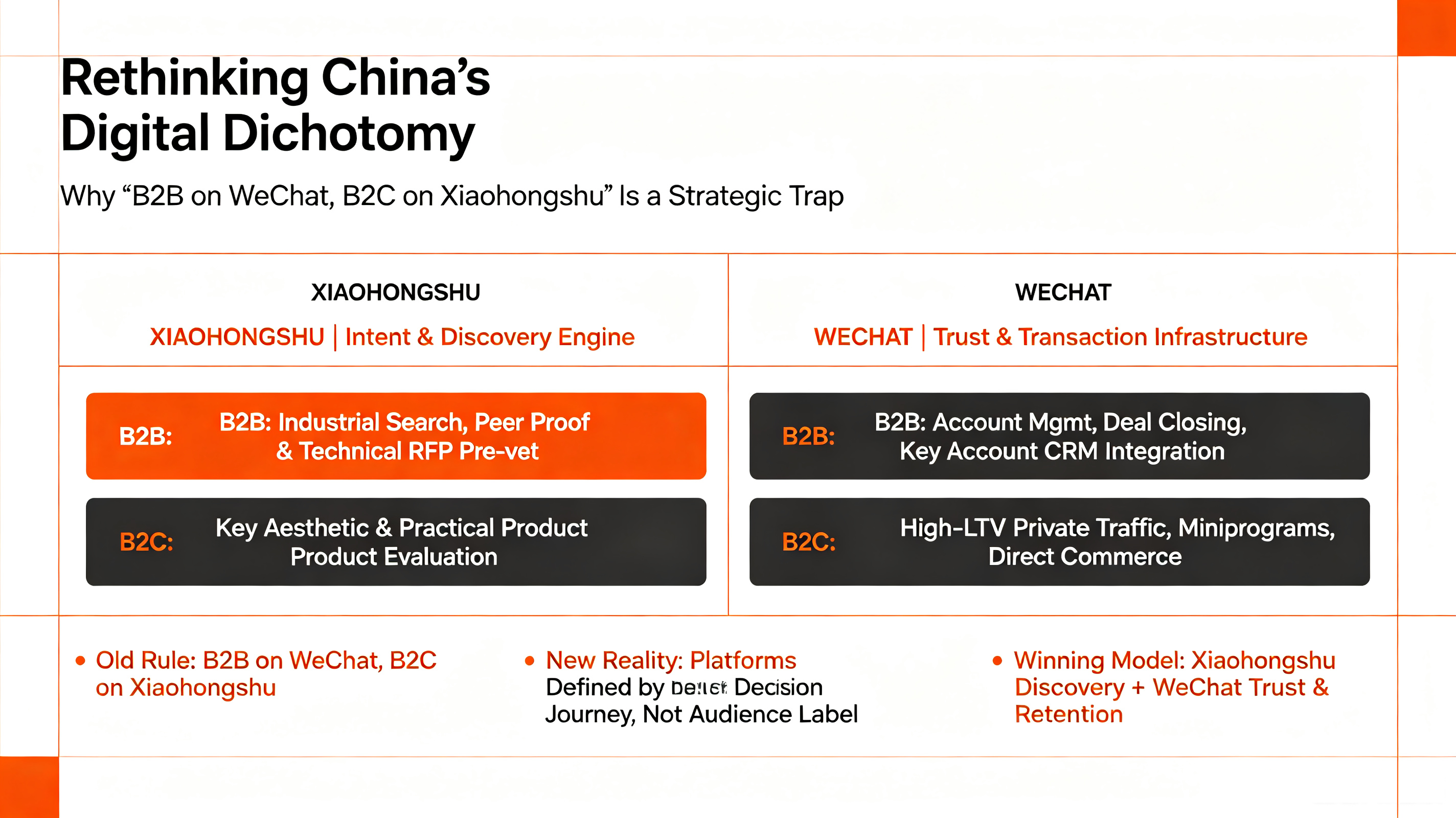
The New Reality: Xiaohongshu has quietly evolved into China’s most effective upper-funnel B2B search engine for industrial equipment, enterprise software, and professional services. Meanwhile, WeChat is not merely a social network for B2B relationship management; it is the infrastructure for high-LTV B2C private traffic, full-funnel customer lifetime value, and closed-loop social commerce.
Executives who divide Chinese digital channels by target audience type (B2B vs. B2C) miss the underlying architecture of China’s internet. In China, platforms are defined not by who uses them, but by how decision-makers move along the trust and intent continuum.
THE NEW MATRIX IN CHINA
XIAOHONGSHU (RED): Intent & Discovery Engine
- B2B: Industrial Search, Peer Proof & Technical RFP Pre-vet
- B2C: Aesthetic & Practical Product Evaluation
WECHAT: Trust & Transaction Infrastructure
- B2B: Account Mgmt, Deal Closing Key Account CRM Integration
- B2C: High-LTV Private Traffic, Miniprograms, Direct Commerce
2. The Recent Catalyst: Search Intent Migration and AI-Mediated Discovery
Two structural shifts over the past 12 to 18 months have shattered the old playbook:
1. The Death of Index-Based Search
Traditional search platforms (such as Baidu) have ceded intent discovery to closed social ecosystems. When a Chinese engineer searches for high-precision CNC machinery, or a procurement manager evaluates enterprise ERP migration, their first query is no longer typed into a standard search bar. It is typed into Xiaohongshu Search or WeChat Search.
2. Generative Engine Optimization (GEO) Inside Closed Ecosystems
With AI integration embedded into WeChat Search (via Tencent’s Hunyuan model) and Xiaohongshu Search, users do not scan through sponsored links. They receive synthesized, consensus-driven answers pulled directly from first-person user experience posts.
If your brand’s technical validation and peer reviews are not indexed within Xiaohongshu’s unstructured text database, your enterprise does not exist in the initial RFP consideration set.
3. Five Original Executive Insights for Boardroom Strategy
- China is the world’s first AI-mediated, intent-driven commercial matrix. Functional labels like “B2B platform” or “B2C network” are obsolete artifacts of Web 2.0 thinking.
- The “Consumerization of B2B” has hit China first and hardest. Chinese B2B procurement decision-makers evaluate enterprise vendors using the same peer-validation, visual-proof, and micro-influencer workflows they use to buy consumer electronics.
- Xiaohongshu is the upper-funnel discovery engine; WeChat is the enterprise OS. Xiaohongshu creates high-intent discovery across both B2B and B2C, while WeChat handles retention, contract closure, and lifetime value extraction.
- Trust verification has replaced brand awareness as the primary growth lever. In an era dominated by AI summary engines, passive advertising yields near-zero ROI. Trust is verified through user-generated peer consensus (KOC proof).
- Private Traffic (Siyu) is not a marketing tactic—it is a balance-sheet asset. Brands treating WeChat merely as a broadcast channel fail. Those using it as an integrated Social CRM system build lower customer acquisition costs (CAC) and higher gross margins than their Western peers.
4. Root Causes: Why China Evolved This Way First
Why are these platform dynamics unfolding in China years ahead of Western markets? Three structural drivers explain the divergence:
| Structural Driver | Western Context (US/Europe) | China Reality | Strategic Impact |
|---|---|---|---|
| Search Architecture | Open Web via Google & Web Browser links | Fragmented App Ecosystem / Walled Gardens | Search happens inside closed apps (Xiaohongshu & WeChat), forcing brands to optimize for internal app search & AI summarization. |
| Buyer Behavior | Formal email trails, LinkedIn, desktop-first RFPs | Mobile-first, instant messaging, peer-led research | B2B buyers reject cold emails and corporate decks in favor of real-world operational breakdowns on mobile feeds. |
| Transaction Friction | Multi-step web checkouts, credit card gateways, separate CRMs | Single-tap ecosystem payments (WeChat Pay) & integrated Mini Programs | Conversion happens inside the messaging app within seconds, eliminating drop-off between intent and purchase. |
The “Consumerization of B2B” in Practice
In China, a 32-year-old supply chain manager or IT director spends 2.5 hours daily on Xiaohongshu after work. When evaluating industrial automation software or specialty chemical suppliers during business hours, they default to the same interface. They seek authentic teardowns, case studies written by fellow engineers, and unfiltered peer critiques.
Corporate websites and glossy whitepapers hold virtually zero credibility compared to verified practitioner insights on Xiaohongshu.
5. Executive Playbook: Reallocating Strategy & Capital
To capitalize on this reality, CEOs and C-suite leadership must audit their China operations against a 4-step structural shift:
Strategic Action Items for the Executive Committee
- Audit Your Xiaohongshu Presence for B2B Search Terms
- Action: Demand a search query audit from your China team. What appears when a customer searches your product category + “solution” or “case study” on Xiaohongshu? If your brand is absent, you are losing upper-funnel deal flow.
- Transform WeChat from an “Editor’s Desk” to an “Operational OS”
- Action: Stop treating WeChat as a corporate press releases account. Reallocate budget toward WeChat Work (Enterprise WeChat) integration, Mini Program commerce workflows, and Social CRM capabilities.
- Master Generative Engine Optimization (GEO) in China
- Action: Ensure technical content, peer reviews, and customer benchmarks are formatted so that WeChat’s and Xiaohongshu’s internal AI engines can easily scrape, index, and surface your brand as the authoritative recommendation.
- Break the B2B vs. B2C Marketing Silos
- Action: Restructure your China marketing organization around Discovery (Upper Funnel) and Conversion/Retention (Lower Funnel) rather than arbitrary B2B vs. B2C business units.
6. Looking Ahead: What China Signals for Global Digital Strategy
China’s current digital landscape serves as a preview for where Western markets are heading over the next 3 to 5 years:
- The Decline of the Open Web Search Engine: Just as Baidu lost dominance to closed app search, Google is navigating similar pressure as younger demographics shift discovery to TikTok, Reddit, and ChatGPT. China shows that search strategy must follow platform-native social intent, not web URLs.
- The B2B Influencer Imperative: The rise of B2B influencer seeding on Xiaohongshu anticipates the growing role of LinkedIn creators, podcasts, and community leaders in Western enterprise software purchasing.
- Unified Messaging Commerce: As WhatsApp and Apple Messages integrate richer business flows in the West, China’s seamless WeChat private traffic model provides the blueprint for direct-to-consumer and enterprise sales integration.
The Bottom Line for Executive Leadership
Dismissing Xiaohongshu as a “B2C lifestyle app” or viewing WeChat as a “B2B broadcast channel” is a costly strategic oversight. Winning in China—and preparing for the global future of digital commerce—requires mastering a dual-engine architecture: Xiaohongshu for high-intent discovery and search dominance, paired with WeChat for deep trust, private ecosystem ownership, and long-term customer value.
 Unlock 2026's China Digital Marketing Mastery!