 English
 German
 Korea
Korea Spanish
The Best CEOs Don’t Wait for Reports. They Watch Signals.
- On August 4, 2026
- AI Perception Metrics, Content Trust Metrics, Proxy Metrics, Source of Trust Metrics
Before Revenue Changes, Reality Whispers. Great Leaders Listen.
1. The Autopsy of the Dashboard
Every Monday morning, executive teams around the globe convene to inspect the exact same financial and operational dashboards: Revenue, Net Profit, Customer Acquisition Cost (CAC), Return on Investment (ROI), Gross Merchandise Value (GMV), and Inventory Turnover.
There is a fundamental flaw in this ritual: Every metric on that dashboard is a financial autopsy.
By the time CAC spikes, your market positioning has already degraded. By the time GMV contracts, your customers have already shifted their intent elsewhere. By the time quarterly profit misses expectations, the structural breakdown in your go-to-market engine occurred months ago.
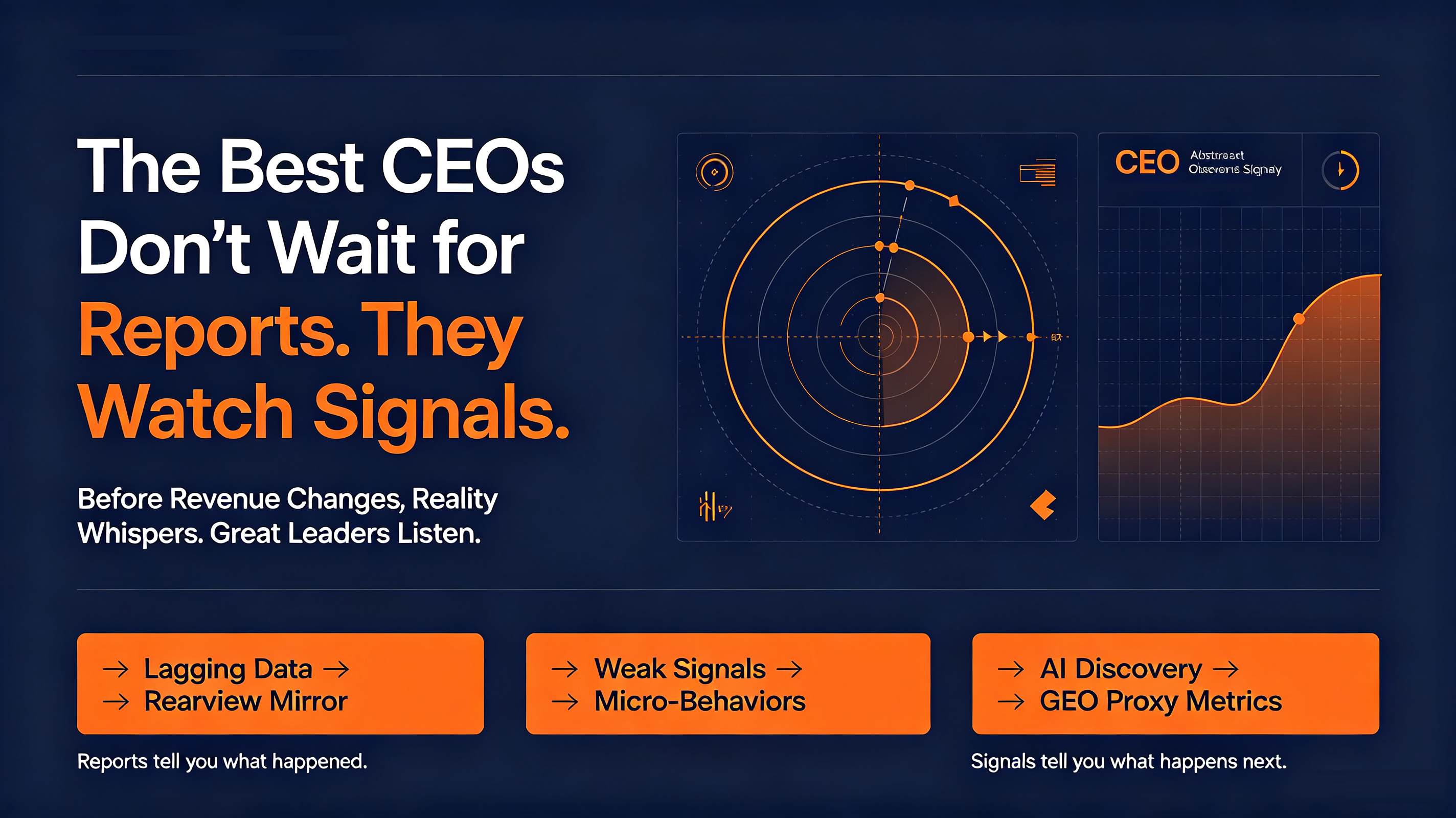
Managing a enterprise by analyzing backward-looking reports is like navigating a high-speed vehicle by staring exclusively in the rearview mirror.
Great CEOs do not win by analyzing lagging data faster than their competitors; they win by discovering weak signals—the subtle, microscopic shifts in customer behavior, operational tempo, and channel mechanics that precede macro results.
Core Insight: Strategic management is not the study of outcomes. It is the disciplined observation of the micro-behaviors that inevitably make those outcomes inevitable.
2. The Recent Catalyst: The Shift from Search Engines to AI Recommendation Engines
The digital environment has hit a definitive tipping point. In Western markets, conversational AI platforms have crossed mainstream adoption, with tools like ChatGPT exceeding 900 million weekly active users and Google’s AI Overviews triggering on nearly half of all search queries.
Concurrently, in China—the world’s most hyper-compressed digital economy—the Generative AI user base has surged past 600 million users. Platforms like DeepSeek, Doubao, and Tencent’s ecosystem have transformed how more than 76% of consumers research products and make enterprise buying decisions.
TRADITIONAL DIGITAL DISCOVERY
[ User Query ] ──> [ Google / Baidu Crawl ] ──> [ SERP Links ] ──> [ Website Click ] ──> [ Conversion ]
AI-MEDIATED DISCOVERY (GEO ERA)
[ User Intent ] ──> [ RAG / Training Data ] ──> [ AI Synthesis & Citation ] ──> [ Direct Consideration ]
This structural evolution has rendered traditional Search Engine Optimization (SEO) and classic digital attribution models obsolete. The discovery layer between brands and buyers is no longer a list of blue links ranked by backlinks—it is an AI-mediated synthesis.
When purchase journeys shift to conversational AI, traditional top-of-funnel web traffic drops quietly long before financial statements reflect the erosion. The CEOs who rely on quarterly marketing reports will notice the decline only after market share has evaporated. Those watching Proxy Metrics saw the whisper two quarters prior.
3. Lead Time is the Only Sustainable Competitive Advantage
Why do macro investors like Warren Buffett analyze freight rail traffic? Why do top-tier private equity firms track US truck tonnage indices, port container throughput, semiconductor order lead times, and spot shipping container rates?
Because in business, Lead Time is margin.
If you gain a one-quarter lead on a structural market shift, you capture disproportionate value. If you react when the shift becomes common knowledge, you pay a premium just to survive.
The Anatomy of a Weak Signal: Google CPC as an Economic Snowflake
Consider a simple digital marketing metric: Google Cost-Per-Click (CPC) begins rising across your vertical.
- The Average Executive View: “Our digital marketing efficiency is dropping. High ad costs are hurting our margin.”
- The Strategic Signal View: “Why is CPC rising?”
- Are venture-backed competitors releasing new capital pools into acquisition?
- Are enterprise buyers restarting frozen budget cycles?
- Is consumer confidence recovering in key sub-segments?
A rise in acquisition costs is rarely just an advertising problem; it is often the first snowflake of an economic spring—or the warning signal of a crowded, low-differentiation channel.

4. The AI Imperative: Machine Intelligence vs. Human Signal Detection
In an era dominated by LLMs, Deep Research tools, and automated BI platforms, access to data offers zero strategic advantage.
Every enterprise rival has access to ChatGPT, Claude, Gemini, and enterprise analytics dashboards. When everyone possesses the same analytical capabilities processing the same internal ERP and CRM data, data-driven management becomes a baseline commodity.
The enduring competitive wedge lies in what AI cannot see: Micro Anomalies in the physical and behavioral world.
| Operational Dimension | What Enterprise AI Sees (Macro) | What Strategic Leaders Notice (Micro Weak Signals) |
| Manufacturing & Logistics | ERP output, inventory turnover ratios, supply chain lead times. | Factory parking lots thinning out, security guards sitting idle, shipping bays clearing early, or factory restrooms suddenly immaculately clean. |
| B2B Tech & SaaS | Monthly Recurring Revenue (MRR), churn rate, funnel drop-off. | Changes in the job titles of inbound leads, prospect questions shifting from “How much does it cost?” to “How does this interface with AI workflows?” |
| Consumer Retail | Monthly store sales, traffic volume, loyalty program registration. | Changes in Xiaohongshu save-to-like ratios, shorter queues at premium tea shops, micro-shifts in residential courier locker density. |
The Human-AI Equilibrium: AI models excel at analyzing macro datasets and synthesizing known variables. Executives must excel at detecting micro-anomalies—identifying the “unmodeled” reality before it hits the data pipeline.
5. China as the Global Strategic Lens: The Micro-Signal Economy
Foreign business executives often treat China as an isolated market with unique localized digital apps. This is a strategic mistake. China is not an isolated ecosystem; it is a preview of hyper-compressed digital competition.
In China’s digital market:
- Industry cycles compress from 3 years to 6 months.
- Relying on official quarterly economic statistics means analyzing history; by the time data is published, the window of opportunity has closed.
- Success depends on reading daily Micro Signals: cross-border logistics spot pricing, Xiaohongshu bookmark-to-like ratios, livestream engagement velocity, and private traffic response latency.
The GEO Revolution: China’s AI-Mediated Frontier
China has become the first market where consumer discovery is fully AI-mediated. Because Chinese Large Language Models (such as DeepSeek, Qwen, and Baidu ERNIE) draw heavily from closed platform ecosystems (WeChat Public Accounts, Zhihu, Baidu Baike) rather than open websites, traditional web SEO in China collapsed faster than in the West.
EVOLUTION OF DISCOVERY METRICS: SEO TO GEO
| Traditional SEO Metrics (Lagging / Traffic-Focused) |
GEO & AI Proxy Metrics (The Leading Signals) (Predictive / Intent-Focused) |
|
|
Brands like L’Oréal, Apple, and Tesla running operations in China quickly recognized that measuring website traffic was no longer meaningful. Instead, they built AI Proxy Metrics Dashboards.
If an AI engine is not citing your brand when a consumer asks for recommendations, your brand effectively does not exist in that consumer’s consideration set.
6. Executive Playbook: Transitioning from Data Intelligence to Signal Intelligence
To build a resilient, forward-looking enterprise, leadership teams must transition from relying solely on Data Intelligence (BI) to cultivating Signal Intelligence (SI).
Signal Intelligence (SI)
Architecture Framework
- PILOT LAYER, Micro-Behavior Triggers
- GEO COGNITION DASHBOARD, LLM Citations & Entity SOV
- ANOMALY HUNTING ANOMALY HUNTING PRACTICE, Identify Outlier Insights
Strategic Implementation Steps
Step 1: Audit Your Proxy Metrics
Identify the micro-behaviors that occur 30 to 90 days before a sale or churn event.
- Example: In B2B enterprise software, a leading signal is not demo requests; it is the number of open API documentation pages viewed by target engineering teams.
Step 2: Establish an AI Visibility Barometer (GEO Dashboard)
Track brand presence inside conversational engines (ChatGPT, Claude, Perplexity, DeepSeek, Gemini):
- Citation Rate: Does the AI cite your authoritative assets when answering industry prompts?
- Entity Definition: Does the AI accurately understand your product positioning and key differentiators?
- Competitor Preference: Is the AI recommending a competitor as the primary choice for high-intent queries?
Step 3: Shift Marketing Evaluation from Reach to Trust
Reallocate marketing capital away from vanity engagement (clicks, impressions, casual likes) toward high-intent actions:
- Bookmark / Save Rates: Measures actual utility and purchase consideration.
- Unsolicited Mentions: Measures authentic organic mindshare.
- Direct Prompt Inclusion: Measures whether buyers explicitly name your brand inside conversational search queries.
Step 4: Institute Institutional “Anomaly Hunting”
Instruct product managers, regional sales heads, and marketing leaders to report monthly on Anomalies, rather than averages or trend lines.
- What unexpected customer behavior appeared this month?
- What edge case unexpectedly converted at a high rate?
- Which unexpected vertical is mentioning our platform?
7. Looking Ahead: The Next 3–5 Years of AI-Mediated Business
Over the next 36 to 60 months, the separation between market leaders and lagging incumbents will widen along a new operational line: Signal Velocity.
THE 3-YEAR STRATEGIC EVOLUTION FOR GLOBAL BRANDS
- 2024–2025: [Search Optimization], Keywords & Backlinks, Human Search Traffic
- 2025–2026: [Generative Optimization], Citations & AI SOV, AI Recommendation Engines
- 2027+: [Autonomous AI], Agent Integration, Machine Consumers
- AI Agents Will Become Primary Purchasing Gatekeepers: Buyers will increasingly deploy autonomous AI agents to research, negotiate, and execute procurements. Optimizing for machine discovery (GEO) will be a prerequisite for market entry.
- First-Party Signal Networks Will Replace Passive Analytics: Companies that build direct, proprietary channels (private communities, specialized tools, direct knowledge bases) will retain access to unpolluted behavioral signals.
- Signal Intelligence Will Outpace Business Intelligence: Legacy BI tools show you where you were yesterday. Signal Intelligence infrastructure predicts where your market will be tomorrow.
The Executive Takeaway:
Financial reports tell you how the game ended.
Dashboards tell you the current score.
Signals tell you how the next play will unfold.
Great CEOs don’t wait for the monthly binder to arrive. They step onto the field, observe the subtle shifts in wind and turf, and act while the rest of the market is still waiting for the data to process.
 Unlock 2026's China Digital Marketing Mastery!