 English
 German
 Korea
 Spanish

Earned, Not Bought: Data PR and the Listicle Game
- On November 29, 2026
- small-middle business geo
The GEO Playbook for Brandless B2B Companies — Part 5
Four parts in, we’ve walked the whole path: new rules (mentions beat links), the citation map (each engine has its kitchen), the foundation (entity hygiene, citable facts), borrowed authority (community and video discipline).
Now we arrive where most owners wanted to start: the authoritative press. The places the brandless supposedly can’t enter.
The gate is real. But it doesn’t check your brand. It checks something else.
What journalists actually need (hint: not big logos)
Step inside a trade reporter’s head for a moment.
She files several stories a week. Deadlines stacked. What she needs isn’t a press release from a famous company — it’s three things: an angle worth writing, numbers nobody else has, and an expert who answers within two hours.
Who can deliver that? Rarely the PR departments of big brands — slow, scripted, risk-averse. Far more often it’s the owner of a small firm who has spent fifteen years in one narrow niche and talks in plain sentences. As one digital PR practitioner put it, a specialist SME operator is worth more to a journalist than any generic corporate spokesperson.
The channels are built and mostly free. HARO (revived in 2025 under Featured), Qwoted, Connectively, and the #JournoRequest tag on X all run the same marketplace: journalists post requests — “writing about warehouse automation, need a practitioner quote” — and you answer within hours with a clear position, one piece of evidence, one quotable sentence. Thirty minutes a day scanning requests translates into four to eight expert placements a month in outlets whose domain authority you could never otherwise touch.
Hit rate has a craft to it. One in five journalists receives 50-plus pitches a week and finds 3% of them relevant. The winners aren’t longer; they’re faster and tighter. Three paragraphs: your take, your proof, your phone number.
And a note on speed: when industry news breaks, the first credible expert comment in a journalist’s inbox usually makes the story. Velocity beats brand recognition in that window, every time.
Your ace: the data only you hold
Answering journalists borrows their agenda. The stronger move is setting it.
Part 3 said every B2B company sits on first-hand data nobody can copy. Time to cash it in. Run a small industry survey, or mine your own customer base, and pull out one newsworthy number — “63% of buyers in our sector disqualify vendors at the spec stage if a certain certification is missing” — then pitch that number, with the report attached, to trade outlets.
The costs will surprise you. One regional e-commerce company ran a single local consumer-habit survey and earned coverage in three regional outlets plus two national ones: nine high-authority referring domains, 23% organic traffic growth within 90 days. A full outsourced data campaign runs a few thousand dollars; doing it in-house costs mostly attention.
Why does it work on both audiences at once? Journalists need attributable numbers. AI needs attributable numbers. When you publish the number, both must name you. Cited releases carry roughly twice the statistics of uncited ones — the model, like the reporter, is looking for something solid to hold.
The listicle game and the review flywheel
For B2B, Layer 3 of the ladder has its own asset class: review platforms, third-party rankings, association memberships.
Part 2 gave you the stakes: third-party “best of” lists capture 80.9% of listicle citations, and a #1 slot in a heavily cited list moves you up 1.17 positions in AI answers on average. Three moves, in order.
Claim and complete your profiles on G2, Capterra, TrustRadius and your industry’s vertical review sites — features, pricing, ideal-customer descriptions, all matching your website word for word. Then build a review stream: fold the ask into your customer-success motions, at go-live, at renewal, at the moment a client tells you they’re happy. Target fifty-plus genuine reviews per platform, recent ones — models favor products with current activity. Genuine, not purchased: these platforms run sophisticated detection, and getting caught zeroes you out.
Then get onto other people’s lists. Track who writes the “best X” and “X vs. Y” articles in your category. Send them demo access, test data, anything that makes writing about you easy. You’re not buying placement; you’re removing friction from coverage they’d write anyway.
Finally, the institutional layer: association memberships, standards-committee participation, analyst report inclusions. These are exactly the machine-verifiable signals AI can cross-check — but only when they live in public registries. A badge on your own homepage is decoration. A name in the association’s official directory is evidence.
The expensive trap to walk around
Everything above is the “earn” side. Now the trap on the “buy” side.
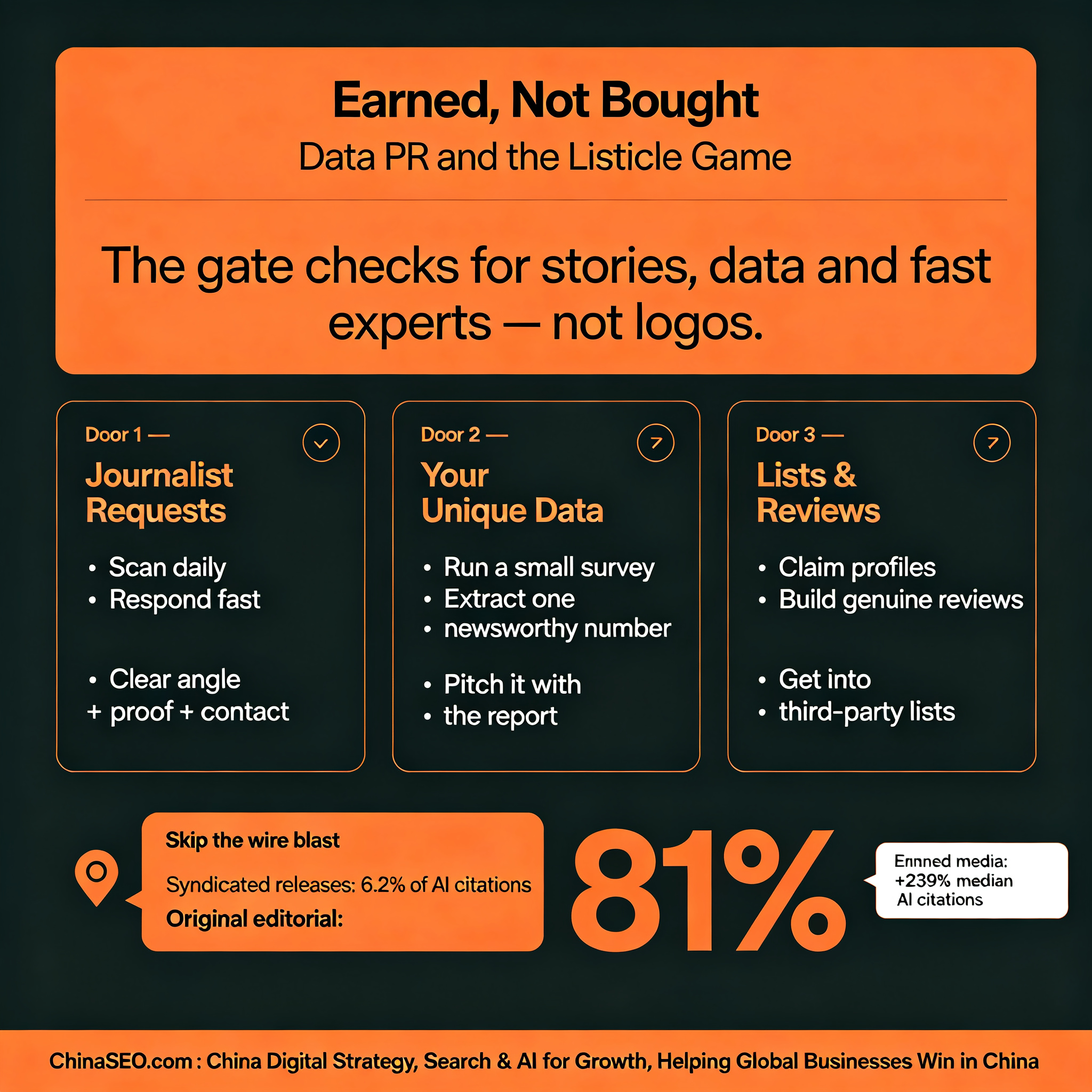
Most companies’ first GEO move is hiring a distribution service to blast press releases. It’s the most expensive and least effective path available. When researchers examined what AI cites in news-style answers, syndicated wire content accounted for 6.2%. Original editorial content: 81%. A hundred near-identical releases read as one weak source to a cross-checking model — which is to say, as nothing.
The earned route has hard numbers behind it. Stacker tracked 87 stories across 8 AI platforms and found earned-media distribution lifted median AI citations by 239%; a story’s distributed version was 5.3 times more likely than the brand’s own site version to be its sole source of AI visibility.
Bain put the whole layer in one sentence: “The sources LLMs trust look much more like a strong PR and earned-media strategy than a performance marketing dashboard.”
The takeaway
The gate to authoritative media checks for stories, data and fast experts — not logos. Three doors: thirty minutes a day answering journalist requests; your own data packaged as a pitchable number; review platforms, third-party lists and verifiable institutional memberships, built one by one. Skip the wire services. Earn the coverage.
That’s the full ladder: entity, facts, community, lists, press — authority assembled rung by rung. The final part turns all of it into a calendar: 90 days, week by week, with honest costs, real case numbers, and the six traps that burn most first-timers.
Previous: Part 4 — Borrowed Authority | Next: Part 6 — The 90-Day Playbook: Costs, Cases, and the Six Traps
 Unlock 2026's China Digital Marketing Mastery!