 English
 German
 Korea
Korea Spanish
From Marketing Tactics to AI Trust Infrastructure
- On September 22, 2026
- AI Trust Infrastructure, Trust Infrastructure
Why the Next Digital Marketing Advantage Is Not a Tactic, but a Trust Infrastructure
01|The Half-Life Collapse of Marketing Tactics
Over the past 24 months, global marketing has entered an unprecedented collapse in tactical half-life.
Look closely at the three micro-trends unfolding across the tech landscape:
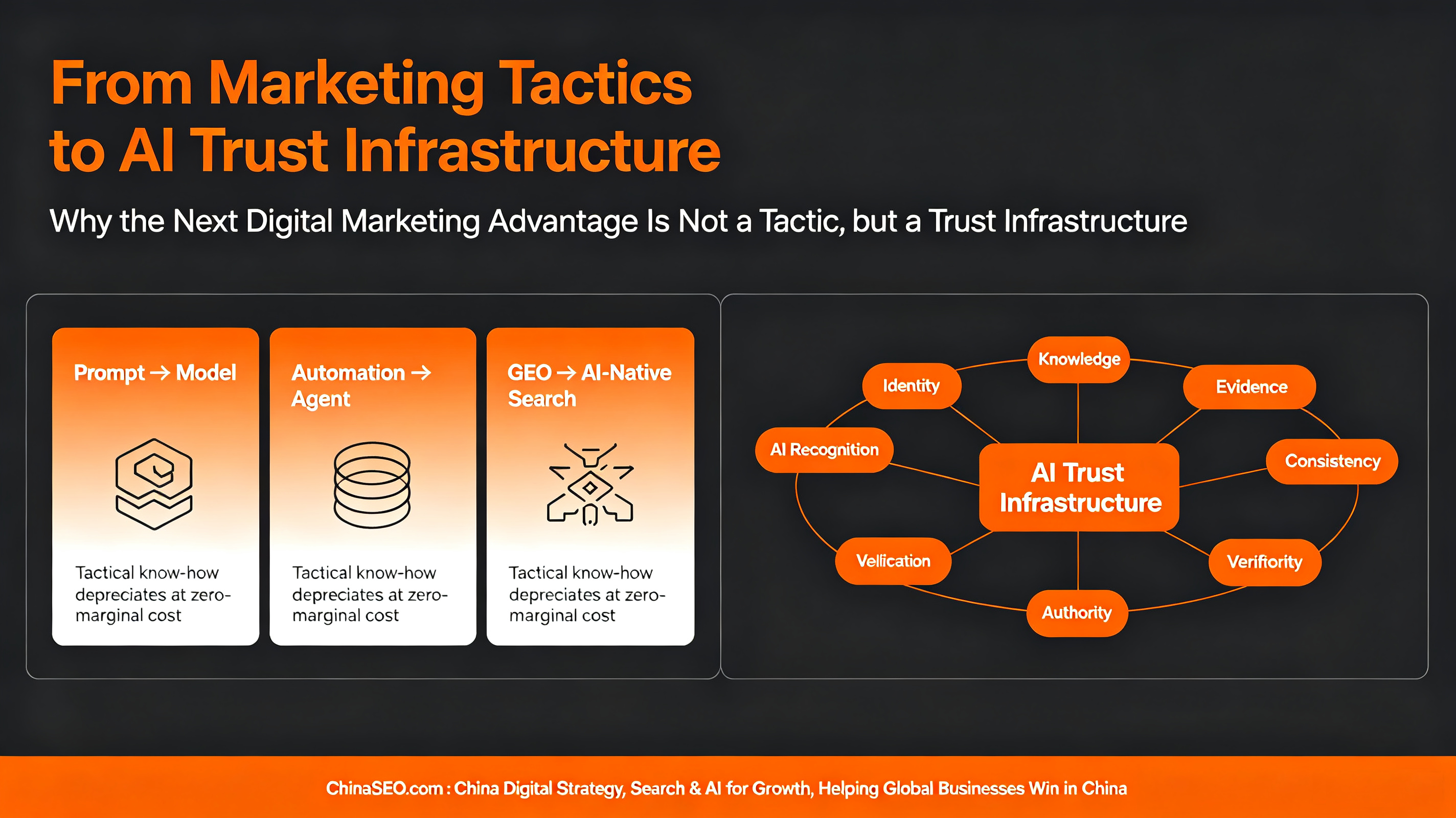
- Prompt → Model: Twelve months ago, enterprises paid premium rates to train teams in “prompt engineering.” Today, frontier models like GPT-4o, Claude 3.5 Sonnet, and Gemini 1.5 natively handle subtle intent, context windows, and multi-step reasoning out of the box. Prompt design moved from a proprietary moat to basic digital literacy overnight.
- Automation → Agent: Rule-based automation—built on rigid decision trees and explicit API triggers—is giving way to multi-agent frameworks capable of executing dynamic, non-linear workflows. The complex Zapier sequences marketing ops spent weeks perfecting can now be analyzed and executed instantly by an autonomous agent.
- GEO → AI-Native Search: While most growth marketers are still testing ways to trick Perplexity or SearchGPT into dropping a brand mention via prompt injection, AI search engines have evolved. They have moved past simple Retrieval-Augmented Generation (RAG) into real-time, multimodal reasoning engines with built-in confidence scoring and verification protocols.
These developments converge on an unforgiving commercial reality: If you teach an AI a marketing tactic today, the underlying model will absorb it tomorrow and offer it natively to your direct competitors for free.
When tactical execution cycles shrink from years to weeks, executive leaders must address a foundational strategic question:
When tactical know-how depreciates at zero-marginal cost, what durable asset should an enterprise build to secure long-term market leadership?
02|Models Eat Best Practices: The Commoditization of Tactics
To navigate this shift, business leaders must recognize how modern AI models fundamentally differ from Web 2.0 digital platforms.
In the legacy Web 2.0 model:
Platforms (Google, Meta, Amazon) established static rules. Human marketers studied those algorithms, identified arbitrage opportunities, and extracted outsized organic reach. In that regime, informational asymmetry held immense value: knowing an undisclosed SEO ranking factor could secure a multi-year growth advantage.
In the emerging AI model:
AI architectures do not merely enforce rules—they ingest and internalize human best practices at scale.
When a strategist devises an elite campaign framework—whether a high-converting copywriting structure, a precise B2B messaging matrix, or an advanced attribution method—that knowledge eventually enters the public domain. During the next fine-tuning run, reinforcement learning from human feedback (RLHF) cycle, or memory sync, the AI ingests that methodology and bakes it directly into its base capabilities.
[Expert System / Tactic] ➔ [Public Execution] ➔ [Model Ingestion & RLHF] ➔ [Native Platform Feature] ➔ [Zero Arbitrage Value]
Tactical knowledge is becoming commoditized.
For enterprise decision-makers, the lesson is clear: building a sustainable competitive advantage on “knowing a growth hack” is officially over.
03|The Misconception of GEO: It Is Not “Hacking AI Citations”
Generative Engine Optimization (GEO) has quickly emerged as the latest industry buzzword. Yet most organizations approach GEO through a dangerously short-sighted lens.
Tactical GEO (The Arbitrage Trap)
The prevailing playbook focuses on surface-level hacks:
- Engineering prompts to force specific brand inclusions;
- Injecting hidden text or semantic triggers into public web pages;
- Mass-generating generic content to flood language model training corpora;
- Gaming citation mechanisms to secure a transient hyperlink.
This approach merely repositions 2010s black-hat SEO tricks—keyword stuffing and link farming—into the generative AI era. Modern LLMs equipped with real-time verification and multi-source cross-checking easily spot these maneuvers. Worse, these tactics risk poisoning your brand’s digital footprint, prompting models to classify your domain as low-confidence.
Strategic GEO (Building Verified Truth)
Strategic GEO shifts the core question from “How do we influence AI output?” to a fundamental operational principle:
Why should an AI trust this company?
Strategic GEO is not about manipulating algorithm outputs. It is the practice of building an unassailable, machine-readable digital infrastructure that independent systems can easily verify.
❌ Tactical GEO : Force brand inclusions via prompt hacks (Hacking Output)
▼ YES Strategic GEO : Build a machine-verifiable enterprise identity (Building Trust Infrastructure)
04|From Search to Recommendation to Transaction
Tracking the evolution of digital visibility reveals how the criteria for winning market share have shifted across three distinct eras:
1. The SEO Era: Ranking Eligibility
Winning required keywords, backlink counts, and metadata tags. Brands competed for real estate on a Search Engine Results Page (SERP). Winning meant mastering platform mechanics.
2. The GEO Era: Recommendation Eligibility
Generative engines eliminate the list of ten blue links, delivering single, synthesized responses instead. When a enterprise buyer asks an AI engine, “Which enterprise software providers comply with strict multi-region data residency requirements?” the model does not measure keyword density. It evaluates its underlying graph:
- Who is this corporate entity?
- Are its claims corroborated by independent, third-party benchmarks and technical literature?
- Are its case studies and customer references verified?
- Can AI trust me enough to recommend me?
3. The AI Agent Era: Transaction Eligibility
As AI transitions from retrieving information to executing autonomous procurement (AI-Mediated Commerce), software agents acting on behalf of B2B procurement teams will operate under strict risk-mitigation parameters.
If an enterprise’s digital footprint contains conflicting specifications, unverified claims, or incomplete structural data, the buyer’s agent will bypass that vendor entirely to protect its execution pipeline.
Can an AI agent confidently bring me into a transaction?
Moving from being discovered to being comprehended, and ultimately being authorized for commerce—this represents the true trajectory of digital strategy.
05|The Strategic Alternative: AI Trust Infrastructure
If tactics depreciate instantly, what constitutes a durable digital asset in the age of AI?
The answer is AI Trust Infrastructure.
An enterprise AI Trust Infrastructure is a interconnected, machine-readable validation network built across seven core layers:
Identity -> Knowledge -> Evidence -> Authority -> Consistency -> Verification -> AI Recognition
The Seven Layers of Corporate Trust Infrastructure:
- Identity: A clean, unambiguous digital entity definition recognized across major knowledge graphs (e.g., Schema.org, Wikidata, industry registries).
- Knowledge: Proprietary, structured domain knowledge addressing complex industry challenges, going far beyond generic public information.
- Evidence: Citable proof points, empirical benchmark data, peer-reviewed technical specifications, patents, and verifiable deployment metrics.
- Authority: Non-sponsored endorsements, co-authored industry standards, academic citations, and coverage from reputable industry bodies.
- Consistency: Perfect alignment across all public data sources, eliminating contradictory product specifications, executive records, or corporate histories.
- Verification: Real-time cross-referencing against independent databases, regulatory filings, certification bodies, and verified buyer reviews.
- AI Recognition: High-confidence entity attribution in frontier model embeddings, positioning the brand as a authoritative option with low hallucination risk.
Under this architecture, your primary corporate website is no longer the final destination—it is simply one node within a distributed Enterprise Trust Network.
When evaluating a vendor, AI models analyze structured signals across the entire digital ecosystem. If your corporate site claims market leadership but third-party industry reports, regulatory filings, or employee graphs contradict those statements, the model assigns a lower confidence score to your brand entity.
06|Compounding Capital vs. Depreciating Expense
Comparing tactical growth operations to trust infrastructure investment highlights a fundamental difference in capital allocation:
| Dimension | Chasing Growth Tactics | Building AI Trust Infrastructure |
|---|---|---|
| Lifecycle | Discover ➔ Copy ➔ Absorb ➔ Commoditize ➔ Obsolescence | Build ➔ Accumulate ➔ Validate ➔ Compound |
| Capital Type | Depreciating Expense | Compounding Asset |
| Model Alignment | Constant friction with model updates | Benefits directly from model intelligence gains |
| Competitive Moat | Low (replicable by competitors in days) | High (rooted in authentic corporate capability) |
As frontier models grow more capable and inference costs drop, the marginal return on clever growth tactics trends toward zero. Conversely, clean, machine-readable, and independently verified enterprise knowledge becomes exponentially more valuable to AI agents making high-stakes purchasing decisions.
This dynamic yields a core strategic directive for executive leadership:
The best AI strategy is not to outrun the model. It is to build assets the model cannot commoditize.
07|Redefining the Role of Marketing Leadership
Chief Executive Officers and Board Directors must fundamentally recalibrate their expectations for the Chief Marketing Officer and the broader growth organization.
Consider how the core mandate of marketing has shifted over three decades:
- 1990s – 2000s (SEO Era): Get Traffic
- 2010s – 2020s (Social/Brand Era): Get Attention
- 2023 – 2024 (Early GEO Era): Get Discovered by AI
- 2025+ (AI Agent Era): Become trustworthy enough for machines to recommend and transact with.
Traffic Generation ─► Trust Infrastructure Building
Marketing must evolve from a Traffic Generator into a Trust Infrastructure Builder.
Modern marketing leaders must combine strategic positioning with digital architecture—organizing enterprise knowledge, validating empirical data, and establishing clean structural entity definitions so autonomous engines can index, verify, and act on their capabilities without friction.
08|The Executive Audit: 10 Strategic Questions for the C-Suite
Board members and C-suite executives should move away from tactical status reports and evaluate their organization using this AI Trust Infrastructure Strategic Framework:
EXECUTIVE AUDIT: AI TRUST INFRASTRUCTURE
- Identity: Can major LLMs uniquely identify your corporate entity without hyper-specific prompting?
- Product: Can AI models accurately articulate your core value proposition and differentiation?
- Evidence: Are your performance claims supported by independent third-party data outside your domain?
- Consistency: Is your corporate data perfectly aligned across trade portals, news outlets, and industry registries?
- Verification: Have external regulatory or auditing bodies validated your capabilities in public data graphs?
- Knowledge: Is your firm’s domain expertise published as structured, machine-indexable IP?
- Experts: Can AI engines map your key executives and researchers to verified industry credentials?
- Case Studies: Are your client success stories and metrics cross-verifiable via independent digital footprints?
- Consideration: When an enterprise buyer asks an AI engine for top-tier providers in your niche, do you appear in the shortlist?
- Commerce: If a buyer’s autonomous agent runs a vendor audit today, does your digital infrastructure support automated verification?
Question 10 is the ultimate benchmark.
It elevates digital strategy from traditional search marketing directly into AI-Mediated Commerce. Organizations that fail this audit risk becoming invisible to the next generation of automated procurement systems.
09|Conclusion: Make AI Your Trust Amplifier
Every executive team faces a choice: continue chasing fleeting prompt optimizations and automated distribution hacks, or invest in a machine-verifiable digital foundation.
Tactics will continue to commoditize. Models will become smarter. Distribution will become automated.
In this environment, long-term enterprise value rests on building digital assets that compound alongside model intelligence:
Authentic Capability + Structured IP + Empirical Evidence + Third-Party Authority + Data Consistency + Verified Identity
The fundamental premise of corporate strategy remains unchanged, even as the interface shifts:
- In the SEO Era, companies optimized their content to appease search algorithms.
- In the GEO Era, companies structured their identity so generative models could comprehend their value.
- In the Agent Era, companies must build a machine-verifiable foundation that autonomous systems can evaluate, trust, and select for commercial transactions.
Do not attempt to outsmart the model with growth hacks. Build an enterprise trust infrastructure that turns advancing AI into your powerful growth amplifier.
 Unlock 2026's China Digital Marketing Mastery!