 English
 German
 Korea
 Spanish

The AI Middle Layer Is Here: What China’s GEO Boom Reveals About the Next Digital Marketing Battlefield
- On September 18, 2026
- china geo
Executives are asking the wrong question about AI search
Most C-suites view Generative Engine Optimization (GEO) as an incremental digital marketing evolution—a mere extension of Search Engine Optimization (SEO) designed to secure citations inside LLM responses.
That view is a strategic error.
China’s digital ecosystem is revealing that GEO is not a tactic for organic traffic; it is the construction of an AI Middle Layer—an autonomous, algorithmic proxy sitting between brands and consumer intent. In China, consumers no longer navigate open web links; they query AI-mediated engines like Doubao, DeepSeek, Baidu ERNIE Bot, Xiaohongshu’s AI search, and WeChat Yuanbao.
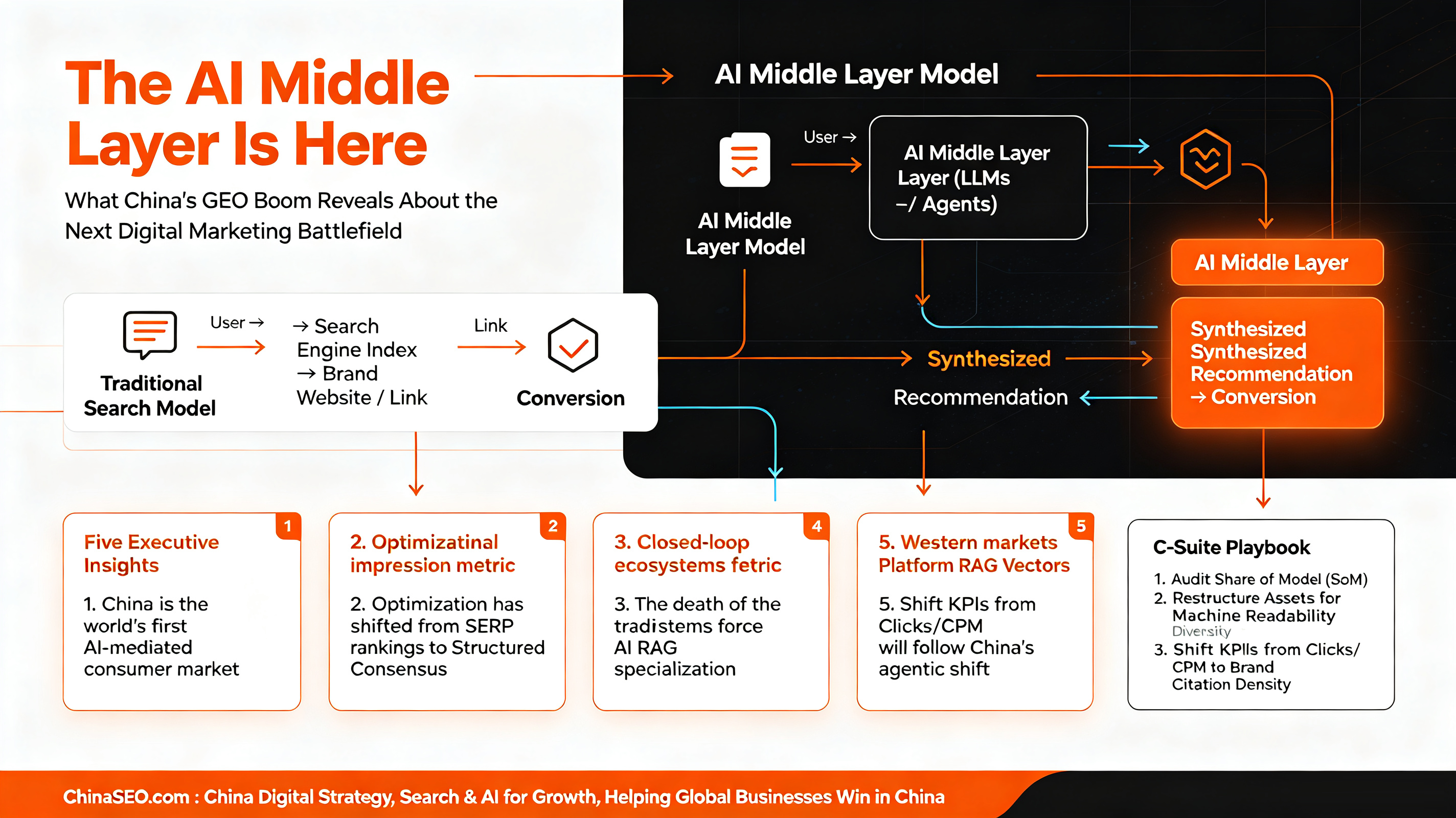
[Traditional Search Model]
User ─► Search Engine Index ─► Brand Website / Link ─► Conversion
[The AI Middle Layer Model]
User ─► AI Middle Layer (LLMs / Agents) ─► Synthesized Recommendation ─► Conversion
When an AI model synthesizes a category purchase decision into a single direct answer, the traditional marketing funnel collapses. If your brand is not embedded within the foundation models powering this middle layer, you do not exist in the decision loop.
The Catalyst: The Shift to AI-Mediated Search
Over the past month, native AI applications and embedded AI search engines across China reached over 500 million active users. Platforms like ByteDance’s Doubao, DeepSeek, and Xiaohongshu’s integrated search have fundamentally altered discovery.
2026 China AI Search Ecosystem Architecture
- Foundational / Native AI Engines
─ DeepSeek (Logic-first reasoning & B2B knowledge retrieval)
─ ByteDance Doubao (Consumer & daily task mediation) - Ecosystem AI Integrations
─ Baidu ERNIE (Enterprise Knowledge Graphs & Baike integration)
─ Xiaohongshu AI Search (KOL/KOC consensus synthesis)
─ WeChat Yuanbao (Private-traffic & official account retrieval)
In the West, Google and Microsoft are wrestling with monetizing AI Overviews without cannibalizing legacy ad revenue. In contrast, Chinese tech giants have moved directly to structuring their ecosystems for AI agents.
The critical shift: Chinese consumers are bypassing brand websites, organic SERPs, and display ads to rely on synthesized consensus.
Five Executive Insights: Structural Realities of the AI Era
1. China is the world’s first AI-mediated consumer market
In traditional digital marketing, brands build direct digital real estate (websites, social accounts, apps). In an AI-mediated market, brands must market to the algorithm first and the consumer second. If an LLM does not retrieve your brand’s attributes, your consumer-facing campaigns suffer a structural conversion tax.
2. Optimization has shifted from SERP rankings to “Structured Consensus”
SEO was about earning top real estate on a page of links. GEO is about embedding high-density, authoritative logic into the training sets, real-time RAG (Retrieval-Augmented Generation) feeds, and index networks of LLMs. In the GEO era, controlling the factual consensus matters far more than purchasing impressions.
3. Closed-loop ecosystems force AI RAG specialization
Unlike the relatively open Western web, China’s digital landscape is divided into walled gardens (Tencent, Alibaba, ByteDance, Baidu). Consequently, GEO in China is not a single unified practice; it requires distinct optimization vectors for different data silos:
- WeChat (Tencent): Private domain trust and official account documentation.
- Xiaohongshu: User-generated sentiment, experiential consensus, and product reviews.
- Baidu & DeepSeek: Authoritative enterprise data, structured whitepapers, and knowledge graph citations.
4. The death of the traditional impression metric
AI engines do not display ad banners; they return direct answers. Media buying strategies built on CPM or CPC are becoming obsolete in conversational contexts. Executive teams must transition to tracking Share of Model (SoM)—measuring how often and how favorably an AI synthesis cites their brand when evaluating product categories.
5. Western markets will follow China’s agentic shift
China is experiencing this shift first due to its mobile-first infrastructure, ubiquitous digital payments, and high consumer willingness to adopt platform features. However, as OpenAI, Anthropic, and Google transform their search interfaces into autonomous transactional agents, Western enterprises will face the exact same structural disruption within 12 to 24 months.
Root Causes: Why China Reached the AI Middle Layer First
| Driver | Western Landscape | China Landscape | Strategic Impact |
|---|---|---|---|
| Data Architecture | Open Web, indexed primarily by central search crawlers (Google). | Highly fragmented, walled-garden super-apps (WeChat, Xiaohongshu, Douyin). | RAG pipelines must pull from specific platform APIs and unstructured social feeds. |
| Consumer Friction | Multi-tab browsing, web navigation, external checkout flows. | Unified in-app journeys; instant mini-program checkouts inside conversational interfaces. | Lower friction accelerates the shift from search to immediate, agent-driven purchase. |
| Cost of Inference | High cost of frontier LLM queries slowing consumer deployment. | Drastic drop in open-weights inference costs (accelerated by DeepSeek and open-source models). | Rapid enterprise integration of lightweight, specialized AI search agents at scale. |
The C-Suite Playbook: Re-Architecting for the AI Middle Layer
Step 1: Audit Share of Model (SoM)
Step 2: Restructure Assets for Machine Readability
Step 3: Diversify Platform RAG Vectors (WeChat, Xiaohongshu, Baidu)
Step 4: Shift KPIs from Clicks/CPM to Brand Citation Density
1.Audit Share of Model (SoM): Establish baseline visibility across AI engines.
Run systematic query audits across major LLM engines (DeepSeek, Doubao, ERNIE, ChatGPT, Perplexity). Benchmark how frequently your brand appears in unbranded category queries versus your primary competitors.
2.Restructure Corporate Assets for Machine Readability: Move beyond marketing fluff.
AI engines discard vague marketing claims in favor of high-density facts, numerical specs, third-party certifications, and clear logical structures. Re-architect technical documentation, product sheets, and press releases into machine-readable formats.
3.Deploy Platform-Specific RAG Tactics: Tailor content to China’s walled gardens.
- For B2B: Populate authoritative knowledge nodes (Baidu Baike, Zhihu, industry forums).
- For B2C: Build structured user consensus on Xiaohongshu and authentic community dialogues that AI sentiment tools index.
4.Realign Marketing KPIs and Budget Allocation: Move away from legacy SEO metrics.
Transition performance metrics from raw web traffic and keyword rankings to Citation Accuracy, Recommendation Rank, and AI Answer Share. Reallocate 15-20% of legacy search media spend toward GEO asset creation and RAG infrastructure.
Strategic Questions for Boardroom Evaluation
- What is our current “Share of Model” in our core product categories across key regional AI engines?
- How much of our digital marketing budget is spent buying clicks that an AI agent will soon bypass?
- Are our digital assets structured so that LLMs can ingest, parse, and trust our brand’s facts?
- If an autonomous AI agent acts on behalf of our target consumer tomorrow, would it recommend our brand or our competitor’s?
The emergence of China’s GEO infrastructure proves that the interface for customer acquisition is changing. Enterprise leaders who view this transition purely as a localized marketing adjustment risk losing structural visibility as AI transforms from a search interface into the central gatekeeper of commerce.
 Unlock 2026's China Digital Marketing Mastery!