 English
 German
 Korea
Korea Spanish
The Next Digital Marketing Battlefield May Be the AI Workplace
- On September 16, 2026
- Next Digital Marketing Battlefield
Why China’s AI office race matters to Western companies far beyond productivity
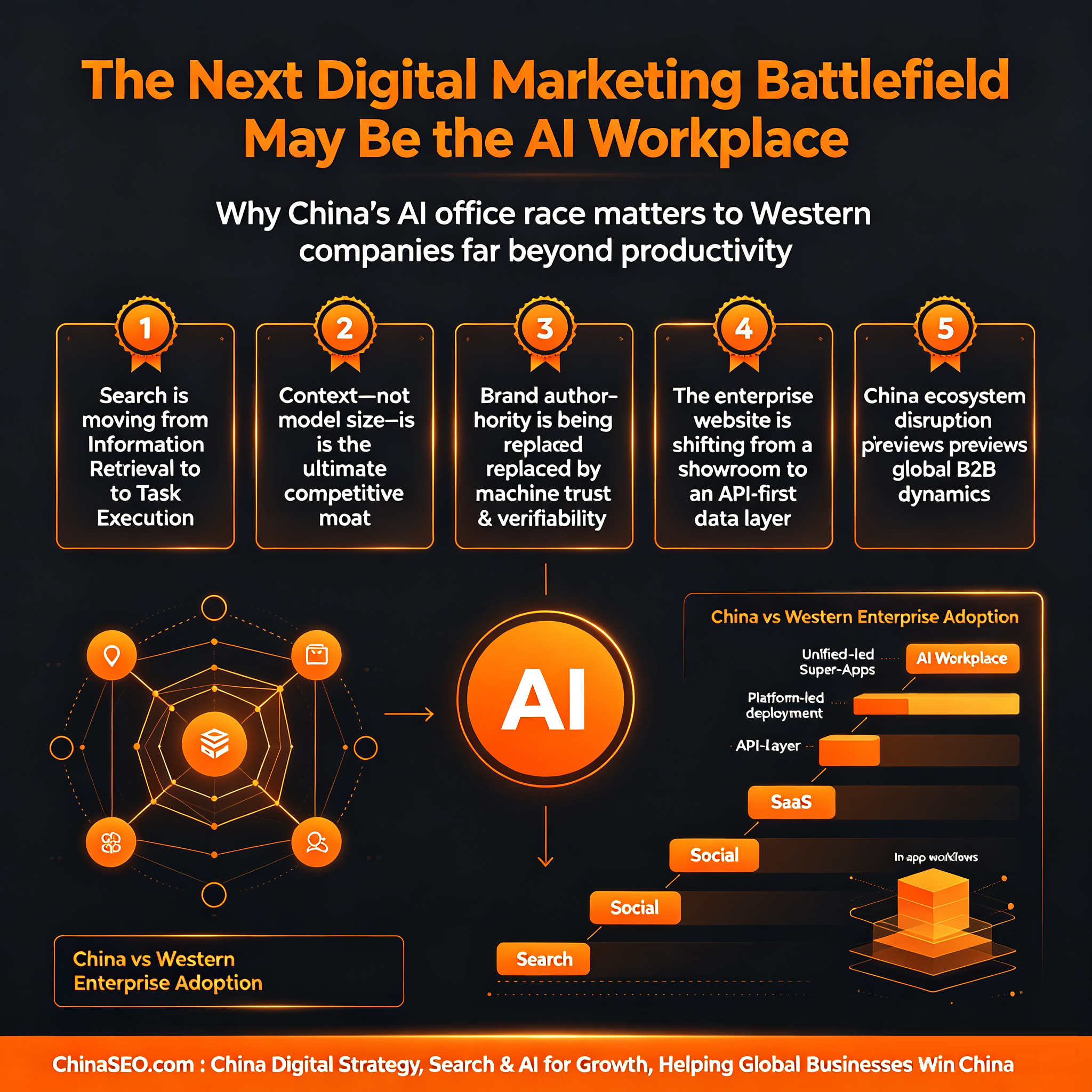
The fundamental assumption of digital marketing—that humans search, browse, compare, and click—is rapidly expiring.
While Western executives remain fixated on optimizing brand sites for human visitors or tweaking SEO strategies for conversational AI queries (GEO), a far more disruptive transformation is taking root in China. The next critical commercial interface between enterprises and customers will not be a search engine, a social feed, or a corporate homepage. It will be an enterprise AI agent embedded inside the buyer’s workplace.
When an AI agent handles product research, vendor screening, technical evaluation, and procurement execution directly within an enterprise workspace, traditional digital marketing ceases to function. If your next B2B customer never visits your website, ranking #1 on a search engine is irrelevant.
This is not a localized marketing shift; it is the birth of the world’s first machine-mediated B2B market. Global executives who treat China’s AI office race as a mere software battle are misdiagnosing the macro landscape. China is providing a clear, high-definition preview of how B2B commerce will be evaluated, trusted, and executed globally over the next decade.
1. The Catalyst: China’s AI Workplace Infrastructure Shift
Over the past quarter, China’s technology giants shifted from consumer-facing LLM wars to standardizing the AI Work Interface.
- Alibaba’s QwenWork Public Beta: Launched as a unified desktop and cloud agent ecosystem, QwenWork integrates directly into DingTalk (serving over 700 million users and 25 million enterprises). It transforms DingTalk from a collaboration tool into an autonomous task-execution engine.
- Tencent’s WorkBuddy Enterprise: Positioned across WeCom, Tencent Docs, and Tencent Meeting, WorkBuddy connects enterprise AI agents directly to organizational communication graphs and cross-company vendor channels.
- Baidu’s Enterprise Knowledge Layer: Baidu has pivoted its AI agent strategy toward indexing unstructured enterprise documents, technical blueprints, and internal file repositories to power workflow-level decision engines.
THE INTERFACE EVOLUTION
- Web Era: Search Engines | Information Retrieval (“Find me data”)
- Social Era: Networks & Feeds | Relationship Graph (“Connect me”)
- SaaS Era: Enterprise Apps | Business Process (“Digitize workflow”)
- Agent Era (NOW): AI Workplaces | Task Execution (“Do it for me”)
The key insight for global C-suites is structural: Alibaba, Tencent, and Baidu are not trying to build a better Microsoft 365 or Google Workspace. They are locking down control over the precise interface through which enterprise spending decisions occur.
2. Five Strategic Insights for the C-Suite
To navigate this environment, leadership teams must abandon legacy digital playbooks and grasp five structural realities of the machine-mediated economy:
Insight 1: Search is moving from Information Retrieval to Task Execution
Traditional search asked: “Who can tell me about industrial CNC machinery?” Agentic execution asks: “Find three European suppliers with local Chinese service centers, verify their ISO certifications and tolerance parameters against our engineering schematic, cross-reference their local customer references, and draft an RFQ.” When software moves from retrieving data to executing tasks, vendor visibility depends entirely on machine-digestibility rather than human persuasion.
Insight 2: Context—Not Model Size—Is the Ultimate Competitive Moat
An LLM without enterprise context is just a chat widget. The winners of the AI workplace ecosystem are those anchoring models to real-time work context:
- Tencent controls relationship context (who works with whom).
- Alibaba controls organizational & workflow context (who approves what budget).
- Baidu controls knowledge & document context (what technical specifications apply). Vendors whose data cannot seamlessly integrate into these contextual environments simply cease to exist to the buyer’s agent.
Insight 3: Brand Authority is Being Replaced by “Machine Trust & Verifiability”
Human buyers rely on glossy web design, trade show handshakes, and brand reputation. AI agents evaluate structured evidence: precise technical parameters, material compatibility matrices, API connectivity, verified third-party audit trails, and machine-readable customer case studies. Adjectives like “world-leading” or “industry-pioneering” act as dead noise to an evaluation agent.
Insight 4: The Enterprise Website is Shifting from a Showroom to an API-First Data Layer
For two decades, websites were built for human eyes. In the AI workplace era, the primary audience for corporate infrastructure is a machine reader. A company’s digital footprint must serve as an authoritative, machine-verifiable knowledge base capable of feeding structured payload data directly into a buyer’s agent.
Insight 5: China Ecosystem Disruption Previews Global B2B Dynamics
Because China’s enterprise landscape is hyper-digitized through super-apps (WeCom, DingTalk), agentic workplace integration is occurring at 3x the speed of Western markets. The agent-to-agent procurement patterns emerging in Shanghai and Shenzhen today will define how enterprise buying unfolds across North America and Europe as Microsoft Copilot, Salesforce Agentforce, and OpenAI Operator mature.
3. Structural Analysis: Why China is Accelerated
Why is this shift happening in China first, and why will it inevitably spill into global markets?
CHINA VS. WESTERN ENTERPRISE ADOPTION
| Dimension | Western Markets (US/EU) | China Ecosystem |
| Enterprise Stack | Fragmented SaaS (Salesforce,Workday, Slack, Hubspot) | Unified Super-Apps (DingTalk, WeCom) |
| Buyer Behavior | Email-driven, multi-tab web research, long sales cycles | In-app workflows, mobile chat procurement |
| Data Architecture | Siloed SQL/NoSQL databases, walled-garden CRMs | Highly integrated platform data graphs |
| Agent Adoption Speed | API-led, cautious enterprise rollout | Platform-led top-down mass deployment |
- Super-App Consolidation Reduces Friction: Unlike the West—where enterprise data is fragmented across dozens of disconnected SaaS tools—Chinese business communication, file sharing, approval workflows, and payments already happen inside unified platform wrappers (WeCom/Tencent, DingTalk/Alibaba). Deploying an agentic layer across an entire economy requires minimal integration overhead.
- Leapfrogging Legacy B2B Procurement: Chinese mid-market enterprises frequently skip traditional legacy ERP/procurement setups, moving straight to platform-native, AI-assisted workflows.
- The Global Ripple Effect: As multinational corporations operate inside China, their local procurement teams are adopting these agentic workflows out of necessity. Western B2B players like Siemens, Bosch, and Schneider Electric are already restructuring their China digital infrastructure to ensure their components remain discoverable to Chinese enterprise agents.
4. The 5-Stage Modern Digital Marketing Stack
The evolution of enterprise discoverability requires an immediate shift in how capital and talent are allocated across the marketing and IT functions:
- Stage 1: Search Visibility -> Search Engines (Google, Baidu) / “Be Found”
- Stage 2: AI Visibility -> Conversational LLMs / “Be Understood & Cited”
- Stage 3: Trust Infrastructure -> Certifications, Audit Data, Proof / “Be Trusted”
- Stage 4: Agent Readiness -> Machine Schema, APIs, Datasets / “Be Selectable”
- Stage 5: Workflow Execution -> Automated RFQs, CRM, ERP Sync / “Be Executable”
To survive Stage 4 and Stage 5, your marketing team can no longer act merely as content creators—they must act as knowledge architects.
5. Looking Ahead: The Next 3–5 Years
Over the next 3 to 5 years, B2B digital commerce will divide into two distinct classes of companies:
- The Invisible Brands: Companies that continue optimizing for human website visits, relying on traditional search engine rankings and subjective brand claims. They will wonder why inbound enterprise leads are evaporating as buyer agents filter them out during automated shortlisting.
- The Infrastructure-Integrated Brands: Companies whose product specifications, application data, compliance credentials, and commercial terms are exposed as structured, trusted data layers across AI workplace engines globally.
The race taking place across Tencent, Alibaba, and Baidu’s workplace platforms is not an isolated Chinese trend. It is the beta test for global B2B commerce. The central strategic question for your executive team is no longer “How do we get more customers to visit our site?”
It is: “When our customer’s AI agent does the work, will it choose us?”
 Unlock 2026's China Digital Marketing Mastery!