 English
 German
 Korea
Korea Spanish
How Western Companies Can Be Recommended by Chinese AI in the New Digital Era
- On July 24, 2026
- chinese geo, geo china
In the AI era, companies are no longer competing only for customers’ attention. They are competing for AI’s understanding, trust, and recommendation.
For decades, international brands entering China relied on a familiar playbook: build a local website, optimize for Baidu SEO, run PPC advertising campaigns, and establish a presence on WeChat or Weibo. But the ground beneath global marketers has fundamentally shifted.
Over 602 million people in mainland China—nearly 43% of the entire population—actively use generative AI applications for information retrieval, product discovery, and B2B vendor evaluation. As AI transforms from a novel chat widget into the primary discovery layer of Chinese digital life, global executives face a stark reality: if Chinese AI engines do not know who you are, your brand simply does not exist in China.
This article explores how China’s generative engine optimization (GEO) landscape operates, why conventional Western digital assets leave international companies invisible to domestic LLMs, and how global business leaders can build the infrastructure required to become AI-recommended.
Part 1: Digital Marketing is Undergoing a Fundamental Transformation
From Search Engine Optimization (SEO) to AI Recommendation Optimization (GEO)
To understand this shift, compare how a buyer evaluated vendors in the search engine era versus how they do so today.
The Traditional Search Era
A foreign procurement manager or Chinese enterprise client searched for a specific keyword on Baidu or Google:
Query: "precision machining supplier China"The buyer reviewed a page of ten blue links, clicked through three or four corporate websites, filled out inquiry forms, and waited for sales follow-ups.
In that environment, brand competition revolved around three tactical levers:
- Search Engine Optimization (SEO): Fighting for top keyword rankings.
- Ad Budgets: Buying sponsored banner and search ads.
- Cost-per-Click (CPC): Bidding aggressively on high-intent terms.
The AI Search Era
Today, decision-makers—whether a B2B buyer sourcing high-end industrial components or a consumer evaluating foreign luxury brands—phrase their intent as a natural, conversational question:
“Which European precision machining suppliers in China have verified ISO 13485 medical certifications, localized technical support in East China, and a proven track record in automotive component manufacturing?”
Instead of delivering a page of blue links, Chinese AI platforms process millions of parameters in real time and return a synthesized response:
- A shortlisted selection of 3 to 4 recommended companies.
- A side-by-side comparative analysis of technical strengths and certifications.
- Direct rationale explaining why each brand was chosen.
- Actionable contact channels or verified platform links.
In over 60% of these interactions, the user never opens a single corporate website. They make their shortlist directly from the AI’s synthesized output.
Core Insight: In the traditional search era, being found was enough. In the AI era, being recommended becomes the new competitive advantage.
Part 2: China Is Building Its Own AI Discovery Ecosystem
When Western marketing executives think of AI search, they usually think of ChatGPT, Google Gemini, or Perplexity. However, China’s AI landscape operates within a completely distinct ecosystem powered by domestic tech giants and breakout model labs.
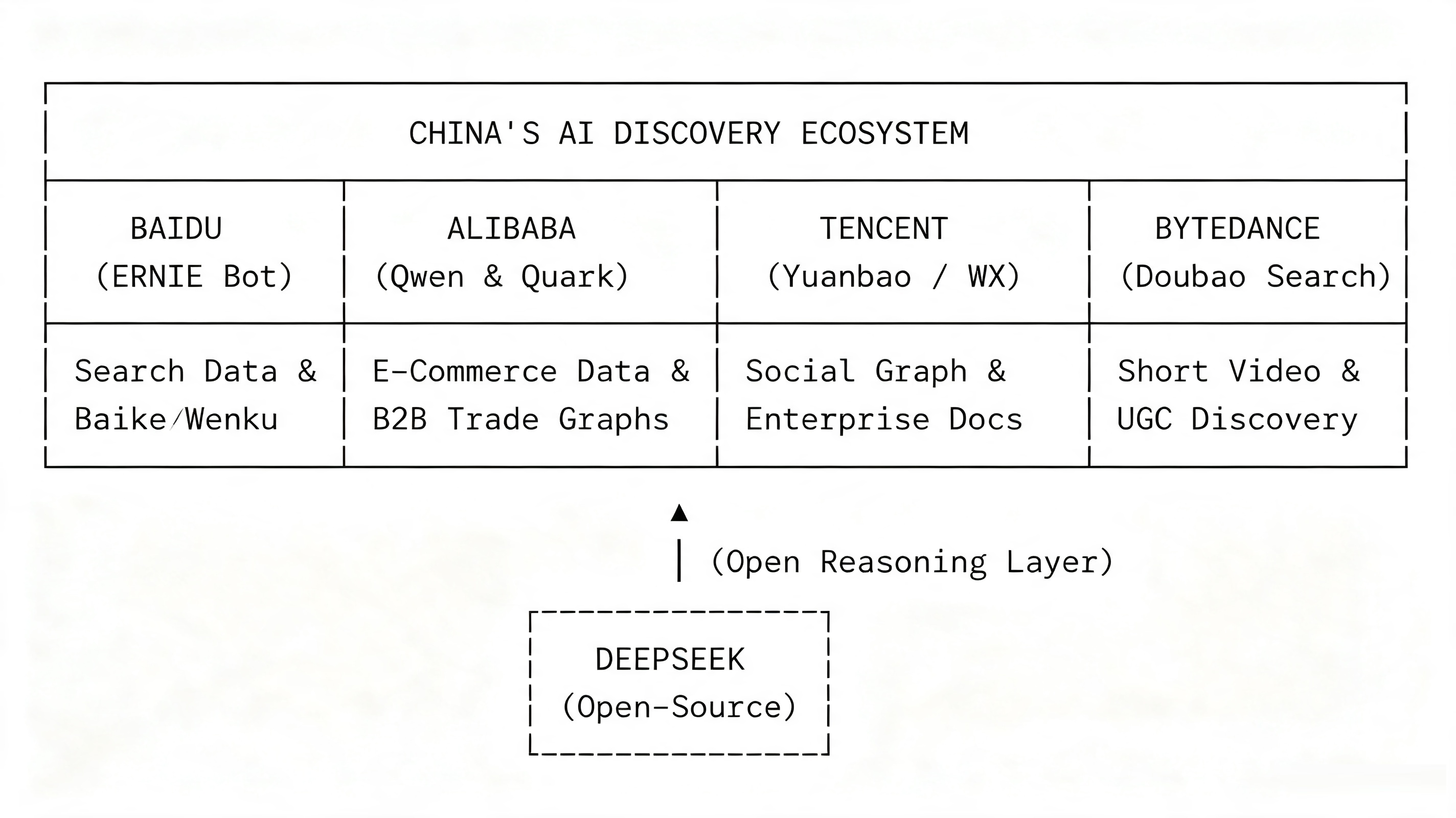
Understanding China’s AI ecosystem requires looking beyond individual software applications to examine how data flows between search, social platforms, e-commerce networks, and AI reasoning models.
1. Baidu (ERNIE Series)
Baidu’s ERNIE Bot (Wenxin Yiyan) serves over 220 million monthly active users and is deeply embedded in enterprise, cloud, and government ecosystems. Baidu relies heavily on its proprietary knowledge assets—such as Baidu Baike (encyclopedia) and Baidu Wenku (document repository)—to train and ground ERNIE’s factual responses.
2. Alibaba Group (Qwen & Quark)
Alibaba’s Qwen model family powers Quark AI Search, which has grown to over 180 million monthly active users, particularly among knowledge workers, researchers, and young professionals. Qwen excels at parsing complex technical queries, product specifications, and commercial supply-chain data across B2B and B2C commerce networks.
3. Tencent (Hunyuan & Yuanbao)
Tencent’s Yuanbao connects directly to the vast WeChat ecosystem. Unlike global AI engines that cannot crawl private WeChat Official Accounts or Channels, Yuanbao accesses WeChat’s rich repository of long-form corporate articles, industry whitepapers, and brand mini-programs.
4. ByteDance (Doubao)
ByteDance’s Doubao has emerged as one of the most widely used consumer AI assistants in China, topping 260 million monthly active users. Doubao connects closely with consumer trends, short-video transcripts, and user-generated content from Douyin.
5. DeepSeek (Open-Source Pioneer)
DeepSeek shocked global markets by demonstrating world-class reasoning at a fraction of typical training costs. In China, DeepSeek operates with high developer and enterprise adoption. Because DeepSeek relies primarily on open web retrieval rather than an in-house consumer app ecosystem, its recommendations lean heavily on publicly indexed, highly cited technical documents across the Chinese web.
Key Takeaway for Foreign Brands
Information retrieval in China is no longer controlled by a single search box. It is driven by a hybrid ecosystem where Search + Social + E-Commerce + AI Assistants work in tandem. If your brand data is missing from these domestic digital hubs, local AI engines will simply bypass you in favor of domestic competitors.
Part 3: The Invisible Problem: Your Company May Not Exist in China’s AI Knowledge Layer
When global CEOs ask why their brand isn’t appearing in Chinese AI search results, they often point to their strong Western digital presence: “Our English website ranks on page one of Google, and we have dozens of whitepapers online.”
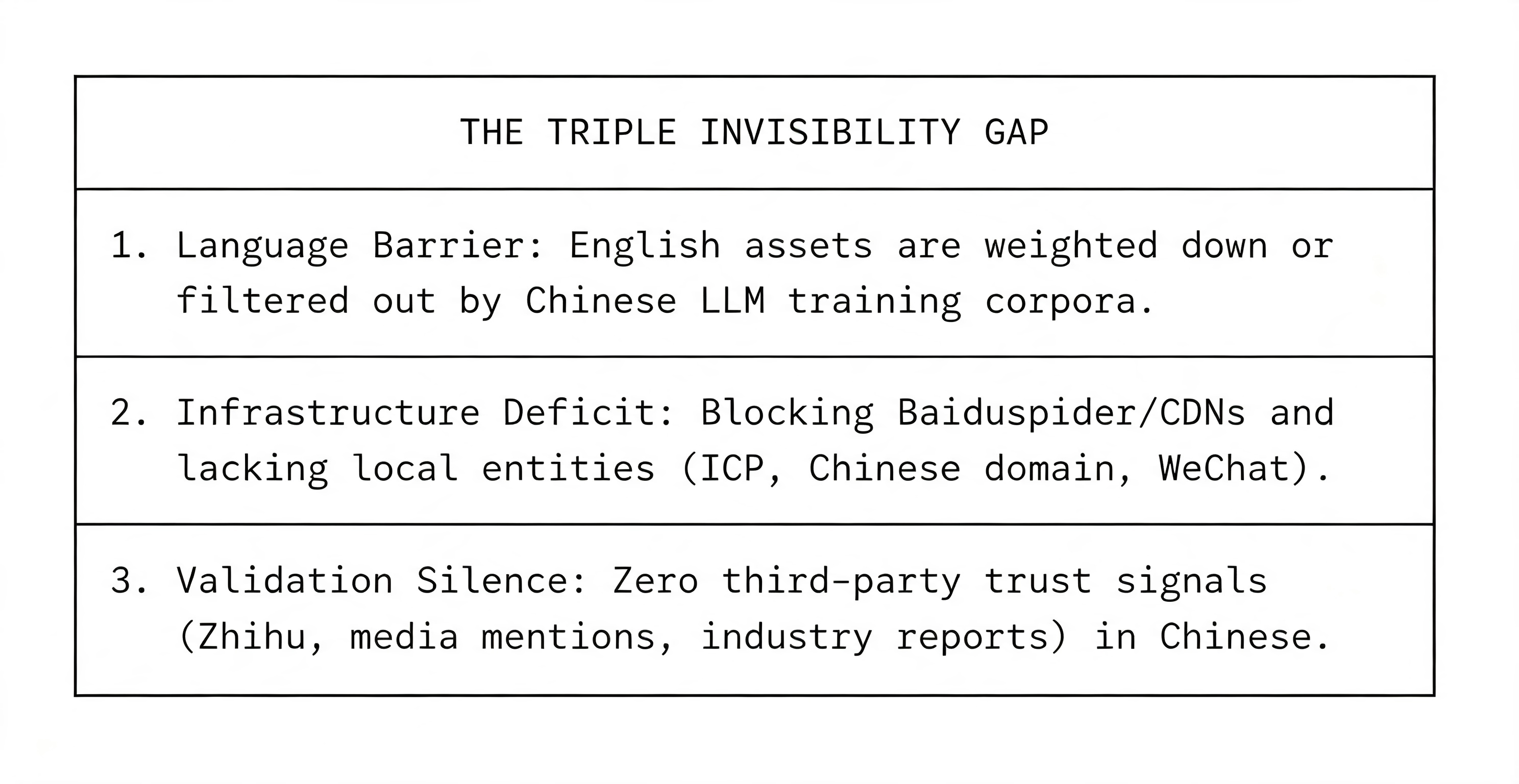
Unfortunately, global authority rarely translates to visibility inside Chinese LLMs. International companies typically suffer from three fundamental structural gaps that render them invisible within China’s AI knowledge layer.
1. The Linguistic and Semantic Disconnect
Chinese AI models prioritize simplified Chinese text over foreign language sources when answering localized queries. When a Chinese AI processes a question about industrial equipment or B2B software, it crawls and retrieves passages from Chinese-language vector databases.
If your corporate case studies, product spec sheets, and technical brochures exist only in English—or in direct machine translations that lack local industry terminology—Chinese LLMs fail to match your content to the semantic intent of local queries.
2. Missing Chinese Digital Assets
Most Chinese AI engines index content from specific, high-authority domestic platforms rather than sweeping the international web. If a company lacks:
- An ICP-licensed, fast-loading Chinese website hosted on local CDN nodes.
- Indexable content verified on Baidu Baike or Baidu Wenku.
- An active WeChat Official Account publishing structured technical articles.
- Authoritative Q&A threads on Zhihu.
…then the AI’s retrieval-augmented generation (RAG) system finds zero structured nodes for your brand. To the model, your corporate entity simply does not exist.
3. Lack of Third-Party Validation Signals
AI models are trained to avoid relying solely on a brand’s self-published marketing claims. When evaluating whether a vendor is “reliable” or “leading,” an LLM scans the web for cross-referencing signals:
- Are there independent trade journalists writing about this company?
- Do industry associations list them in whitepapers?
- Are domestic engineers or users discussing their performance on Zhihu or industry forums?
If a Western enterprise has no third-party digital footprint across Chinese media, the AI treats the brand as unverified and substitutes a domestic competitor that possesses rich third-party citation signals.
Part 4: How AI Evaluates Business Credibility: The AI Trust Pyramid
To systematically solve the invisibility problem, businesses must understand how an AI model determines whether a company deserves a spot in its answer shortlist.
We can frame this process through the AI Trust Pyramid, a framework that maps directly to AI retrieval and evaluation mechanics.
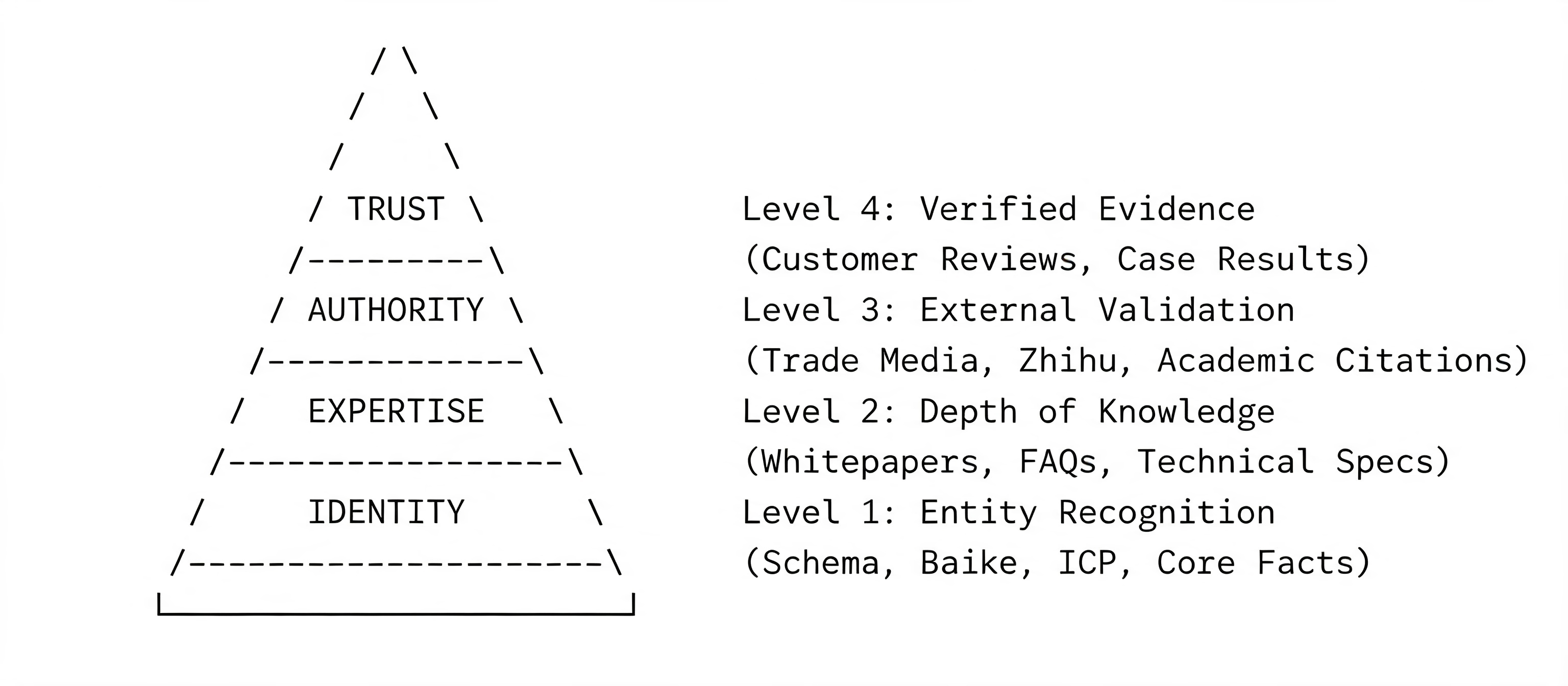
| Pyramid Level | Core Question Answered | Primary Data Sources in China | Marketing Equivalent |
|---|---|---|---|
| Level 1: Identity | Who is this company, what do they make, and where do they operate? | Baidu Baike, Structured Schema Markup, Official Website, Enterprise Registrations. | Basic Entity Registration |
| Level 2: Expertise | Does this company possess deep technical know-how in its domain? | In-depth technical articles, FAQ banks, localized whitepapers, WeChat long-form content. | EEAT (Experience & Expertise) |
| Level 3: Authority | Do independent industry players validate this company’s standing? | Trade media publications, Zhihu expert columns, industrial portals, government or association listings. | Third-Party Citations |
| Level 4: Trust | What are the real-world results and customer feedback for this vendor? | Real client case studies with quantifiable metrics, B2B user reviews, forum discussions. | Verified Social Proof |
When a Chinese LLM receives a query, it works upward through this pyramid. It first confirms entity Identity. It then scans for passage-level Expertise to answer specific technical parameters. Next, it verifies Authority across external databases to ensure the brand isn’t making false claims. Finally, it factors in Trust signals to select the top 3 recommended solutions.
Part 5: Building “AI-Readable Digital Assets” for the China Market
Securing AI recommendations requires building an AI Visibility Infrastructure—a structured digital footprint designed specifically for AI extraction and indexation.
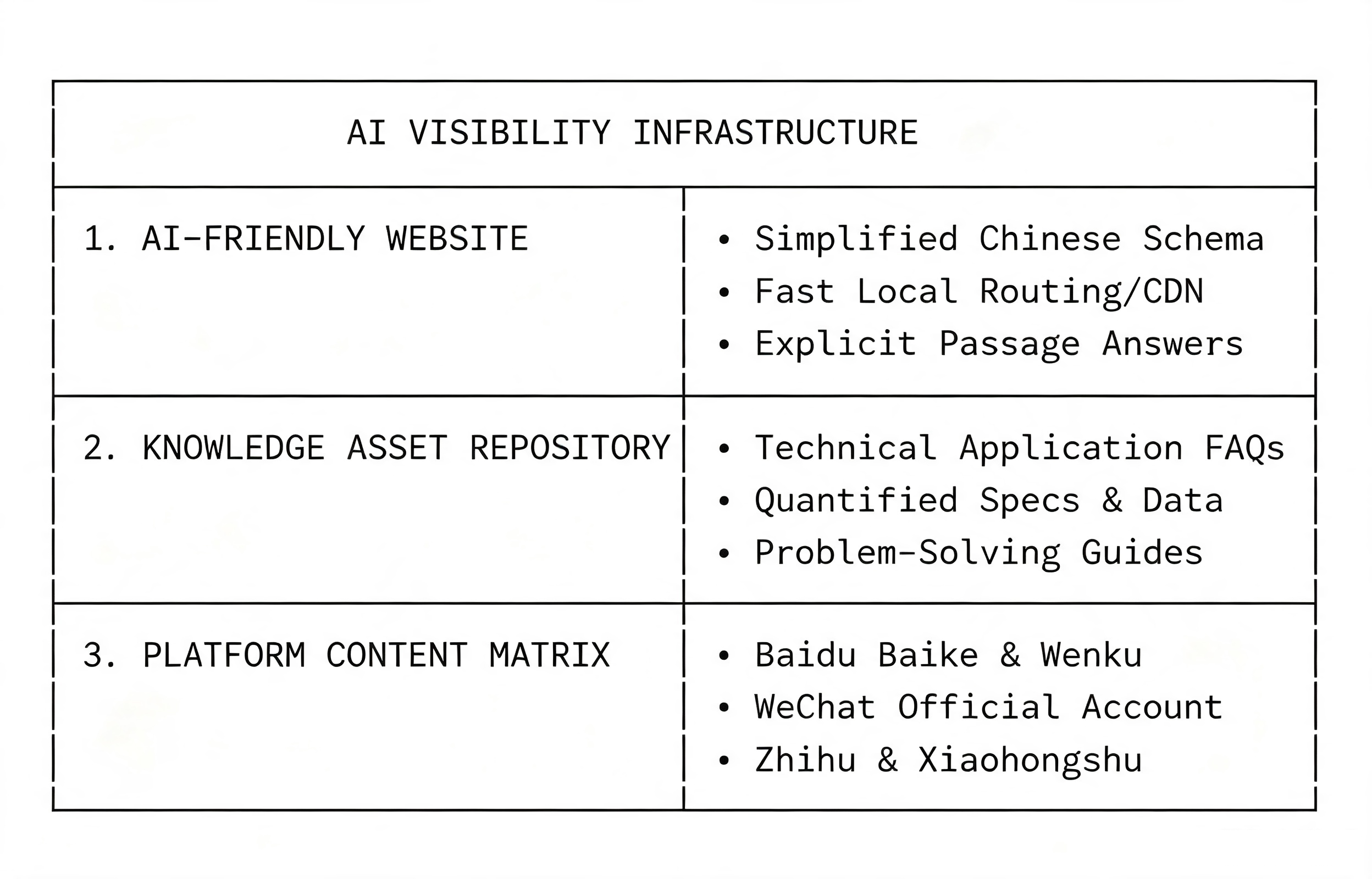
1. Construct an AI-Friendly Local Website
Translating an existing Western website word-for-word is not enough. An AI-optimized Chinese web presence requires explicit engineering:
- Explicit Passage Structuring: AI engines extract passage-level answers rather than summarizing full pages. Place immediate, 2-to-3-sentence direct answers immediately below section headings.
- Clear Heading Hierarchy: Keep headings clear, descriptive, and framed around specific questions.
- Unblock Chinese Spiders: Ensure CDN firewalls and security rules explicitly allow
Baiduspider,Bytespider, andSogouspiderto crawl without latency.
2. Develop a Comprehensive Knowledge Asset Repository
AI models thrive on detailed knowledge assets rather than generic promotional language. Replace vague claims like “We are a global leader in precision components” with factual, structured knowledge:
- How do high-temperature alloy bearings perform under continuous 800°C environments?
- What are the specific ISO compliance standards required for importing foreign medical equipment into China?
- What is the step-by-step installation protocol for industrial filtration systems in semiconductor cleanrooms?
When your digital channels provide explicit, data-backed solutions to complex operational questions, LLMs pull those passages directly into generated responses.
3. Deploy a Multi-Platform Content Matrix
Because Chinese AI models draw heavily from walled-garden ecosystems, brands must maintain structured content across key domestic hubs:
- Baidu (Baike & Wenku): The baseline anchor for brand identity and whitepaper documentation.
- WeChat (Official Accounts & Search): Long-form technical articles, corporate announcements, and localized product breakdown guides.
- Zhihu (Q&A & Expert Columns): Detailed technical discussions that build domain authority and generate citation nodes for models like DeepSeek and Qwen.
- Xiaohongshu (RED) & Douyin: Visual proof, product usage demonstrations, and user feedback that enrich multimodal AI recommendations.
Part 6: From Creating Content for Humans to Creating Knowledge for Humans and AI
Traditional content marketing focused on writing catching headlines to maximize human click-through rates. In the GEO era, marketers must build content that satisfies both human decision-makers and AI extraction algorithms.
The most effective way to execute this shift is by building a centralized AI Question Database.
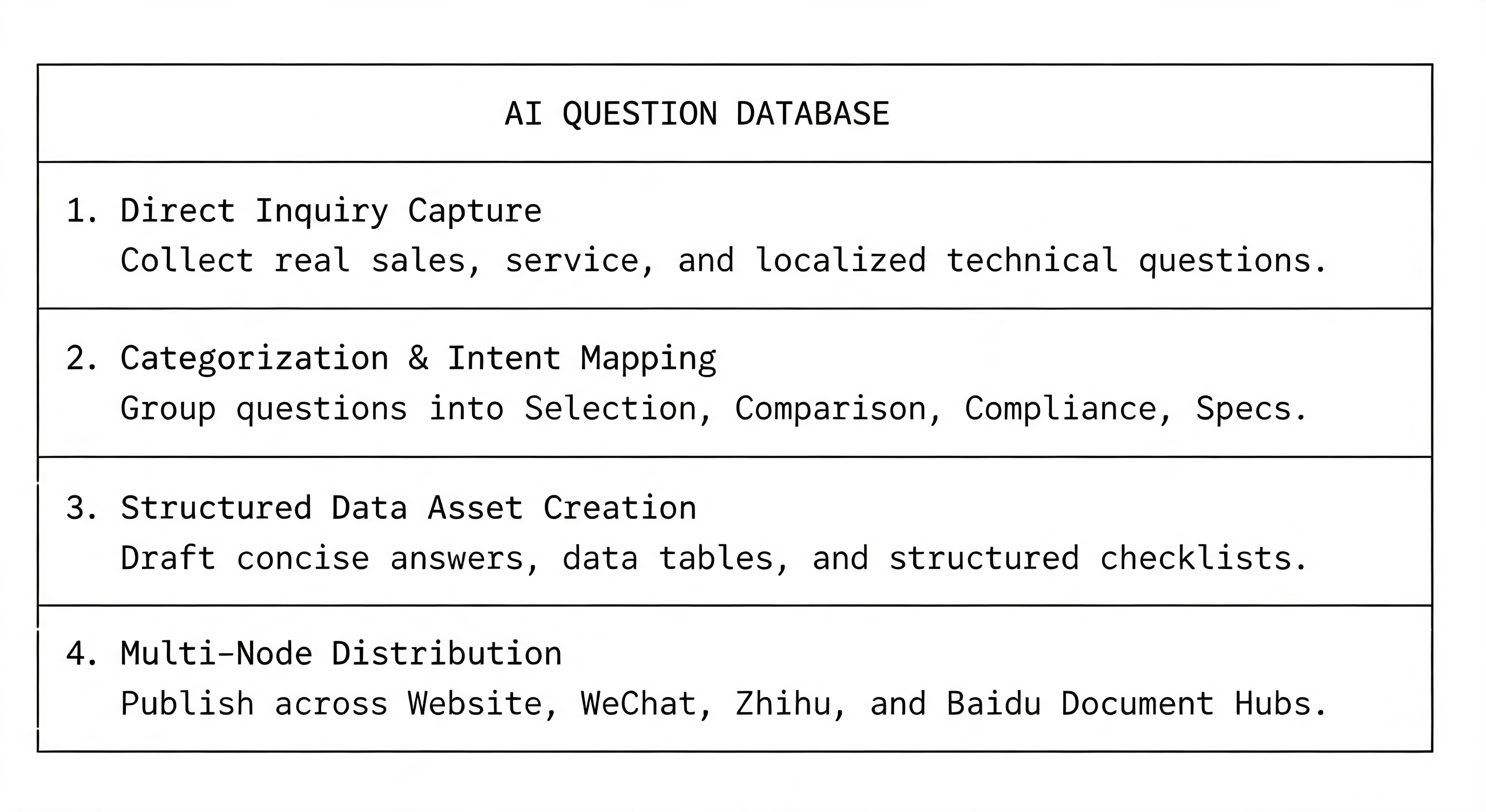
How to Build an AI Question Database
- Gather Real Commercial Enquiries: Interview your local sales teams, technical support engineers, and distributor networks in China. Identify the precise technical, financial, and logistical questions prospects ask during sales calls.
- Formulate Interrogative Content Headers: Structure articles using natural, interrogative titles that mirror how users query AI models:
- “How should European automation brands adapt PLC protocols for Chinese factory lines?”
- “What are the key tax and regulatory considerations for Swiss medical device suppliers entering China?”
- Embed Pre-Formatted Data Tables: AI engines frequently extract tabular data because it requires zero structural reformatting. Include comparison tables covering technical specifications, pricing models, and compliance certifications.
Part 7: A Practical Roadmap: Becoming AI-Recommended in China
Transforming a foreign enterprise from invisible to AI-recommended requires a structured, multi-phase execution plan.
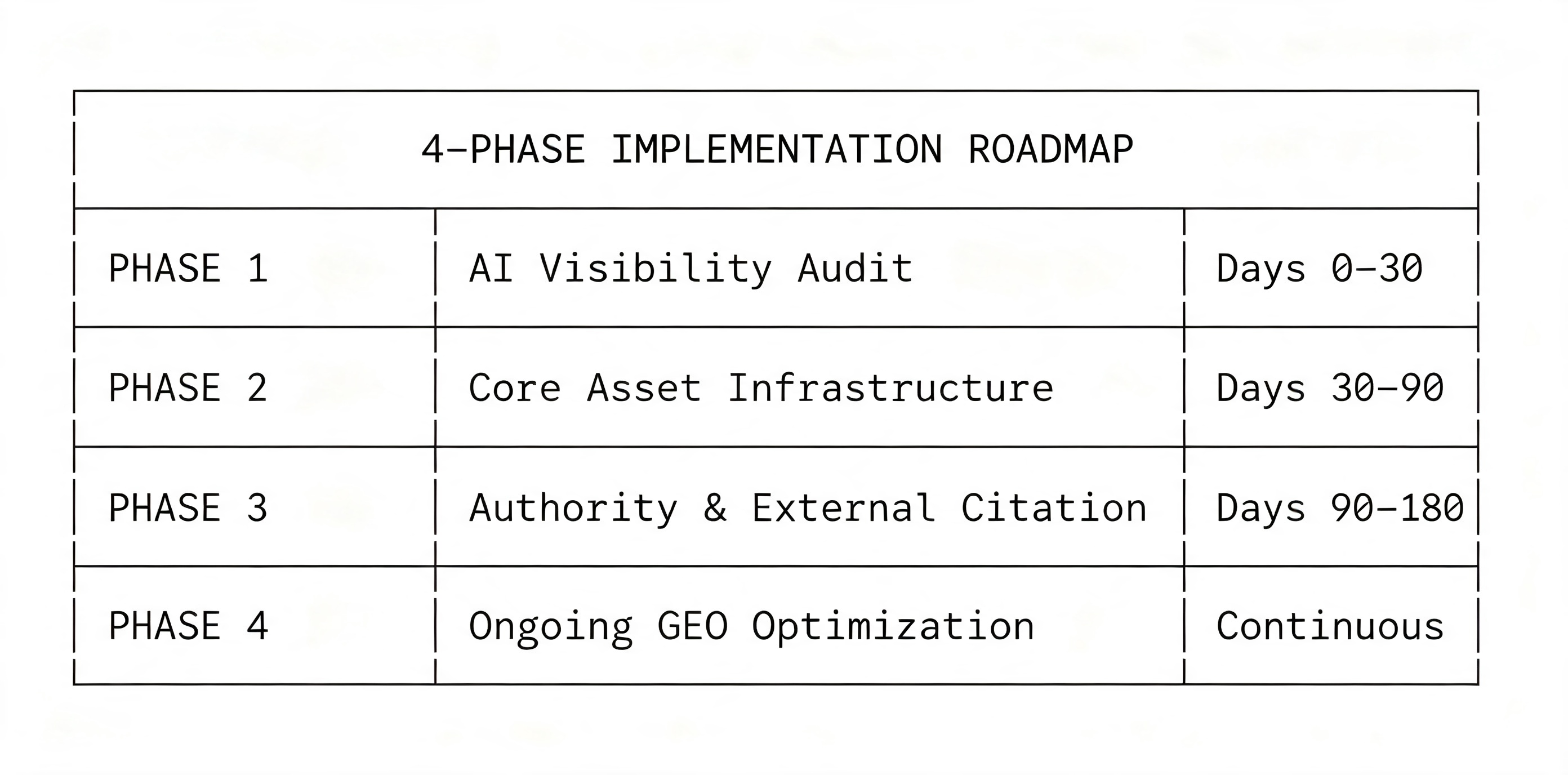
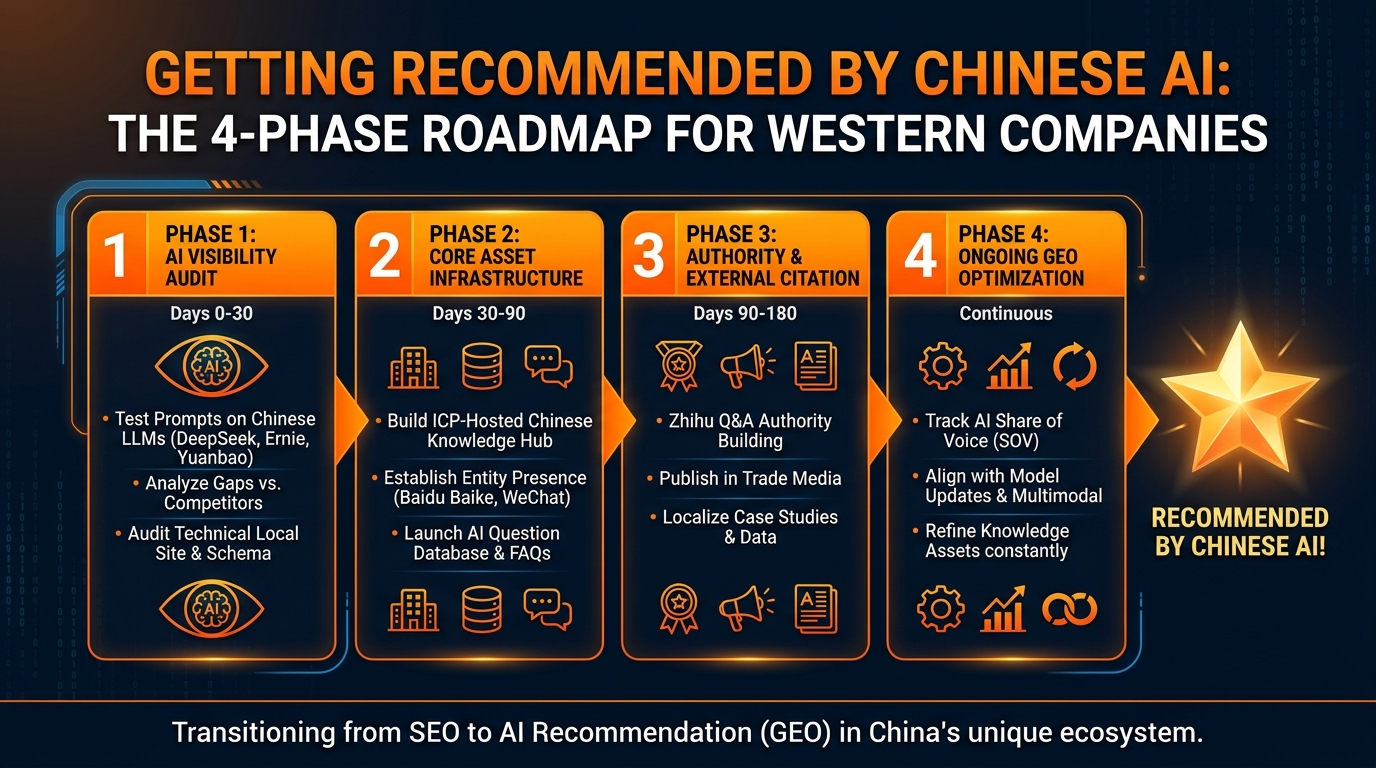
Phase 1: AI Visibility Audit (Days 0–30)
- Prompt Testing: Test 20 to 30 core commercial prompts across China’s leading AI engines: DeepSeek, Baidu ERNIE, Tencent Yuanbao, Alibaba Quark, and ByteDance Doubao.
- Gap Analysis: Track whether your brand appears in generated shortlists, how your products are described, and which competitors are cited instead.
- Technical Check: Audit your local website for crawler accessibility, page load speeds in mainland China, and Schema markup implementation.
Phase 2: Core Asset Infrastructure (Days 30–90)
- Localized Knowledge Base: Build an ICP-hosted Chinese knowledge hub optimized for AI indexing.
- Essential Entity Assets: Create or update your brand’s Baidu Baike entry and establish an official WeChat corporate channel.
- Deploy AI Question Database: Draft and publish 20+ structured technical FAQ articles addressing high-intent buyer queries.
Phase 3: Authority & External Citation (Days 90–180)
- Zhihu Authority Building: Launch targeted Q&A initiatives on Zhihu to create authoritative, highly citeable technical discussions.
- Trade Media Distribution: Publish technical whitepapers and executive insights across respected Chinese industrial and B2B media outlets.
- Case Study Localization: Publish detailed client case studies featuring concrete data points, ROI metrics, and verified application scenarios.
Phase 4: Ongoing GEO Optimization (Continuous)
- AI Share of Voice (SOV) Tracking: Monitor your brand’s citation frequency, sentiment, and context across major AI models on a monthly basis.
- Model Update Alignment: Adjust content structures as Chinese LLMs release updated multimodal features and real-time retrieval mechanisms.
- Feedback Integration: Refine your knowledge assets based on new customer questions and evolving industry trends.
Conclusion: The New Competitive Landscape
After 28 years working inside China’s digital marketing ecosystem, I have watched three major waves transform how companies win in this market:
- The Search Era: Companies competed for keyword rankings on search engines.
- The Social Era: Companies competed for user attention on WeChat, Douyin, and Xiaohongshu.
- The AI Era: Companies now compete for AI recognition, trust, and recommendation.
The companies that recognize this shift early will not simply capture more organic traffic. They will become the definitive solutions that Chinese AI platforms trust, cite, and recommend whenever local customers ask for guidance.
 Unlock 2026's China Digital Marketing Mastery!