 English
 German
 Korea
Korea Spanish
The AI War Between America and China: How Global Businesses Must Rethink Digital Marketing Before It’s Too Late
- On July 23, 2026
- ai marketing strategy
The AI Race Is Not About Technology — It Is About Who Controls Business Decisions
For the past two decades, global digital marketing operated under a unified consensus: search engines like Google and Baidu indexed the internet, while social media networks like Meta, WeChat, and TikTok captured consumer attention. Brands competed for high-ranking keyword positions, ran targeted ad campaigns, and drove traffic back to their corporate websites.
That consensus is officially over.
The geopolitical and technological race between the United States and China is often framed in Western media as a battle over silicon, parameters, and semiconductor chips. But for executive leadership and brand strategists, the true AI war is happening at a much more immediate level: the battle over who controls the primary interface of commercial decision-making.
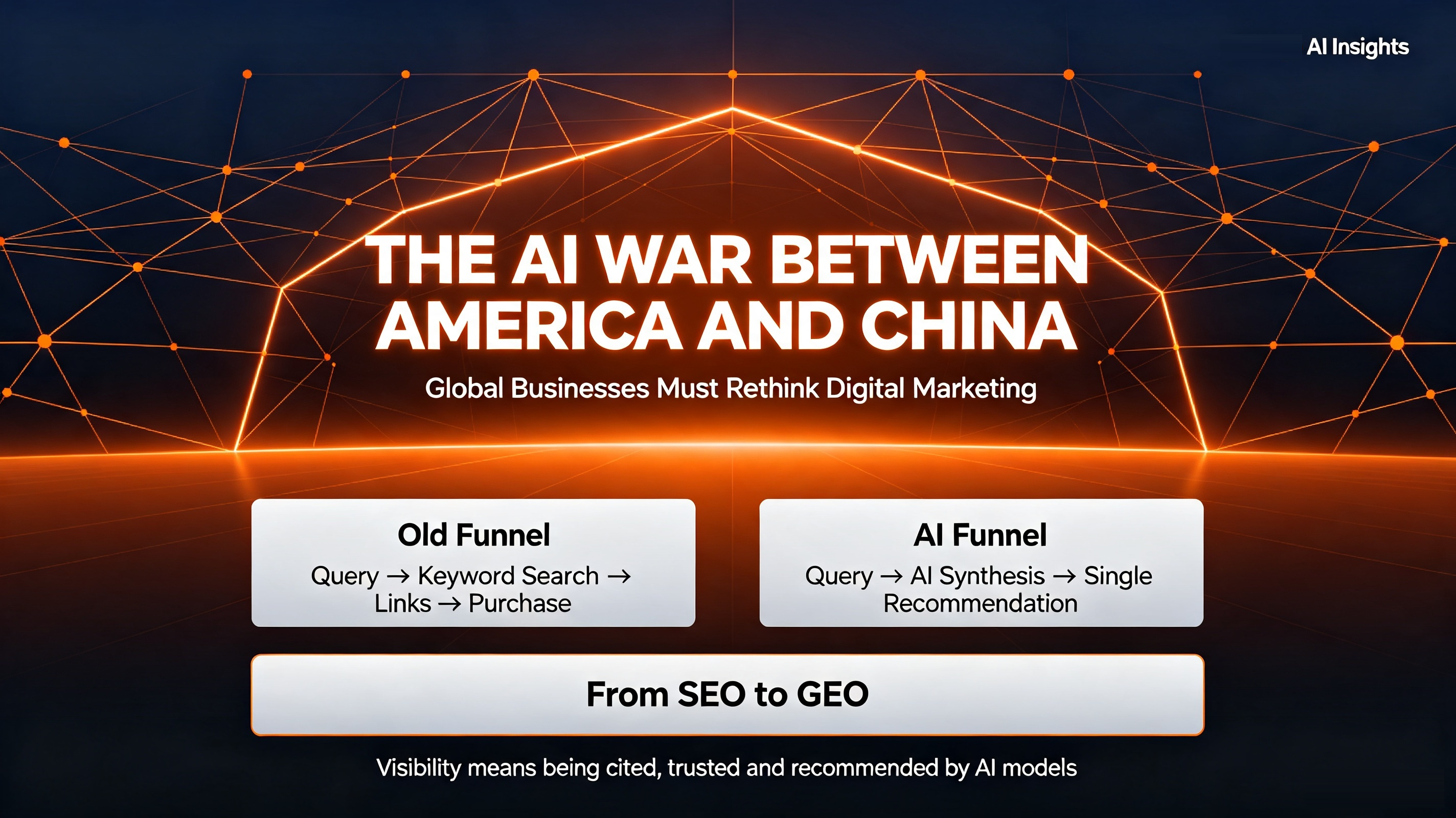
AI is no longer merely a productivity tool for generating copy or editing images; it is becoming the central decision-making layer between buyers and businesses. When prospective clients—whether a B2B buyer searching for high-precision manufacturing equipment or a consumer choosing a luxury travel destination—ask an AI assistant for recommendations, the AI does not return ten blue links. It synthesizes data, evaluates options, and delivers a single, authoritative recommendation.
If your brand is not synthesized, cited, and recommended by those models, your business simply ceases to exist in the mind of the customer.
1, Beyond Chatbots: Why AI Will Redefine Global Business Competition
To understand why traditional digital marketing strategies are failing, business leaders must recognize three fundamental structural shifts occurring across global markets:
- Traditional Search Funnel:
Query -> Keyword Search -> List of Links -> Manual Evaluation -> Purchase - AI Synthesis Funnel:
Query -> Multimodal Prompt -> AI Synthesis & Evaluation -> Single Recommended Answer
a. AI Is an Architecture, Not an Upgrade
Viewing generative AI as a faster content creation tool is a fatal strategic mistake. Generative AI is replacing the browser URL and search box as the primary commercial portal. AI engines operate as cognitive gatekeepers, filtering out noise and deciding which corporate entities possess true market authority.
b. The Complete Disruption of the Consumer Decision Path
The historical funnel—Awareness → Consideration → Decision—relied heavily on user exploration across multiple web touchpoints. Today, AI agents condense this process into a single conversational prompt.
- Zero-click searches now exceed 69% to 77% across major search engines.
- Over 44% of AI search users cite generative AI as their primary product discovery channel, outpacing traditional search engines (31%) and review sites (6%).
c. From Traffic Acquisition to Cognitive Gateway Rights
In the Web 2.0 era, victory meant capturing traffic volume (clicks and visits). In the AI era, victory means securing recommendation rights within the Large Language Model’s synthesized answer. If an AI engine does not include your company in its synthesized response, no amount of traditional ad spend can buy back that lost customer interaction.
2, US vs. China AI: Two Different Paths Toward the Future
Global enterprises face a dual-front challenge because the AI landscapes in the US and China have diverged into two distinct operational paradigms. Companies operating internationally must master both.
THE GREAT AI DIVIDE
| UNITED STATES PARADIGM | CHINESE MARKET PARADIGM |
Frontier Intelligence & Capital
|
Mass Adoption & Super-App Systems
|
| Dimension | United States: Frontier Intelligence | China: Mass Adoption & Ecosystem Integration |
| Core Philosophy | Scaling raw intelligence, massive parameters, and centralized compute. | Rapid commercialization, ultra-low-cost inference, and real-economy deployment. |
| Key Players | OpenAI (ChatGPT), Google (Gemini), Anthropic (Claude), Perplexity. | DeepSeek, Baidu (ERNIE), Alibaba (Qwen), Tencent (Hunyuan), ByteDance (Doubao). |
| Infrastructure Focus | Capital expenditure exceeding $400B–$800B in data center compute. | High-efficiency localized models embedded directly into existing Super-App workflows. |
| Search & Discovery Layer | Open-web crawlers, standalone AI search engines, browser integrations. | In-app AI agents inside WeChat, Xiaohongshu (RED), Douyin, and Baidu’s AI search portal. |
Why Western Companies Misunderstand the Chinese AI Ecosystem
Western executives often assume that optimizing for AI search means targeting Google AI Overviews, Perplexity, or ChatGPT. In China, however, the open web accounts for a fraction of user discovery.
Chinese consumers and business decision-makers interact with AI through tightly integrated, closed ecosystems:
- WeChat’s Search & AI ecosystem crawls verified Official Accounts and channels within its walled garden.
- Xiaohongshu (Little Red Book) functions as an AI-enhanced lifestyle and product research engine powered by user-generated visual sentiment.
- DeepSeek and Baidu ERNIE draw heavily on verified, localized business databases, industrial registries, and structured Chinese-language domain platforms.
Strategic Implication: A Western enterprise attempting to reach Chinese or Asian B2B buyers using standard Western digital PR and website SEO will remain completely invisible to Chinese AI recommendation engines.
3, The New Battle for Customers: From Search Ranking to AI Recommendation
The transition from Search Engine Optimization (SEO) to Generative Engine Optimization (GEO) represents a fundamental strategic shift in how digital information is parsed, evaluated, and presented.
| Traditional SEO Framework | Generative Engine Optimization |
|
|
From Keywords to Entity Authority
Traditional SEO relied on keyword density and backlink quantities. Generative engines do not rank pages; they map entities (companies, products, concepts) and their relationships. When a prompt is issued, the AI breaks the query into multiple sub-queries (fan-out queries), searches its internal knowledge graph and index, and synthesizes answers from verified sources.
How AI Citation Works Across Markets
- Verifiable Sources Win: According to media and marketing analysis, 82% of AI citations come from earned authority media and structured technical documentation, while only 6% come from pure paid ad copy.
- Multi-Prompt Presence: Being cited once is insufficient. Brands must ensure consistent entity attribution whether an AI agent is prompted in English on ChatGPT or in Mandarin on DeepSeek or Baidu ERNIE.
4, The Death of Traditional Content Marketing
For the past decade, corporate marketing teams produced vast volumes of keyword-stuffed blog posts, generic press releases, and superficial eBook landing pages. In the AI era, this strategy is dead.
Why Generic Content Value Has Collapsed
- Search Traffic Decline: Major publishers and brand blogs have seen organic search traffic fall by 30% to 50% as AI answers directly address consumer queries on the search page.
- LLM Filtering: Large Language Models are specifically trained to filter out generic fluff, circular arguments, and unverified marketing fluff.
What Replaces It: AI-Readable Authority Content
To remain visible, businesses must transition from “content production” to building structured knowledge assets:
AI-READABLE AUTHORITY ARCHITECTURE
JSON-LD & Schema Markup -> Direct parsing by AI Web Crawlers
llm.txt & Structured Docs -> Explicit machine-readable context
Original Research Data -> Primary source for LLM citations
Verified Industry E-E-A-T -> Uncontested entity authority ranking
- Machine-Parsable Code & Schemata: Plain HTML and JavaScript-heavy pages suffer high failure rates when scraped by AI bots. Sites utilizing clean JSON-LD, Schema.org markup, and explicit
llm.txtfiles experience up to a 34% increase in AI citation coverage. - Primary Data & Original Whitepapers: LLMs prioritize primary sources that supply verifiable statistics, proprietary research, and clear tabular data.
5, The New Digital Marketing Stack in the AI Era
To maintain market leadership across both Western and Asian markets, modern marketing departments must restructure their core operational capabilities around four essential pillars:
THE AI-ERA MARKETING STACK
- AI visibility tracking
- knowledge assets
- expert authority
- multi-platform presence
a. AI Visibility Analytics
Moving beyond keyword rank tracking. Companies must continuously monitor prompt coverage across leading platforms: ChatGPT, Gemini, Perplexity, DeepSeek, Baidu ERNIE, and Qwen. Key metrics include:
- Citation Share of Voice: How often your brand is cited compared to key competitors for core industry prompts.
- Sentiment & Sentiment Accuracy: How accurately the AI represents your technical capabilities and pricing model.
b. Structured Knowledge Assets
Converting raw whitepapers, technical datasheets, and client case studies into clear, structured formats optimized for AI context windows.
c. Verified Expert Authority (E-E-A-T)
Building real-world credibility through peer-reviewed articles, industry awards, trade association partnerships, and verified executive commentary. AI engines rely on these signals to assess domain authority.
d. Cross-Ecosystem Alignment
Maintaining consistent, translated, and localized entity definitions across both the open-web platforms of the West and the walled-garden platforms of China.
Conclusion: The Winners of the AI Era Will Be Those Who Become Visible and Trusted Through AI
The broader technological race between the US and China will continue to evolve across hardware labs and data centers. But for commercial enterprises, the battle is already underway right now on the user’s screen.
Over the next decade, the single biggest impact of artificial intelligence on business will not be who built the model with the most parameters. It will be who successfully redefines how customers discover, evaluate, and trust products.
The greatest strategic mistake a global business can make today is not failing to build its own AI tools. The greatest strategic mistake is attempting to market a modern business using Web 2.0 digital tactics.
Winning in the AI era requires moving beyond the fight for clicks and traffic. Businesses must construct the authority, structure, and market trust necessary to become the uncontested, recommended answer across every AI platform in the world.
 Unlock 2026's China Digital Marketing Mastery!