 English
 German
 Korea
Korea Spanish
The Death of Brand? Or the Biggest Brand Transformation in 100 Years?
- On July 22, 2026
- ai brand marketing, brand marketing
AI Didn’t Kill Brands. Platforms Didn’t Kill Brands. They Changed What Brands Are For.
For decades, marketing directors and C-suite executives operated under a comfortable consensus: build a compelling brand story, purchase broadcast frequency, secure shelf space, and collect a premium margin.
Today, that consensus is collapsing.
Headlines across Western trade media regularly warn of consumer cynicism, digital ad fatigue, and the commoditization of DTC (Direct-to-Consumer) darlings. Many observers look at this landscape and declare “the death of the brand.”
They are asking the wrong question.
Brands are not dying. What is dying is a specific, century-old definition of what a brand actually does.
The core thesis governing the modern market is straightforward: Every technological revolution destroys one layer of brand value while creating another.
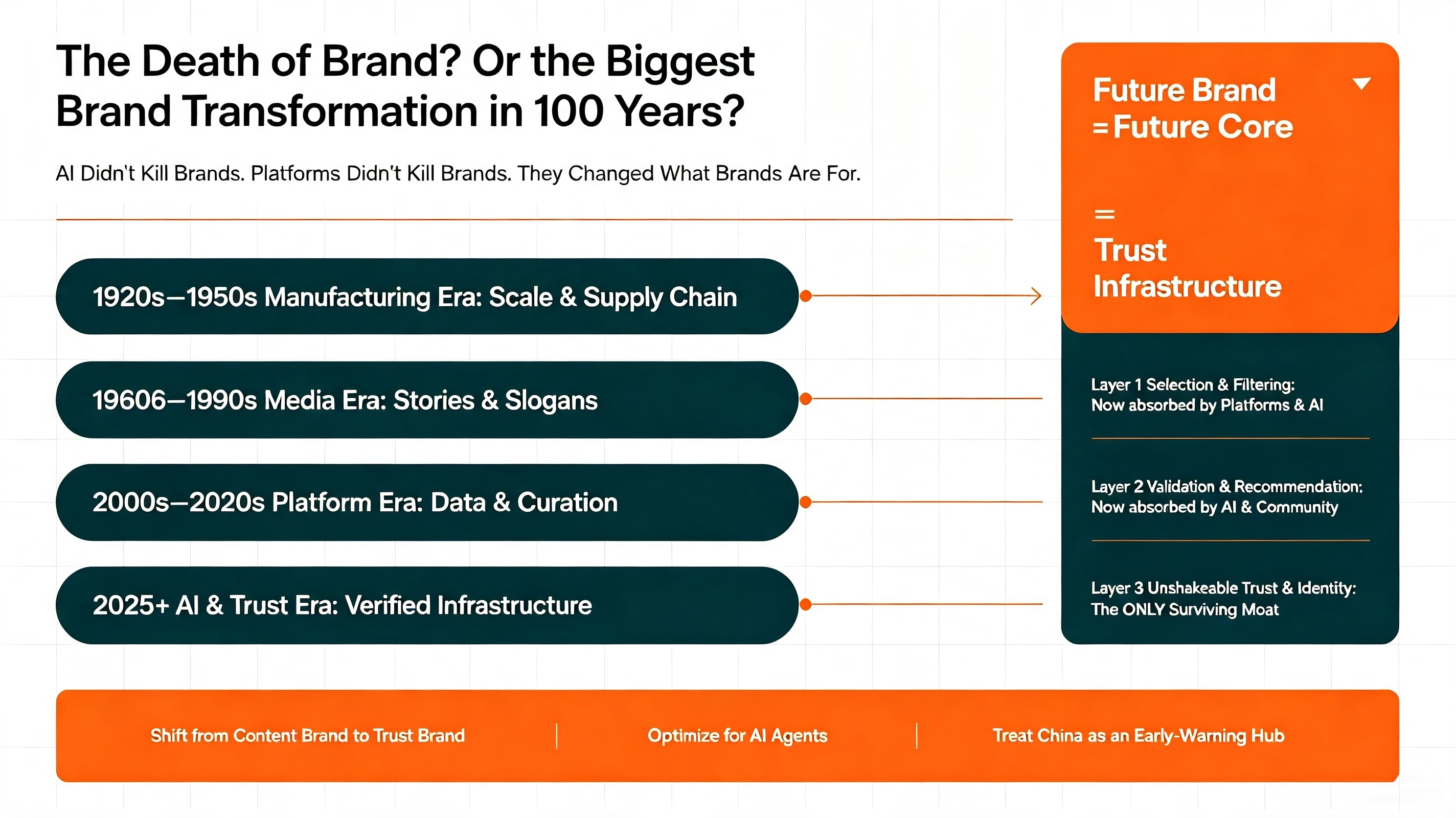
- [Media / Advertising Era]: Brand = Storytelling & Slogans
- [Platform / Search Era]: Brand = Channel Curation & Data
- [AI / Trust Era]: Brand = Trust Infrastructure
To see this dynamic playing out in its most extreme, accelerated, and predictive form, Western leaders must look at China. China is not merely an isolated market with unique digital apps; it is the world’s most advanced testing ground for the future of global retail, platforms, and AI-driven consumer behavior.
Part 1: The Disappearing Layers of Brand Value
To understand why brands feel weaker today, we must deconstruct what a brand historically provided to a consumer. Historically, brands performed two core functional duties:
- Filtering & Curation: “I will filter the market for you so you don’t have to waste time testing ten different products.”
- Quality Guarantee: “I will assure you this item is worth buying through my reputation and media authority.”
What has happened over the last decade—and what is accelerating radically in 2025–2026—is that platforms and AI agents have completely absorbed these two functions.
HISTORICAL BRAND VALUE LAYERS
- Layer 1: Selection & Filtering (Now absorbed by Platforms & AI)
- Layer 2: Validation & Recommendation (Now absorbed by AI & Community)
- Layer 3: Unshakeable Trust & Identity (The ONLY Surviving Moat)
Consider how consumers shop today:
- In physical and instant retail: Consumers no longer manually research dozens of detergent or olive oil brands. They rely on Sam’s Club, Costco, or Freshippo (Hema) to pre-curate products. If Sam’s Club puts an item on its shelf, the member assumes it is already vetted.
- In digital discovery: Consumers do not rely on a brand’s website to tell them if a product works. They consult algorithmically aggregated reviews on Xiaohongshu (RED), community consensus on Reddit, synthetic search summaries on Google AI, or contextual feeds on Douyin.
When a platform or an AI agent screens, evaluates, and recommends options in milliseconds, the brand’s first two layers of value vanish. The brand was not “killed” by malice; its informational duties were simply offloaded to more efficient computational engines.
Part 2: Platform Dominance – The Three Structural Asymmetries
Why have platforms like Amazon, Sam’s Club, Douyin, and Tmall stripped power away from traditional brand portfolios? Because platforms possess three structural advantages that standalone brands can never replicate:
THE THREE PLATFORM ASYMMETRIES
- Granular Behavioral Data: Brands know what sold; Platforms know why consumers browsed, abandoned, or refunded.
- Ownership of the Transaction: Brands own ad budgets; Platforms own real-time settlement and fulfillment data.
- Inverted Institutional Trust: Consumers trust platform quality control over self-serving brand promises.
1. The Data Asymmetry
A traditional brand knows what it sold, where it shipped, and how much revenue was generated.
A platform knows why the consumer bought it, what else they put in their cart, which three competitors they compared for 45 seconds before deciding, why they initiated a return, and the exact day they will run out of product. Brands own lagging sales figures; platforms own live behavioral intelligence.
2. The Transaction Asymmetry
Brands own advertising budgets; platforms own the transactional engine. When a platform controls the payment gateway, fulfillment infrastructure, and one-click checkout, the friction between consumer impulse and transaction drops to zero. The platform sits directly at the point of exchange.
3. The Trust Asymmetry
Historically, platforms borrowed credibility from famous brands to attract shoppers to their marketplaces. Today, that relationship is completely inverted: brands borrow credibility from platforms.
When Sam’s Club China expanded to over 10.7 million paid members and generated over 140 billion RMB ($20+ billion USD) in revenue in 2025, it proved a fundamental shift: millions of high-earning households trust the retailer’s blue logo far more than the individual manufacturer brands inside the box.
Part 3: The Threat of Data-Driven Private Labels
Many Western executives assume that private label products (like Kirkland, Member’s Mark, or retailer-owned lines) succeed purely because they are cheaper alternatives during inflationary periods.
This completely misses the underlying structural mechanics.
Private label growth is not driven by lower prices. It is driven by channels acquiring manufacturing power.
In the 20th century, brands owned R&D, manufacturing facilities, and consumer mindshare, while retailers merely rented out floor space. Today, platforms do not need to own factories. They possess something far more lucrative: real-time demand signals.
TRADITIONAL MARKETING-DRIVEN BRAND:
[R&D Innovation] ──> [Factory Production] ──> [Ad Campaign] ──> [Channel Distribution]
MODERN DATA-DRIVEN PRIVATE LABEL:
[Real-Time Demand Data] ──> [Contract OEM Sourcing] ──> [Algorithm Spotlighting] ──> [Instant Conversion]
Platforms know precisely which SKU is experiencing margin expansion, which product features have high search volume but low satisfaction scores, and where supply bottlenecks exist.
The platform simply identifies a top-tier Original Equipment Manufacturer (OEM)—often the exact same OEM manufacturing for luxury or legacy brands—and launches a private label product tailored to exact consumer preferences.
This is a Data-driven Brand, competing against a Marketing-driven Brand. A marketing-driven brand spends 30% of its revenue convincing people its product works; a data-driven private label spends 0% on traditional storytelling because the platform algorithm directly routes high-intent traffic to its store.
Part 4: How AI Destroys the Cheapest Moat (The Content Inflation Trap)
If platforms eroded channel access and pricing power, artificial intelligence is now obliterating the cheapest moat brands historically relied on: content production.
For fifty years, brands built moats out of high-production glossy commercials, celebrity endorsements, polished copy, and slick imagery. This required substantial agency fees and multi-million-dollar media budgets.
AI makes synthetic high-quality content costless and instantaneous.
THE CONTENT INFLATION CYCLE
- AI Content Tools ──> Infinite Assets Created ──> Human Attention Cap
- Value of Pure Content Drops to Zero <── Digital Noise Overhead Increases
When hyper-realistic video generation, synthetic brand models, localized scripts, and personal messaging can be deployed automatically at scale, two things happen:
- Content Inflation: The volume of marketing assets approaches infinity.
- Attention Bottlenecks: Human cognitive capacity remains strictly finite.
When content becomes infinite, content itself becomes worth zero.
AI did not kill branding—it killed cheap branding. Storytelling, aesthetic feeds, and creative copy are no longer defensible competitive advantages because any competitor can replicate them in minutes using generative tools.
Part 5: From Content Brand to Trust Brand
If content is zero-cost and platforms own discovery, what is a brand actually for?
This marks the definitive pivot of our era: Brands are shifting from Content Brands to Trust Brands.
Old Model: Content Brand
- Primary Currency: Attention
- Moat: Creative Assets
- Core Message: “Look how cool/beautiful we are.”
New Model: Trust Brand
- Primary Currency: Veracity & Accountability
- Moat: Proven Infrastructure & Assurance
- Core Message: “We guarantee this is real and uncompromised.”
In an AI-saturated world where everything can be fabricated—synthetic reviews, deepfake influencer endorsements, fake product demonstrations, and AI-generated user testimonials—the ultimate premium is authenticity verification.
The future brand functions as Trust Infrastructure. Consumers will not buy from a brand because its ad was clever; they will buy because they know the brand will not deceive them, default on quality, or leak their personal data.
Brands like Apple, Visa, Rolex, Hermès, and OpenAI do not compete on content volume. They compete on systemic, unshakeable consumer reliance. When a consumer buys from them, they are paying for a simple, implicit guarantee: “This is authentic, verified, and backed by a counterparty that cannot afford to fail me.”
Part 6: China as the World’s Brand Destruction Laboratory
Western corporate boards often treat China as an isolated ecosystem. This is a critical strategic mistake. China is a real-time preview of global market dynamics five years in advance.
Why China Accelerates Brand Erosion & Innovation:
- World’s Highest Platform Density (Douyin, Taobao, Xiaohongshu, JD)
- Total Price Transparency & Hyper-Mature OEM Supply Chains
- Ultra-Fast Delivery Infrastructure & Instant E-Commerce Integration
- Rapid Consumer Adoption of AI Shopping Assistants
With social commerce projected to surpass $4.2 trillion in China by 2026 and live-shopping GMV on platforms like Douyin alone topping 4.3 trillion RMB ($600B+ USD), the speed of product replication is unprecedented.
A viral “hero product” launched on Xiaohongshu can be cloned by specialized OEM factories, white-labeled, listed on Pinduoduo or Douyin Mall, and price-undercut within 90 days.
China has become the world’s fastest brand destruction laboratory—and simultaneously, its fastest brand innovation laboratory.
THE SHORTENED CHINA BRAND LIFECYCLE:
[Viral Discovery (0-1 Months)] ──> [Peak Scaling (2-3 Months)] ──> [OEM Cloning & Price Collapse (4-6 Months)]
If a brand relies solely on paid social acquisition, catchy packaging, and influencer seeding, its lifecycle in China is now measured in months. To survive in this environment, Chinese companies have been forced to pioneer new strategies that go far beyond surface-level marketing.
Part 7: The Strategic Framework: The Four Ages of Brand Power
To put this transformation in historical perspective, executives must understand how the source of brand leverage has migrated over the last century:
THE FOUR AGES OF BRAND POWER
| Era | Dominant Controller | Core Strategic Lever |
|---|---|---|
| 1. Manufacturing 1920s – 1950s |
Factory Owners e.g., GE, Ford |
Scale, supply chain mastery, and physical manufacturing output. |
| 2. Media 1960s – 1990s |
Ad Buyers & Agencies e.g., Coca-Cola, P&G |
Mass attention, broadcast TV reach, advertising print, and high-frequency slogans. |
| 3. Platform 2000s – 2020s |
Marketplaces & Tech Giants e.g., Amazon, Douyin, Sam’s Club |
Search traffic placement, zero checkout friction, and granular consumer behavioral data. |
| 4. AI & Trust 2025+ NEXT GEN |
Trust Infrastructure & Cognitive Moats | Verifiable quality, AI system recommendation preferences, and systemic truth assurance. |
The Transition to Age 4
In Age 2, brand power was purchased through ad frequency. In Age 3, brand power was rented from platform algorithms. In Age 4 (The AI & Trust Era), brand power belongs to those who control verifiable consumer trust and AI preference.
AI shopping agents (such as Douyin’s integrated Doubao or OpenAI search integrations) will soon execute purchases on behalf of users. An AI agent does not care about emotional storytelling or catchy jingles. It evaluates:
- Historical refund rates and fulfillment integrity.
- Cross-platform sentiment consistency.
- Supply chain traceability and compliance metrics.
- Value-to-utility efficiency ratios.
To win in Age 4, brands must be trusted not just by human consumers, but by the AI agents acting on their behalf.
Part 8: The Executive Playbook: Strategic Actions for International Leaders
Western business leaders looking at this shifting landscape should avoid superficial tactics like simply increasing ad spend or copying viral video formats. Instead, they must fundamentally redesign their competitive advantage.
THE EXECUTIVE ACTION PLAYBOOK
- Shift Capital from Paid Awareness to Product Propriety
- Build Direct-to-Trust (D2T) Channels Over Pure DTC
- Optimize for GEO (Generative Engine Optimization) & AI Agents
- Treat China as an Early-Warning R&D Hub, Not Just a Sales Channe
1. Shift Capital from Paid Awareness to Product Propriety
If an OEM factory can produce an identical version of your product at 40% of the cost, you do not have a brand; you have an markup on supply chain friction. Reallocate capital from top-of-funnel ad spend into proprietary material IP, clinical validations, supply chain ownership, and physical performance differentiation that cannot be white-labeled overnight.
2. Pivot from DTC (Direct-to-Consumer) to D2T (Direct-to-Trust)
DTC as a customer acquisition model relying on cheap digital ads is economically dead. Direct-to-Trust means building direct, non-transactional relationships rooted in accountability. Whether through lifetime guarantees, transparent supply chain tracking, or high-touch post-purchase service, focus on metrics like long-term cohort retention over first-touch conversion.
3. Optimize for AI Recommendation Engines (GEO)
As consumers increasingly delegate product discovery to AI search summaries and personal assistants, brands must manage their digital footprint for machine readability. Ensure structured product data, verifiable third-party testing, authentic community feedback, and technical documentation are easily indexable by large language models.
4. Use China as an Innovation Laboratory
Do not treat China solely as an expansion market for excess inventory. Use your operations in China as an early-warning radar for platform shifts, instant retail trends, social commerce mechanics, and rapid product iteration cycles. What happens on Douyin and Xiaohongshu today will influence global digital commerce paradigms tomorrow.
Conclusion
The debate over whether “brands are dying” misses the underlying transformation of our economic landscape.
Platforms took over discovery and curation. AI took over asset creation and content production. But neither killed the intrinsic value of a brand; they elevated what a true brand must be.
AI didn’t make branding less important. It made cheap branding worthless.
The era of building multi-billion-dollar enterprises purely on clever slogans, media buying, and outsourced manufacturing is over. The future belongs to brands that accept this reality and evolve from mere Content Creators into unshakeable Trust Infrastructure.
 Unlock 2026's China Digital Marketing Mastery!