 English
 German
 Korea
Korea Spanish
Beyond Influencers: How China Built the World’s Largest KOC Trust Network
- On July 21, 2026
- China consumer behavior, china social media marketing
Why Ordinary Consumers Are Becoming More Valuable Than Celebrities in the Age of AI and Information Overload
The Biggest Misunderstanding Western Brands Have About Chinese Social Media
For decades, global marketing playbooks operated on a top-down mandate: influence flows from the peak. Brands invested heavily in securing elite endorsements—movie stars, top-tier athletes, and macro-creators with millions of followers—assuming that wide broadcast equates to deep influence.
In China, this model has broken down.
While Western executives continue to measure social strategy through follower counts and impression totals, China’s digital ecosystem has pivoted to a decentralized paradigm: the most decisive force in commerce is no longer the celebrity with 5 million followers, but thousands of ordinary consumers with 5,000 followers sharing unscripted, highly contextual experiences.
Why?
The answer lies in a fundamental metric that traditional advertising metrics overlook: Trust Density.
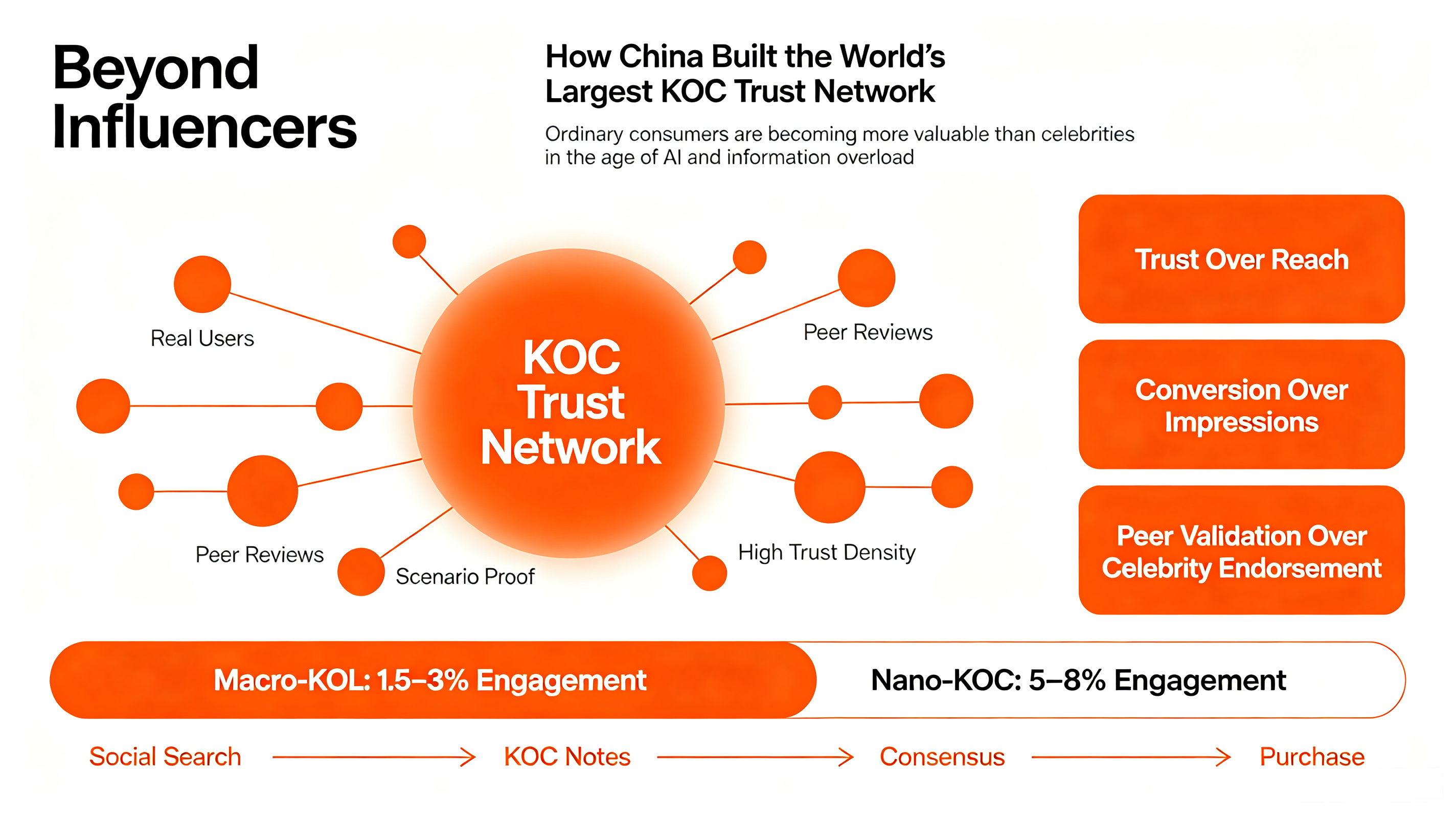
A mega-influencer commands massive reach, but their trust density per viewer is razor-thin. A Key Opinion Consumer (KOC)—a real person sharing real usage stories—commands localized reach with near-total trust density. In a market saturated with branded noise and hyper-curated synthetic media, Chinese consumers have stopped buying top-down promises. They buy bottom-up peer validation.
1, The End of Celebrity Influence: Why Traditional Influencer Marketing Is Losing Effectiveness
To understand the shift in China, Western leaders must first recognize the structural breakdown of top-down influence.
For decades, global brands relied on a linear equation: Celebrity Reputation → Product Credibility. If Nike signed Michael Jordan or Apple featured a global icon, the halo effect was immediate and defensible.
Today’s consumer landscape operates under entirely different cognitive conditions:
- Commercial Skepticism: Consumers are hyper-aware of sponsorship mechanics. They understand contracts, gifted products, agency scripts, and agency commissions.
- Ad Burnout: The average consumer processes thousands of brand signals daily. Polished production no longer signals quality; it signals a sales pitch.
- The AI Authenticity Crisis: As generative AI floods feeds with cheap, flawless synthetic content, polished images and scripts have zero incremental value.
PAST DECISION MODEL:
“I trust famous people.” ➔ [Brand Endorsement] ➔ [Purchase]
CURRENT DECISION MODEL:
“Famous people are paid to say this.” ➔ [Commercial Skepticism] ➔ [Seek Peer Reviews] ➔ [Purchase]
This evolution has inverted the economics of influence. Attention has become cheap and abundant; trust has become rare and expensive.
While listed rates for top Key Opinion Leaders (KOLs) in China rose 11.6% recently, actual conversion rates per impression tell a different story. A macro-KOL command post might yield an engagement rate of 1.5% to 3%, whereas nano-KOC accounts (1,000–10,000 followers) regularly achieve engagement rates between 5% and 8%, converting at 3 to 8 times the rate of macro-KOLs per impression.
2, What Exactly Is KOC? Beyond the Simple Definition
Western executives frequently mislabel KOCs as “micro-influencers.” This misapprehension causes multinational brands to run flawed campaigns in Asia.
A KOC is not just a smaller influencer.
A micro-influencer is an aspiring macro-influencer—they sell access to an audience, curate an aesthetic persona, and seek monetization through sponsorship. A KOC is a product-end user whose primary social asset is genuine personal experience.
| Dimension | Key Opinion Leader (KOL) | Key Opinion Consumer (KOC) |
| Core Asset | Reach, production value, halo effect | Authenticity, peer trust, contextual proof |
| Primary Currency | Sells Attention | Sells Confidence |
| Target Relationship | Fan-to-Star | Peer-to-Peer |
| Content Style | Professional, curated, cinematic | Unpolished, raw, scenario-based |
| Funnel Role | Top-of-Funnel (Discovery & Awareness) | Mid-to-Bottom Funnel (Validation & Conversion) |
| Commercial Role | Media channel | Consumer testimonial |
KOLs help consumers see a product. KOCs help consumers believe a product.
3, Why China Created the World’s Largest KOC Ecosystem
The rise of China’s KOC network is not accidental; it is the natural consequence of three converging structural forces.
Factor 1: Mobile-First, Decentralized Discovery
In Western markets, consumer journeys remain relatively compartmentalized: Google for search, Instagram for visual inspiration, Amazon for transaction.
In China, consumer search has migrated entirely to social ecosystems like Xiaohongshu (RedNote) and Douyin. Xiaohongshu alone boasts over 300 million monthly active users (MAUs), with more than 80% of its user base utilizing the platform directly as a search engine for product research prior to making buying decisions.
The decision loop is socialized:
Discovery (Xiaohongshu) -> Video Demonstration (Douyin) -> Peer Inquiry (WeChat) -> In-App Checkout
Factor 2: The Social Proof Economy
Having navigated rapid market evolution, counterfeit scares, and intense advertising saturation, Chinese consumers maintain high natural skepticism toward direct brand statements. This environment created an absolute requirement for peer validation—a Social Proof Economy where an unboxing video by an unpaid college student carries more persuasive power than a multi-million-dollar TV commercial.
Factor 3: Recommendation Algorithms Built for Discovery
Platforms like Xiaohongshu and Douyin prioritize content engagement metrics (saves, shares, detailed comments) over raw follower counts. A user with 1,200 followers who posts an exceptionally detailed breakdown of how a serum reacts on sensitive skin in winter can easily go viral, outranking sponsored posts from account accounts with millions of followers.
WESTERN SEARCH MECHANIC (Search-First):
Intent ➔ Google Query ➔ Official Website ➔ Purchase
CHINA DISCOVERY MECHANIC (Algorithmic-First):
Algorithmic Feed / Social Search ➔ KOC Scenario Notes ➔ Peer Consensus ➔ Seamless In-App Purchase
4, The KOC Matrix: How Chinese Brands Scale Trust
When domestic Chinese brands launch a new product line, they do not rely solely on a celebrity campaign. They build a KOC Trust Infrastructure.
Rather than distributing 80% of their media budget to a single high-profile brand ambassador, these companies allocate significant resources toward seeding hundreds—or thousands—of authentic user reviews across targeted demographics.
- 1-2 Anchor Mega-KOLs -> Awareness & Brand Framing
- 20-50 Mid-Tier KOLs -> Category Authority & Context
- 500 – 5,000+ Key Opinion Consumers (KOCs) -> Mass Social Proof & Trust Density
When a prospective buyer searches for the product on Xiaohongshu, they don’t find corporate press releases. They find fifty pages of decentralized proof points:
- “How this moisturizer held up on a 10-hour flight to London.”
- “Day 1 vs. Day 14 comparison on oily, acne-prone skin.”
- “Why the bottle design is great for travel, but the cap gets loose.”
This density of organic feedback removes buying friction. The brand doesn’t just run an ad campaign—it populates a search layer with permanent, peer-validated signals.
5, Why KOC Works Better: The Psychology Behind It
The effectiveness of KOC marketing rests on three foundational principles of human decision-making:
1. Similarity Bias
Psychological research consistently demonstrates that individuals assign higher trust to peers who match their demographic and lifestyle profile. A 28-year-old mid-level manager living in Shanghai does not see her daily life reflected in a celebrity living in a luxury villa. She relates to a KOC working similar hours, dealing with similar weather, and managing a similar household budget.
2. Imperfection Creates Authenticity
Traditional marketing strives for flawless execution. KOC marketing thrives on calculated imperfection. A review that notes a minor product drawback (“The cream smells incredible and hydrates deeply, though the texture takes about two minutes to absorb”) carries far higher credibility than a flawless 5-star review. The minor critique validates the sincerity of the praise.
3. The Consensus Effect
When a consumer encounters a single positive review, it registers as an opinion. When they encounter dozens of independent posts across different user profiles repeating similar nuances, it triggers the Consensus Effect. The purchase choice shifts from a speculative risk to a validated social norm.
6, What Western Brands Can Learn From China
The principles driving China’s KOC revolution are no longer confined to Asia. As Western consumers grow increasingly weary of sponsored content on TikTok and Instagram, global marketing leaders must adjust their operational playbooks.
Strategic Directive 1: Reallocate Influencer Metrics
Stop evaluating creator partnerships solely on follower count and reach. Shift performance tracking toward Cost-Per-Engagement (CPE), Save/Bookmark Rates, and Search Index Penetration.
Strategic Directive 2: Build Consumer Networks, Not Campaigns
Instead of viewing marketing as a series of isolated quarterly pushes, invest in perpetual user seeding. Build structured consumer feedback panels, product gifting programs, and community advocate channels that generate organic user-generated content (UGC) year-round.
Strategic Directive 3: Embrace Human Authenticity as a Moat
As generative AI lowers the cost of producing synthetic content to near zero, authentic human experience becomes a brand’s most defensible asset. When artificial content is limitless, real human validation commands the highest premium.
Conclusion: The Future of Global Marketing
China’s KOC revolution is not a localized marketing anomaly. It is a preview of how global digital commerce operates under conditions of extreme choice, algorithmic discovery, and high information volume.
As trust shifts from centralized corporate voices to distributed peer networks, market leadership will no longer belong to the brands with the largest advertising budgets. It will belong to the brands that build, maintain, and scale the most resilient networks of consumer trust.
 Unlock 2026's China Digital Marketing Mastery!