 English
 German
 Korea
Korea Spanish
China’s Live Commerce Revolution: It Is Not About Selling Products, It Is About Engineering Trust
- On July 20, 2026
- China Live Commerce
To most Western executives, live commerce appears to be little more than a digitized incarnation of 1980s television shopping—QVC or HSN retrofitted with a smartphone screen, a live chat room, and a promo code.
That interpretation misses the entire paradigm shift.
While Western brands view live streaming as an incremental sales channel or a novelty tactic within influencer marketing, leading enterprises in China operate under a fundamentally different reality: Live commerce is a new consumer decision-making infrastructure.
- Western Paradigm: Brand Exposure -> Ad Impression -> Web Redirect -> Deferred Purchase
- Chinese Paradigm: Attention -> Human Trust -> Product Education -> Instant Closed-Loop Conversion
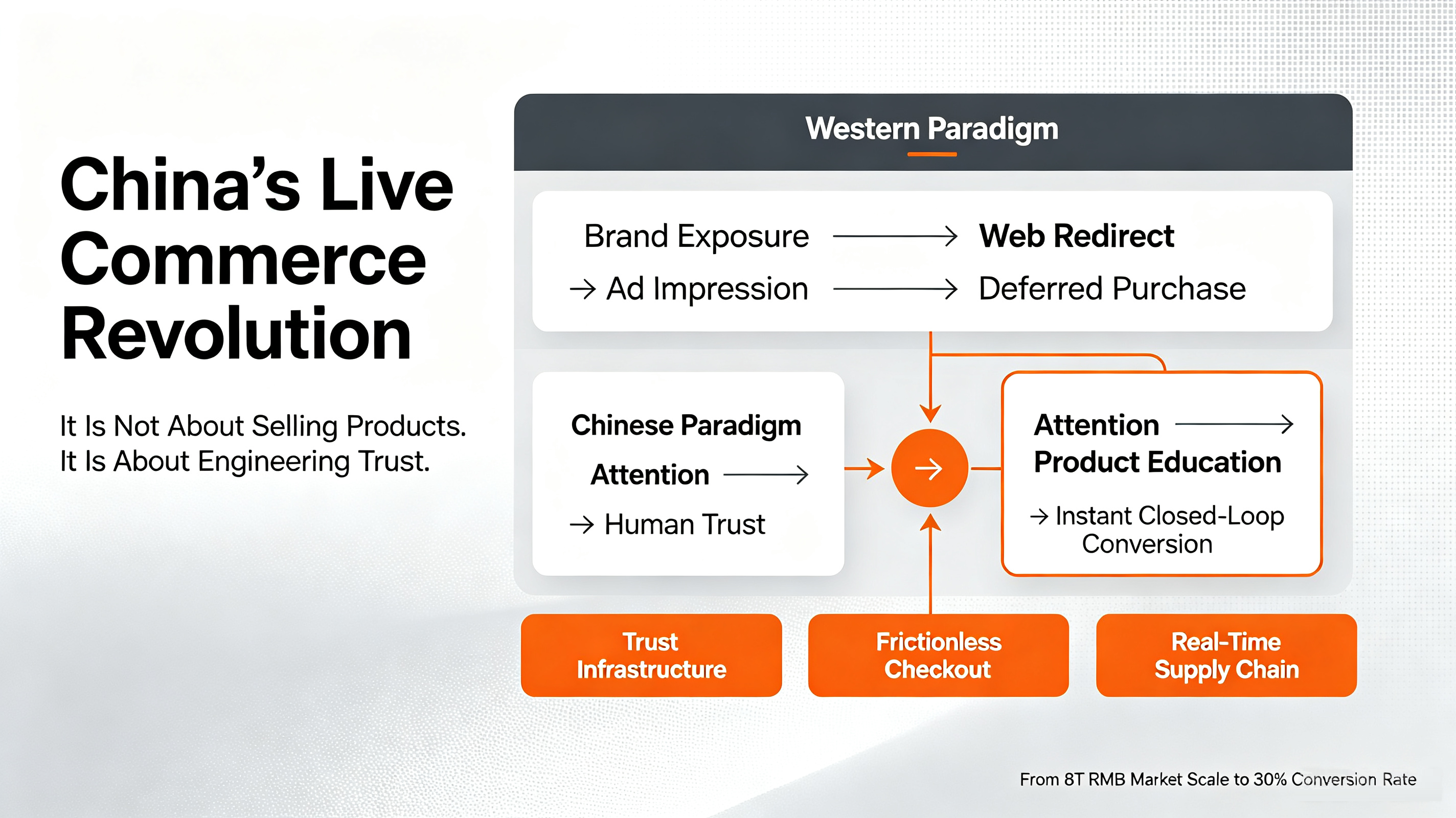
China’s live commerce ecosystem—projected to surpass RMB 8 trillion (~$1.1 trillion USD) and approaching the scale of the entire U.S. e-commerce market—does not merely showcase items. It collapses the entire marketing funnel into a real-time, zero-friction loop of content, validation, transaction, and algorithmic feedback.
- Traditional Western Funnel (Weeks/Months)
[ Awareness ] -> [ Interest ] -> [ Consideration ] -> [ Purchase ] - China’s Live Commerce Infrastructure (Minutes)
[ Attention + Human Verification + Real-time Peer Proof ] -> [ Frictionless Conversion ]
Understanding why this model exploded in China—and why it has systematically failed when transplanted directly into Western markets—requires moving beyond superficial UX comparisons. It demands an examination of structural trust, digital architecture, and supply-chain dynamics.
Part I: The Fundamental Misconception: Why the West Sees “QVC with TikTok”
When Western retail leaders analyze Chinese live commerce, they observe a host demonstrating a product, shouting a countdown timer, and offering a temporary discount. The immediate parallel drawn is Home Shopping Network on a mobile app.
Traditional TV Shopping Model:
Brand / Retailer -> Broadcast Signal -> Passive Viewer -> Call-In Purchase
China’s Interactive Closed-Loop System:
[ Algorithmic Discovery ] ->
[ Live Stream Host ] <- Real-time Chat / Requests -> [ Consumer Cohort ] ->
[ Instant In-App Checkout ] -> [ Social Peer Proof ] ->
[ Real-Time Data Feedback to Factory Supply Chain ]
This structural difference invalidates the TV shopping comparison across four dimensions:
- Unidirectional vs. Multi-Dimensional Communication: TV shopping is a one-to-many broadcast. Chinese live commerce is a multi-node conversation where thousands of viewers ask hyper-specific questions (“Show the texture of the serum under natural light,” “Stretch the waistband on camera”), receiving immediate physical proof.
- Static Catalog vs. Algorithmic Real-Time Merchandising: A TV channel broadcasts a static schedule. Platforms like Douyin (TikTok’s sister app in China) dynamically route viewers into specific live streams based on real-time affinity algorithms. The product stream adapts live based on viewer retention metrics and drop-off rates.
- Decoupled vs. Native Frictionless Checkout: TV shopping requires picking up a phone or navigating to a external web browser. In China, transaction infrastructure is native to the video feed. A consumer touches an icon, authenticates via biometric facial scan linked to Alipay or WeChat Pay, and completes the purchase in under three seconds without leaving the stream.
- Third-Party Influencer vs. Trust Proxy Engine: TV hosts are network employees reading scripts. Top Chinese Key Opinion Leaders (KOLs) and Key Opinion Consumers (KOCs) operate as consumer advocates who negotiate directly with brands to secure exclusive terms for their specific audience.
Part II: The Structural Mechanics: Why Live Commerce Exploded in China (and Not in the West)
The rapid scaling of live commerce in China was not caused by an innate preference for watching live video. It was born out of unique structural constraints and digital evolutions within the Chinese market.
1. The Trust Deficit: Person-First vs. Brand-First Commerce
The most significant driver of live commerce in China is rarely addressed in Western management literature: a fundamental difference in how commercial trust is established.
- Western Market Mechanics:
Established Brand Heritage -> Corporate Trust -> Transaction Security - Chinese Market Mechanics:
Relatable Human Proxy (KOL/KOC) -> Personal Trust -> Brand/Product Validation
In mature Western markets, consumer decision-making rests on decades of brand equity, clear product standards, strict regulatory frameworks, and independent review systems (e.g., Wirecutter, Trustpilot). When a Western consumer buys from Nike, Apple, or Sephora, they trust the corporate institution.
In China, rapid economic transition created a unique commercial landscape. Consumers navigated decades of market fragmentation, counterfeit goods, and information overload on digital marketplaces like Taobao. As a result, Chinese consumers placed lower baseline trust in corporate brand advertising.
Instead, trust became personified.
- Traditional Western Path: Brand -> Trust -> Purchase
- China Live Commerce Path: Person (KOL/Host) -> Trust -> Product -> Purchase
When top-tier anchors like Li Jiaqi (Austin Li) or institutional accounts like Dongfang Zhenxuan (East Buy) broadcast, consumers rely on the host’s personal reputation to filter out bad products, audit the supply chain, and guarantee the lowest price. The host acts as an algorithmic filter and a human proxy for quality control.
2. Digital Infrastructure: Integrated Super-Apps vs. Fragmented Ecosystems
The Western digital economy operates in silos:
- Discovery & Social: Instagram, TikTok, YouTube
- Search & Intent: Google
- Transaction & Logistics: Amazon, Shopify-backed storefronts
This fragmentation introduces friction at every conversion stage. A user seeing an ad on Instagram must click out to a mobile web browser, re-enter payment credentials, or manage a separate checkout system. Drop-off rates compound at every step.
- Western Commerce Architecture (Fragmented):
[ Instagram / TikTok ] ──(Click Out) -> [ Web Browser ] ──(Manual Input) -> [ Payment Gateway ] - China Super-App Architecture (Unified Closed-Loop):
[ App Content Feed ] ──(1-Tap Embedded) -> [ Native Merchant Store ] ──(Biometric Pay) -> [ Fulfillment ]
China completely bypassed this fragmented web topology. Platforms like WeChat, Douyin, and Taobao evolved into self-contained super-apps. Content, social graph, digital identity, merchant storefronts, and instant payments co-exist natively within a single application framework.
3. Historical Mobile Leaping: Skip the PC, Skip the Open Web
While Western e-commerce developed during the desktop era around domain names, search bars, and standalone destination websites, China’s digital consumer class jumped straight to the mobile web.
Chinese consumers never developed a strong habit of visiting standalone brand websites. Commerce in China exists entirely within centralized digital platforms. Because consumers expected algorithms to surface relevant products within centralized apps rather than searching via desktop web browsers, live video feeds fit naturally into their content consumption habits.
4. Supply Chain Agility: Micro-Batches and Real-Time Feedback
Live commerce cannot function without an agile, responsive supply chain.
In traditional retail, production schedules run on 6-to-9 month lead times. If a live stream sells 50,000 units of an item in 10 minutes, a conventional supply chain crashes into stockouts or massive over-inventory.
- Traditional Supply Chain:
Design -> 6-Month Lead Time -> Mass Production -> Fixed Warehouse -> Retail Channel - Agile Live Commerce Supply Chain:
Micro-Batch (500 units) -> Live Stream Test -> Real-Time Demand Data -> 7-Day Factory Scale-Up
China’s manufacturing ecosystem, particularly in industrial clusters around Zhejiang and Guangdong, developed a hyper-agile model directly linked to digital sales data:
- Flexible Manufacturing Systems (FMS): Factories run micro-batches of 300–500 units for an initial live test.
- Instant Signal Processing: If real-time audience engagement indicators (view time, add-to-cart rates) spike, the platform triggers an automated re-order signal directly to the factory floor.
- 7-to-14 Day Replenishment: Factories adjust colorways, sizing, or packaging based on live stream chat feedback and deliver finished stock to fulfillment centers within two weeks.
Part III: The Regional Isolation: Why Other Asian Markets Haven’t Replicated the Scale
A common error among global strategists is treating “Asia” as a monolith. If live commerce succeeds in China, why hasn’t it scaled to the same proportion in Japan, South Korea, or India?
| Market | Dominant Retail Dynamic | Why Live Commerce Scaling Diverges |
| Japan | High trust in brick-and-mortar & legacy brands | Extreme consumer trust in established physical retail networks (convenience stores, department stores) and entrenched brand equity. Consumers do not require a live host to validate product quality. |
| South Korea | High social media adoption & strong influencer culture | Strong adoption in niche beauty and fashion sectors, but overall market size (~50 million population) limits the massive network effects and scale economies required to sustain deep-discount live commerce infrastructure. |
| India | Massive population & rapid digital adoption | Rapidly growing social commerce, but lower average basket sizes, higher fulfillment logistics friction, and evolving digital payment infrastructure relative to Tier-3+ penetration keep conversion rates well below China’s benchmarks. |
China’s live commerce revolution requires a confluence of conditions: a massive homogeneous mobile market, a personified trust model, fully closed-loop super-apps, and proximate flexible manufacturing.
Part IV: The Core Innovation: “Attention-to-Transaction” Infrastructure
The strategic breakthrough of Chinese live commerce is not the stream itself; it is the radical condensation of time-to-conversion.
- Legacy Marketing Journey:
Awareness (Week 1) -> Interest (Week 2) -> Consideration (Week 3) -> Action (Month 2) - Live Commerce Engine:
Attention -> Human Validation -> Contextual Urgency -> Biometric Checkout (300 Seconds)
In traditional marketing, brand managers accept funnel decay: millions see an ad, thousands visit the site, hundreds add to cart, and dozens buy.
Live commerce eliminates funnel leak by turning attention directly into execution. When a live host demonstrates a product, addresses objections in real time, offers a time-bounded bundled price, and provides a native buy button, the consumer moves from cold discovery to completed transaction inside a single session.
According to McKinsey, conversion rates in top-tier live streams reach approaching 30%—up to ten times higher than standard e-commerce conversion rates.
Part V: Live Commerce in the AI Era: Trust as the Ultimate Bottleneck
As Generative AI tools proliferate globally, the cost of generating content, product descriptions, marketing copy, and synthetic media drops to near zero.
Post-AI Market Paradox:
Abundance of Synthetic Content / AI Recommendations -> Extreme Consumer Friction -> “Which product claims are real?” -> Scarcity Shift: Human Trust & Unedited Physical Verification
In an era where consumers face millions of AI-generated synthetic recommendations and algorithmically generated store fronts, information becomes infinite, but trust becomes scarce.
This reality reshapes the live commerce value proposition:
- Unedited Physical Reality: A live video feed provides unscripted proof. If a host applies a foundation on raw skin live on camera, no synthetic text product description can match that level of immediate, unedited verification.
- Human Empathy vs. AI Efficiency: While AI avatars handle low-tier, overnight customer service streams (a rapidly growing trend for utility items in China), high-margin, high-consideration purchases still rely on human hosts who share personal vulnerabilities, live tests, and relatable experiences.
- Curation over Choice: Overwhelmed by choice, consumers look to human curators. The host acts as an editorial filter, saving the buyer time and cognitive effort.
Strategic Realization: In the AI era, trust becomes more valuable than information. Chinese live commerce built the infrastructure for human-verified commerce long before the AI content wave hit.
Part VI: Operational Playbook: What Western Enterprises Must Adapt
Western business leaders should not attempt to clone Chinese live commerce streams verbatim on platforms like Instagram or web properties lacking closed-loop checkout. Instead, they must translate the underlying strategic principles into their regional commerce operations.
Principle 1: Shift from Brand-Centric Advertising to Personal Trust Assets
Western companies invest heavily in corporate brand guidelines while keeping individual creators at arm’s length. Modern commerce demands human faces.
- Action: Empower brand founders, product engineers, and specialized internal experts to become the primary video presenters of the product. Move beyond polished commercial ads toward transparent, unscripted product testing and development deep-dives.
Principle 2: Treat Live Environments as Real-Time Consumer Laboratories
In China, a live stream double-hats as a sales channel, a focus group, and a product management tool.
- Action: Use interactive video sessions to test prototype features, gauge price sensitivity, and collect customer objections in real time. Feed chat analytics directly into product engineering and merchandising teams rather than relying solely on quarterly survey data.
Principle 3: Evolve Influencer Marketing from Ad Buying to Trust Franchising
In the West, influencer marketing is often managed as transactional ad spend: paying a creator to feature a product once on their channel. In China, top anchors act as retail partners who negotiate co-branded bundles, exclusive formulations, and custom packaging.
- Action: Transition key creator relationships from transactional sponsored posts to long-term performance equity models. Involve creators directly in product curation and offer them input on product design to leverage their built-in trust assets.
Principle 4: Work to Eliminate Funnel Disconnection
While Western social apps continue building out native commerce features, brands must minimize technical friction between social discovery and transaction.
- Action: Implement single-click payment integrations (e.g., Apple Pay, Shop Pay) directly within video platforms. Any step that redirects a user away from a content stream reduces conversion rates exponentially.
Conclusion: A Strategic Preview of Integrated Commerce
China’s live commerce ecosystem is not merely a regional trend or a temporary discount channel. It serves as a working model of how retail functions when attention, human trust, algorithmic discovery, real-time data, and frictionless transactions converge into a single ecosystem.
For Western brands, attempting to copy Chinese live streaming mechanics without building the underlying trust and supply chain capabilities leads to disappointing results. The path forward requires adopting the structural philosophy: reducing friction, humanizing brand promises, accelerating product feedback loops, and treating consumer trust as the central commercial asset.
China did not reinvent shopping by broadcasting video over the internet. It redesigned the consumer decision-making path for a mobile-first, high-velocity world. Global retail leaders who recognize this shift today will build the decision-making infrastructure of tomorrow.
 Unlock 2026's China Digital Marketing Mastery!