 English
 German
 Korea
Korea Spanish
China’s Social Media Marketing Revolution: From Traffic Competition to Trust Engineering
- On July 17, 2026
- china social marketing, china social media marketing
For decades, multinational executives have viewed China’s digital landscape through a lens of scale and speed. Western boardrooms look at the eye-watering numbers—1.1 billion internet users, multi-billion-dollar single-day shopping festivals, and dominant super-apps—and draw a logical, yet fundamentally flawed, conclusion: “We need to buy our way into this traffic.”
But as we navigate 2026, a quiet revolution has fundamentally rewritten the rules of engagement. The era of brute-force “traffic acquisition” is officially dead. In its place has emerged a highly sophisticated paradigm: Trust Engineering.
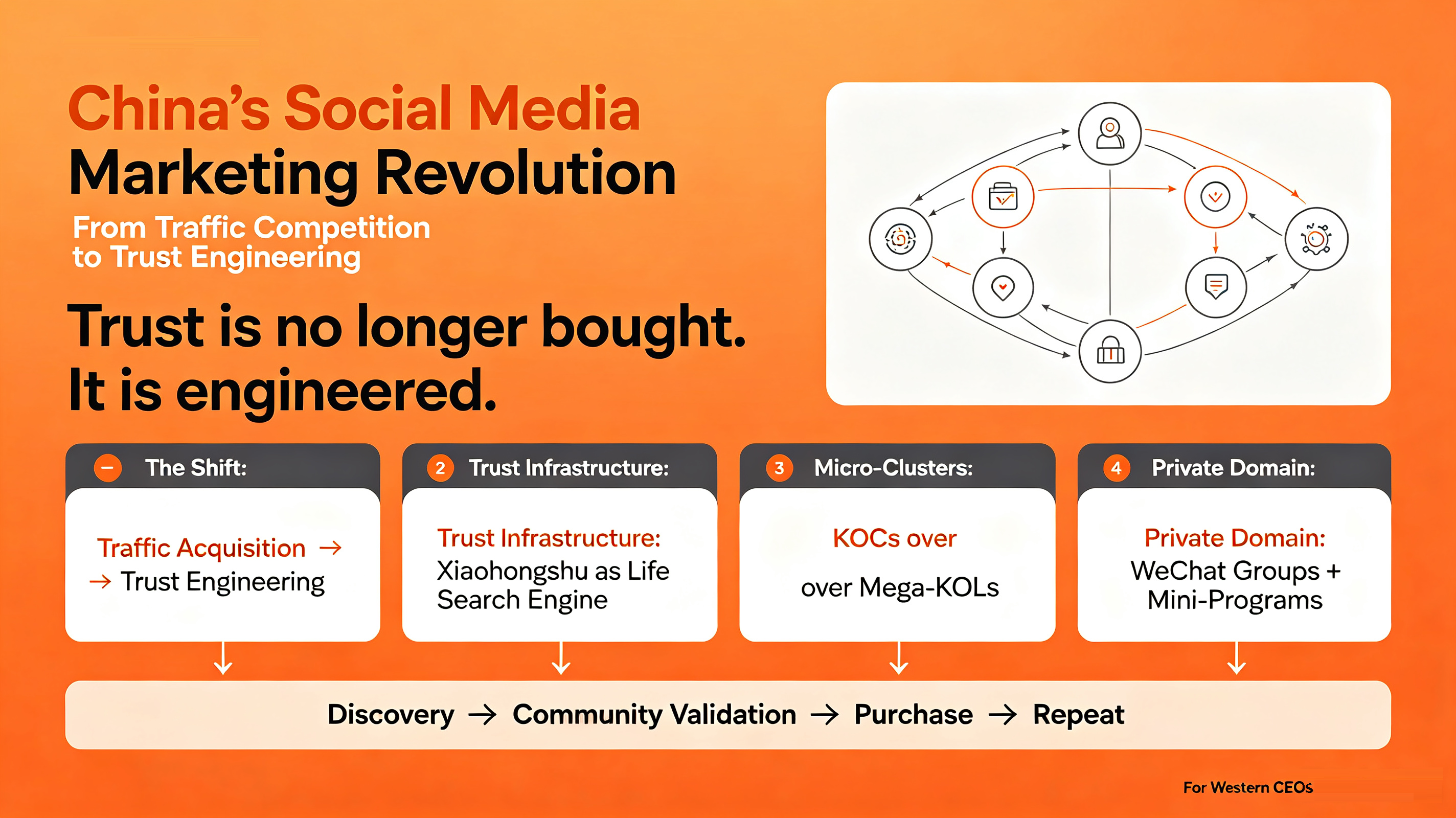
To win in China today, CEOs and CMOs must understand that this is not merely a shift in channel tactics. China is not just a different market; it is a time machine. The structural changes happening inside China’s social commerce ecosystem represent the future of global marketing—a future where traditional advertising funnels collapse and peer-to-peer validation becomes the only viable infrastructure for commerce.
1. The Great Misunderstanding: The Closed Loop vs. The Linear Funnel
Western marketing is historically built on a linear, highly controlled funnel designed to build top-of-mind awareness and push consumers toward a transaction:
Brand -> Advertising -> Consumer Awareness -> Consideration -> Purchase
In this classic system, the brand dictates the message, media channels distribute it, and the consumer acts as a passive recipient.
In China, this linear model has completely collapsed. The Chinese consumer journey is a highly fragmented, highly collaborative, and deeply social closed-loop network. It does not flow downward; it orbits around trust:
Consumer Conversation -> Community Validation -> Trust Formation -> Purchase Decision -> Brand Relationship
The fundamental difference lies in where the consumer looks for truth. In Western markets, search engines (Google) and aggregate reviews (Amazon) act as cold, transactional filters. In China, search is social. Platforms like Xiaohongshu (RedNote) have largely displaced traditional search engines for lifestyle, beauty, travel, and luxury purchases.
When a Chinese consumer discovers a brand, their immediate reflex is not to visit the brand’s website. Instead, they execute a highly coordinated multi-platform validation ritual:
- Discovery & Aesthetic Vetting: They spot the product on Xiaohongshu, seeking authentic user-generated notes (UGC) regarding real-world performance.
- Contextual Proof: They watch a short-video or livestream on Douyin (TikTok’s sister app) to see the product in a live, unvarnished scenario.
- Social Verification: They query their private WeChat groups, asking friends or community members if anyone has purchased it.
- Frictionless Conversion: They buy the product directly inside the social ecosystem—often via a WeChat Mini-Program or a Douyin Flagship Store—and instantly post their own feedback, feeding the loop for the next consumer.
To a Chinese consumer, branded advertising is a claim, but social proof is the truth. If a brand has not seeded a robust layer of authentic peer reviews across this network, no amount of paid media will convert a customer.
2. Shift 1: Xiaohongshu as a “Trust Infrastructure” and Search Engine
Western marketers often mistake Xiaohongshu (Little Red Book) for a Chinese equivalent of Instagram or Pinterest. In 2026, this comparison is dangerously outdated. Xiaohongshu has mutated into a “Life Search Engine” powered by high-intent social search.
With over 300 million monthly active users (MAUs), more than 70% of Xiaohongshu users actively use the search bar before making any lifestyle or purchasing decision. It serves as a decentralized, crowd-sourced encyclopedia of lived experience.
The concept that governs this platform is Zhongcao, literally translated as “planting grass”—the art of cultivating desire in a consumer’s mind. When a consumer buys, it is called Bacao, or “pulling weeds”.
For a Western brand, this means traditional Search Engine Optimization (SEO) must be replaced by Search Engine Seeding (SES).
Case Study: A Western Derma-Cosmetics Brand’s Counter-Intuitive Success
In mid-2025, a European clinical skincare brand attempted to enter the Chinese market. Instead of hiring a mega-celebrity or launching a massive banner ad campaign on Tmall, they focused entirely on a hyper-targeted Xiaohongshu seeding strategy.
- The Strategy: The brand identified a highly specific, painful consumer problem: “redness and skin barrier irritation caused by seasonal pollen allergies in Tier 1 cities.”
- The Execution: They did not send polished marketing copy to influencers. Instead, they sent unbranded lab samples to 150 micro-Key Opinion Consumers (KOCs) with fewer than 5,000 followers each. They asked for honest, daily, close-up photos of their skin healing over 14 days.
- The Result: When allergy season hit, hundreds of thousands of urban consumers searched Xiaohongshu for “allergic skin redness rescue.” Instead of polished corporate ads, they were met with hundreds of raw, high-definition, day-by-day skin transformation journals. The authentic, peer-validated proof points drove a 340% increase in search volume and a complete sell-out of their initial stock via their WeChat mini-store within 45 days, entirely via organic word-of-mouth and highly targeted search ads.
3. Shift 2: The Fall of the Mega-KOL and the Rise of KOC “Micro-Clusters”
For years, the playbook for China marketing was simple: pay a top-tier Key Opinion Leader (KOL) with 10 million followers to feature your product in a livestream or social post.
In 2026, this strategy is not only financially inefficient; it is increasingly ineffective. The Chinese consumer’s “ad-dar” (advertisement radar) is sharper than ever. They can spot a highly paid, transactional endorsement instantly. Furthermore, top-tier KOLs have become so expensive that they capture almost all the margin, leaving brands with high GMV (Gross Merchandise Volume) but negative ROI.
The power has shifted to Key Opinion Consumers (KOCs)—ordinary users who post out of genuine passion and possess highly engaged, hyper-niche follower bases (typically 1,000 to 50,000 followers).
| Metric | Traditional KOL (Key Opinion Leader) | Modern KOC (Key Opinion Consumer) |
| Primary Value | Mass Awareness & Reach (Broadcasting) | Trust, Credibility & High Conversion |
| Audience Relationship | Transactional (Fan to Star) | Peer-to-Peer (Friend to Friend) |
| Content Style | Polished, studio-quality, highly curated | Raw, experiential, unvarnished, detail-rich |
| Cost Model | High flat fees per post / high commissions | Low fees, product-for-post, organic seeding |
| Long-term Value | Transient (spike in traffic, then drops) | Cumulative (persistent social proof in search) |
Trust is no longer a centralized broadcast; it is a decentralized, peer-validated network. To build a brand in China today, you do not buy one voice with 10 million followers; you coordinate 1,000 voices with 10,000 followers each.
4. Shift 3: Private Domain Traffic as the Ultimate CRM
In the West, brands own their customer relationships through email marketing. In China, email is practically nonexistent for B2C commerce. The absolute gold standard of customer retention and lifetime value (LTV) maximization is Private Domain Traffic.
Unlike “Public Domain” platforms (like Douyin or Tmall), where brands must pay every time they want to reach their audience, “Private Domain” refers to digital channels that the brand directly owns and can communicate with for free. This ecosystem is anchored almost entirely within WeChat.
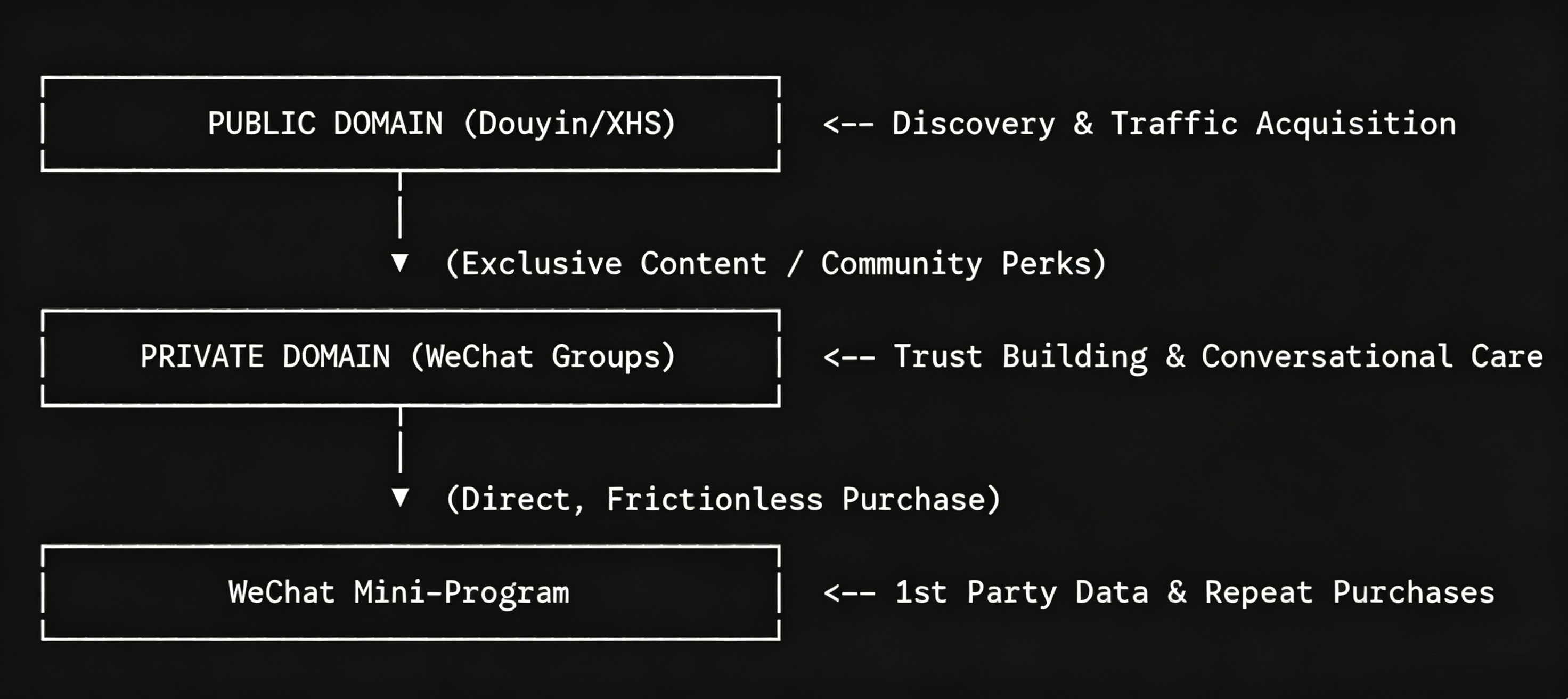
Within these private WeChat groups, brands do not just blast coupons. They run hyper-active, highly customized micro-communities managed by real people (or highly advanced, brand-specific AI assistants that mimic a knowledgeable peer).
In 2026, the brands winning in China are treating these groups as intimate digital salons. For example, a premium pet food brand doesn’t just sell kibble; they run 50 different WeChat groups segmented by dog breed and health concerns, with real-time veterinary advice available 14 hours a day. The commerce happens naturally through embedded Mini-Programs inside the chat.
5. Strategic Recommendations: The “Trust Engineering” Playbook for Western CEOs
If you are a Western business owner or marketing executive looking to enter or scale in China, you must stop translating Western marketing funnels into Chinese. You need to build a bespoke trust engine.
Here is the tactical framework to implement:
Step 1: Replace “Media Buying” with “Micro-Seeding”
- The Action: Allocate 40% of your initial marketing budget away from massive paid ads and top-tier KOLs. Instead, partner with a specialized agency to build a “KOC Matrix” of 100 to 500 micro-creators.
- The Guardrail: Do not send them pre-written scripts. Provide them with the product, transparently explain your ingredients or manufacturing process, and ask them to document their real, unvarnished experiences. The Xiaohongshu algorithm explicitly rewards detailed, genuine copywriting over polished, commercial layouts.
Step 2: Optimize for Social Search, Not Just Web Search
- The Action: Treat Xiaohongshu as your primary search engine. Analyze the exact search terms your target demographic uses when they face a problem your product solves.
- The Guardrail: Ensure that when those terms are searched, the first 20 to 50 results contain organic, highly detailed, and visually consistent reviews from real users. Once that foundation of organic proof is built, use Xiaohongshu’s native paid search tool (Juguang) to amplify the top-performing organic reviews directly into high-intent search queries.
Step 3: Build a Frictionless “Social to Store” Loop
- The Action: Do not force consumers to click an external link that redirects them to a heavy, slow website or requires them to log in. Establish your direct-to-consumer presence inside the social apps themselves via WeChat Mini-Programs or Douyin Flagship Stores.
- The Guardrail: Keep the checkout process under three clicks. Ensure that payment methods are native (WeChat Pay or Alipay) to minimize cart abandonment.
Step 4: Construct a Gated Private Domain Community
- The Action: Every single product package shipped to a Chinese consumer must contain a highly attractive “insert” (DM) containing a QR code. This QR code should not lead to a generic newsletter signup; it must invite them into a private WeChat community that offers genuine utility—such as expert advice, exclusive community-first product drops, or interactive loyalty perks.
The Ultimate Strategic Takeaway
The Chinese consumer has matured faster than any other consumer cohort in digital history. They are hyper-connected, incredibly discerning, and deeply skeptical of polished corporate narratives.
Western brands that fail in China almost always do so because they treat the market as a dumping ground for global advertising assets. The brands that succeed are those that realize trust cannot be bought through a media plan; it must be engineered through a community.
By shifting your mindset from “traffic acquisition” to “trust engineering,” you do not just unlock the key to the world’s most dynamic consumer market—you build the exact marketing capabilities required to survive the next decade of global, decentralized commerce.
 Unlock 2026's China Digital Marketing Mastery!