 English
 German
 Korea
 Spanish

Marketing Is No Longer a Megaphone. It Is Becoming the Company’s Nervous System
- On November 16, 2026
- ai marketing strategy, AI-Driven Digital Marketing, Digital Trust Infrastructure
The strongest companies are quietly redefining what marketing is: not a set of promotional activities, but an organizational intelligence system for understanding and winning customers. Most executives haven’t noticed yet.
Here is a puzzle worth a board meeting.
Companies have never spent more on marketing technology. AI now drafts the copy, sizes up the keywords, cuts the ad variations, and summarizes the dashboards. A three-person team ships what once took a department. And yet, when you ask CEOs whether their companies understand their customers better than they did five years ago, the honest answer is usually an uncomfortable pause.
The productivity went up. The intelligence did not.
That gap tells you something important: the way most companies think about marketing — as a collection of promotional activities, executed by specialists, measured in output — has quietly stopped matching what marketing now needs to be. What it needs to be is something else entirely: an organizational intelligence system that senses the market, decides where to compete, acts across channels, and learns from every result. Promotion is becoming the exhaust of that system. It is no longer the engine.
This is not a semantic distinction. It is a strategic one, and it will decide who wins customers in the AI era.
The Factory That Changed Its Machines but Not Its Mind
A century ago, factory owners swapped steam engines for electric motors and waited for productivity to soar. It didn’t — not until they stopped bolting new motors onto old layouts and redesigned the factory around what electricity made possible. The technology was never the bottleneck. The organizational imagination was.
Watch a typical marketing department adopt AI and you are watching that mistake replay in real time. The SEO specialist researches faster. The content team publishes more. The performance marketer tests more variants. Every workstation hums — and the work still moves between departments in the same sequence, through the same approvals, toward the same disconnected goals. Customer insight from a sales call in Hamburg never reaches the person writing landing pages in Shanghai. The company upgraded its machinery. Nobody touched the factory.
So let us be precise about the claim, because it is the one this entire argument rests on:
Digital marketing is evolving from a collection of promotional activities into an organizational intelligence system for understanding and winning customers.
Read that sentence twice. “Promotional activities” describes marketing as output — campaigns, posts, ads, rankings. “Organizational intelligence system” describes marketing as capability — a standing infrastructure that continuously converts market signals into customer understanding, and customer understanding into commercial decisions. The first depreciates the moment a campaign ends. The second compounds.
Most companies are investing in the first and calling it transformation.
When Everyone Can Produce, Production Stops Mattering
AI’s most visible effect is deflationary: the cost of producing marketing content is collapsing toward zero. Two hundred articles, a thousand ad variants, a product page for every long-tail keyword — all affordable, all instant.
Which raises an awkward question. If your competitor can generate the same volume with the same tools, what exactly is your advantage?
Consider a mid-sized manufacturer of precision industrial equipment selling into international markets. Its team uses AI to publish two hundred technical articles in a quarter. Traffic climbs. Rankings improve. And the serious buyers — the plant engineers and procurement leads who actually sign contracts — still cannot find answers to the questions that decide the deal: Has this supplier solved my specific application problem? Can it prove it? Why should I trust it over the incumbent?
The company’s constraint was never content volume. It was the absence of accumulated, structured, credible knowledge about its customers’ real concerns — knowledge that existed somewhere in the organization, scattered across sales call notes, service tickets, and project post-mortems, never captured, never connected, never deployed.
This is what the promotional view of marketing misses. Producing more information is easy. Becoming the most relevant and credible source of information for a specific customer requires intelligence — the kind an organization has to build deliberately, over time, from everything it learns.
When AI makes output abundant, intelligence becomes the scarce input. That inversion is the entire strategic story.
What an Intelligence System Actually Looks Like
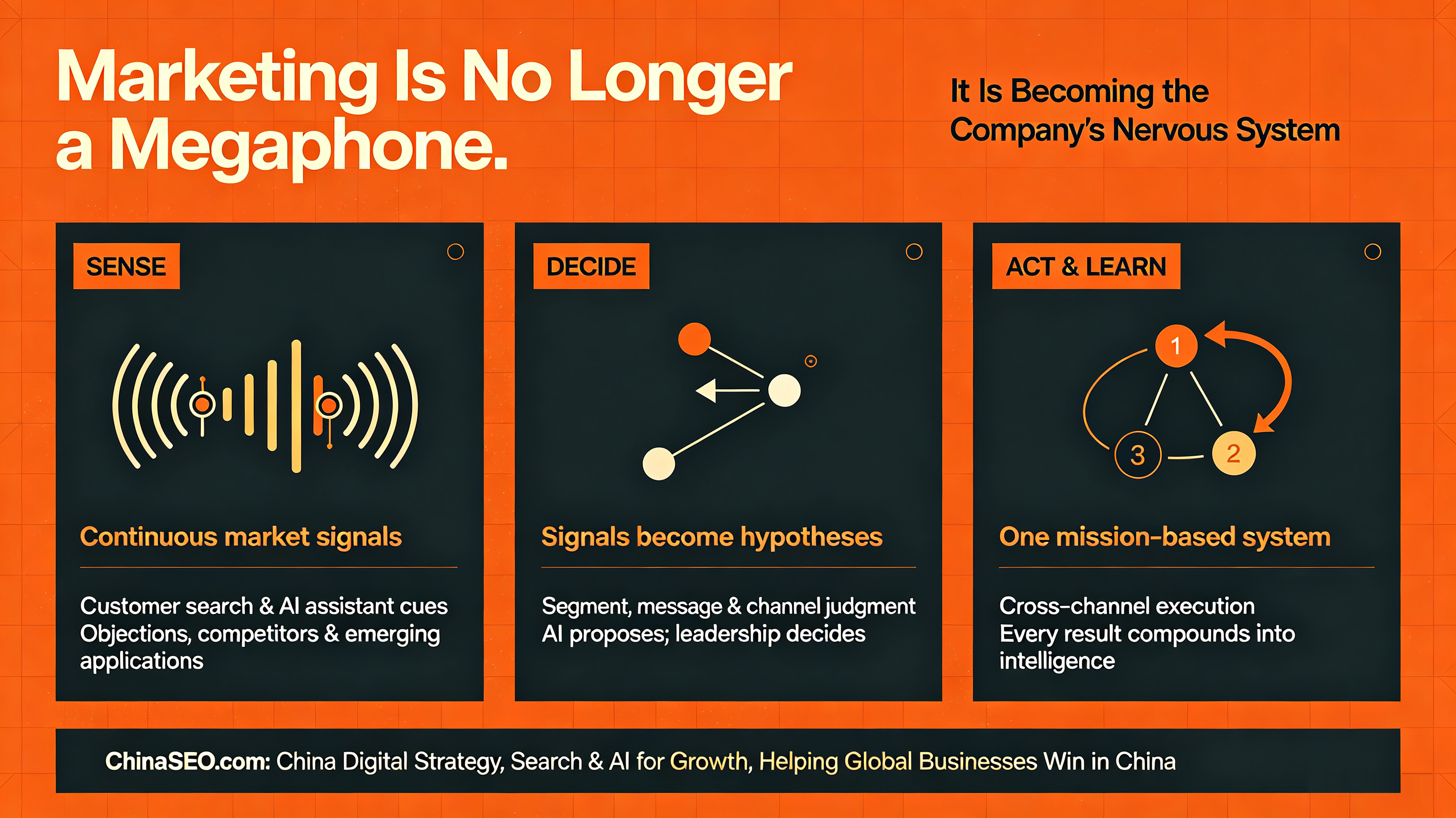
Strip away the jargon and an organizational intelligence system for marketing has four moving parts — and most companies have, at best, one and a half of them.
It senses. Not quarterly market research, but continuous instrumentation of demand: what customers search, what they ask AI assistants, which objections stall deals, which competitors gain share of voice, which applications are emerging before they have names.
It decides. Signals become hypotheses — which segments, which messages, which channels carry real commercial weight — and a human being with P&L accountability makes the call. AI proposes; judgment disposes.
It acts as one system, not seven departments. Here the organizational chart has to bend. Customers do not experience your SEO team, your content team, and your sales team; they experience one company across one decision journey. The emerging model is a small, mission-based customer acquisition team — accountable for winning a defined market segment — orchestrating specialized AI agents across research, content, distribution, and analysis. The human leads; the agents coordinate the supporting work. The unit of execution shifts from the job description to the mission.
It learns — and this is the part almost everyone skips. Most companies measure marketing; few learn from it. Measurement tells you the campaign got clicks. Learning tells you which claim made a skeptical engineer trust you, encodes that finding where the next campaign can use it, and retires the assumption that failed. A customer objection should not die in a sales rep’s memory. A successful article should not sit in the CMS as a trophy. Both are intelligence, and intelligence should compound.
Two companies can buy identical AI tools. The one that treats every campaign as an experiment and every interaction as data will, within a few years, operate with an understanding of its market that the other cannot buy, borrow, or prompt its way into. That is the moat.
Search Is Where This Stops Being Theory
If the intelligence-system framing sounds abstract, watch what is happening to search — the oldest discipline in digital marketing.
Buyers increasingly begin their research inside conversational AI: compare suppliers, explain this failure mode, who is credible in this category. The machine synthesizes; it does not merely list. Which means the old question — how do we rank for this keyword? — is being displaced by a harder one: how do we become the source an AI system understands, trusts, and recommends?
Notice what that question actually demands. Not keyword density. Not backlinks. It demands that a company’s expertise, evidence, applications, and reputation exist as coherent, machine-legible, corroborated knowledge — consistent across its site, its documentation, its case studies, and its third-party references. Generative Engine Optimization, understood properly, is not a checklist. It is a test of whether your organization has converted what it knows into infrastructure.
And here the loop closes: a company can only feed AI systems credible knowledge if it possesses that knowledge in structured form — which is exactly what a marketing organization built as an intelligence system produces as a byproduct. The promotional marketing department optimizes pages. The intelligence system becomes worth citing.
In B2B especially, where buyers research for months before ever contacting a vendor, your first sales conversation now happens between your customer and a machine. Whether you are present in that conversation depends on everything your organization has learned, encoded, and published up to that moment. Marketing has moved upstream, from generating visits to establishing standing credibility. It has become, quite literally, the system by which the market comes to understand you.
Three Assets That Compound
If tools are commoditizing, differentiation migrates to whatever cannot be copied with a subscription. Three assets qualify, and each is a property of the organization rather than of any individual.
Proprietary customer intelligence. The most valuable knowledge about your buyers — why they hesitated, what nearly killed the deal, what they actually value — flows through your sales conversations, service records, and project histories every day, mostly evaporating on contact. Companies that capture and structure it hand their AI something no competitor’s AI has: their reality.
Learning velocity. Same tools, same budgets, diverging trajectories. One organization runs each campaign smarter than the last because yesterday’s results change tomorrow’s assumptions. The other produces the same content calendar with better software. Efficiency is a race to parity; learning is a race away from it.
Digital trust infrastructure. In a feed saturated with generated content, credibility is the filter — for humans and machines alike. Evidence-backed claims, consistent identity, authoritative corroboration: this is the layer that makes everything else convertible into demand.
Notice the common thread. All three are intelligence assets. All three compound. And none of them appears on the budget line marked “promotion.”
Five Questions for the Next Board Meeting
This redesign cannot be delegated to the marketing department, because the obstacles are structural, not technical. Five questions will tell you where you stand.
Are we organized around our internal functions or around the customer’s journey? Do we reward marketing activity or commercial outcomes? When a project ends, does its learning enter the organization’s memory or leave with the agency? Are we automating processes we should be abolishing? And the one that matters most: can our marketing organization learn faster than our customers’ behavior is changing?
If those questions sting, the machinery-upgrade trap has already been sprung.
Looking Ahead: The Next Three to Five Years
Short term (12–24 months). Content deflation accelerates; undifferentiated output approaches zero value. AI-mediated discovery takes measurable share of B2B and considered-purchase research, and early movers in machine-legible credibility will harvest outsized visibility while laggards wonder where the traffic went. Expect the first wave of reorganizations: mission-based growth pods absorbing what were separate SEO, content, and performance functions. The practical move now is unglamorous — audit where customer knowledge currently dies inside your company, and build the pipe that captures it.
Long term (3–5 years). The marketing organization as we know it bifurcates. Routine production collapses into AI agent layers supervised by small human teams; the surviving human core concentrates on judgment, trust, and strategy. The CMO role converges with what we might call a chief intelligence officer for demand — accountable not for campaigns but for the quality of the company’s understanding of its market. Companies that compounded learning early will hold advantages that look, in retrospect, unfair: five years of structured customer intelligence is not catchable in a quarter, at any price.
The strategic priority, then, is sequencing: capture knowledge before scaling production, build trust infrastructure before chasing AI visibility, and redesign accountability around learning before reorganizing around tools.
The Closing Thought
Baidu’s Robin Li, speaking at the company’s 2026 World Conference, put the organizational point plainly: AI is the new electricity, but most companies have not yet redesigned their factories. He was describing a general condition. In marketing, it is simply easier to see.
The companies that win the next decade will not be the ones that produce the most marketing. They will be the ones that understood, earliest, what marketing was becoming — not a louder megaphone, but a nervous system: sensing the market continuously, learning from everything it touches, and converting that intelligence into customers won and kept.
The megaphone is a commodity. The nervous system is a monopoly you build one learning cycle at a time.
 Unlock 2026's China Digital Marketing Mastery!