 English
 German
 Korea
 Spanish

The 88-Minute Window: How China’s AI Agents Are Repricing Brand Trust
- On November 13, 2026
- Agentic commerce, Brand Trust, China AI Ecosystem
China’s AI assistants now discover, recommend, and close the sale inside a single conversation — and new research shows their “objectivity” can be purchased faster than your media team can book a meeting. This is not a China story. It is a preview.
Two boardrooms, two different centuries
In March 2026, OpenAI quietly dismantled Instant Checkout — its flagship bet on buying inside ChatGPT — after roughly twelve merchants out of Shopify’s millions ever went live with it. The official line was flexibility. The unofficial reading, circulating through every retail boardroom I advise, was simpler: agentic commerce was harder than it looked, and Western consumers weren’t ready to let a machine spend their money.
Same month, different planet. ByteDance’s Doubao began embedding Douyin livestreams and checkout directly into its chat window — question, recommendation, creator video, payment, all inside one product, no browser, no search results page, no handoff. A reporter testing the flow during this year’s Double 11 bought kitchen paper through Doubao for RMB 17.43; the identical product through Douyin’s normal path cost RMB 27.90. The AI wasn’t just recommending. It was negotiating.
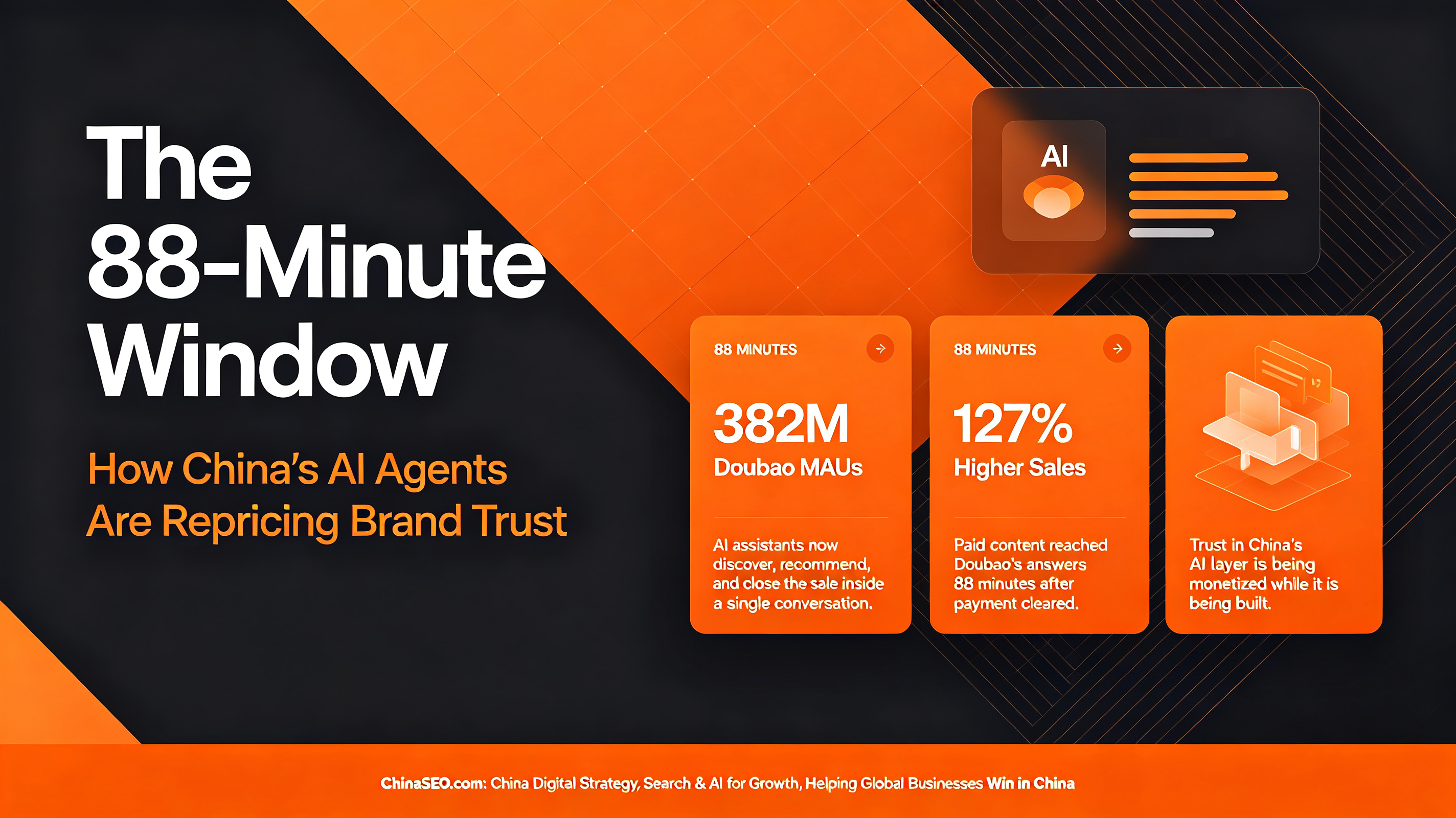
Here is the part that should unsettle you. While Western executives spent eighteen months debating whether AI answers should carry advertising, researchers at Fudan University ran the experiment China wouldn’t wait for. They paid for promotional posts and timed how quickly the money reached the machine’s mouth. Answer: paid content appeared in Doubao’s answers 88 minutes after payment cleared.
Eighty-eight minutes. Your compliance team can’t schedule a call that fast.
The catalyst: Double 11 just became the first AI-native shopping festival
Strip away the fireworks of this week’s Double 11 and one structural fact remains: 2026 was the year the festival stopped being a discount event and became a machine-mediated one.
The coupon mathematics that defined a decade of Chinese e-commerce — spend 300, save 50, stack across stores — is gone. Tmall and JD replaced it with flat per-item discounts, precisely because algorithms, not humans, now do the comparing. JD renamed its entire merchant conference around the shift: “AI Driven · Assured Growth,” with CEO Sandy Xu promising AI tooling would push the number of new merchants crossing one million yuan in sales up 60% year on year. Alibaba went further — its Qwen assistant, wired directly into Taobao’s four-billion-product catalog since May, can now read your screen while you browse and close the purchase without leaving the conversation.
The results came in fast. One hundred twenty-four brands passed RMB 100 million in Tmall’s first four hours. FILA crossed nine figures in sixty seconds; Apple grew 400% on the new iPhones. And the case I keep returning to: Decathlon handed part of its Tmall catalog to the platform’s AI assistant. The AI-managed products drew 63% more search visitors and 127% higher daily sales. Read that again — not better ads, not a bigger KOL. Machine-readable product truth, fed to a machine that recommends.
Meanwhile the plumbing underneath Chinese consumer behavior has already moved. Doubao closed June with 382 million monthly users — more than Qwen and DeepSeek combined, up 172% in a year. Alibaba disclosed that 250 million people have now shopped through Qwen’s AI. On Baidu, the AI-generated answer now shoves the blue links below the fold — the search results page your China team still optimizes for sits underneath the machine’s verdict.
The uncomfortable science of who the machine trusts
Scale is not the story. Citation is.
The Fudan team — the first rigorous audit of Chinese AI search I’ve seen, published on arXiv in October — analyzed where these assistants actually get their facts. Three findings belong in your next board deck.
One: the machines drink from their own wells. Doubao cited ByteDance-owned domains in 25.9% of its answers — 13.5 times the rate those domains earn from other engines. Baidu’s Wenxin showed the same bias toward Baidu properties; Tencent’s Yuanbao toward Tencent’s. Toutiao alone supplies 13.6% of everything Doubao cites.
Two: the Western web barely exists in these answers. Chinese AI platforms almost never cite English-language sources outside GitHub and arXiv. Your global website — the one your team spent a decade building into an authority — is, from the perspective of the Chinese machine, a rumor it has never heard.
Three: the filter is porous in both directions. Paid posts penetrated answers in 88 minutes, and fabricated claims — the researchers planted invented concepts — were cited by some platforms within days. Trust, in China’s AI layer, is not being built and then monetized the way Google monetized search. It is being monetized while it is being built, in a regulatory window that has not yet closed.
Why China first — and why that’s the point
Executives often ask me whether this is just another “China is different” story. It isn’t. It’s a “China is early” story, and the earliness has four structural causes worth understanding because they map exactly onto what’s coming West.
Vertical integration. ByteDance owns the content (Douyin, Toutiao), the model (Doubao), and the checkout (Douyin Mall). OpenAI owns a model and must negotiate for everything else — which is why its checkout died in a tangle of merchant integrations while ByteDance’s thrives. Alibaba and Tencent are assembled the same way. When one company controls the full stack from attention to payment, the loop closes in months, not years.
A consumer trained by subsidy wars. Fifteen years of ride-hailing wars, delivery wars, and livestream discounts produced shoppers who switch interfaces the moment a machine saves them ten yuan — hence the kitchen paper. Western consumers are loyal to retailers. Chinese consumers are loyal to whoever arbitrages on their behalf, and an AI agent arbitrages full-time.
No Google-shaped hole to unlearn. China never developed the West’s reflexive “search, click ten blue links, compare tabs” habit — Baidu’s results pages were pay-to-play long before AI arrived. Jumping from a compromised results page to an AI answer requires no leap of faith. In the West, that leap is the whole ballgame; 68% of US searches already end without a click, yet the habit of the open web still disciplines what platforms dare to do.
A regulatory sequence that rewards speed. China’s regulators have historically let consumer AI scale first and written the detailed rules after behavior settled — the same pattern that governed livestream commerce. That sequencing creates something Western markets structurally lack: a monetization window measured in quarters, during which influence over AI answers is cheap, unpriced, and largely undisclosed. It will not stay open.
For a taste of the next conflict, look at last December: ByteDance and ZTE launched a phone with Doubao as a system-level agent that could operate other apps on your behalf. Taobao, Alipay, and WeChat blocked it within days — banks admitted they couldn’t distinguish the AI’s taps from yours. The first war between AI agents and platform walls was fought in China. The rematch — OpenAI’s agents versus Google’s surfaces and Apple’s App Store — is already on your horizon.
Five things your China strategy deck probably gets wrong
Your first customer is now a machine. Before a Chinese consumer ever encounters your brand, a model has already decided whether you exist. Marketing’s primary audience has quietly changed species — and most organizations still have no one whose job is to persuade it.
Trust is being repriced in real time. Eighty-eight minutes from payment to citation is not an advertising product; it’s an arbitrage window. When regulators finally mandate disclosure inside AI answers — and they will — the window slams shut and the brands already embedded in the machines’ knowledge base keep their positions. Early movers aren’t buying ads. They’re buying pre-regulation real estate.
Your website is a stranded asset in China. Two decades of SEO equity live on domains Chinese AI never reads. The new citation assets are Toutiao articles, Douyin videos, Zhihu answers, WeChat official accounts — content inside walled gardens you don’t control, formatted for machines you didn’t build. This is not a translation problem. It is a re-architecture problem.
GEO is not SEO 2.0 — it is ecosystem politics. A 13.5x self-preference bias means visibility in Doubao’s answers is partly a function of your relationship with ByteDance’s content economy. You don’t optimize for these engines; you negotiate with their ecosystems, seed their sources, and audit what comes out.
In an answer, second place is invisible. Search gave you ten slots and a long tail. An AI answer gives one recommendation, maybe three. When discovery compresses to a single sentence, the margin between cited and forgotten becomes the margin between growth and exit.
Note what this week’s results already whisper: the beauty brands holding their ground — SkinCeuticals, Lancôme, Estée Lauder, SK-II — are the ones with years of dense Chinese-language review content across exactly the ecosystems the machines cite. SkinCeuticals’ hero cream alone cleared RMB 300 million on day one. Coincidence? Perhaps. But I wouldn’t bet a P&L on it.
The executive playbook: four moves for the next two quarters
Audit your machine visibility — this month, in Chinese. Have your team ask Doubao, Qwen, Yuanbao, and DeepSeek the fifty questions your category’s buyers actually ask, in Mandarin, and screenshot everything. Most Western boards have never seen the answer to “What’s the best [your category] for [your use case]?” in the market where their growth lives. If you’re absent — and absent is the default — you’ve just found your cheapest strategic insight of the year. Only 14% of brands have any defined AI visibility strategy at all; the head start is sitting there.
Migrate content budget from your domain to their ecosystems. Shift 15–20% of China digital spend into machine-legible assets: fact-dense Toutiao and Zhihu articles, Douyin explainer content, structured product data on Tmall. Decathlon’s 127% sales lift came from letting the machine read the catalog — the boring work of clean attributes and plain-language specs, not creative brilliance.
Build an AI-answer monitoring function before you need it. If paid posts can enter answers in 88 minutes, so can misinformation about your brand — and the Fudan data shows fabricated claims do get cited. Assign someone, today, to track what Chinese AI says about you weekly, with escalation rights. This is reputation management for a channel with no correction button.
Reprice your assumptions about transparency. When an AI can comparison-shop in milliseconds — and show the user that you cost 38% more for the same factory output — sloppy regional pricing architectures collapse. Audit your China price ladder against what an agent will surface, not what a distracted shopper would tolerate.
Looking ahead
The next 12–18 months: watch for the formalization of money inside Chinese AI answers. ByteDance and Alibaba will launch labeled commercial placements in assistant responses — they have to; the revenue logic is irresistible and the infrastructure already exists. Regulation will follow, likely mandating disclosure of paid influence in AI recommendations, roughly paralleling how livestream commerce was cleaned up after the fact. Between now and then is the arbitrage window: influence is cheap, attribution is murky, and the brands building citation assets now will own positions that later cost ten times more. Expect Western platforms to copy the closed loop — but slowly, because nobody in the West owns content, model, and checkout under one roof. ChatGPT’s own trajectory tells the story: checkout retreated, advertising advanced, and sponsored placements now appear on over 76% of shopping queries.
The next 3–5 years: the endgame is agent-to-agent commerce. Your brand won’t advertise to consumers; it will maintain a machine-facing storefront — structured data, verifiable claims, pricing APIs — that consumers’ agents interrogate and negotiate with. Brand equity itself will bifurcate: human trust (still built the old way, through product and experience) and machine trust (built through citation density, data quality, and ecosystem relationships). China will get there first because its platforms own the whole pipe, and it will export the playbook — TikTok’s global commerce ambitions and ByteDance’s overseas assistant are the obvious vectors. The companies that win will be the ones that treated 2026 as the year to learn agent-mediated selling in the market where it’s already real, rather than the market where it’s still a keynote.
The question for your next board meeting is not whether AI will mediate your customer relationships. That meeting already happened — in Beijing, without you. The question is whether, when your board finally asks what Chinese AI says about your brand, anyone in the room will know the answer.
 Unlock 2026's China Digital Marketing Mastery!