 English
 German
 Korea
 Spanish

The First Singles’ Day the Machines Shopped
- On November 12, 2026
- china ecommerce, china singles' day
What a RMB 17.43 Roll of Kitchen Paper Tells You About the Next Five Years of Commerce
The most important transaction in Chinese retail this year was a roll of kitchen paper.
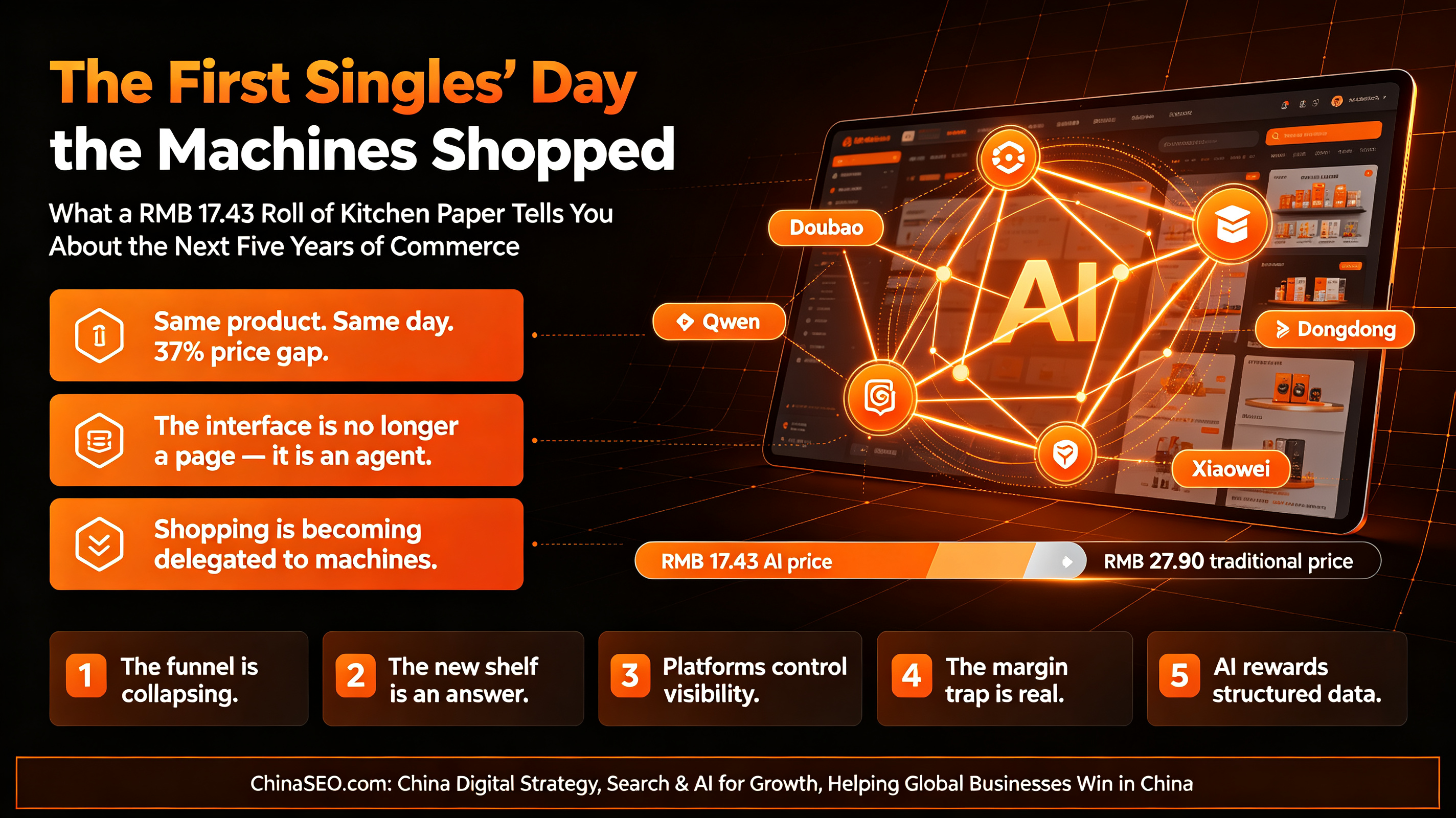
In late October, three weeks before the peak of this year’s Double 11 shopping festival, a Chinese reporter ran a small experiment. ByteDance had just embedded Douyin livestream shopping rooms inside Doubao, its AI assistant — which now counts 382 million monthly active users, more than the population of the United States. The reporter asked the assistant for kitchen paper. The agent found a livestream, surfaced an offer, and completed the order at RMB 17.43. The same product, bought the old way — scrolling Douyin, tapping into a store, checking out — cost RMB 27.90.
Same platform. Same product. Same day. A 37 percent price gap, determined entirely by which door you walked through — your own fingers, or an AI’s.
That gap is the story. Not the discount itself, but what it implies: in China, the interface between a brand and its customer is no longer a page, a feed, or a search box. It is an agent. And on November 11, 2026 — the biggest single day of consumer spending on earth — that agent went from experiment to infrastructure.
If your mental model of China is still “a big e-commerce market with different apps,” you are looking at the wrong layer. What changed this autumn is not where Chinese consumers shop. It is who does the shopping.
The Catalyst: A Festival Quietly Rebuilt Around AI
Double 11 has been declining as a cultural spectacle for years. GMV counters went dark, platforms stopped boasting, and the 2025 edition posted RMB 1.695 trillion in online sales with more fatigue than fanfare. So when the 2026 festival opened in mid-October, most Western observers filed it under “mature promotion event, diminishing returns.”
Look closer. Underneath the familiar discounting, every major platform rewired the purchase journey around AI agents in the same four-week window.
Alibaba’s Qwen app began closing Taobao purchases entirely inside the chat interface, and a new “Qwen shops with you” mode can read a shopper’s screen as they browse Tmall and answer questions in real time. ByteDance folded Douyin’s livestream commerce into Doubao, as the kitchen-paper test showed. JD.com set its merchant conference theme as “AI-driven, certain growth” and deployed its Dongdong assistant across the festival. Tencent, characteristically quieter, has been testing Xiaowei, an agent inside WeChat that can operate Mini Programs to find products and pay on a user’s behalf. As one agency put it in mid-October, shopping assistants from Alibaba, JD and ByteDance are “now integrated into the shopping experience on their respective platforms” — not as demos, but as load-bearing infrastructure during the year’s highest-traffic weeks.
Even the product catalogue changed. For the first time, AI itself went on sale: Zhipu, MiniMax and Qwen sold model token packs through a dedicated “AI Token station” on Tmall, alongside more than a hundred AI hardware products. China is now mass-marketing the raw fuel of the agent economy the way it once mass-marketed smartphones.
And the earliest returns suggest consumers are following the agents. On Douyin, merchants passing RMB 1 million in sales through search — the intent-capture layer agents feed on — rose 111 percent year on year in the opening phase. On Tmall, 124 brands crossed RMB 100 million in the first four hours of the main sale.
Why China, Why Now
It is tempting to attribute this to Chinese consumers’ appetite for novelty. That explanation is lazy, and wrong. Three structural conditions made China the first market where agentic commerce could run at festival scale — and none of them exists in the West.
The agents have hands, not just mouths. A Western AI assistant can recommend a product. A Chinese one can complete the transaction, because chat, product catalogue, payment and logistics already live inside the same corporate perimeter. When Alibaba opened the full Taobao and Tmall catalogue — over four billion products — to the Qwen app in May, with Alipay checkout native to the conversation, eMarketer called it the largest end-to-end agentic commerce deployment to date.
ChatGPT can tell you which running shoe to buy. Qwen can buy it, pay for it, and track the parcel. The difference sounds incremental. Strategically, it is the difference between a librarian and an employee.
The super-app substrate was already there. China did not need to teach consumers a new behavior; it upgraded an existing one. China entered the AI era with super apps already embedded into daily life — the platforms never had to find users for AI, because the users were already inside.
Western platforms face fragmented identity, payments and data across a dozen apps and a regulatory environment that treats cross-service data fusion as a problem to be managed. Chinese platforms treat it as a feature to be shipped.
Platforms are willing to buy the habit. During the 2026 Lunar New Year, China’s tech giants spent roughly $647 million subsidizing AI-mediated shopping — Alibaba alone put up $431 million.
Alipay processed 120 million AI-agent transactions in a single week of that campaign. One estimate had ByteDance, Alibaba and Tencent together burning about RMB 300 million a month on AI shopping tools with no proven business model behind them. Read that correctly: this is not marketing spend. It is customer-acquisition cost for the agent itself — platforms purchasing, in bulk, the reflex of asking an AI before buying. Once that reflex is installed, the subsidy can stop. The habit won’t.
What Actually Changed: Five Observations Worth Your Board’s Time
Strip away the festival noise and five structural shifts come into focus. Each has a longer half-life than Double 11 itself.
First: the funnel is not moving — it is collapsing. Discovery, comparison, price negotiation and checkout used to be four separate events a brand could influence separately. In an agent-mediated purchase they become one conversational act. You do not get four chances to win the customer. You get one chance to be the answer. A shopper who asks Doubao for kitchen paper never sees your competitor’s banner ad, your search placement, or your beautifully optimized product page. They see whatever the agent selects. That selection event — invisible, unbiddable (for now), and increasingly decisive — is where market share will be won or lost in China over the next three years.
Second: the new shelf is not a page, it is an answer. Agencies on the ground are already reorienting. WPIC, one of the larger China e-commerce operators, noted during the festival that its client teams are now actively helping brands position themselves to appear in AI-generated results.
This is GEO — generative engine optimization — and in China it is graduating from conference topic to budget line. The uncomfortable implication for headquarters: your brand equity now has a machine-readable component. If an agent cannot parse your product’s attributes, certifications, price history and review corpus, you are not “ranked lower.” You do not exist.
Third: platforms have found a new lever on brands, and it is subtle. The kitchen-paper price gap was no accident. Platforms are routing preferential prices and coupon inventory through the agent channel because they want the habit to form there. Which means brands now face a quiet toll: the depth of your discount increasingly buys not just conversion, but algorithmic visibility inside the agent. Douyin’s opening-phase data showed merchants passing RMB 100 million through platform coupons up 200 percent year on year. The agent is becoming the new shelf-stocker, and shelf-stocking has never been free.
Fourth: the margin trap is real, and the data is starting to surface. Agentic and algorithmic commerce amplifies impulse purchasing — and impulse purchasing has a hangover. During this festival, listed apparel company Baoxiniao disclosed a return rate of 49.9 percent on Douyin, against 38.3 percent on Tmall. When an AI optimizes for conversion, someone still has to optimize for kept revenue. That someone is you. Smart merchants are already adjusting: the sharpest signal from this year’s merchant interviews is a shift from GMV targets toward profit-after-returns, repeat-purchase rate and member acquisition as the festival’s real scoreboard.
Fifth: AI is compressing the translation cost of complexity — and rewarding those who feed it well. Tmall reported during the festival that AI tools rewriting technical specifications into plain language lifted apparel conversion by nearly twenty percentage points — turning “16.5-micron wool fibre” into “about one-fifth the width of a hair.” This cuts both ways. Brands with genuinely superior specifications now have a machine that can explain them at scale. Brands whose positioning survives on ambiguity and marketing fog have just been exposed.
The Executive Playbook
What should a Western CEO or CMO actually do with this? Five moves, in order of urgency.
1. Audit your machine visibility this quarter, not next year. Have your China team — or an agency — systematically query Doubao, Qwen, Yuanbao and DeepSeek about your category, in Chinese, the way a consumer would. Who does the agent recommend? What does it say about you? Is it accurate? Most global brands have never run this audit. It is the 2026 equivalent of checking your Google ranking in 2004, and it takes a week.
2. Rebuild your product content for two audiences. Your Tmall and Douyin listings are now read by humans and parsed by agents that mediate purchases. Structured attributes, certifications, comparison-relevant specs, review volume and price history all feed the recommendation layer. This is unglamorous work — data hygiene, not creative brilliance — and it will outperform your next campaign.
3. Reforecast your China marketing budget around answers, not impressions. The legacy split — SEM, feed ads, KOL spend — assumed a human scrolling. Start carving out a distinct GEO line item: authoritative content on the sources Chinese models trust, structured product knowledge, and agent-channel monitoring. Early movers are reporting that AI-mentioned keywords convert at multiples of non-mentioned ones.
4. Negotiate the subsidy, don’t just accept it. When platforms route traffic through agents with coupon co-funding, ask the unromantic questions: What is our margin after returns? Who owns the customer data from an agent-mediated sale? Does the agent channel cannibalize our existing repeat buyers, or add new ones? Platforms need premium brands inside their agents to make the recommendations credible. That is leverage. Use it.
5. Treat China as your early-warning system, not a regional P&L. Assign someone at group level to track Chinese agentic commerce the way you’d track a competitor’s R&D lab. McKinsey estimates agentic transactions could influence up to $5 trillion in sales globally by 2030.
The playbook being written in Hangzhou and Beijing this quarter — agent placement, machine-readable merchandising, conversational checkout — is the one Amazon, Google, OpenAI and TikTok will execute in your home market within 24 to 36 months. China’s Double 11 is your dress rehearsal.
Looking Ahead
The next 12 months. Expect the agent channel to get its own ad product — “agent placement,” paid inclusion in AI recommendations, disclosed or not. Regulators will follow: China has already shown it moves faster than Brussels or Washington on platform governance, and algorithmic recommendation transparency is an obvious next target. Price transparency will compress margins further in commoditized categories; when every consumer’s agent can find the 37 percent cheaper door, undifferentiated brands have nowhere to hide. And watch WeChat: if Tencent scales Xiaowei across 1.4 billion users, the last piece of Chinese daily life — the social graph itself — becomes transactional, and the agent wars enter their decisive phase.
The next 3–5 years. Three developments look probable. First, the model exports: TikTok’s global commerce ambitions, Amazon’s shift from Rufus toward a full Alexa shopping agent, and OpenAI’s retail partnerships are all downstream of what China is proving at scale right now — that consumers will delegate purchases to machines when the machine also holds the wallet. Second, brand equity bifurcates: companies will need a human brand (emotion, story, trust) and a machine brand (structured authority, review corpus, data integrity), and most organizations today are built to manage only the first. Third, agent-to-agent commerce emerges — your enterprise’s procurement AI negotiating with a platform’s selling AI — at which point the consumer marketing logic of the last thirty years completes its inversion.
The deeper pattern is worth naming plainly. Every previous platform shift — web, mobile, social — changed where brands met customers. This one changes who decides. The customer still pays. But increasingly, in the world’s most digitized consumer market, the customer no longer shops.
A roll of kitchen paper taught us that this October. The question for your next strategy review is whether you intend to be the answer the machine gives — or the product it quietly leaves on the shelf.
 Unlock 2026's China Digital Marketing Mastery!