 English
 German
 Korea
Korea Spanish
The Algorithm Doesn’t Just Find Your Customers. It Helps Create Them.
- On October 16, 2026
- recommed algorithm
What China’s recommendation-driven digital economy reveals about the future of marketing, the economics of attention, and the competitive advantage Western businesses cannot afford to overlook.
Imagine this. You mention to your spouse over breakfast that the refrigerator is getting old. No searches. No shopping apps opened. No messages sent. By the next morning, your social media feed serves up refrigerators.
Your first instinct? My phone is listening.
Reality, however, proves far more complex—and vastly more consequential for the bottom line. Digital platforms infer intent long before it turns explicit, parsing browsing fingerprints, spatial pings, and historical peer patterns to forecast what you desire before you even articulate it.
Yet, for corporate leaders, this capability sparks a far sharper dilemma: What happens to your growth strategy when you no longer need to wait for a buyer to raise their hand?
China’s recommendation-first digital ecosystem—spanning Douyin, Xiaohongshu, and beyond—unveils a future already bleeding into TikTok, Instagram Reels, and YouTube. The paradigm has shifted. Algorithms haven’t merely optimized traditional marketing; they have rewritten the very economics of demand creation.
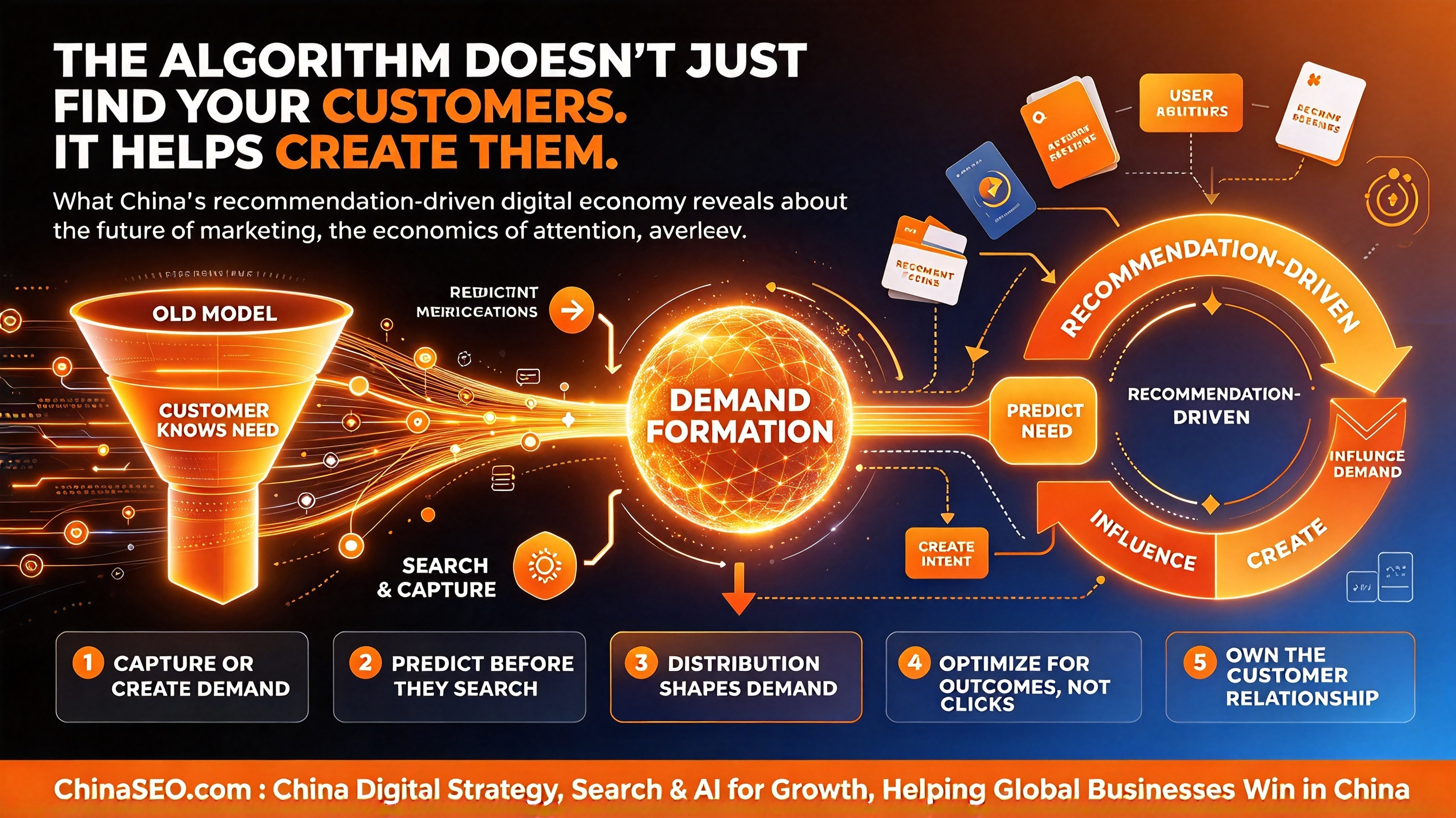
1. The Old Playbook Started After the Need; the New One Shapes It
For decades, modern marketing followed a predictable, linear march. A buyer felt a pain point. They queried search engines, polled peers, or visited a storefront. Brands then scrambled to capture that active intent.
Search ads were built precisely for this reactive loop. Someone needs an industrial drainage system or a replacement compressor; the enterprise that captures that exact query wins the pipeline.
That machinery still matters. But it ignores a foundational gap: Who primes the buyer before they even know what to search for?
Picture a consumer winding down with short-form video after dinner. They aren’t hunting for a coffee machine. They want entertainment. An algorithm serves up a clip of a master brewer extracting a precise espresso shot. Curiosity sparks. They watch another clip, read community breakdowns, compare specs, and hit buy.
The journey didn’t start with a keyword query. It started with a recommendation.
The algorithm didn’t just route the customer to a product; it planted the seed of desire itself. If your marketing engine only kicks in after someone types your product category into a search bar, you are surrendering the entire genesis of their decision-making.
2. Prediction Beats Profiling
How do recommendation engines pull this off without reading minds?
Through collaborative filtering and massive behavioral prediction loops. Platforms don’t need a psychological masterclass on why users love a specific product; they spot statistical correlations across millions of touchpoints and update their predictions in real time.
Traditional market research leans on surveys, focus groups, and explicit feedback—methods notoriously constrained by what people say they want versus how they actually behave.
Recommendation systems bypass that noise entirely by tracking raw, unvarnished action.
For executives, this introduces an uncomfortable corporate audit: If a platform can predict what your prospective buyers will watch, click, or procure before they do, what is your actual competitive moat? Is it your customer intimacy? Your product engineering? Or your capacity to game the prediction system that decides whether you exist in their feed at all?
Confusing platform reach with owning a durable customer relationship is a fatal strategic gamble.
3. The Algorithm Isn’t a Channel. It’s a Market-Maker.
Traditional distribution channels connect products to buyers. Recommendation engines go a step further: they dictate visibility, curate consideration sets, and allocate market share.
Put two identical B2B manufacturers side by side:
- Manufacturer A builds superior hardware but treats digital platforms as an afterthought.
- Manufacturer B produces solid gear, natively understands native content formats, and feeds the recommendation engine structured, highly engaging technical assets.
Manufacturer B scales interactions, gathers rapid market feedback, and uncovers emerging niches overnight. Their advantage compounds.
Visibility is no longer tied strictly to product excellence; it reflects an enterprise’s fluency within attention-distribution infrastructure. Platforms are not passive billboards—they are the arbiters of commercial opportunity.
4. When Metrics Become Masters: The Trap of Optimizing for Engagement
Every system optimizes for what it is fed. Tell an algorithm to chase clicks, watch-time, or cheap top-of-funnel leads, and it will deliver—regardless of whether those metrics translate into profitable lifetime value.
Goodhart’s Law reigns supreme here: When a measure becomes a target, it ceases to be a good measure.
Corporate marketing often falls into the exact same trap. Reward agencies for raw lead volume, and sales teams drown in unqualified prospects. Reward teams for quarterly conversions, and long-term customer health gets sacrificed.
Automation doesn’t cure structural myopia; it accelerates it at scale. The CEO’s mandate isn’t just to deploy smarter martech stack tools, but to interrogate what those tools are actually optimizing for.
5. Personalization vs. Pricing Power
Predictive accuracy unlocks massive commercial leverage, particularly in how offers, timing, and pricing are deployed.
Yet, technical feasibility does not equal commercial wisdom. Dynamic pricing and individualized offers can certainly extract short-term margin from less price-sensitive buyers. But pricing is fundamentally tied to perceptions of fairness.
If a buyer discovers they were billed a premium simply because predictive analytics flagged their urgency, trust shatters. And when trust erodes, the damage bleeds far beyond a single ledger—torpedoing brand equity, customer retention, and long-term valuation.
Never optimize today’s transaction at the expense of tomorrow’s relationship.
6. The Trust Paradox: Precision Breeds Scrutiny
Personalization walks a razor-thin line. Relevant recommendations make customers feel understood; hyper-accurate inferences make them feel surveilled.
When predictive systems cross the boundary from helpful suggestions into exploiting personal vulnerabilities, the commercial fallout is severe. In Western markets defined by strict regulatory frameworks and consumer privacy expectations, data governance cannot be outsourced entirely to the legal department.
A business that can predict behavior without being able to defend how it gathered or used that prediction possesses a lethal tool—and a fragile market position.
7. What the West Can Learn From Recommendation-Driven Ecosystems
China’s digital economy serves as a high-speed stress test for the West because discovery, social validation, and commerce are completely fused into daily consumer behavior.
Buyers encounter categories they never knew existed, watch real-time demonstrations, debate specs in community threads, and execute transactions without ever leaving the flow of content.
Western enterprises face matching dynamics across TikTok, Instagram, and YouTube, even as traditional search and enterprise marketplaces retain dominance in specialized B2B sectors.
The takeaway isn’t to copy foreign tactics line-by-line. The takeaway is to audit your own blind spots: How much demand is captured after a search, and how much is quietly shaped long before the buyer ever reaches out to sales?
8. The Strategic Sin: Renting Access Instead of Owning Relationships
Platforms grant unprecedented reach, but they also exact a toll. Too many companies generate millions in revenue while remaining utterly blind to why customers buy, what unserved pain points linger, or what keeps them coming back.
The platform holds the data. The platform owns the interface. When algorithms or ad rates shift overnight, the dependent business bleeds.
The fix isn’t abandoning platforms—that’s commercial suicide. The fix is aggressively building compensating assets:
- First-Party Intelligence: Deep behavioral and transactional insights harvested via transparent, lawful channels.
- Brand Equity: A reputation that survives platform policy pivots.
- Direct Channels: Unfiltered lines of communication for support, education, and community.
- Verifiable Proof: Engineering data, third-party validations, and case outcomes that establish unassailable credibility.
In B2B, a video might introduce an industrial supplier, but the purchase order depends entirely on technical documentation, compliance guarantees, and confidence in execution.
9. Five Questions Every Executive Boardroom Must Ask
- Are we capturing demand, or are we helping create it? Map the invisible months of the customer journey before the first search query is ever typed.
- What are our marketing systems actually optimizing? Strip away vanity metrics. Are you driving incremental margin, or just buying expensive noise?
- Where is the line between relevance and manipulation? Draw hard ethical boundaries around your targeting and pricing strategies.
- Do we own a relationship, or are we renting an audience? Calculate how much of your pipeline vanishes if a platform changes its algorithm tomorrow.
- Are we optimizing transactions, or building preference? Does your marketing build enduring loyalty, or does it merely fund temporary attention?
Conclusion: Earn the Right to Be Chosen
The algorithmic revolution is rarely discussed for what it truly is: a permanent shift in the economics of demand.
Marketing is no longer just about hunting down people who already want your product. It requires mastering how interests ignite, how trust scales, and how platforms mediate attention.
Algorithms can fast-track your customer discovery. They can forecast desires and orchestrate digital journeys.
But prediction is not trust. Engagement is not loyalty. And gaming an interface is a far cry from earning a choice.
The long-term winners won’t simply be the slickest manipulators of the ad auction. They will be the enterprises that pair predictive agility with unshakeable product value, deep market authority, and customer relationships that outlive any single platform.
Let the algorithm find them. Give them a reason to choose you when the feed goes dark.
 Unlock 2026's China Digital Marketing Mastery!