 English
 German
 Korea
Korea Spanish
When AI Becomes the Customer, Who Owns the Customer?
- On October 15, 2026
- AI Agents & Digital Platforms, AI marketing
Your customer is vanishing. Not from the market—but from your interface.
Right now, a traveler planning a London getaway skips Airbnb entirely. A procurement director sourcing industrial valves bypasses supplier directories. They are delegating the grunt work of comparison, filtering, and vetting to an AI agent.
This is not a software upgrade. It is a tectonic fracture in commercial power.
When software makes the short-list, your multi-million-dollar marketing funnel, your glossy landing pages, and your finely tuned SEO strategy collide with a brutal reality: machines do not browse. They evaluate.
If your competitive advantage relies on catching a human eye during a casual scroll, you are building your house on sand.
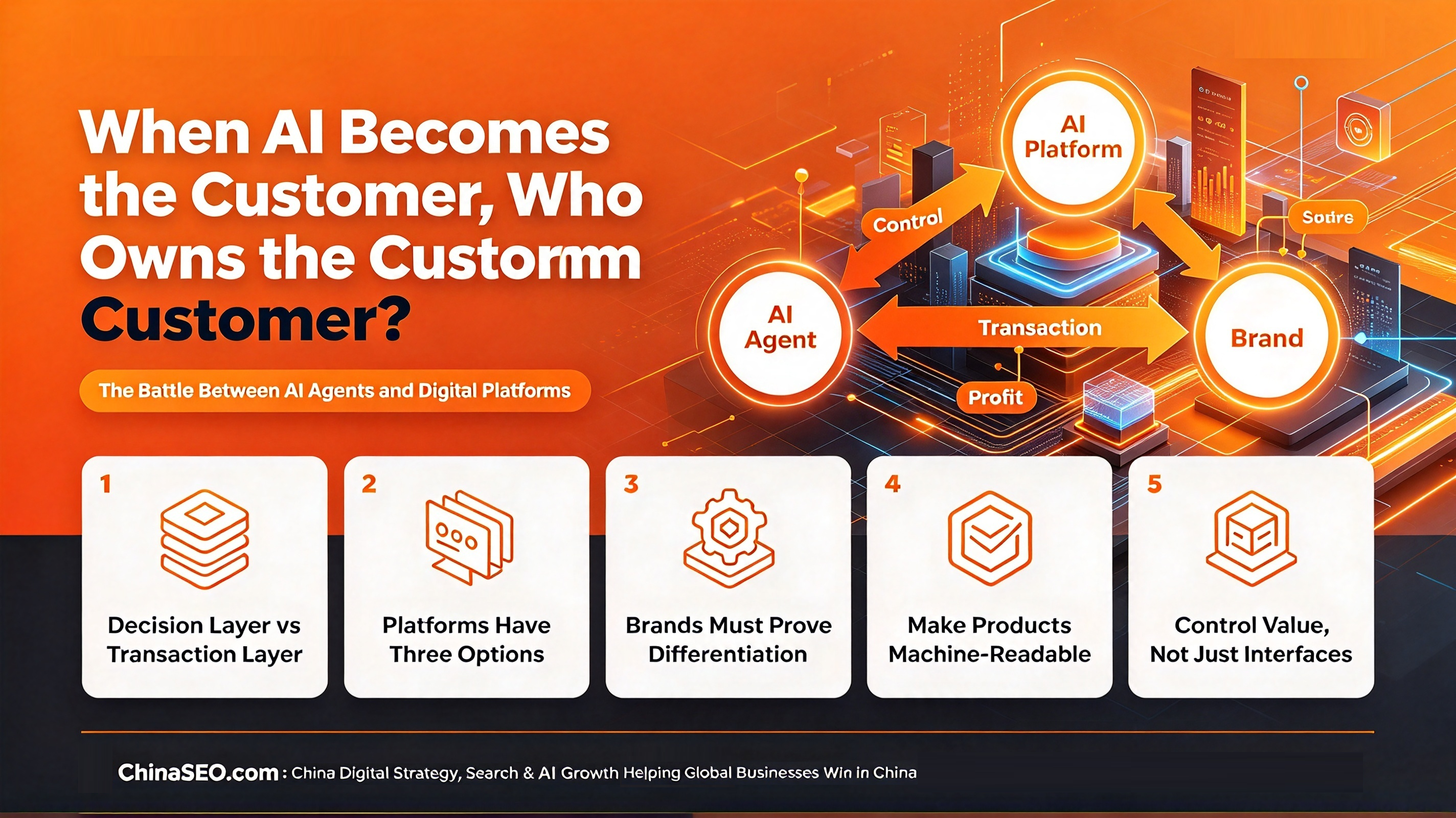
The Great Unbundling: Decision vs. Execution
For decades, digital platforms enjoyed a comfortable monopoly. They owned the entire journey—capturing attention, dictating comparisons, processing the transaction, and hoarding the data.
Amazon, Expedia, and enterprise marketplaces did not just sell goods. They sold discovery. They leased you the right to be seen.
AI agents are tearing that architecture apart.
They operate in the shadows between intent and checkout. An agent crawls dozens of vendor catalogues, cross-references warranty claims, weighs delivery risks against historical downtime, and spits out a single, definitive recommendation. The buyer taps “Approve.”
Suddenly, the entity that holds the transaction interface is no longer the entity that shaped the purchase decision.
- The decision layer migrates to the AI assistant.
- The transaction layer remains with the platform or merchant.
- The product sits wherever the economics make sense.
Look at the skirmishes already breaking out. When tech giants throw up walls—such as retail platforms blocking automated shopping bots over unauthorized data scraping—they are not just guarding servers. They are fighting for their right to tax the discovery process.
Do not expect platforms to surrender quietly. They will bunker down behind proprietary closed loops, launch their own native assistants, or selectively monetize APIs. But the fundamental leverage has shifted. The company that owns the customer’s intent will dictate terms to everyone downstream.
Why the “Rational Buyer” Myth Will Break Your Pricing
There is a comforting fantasy floating through corporate boardrooms: AI will turn markets into pure, frictionless math.
Proponents argue that machines will sniff out the absolute lowest price, rendering branding, emotional appeal, and design obsolete.
That theory collapses the moment you look at complex B2B procurement or premium consumer goods.
Lowest price is rarely lowest cost. A cheap valve that fails on a chemical plant line triggers millions in downtime losses. A budget hotel with rigid non-refundable cancellation clauses is a liability for an executive whose meetings shift on a dime.
An intelligent agent cannot choose the “best” product unless it understands variables that go far beyond a price tag.
This introduces a harsh truth for incumbent brands: AI does not eliminate brand value—it acts as an audit engine for it.
If your brand equity rests on hollow adjectives like “industry-leading” or “uncompromising quality,” an algorithm will shred it to pieces. But if your premium pricing is anchored to verifiable operational metrics, rigorous field tests, and clear failure-mode documentation, the machine becomes your best salesperson.
When Your Value Proposition Becomes a Spreadsheet Row
Imagine three industrial manufacturers bidding for a major supply contract.
- Supplier A invests in high-gloss branding, corporate heritage videos, and emotional storytelling.
- Supplier B lists basic technical specifications, dimensions, and standard retail prices.
- Supplier C publishes structured performance matrices, environmental tolerance limits, verified failure rates, integration constraints, and scenario-specific engineering guides.
When an AI agent evaluates the shortlist, Supplier A gets filtered out for lack of data. Supplier B looks indistinguishable from twenty competitors. Supplier C gets recommended because its data is legible, verifiable, and directly answers the procurement team’s operational risk profile.
This is what happens when your enterprise capabilities are translated into machine-readable assets.
Executive leaders must audit their organizations against three unpardonable questions:
- Can an external system parse your true differentiation without a human sales rep walking them through a slide deck?
- Are your marketing claims backed by hard, structured evidence—or are they trapped in marketing prose?
- Do you understand the specific operational headaches your product cures, or are you still selling features?
If your differentiation vanishes the moment it hits a structured data feed, your moat does not exist.
The Executive Playbook: Securing Your Position in the Agentic Economy
You cannot outrun this transition by doubling down on legacy playbook tactics. Buying more keyword ads or churning out generic blog posts will not save you when the buyer is an algorithm.
If you want to command margins when agents control the shortlist, execute these five moves:
1. Architect Machine-Readable Assets
Stop designing your digital presence solely for human eyeballs. Build robust product feeds, clean APIs, and transparent technical documentation. Eliminate ambiguity between what you claim and what an automated verifier can confirm.
2. Turn Expertise into Proof
Erase empty superlatives from your collateral. Replace them with rigorous test data, transparent compliance records, environmental boundary limits, and documented customer outcomes. Real operational proof is nearly impossible for competitors to fake.
3. Diversify Your Route-to-Market
If ninety percent of your revenue flows through a single marketplace, a single search engine, or a single dominant platform, you do not have a business model—you have a landlord. Build direct customer relationships, owned digital assets, and alternative distribution channels before the rules change.
4. Reclaim the Post-Transaction Relationship
When an intermediary or an AI agent intermediates the sale, you risk becoming an invisible contract manufacturer with zero relationship to the end user. Double down on onboarding, technical support, community, and direct value delivery that makes switching painful.
5. Recalibrate Unit Economics
Agent-driven commerce will compress margins in commoditized categories while rewarding specialized mastery. Run the numbers now: Does an AI-routed channel expand your addressable market, or does it simply commoditize your pricing power?
The Bottom Line
Platforms will adapt. Algorithms will evolve. New intermediaries will rise to take the place of old ones.
Fixating on which specific AI model or app will win the consumer interface is a distraction.
The real test of leadership is simpler and far more demanding: What makes your business indispensable when nobody has to look at your website to choose you?
In the agentic economy, power does not belong to whoever owns the screen. It belongs to whoever delivers the irreplaceable value—and proves it.
 Unlock 2026's China Digital Marketing Mastery!