 English
 German
 Korea
 Spanish

Why AI Trust Cannot Simply Be Bought
- On October 14, 2026
- AI trust, china geo
What China’s Media-Led GEO Boom Reveals About the Next Battleground in Marketing
As generative AI inserts itself between businesses and their buyers, digital leverage is shifting. Producing a higher volume of content no longer wins markets; becoming a verifiable, discoverable source of truth does.
When Trust Becomes a Commodity
Picture a procurement director evaluating industrial suppliers. Instead of vetting dozens of vendor websites, downloading heavy specification PDFs, and chasing sales reps, she prompts an AI assistant to surface the best-fit vendors, cross-examine their engineering claims, and flag operational risks.
Seconds later, the assistant outputs a shortlist with supporting evidence.
Your company is missing. Or worse, you are on the list—and the AI has mischaracterized your manufacturing tolerances.
You have spent years pouring capital into your website, technical SEO, performance ads, and thought-leadership blogs. None of it protects you. None of it ensures the model reads your business accurately or includes you in the commercial dialogue.
This is the structural fault line of AI-mediated commerce.
In China, a fascinating counter-movement is taking shape: mainstream media houses and authoritative publishers are aggressively moving into Generative Engine Optimization (GEO). They are capitalizing on a raw corporate panic—the urgent need to control how enterprise brands appear inside machine-generated answers.
The implications stretch far beyond East Asia. They force every global executive to confront an uncomfortable question: When machines dictate buyer consideration, what exactly are you buying when you pay for visibility?
Visibility, credibility, and trust travel together, but they are not interchangeable. Confusing them means deploying capital into the wrong capabilities precisely as market economics flip.
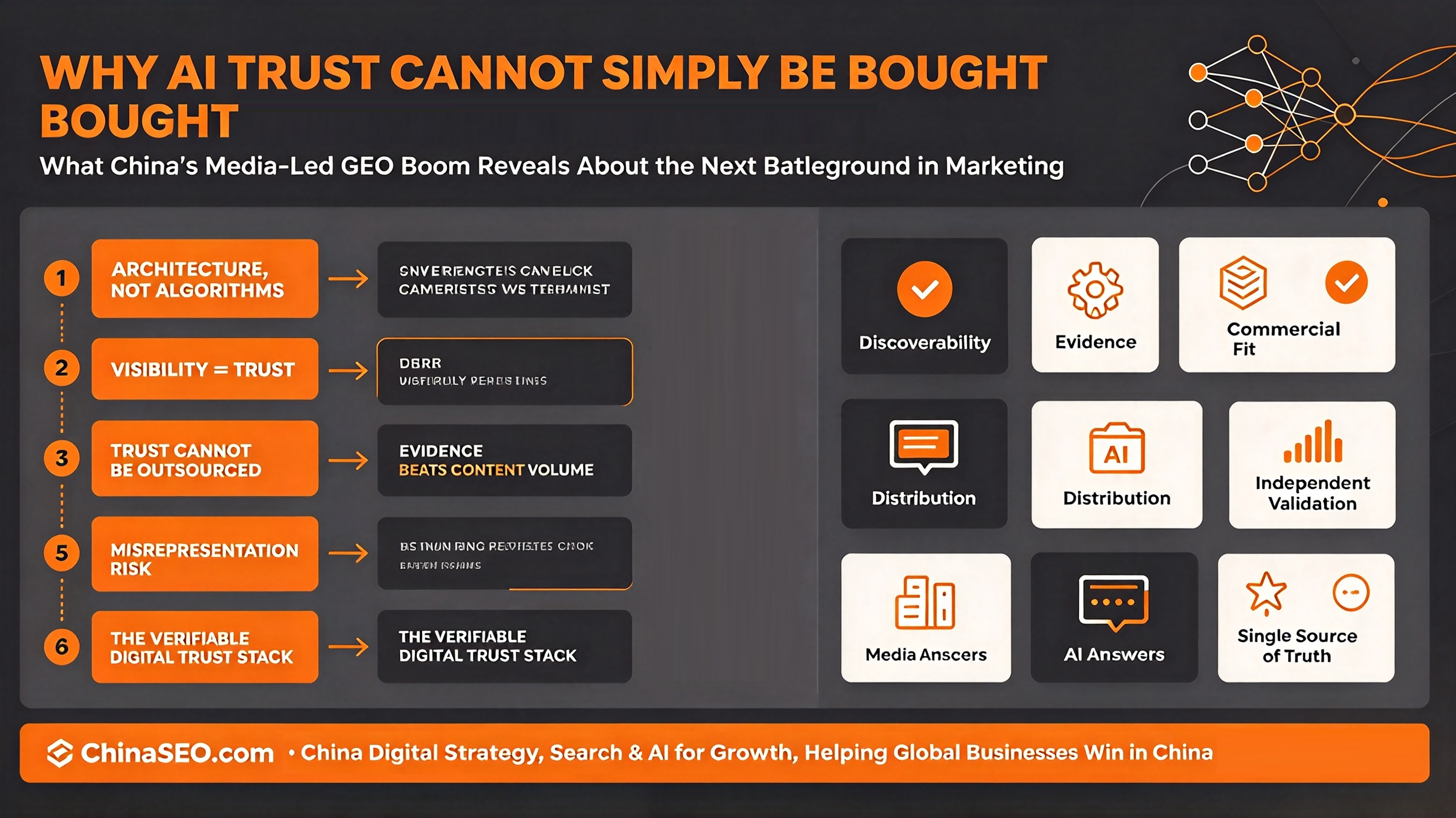
1. China’s GEO Boom Is About Architecture, Not Algorithms
Traditional search optimization chased a familiar target: ranking a landing page at the top of a blue-link results page for a high-intent keyword.
Generative engines operate differently. When an engineer asks an LLM for an engineering comparison or an architectural solution, the system doesn’t return a directory—it writes an original synthesis. It either integrates your capabilities into the narrative or leaves you out entirely.
In standard search, you fight for a click. In AI-generated answers, you fight for inclusion in the premise.
A buyer who lands on your website via a search engine still has to evaluate your credibility. A buyer reviewing an AI shortlist has already bypassed that friction, comparing you against a narrow set of pre-vetted alternatives.
This reality explains why diverse market players are rushing to commercialize GEO services:
- Publishers and media houses monetize editorial authority and proprietary industry networks.
- Tech providers supply the crawling infrastructure, vector databases, and retrieval monitoring.
- Agencies attempt to bridge technical accessibility with content structuring.
- Standards bodies push for compliance frameworks and verified disclosures.
These vendors solve distinct problems. A media brand can lend prestige, but it cannot force an LLM to parse a broken API. A tech stack can improve crawlability, but it cannot validate whether your product specs are true.
China’s nascent GEO market matters because it exposes a deeper truth: the race is on to structure commercial reality so that AI systems can safely read, interpret, and deploy it.
2. The Dangerous Illusion: Visibility Is Not Trust
Marketing has always suffered from a fatal proxy addiction. Traffic is not revenue. Impressions are not demand. And an AI brand mention is not proof that the system—or the buyer—trusts you.
Consider three distinct operational hurdles.
First: Discoverability. Can the machine actually find your data? If your technical documentation is buried behind unrendered JavaScript or locked in unindexed PDFs, you are invisible.
Second: Evidence. Can the machine substantiate your claims? Do you provide raw performance metrics, accredited test results, and verifiable case studies, or merely enthusiastic ad copy?
Third: Commercial Fit. Should the buyer actually select you? This depends on price, risk profile, service-level agreements, and real-world execution capability.
Success in the first category guarantees nothing in the second.
Take an industrial manufacturer of heavy-duty stainless steel drainage systems. They can publish fifty SEO articles on food-safety compliance and dominate keyword rankings. Yet, when a plant engineer asks an AI assistant to evaluate corrosion resistance under high-temperature caustic washdowns, general content fails.
If the model cannot ingest precise metallurgical data, they have a discoverability problem.
If the data exists but contradicts other specs, they have an evidence problem.
If the specs are sound but the product cannot handle caustic washdowns, they have a product-market fit problem—not a GEO problem.
No amount of marketing optimization can paper over a fundamental engineering gap. AI visibility is a marketing metric; verifiable data is an operational discipline; commercial trust is earned in the field.
3. Can Trust Be Outsourced?
For decades, enterprises bought reach. They purchased ad placements, PR wire distributions, sponsored thought-leadership, and search engine real estate.
Reach buys exposure. Exposure builds awareness.
It does not buy independent validation.
When applied to generative AI, this distinction becomes critical. Enterprises can purchase three distinct tiers of service:
- Distribution: Multiplying channel presence and message delivery.
- Infrastructure & Engineering: Optimizing data architectures, structured schemas, and discoverability pipelines.
- Independent Validation: Subjecting products and performance records to rigorous third-party auditing.
The first two are commodities you can buy off the shelf. The third is valuable only to the extent that the validator remains ruthlessly independent.
When a service provider sells both promotional optimization and authoritative endorsement, a conflict of interest immediately arises. If buyers discover that an AI trust signal can be purchased without empirical verification, the signal collapses.
Be wary of any vendor promising guaranteed AI recommendations or “secret backdoors” to LLM trust. Models change their weights, retrieval mechanisms, and safety guardrails daily. No agency controls the foundational architecture of frontier AI models.
You can buy distribution. You can engineer better data structures. But you cannot purchase the truth of your claims—nor can you compel an AI to endorse a weak product.
4. Scarcity Has Shifted from Content to Evidence
Generative AI has driven the marginal cost of producing plausible marketing copy close to zero.
Your competitors can spin up hundreds of product pages, blog posts, and whitepapers every single hour. When content becomes infinitely abundant, volume ceases to be a differentiator.
The strategic bottleneck is no longer how much you publish, but what you can substantiate that competitors cannot easily fake.
Compare two competing equipment manufacturers:
- Manufacturer A floods the web with articles on innovation, reliability, and market leadership.
- Manufacturer B publishes sparingly, but backs every claim with downloadable CAD schematics, third-party metallurgical lab tests, traceable failure-rate data, and explicit application constraints.
Manufacturer B has built a durable information asset: decision-useful evidence.
While LLMs are probabilistic and might occasionally misroute queries, Manufacturer B provides the structured, verifiable truth that modern retrieval-augmented generation (RAG) systems thrive on.
Defensible information assets have common DNA:
- Raw engineering data and operational telemetry.
- Verifiable customer deployment outcomes.
- Unvarnished product limitations and operating thresholds.
- Deep diagnostic expertise explaining when not to use a solution.
This collapses the traditional silo between marketing and engineering. Your marketing output is now only as strong as your internal engineering and operational documentation.
5. The Invisible Risk: AI Misrepresentation
Most executives measure AI performance through a vanity lens: Do we get mentioned?
That is a dangerous half-truth.
Suppose an LLM mentions your brand in 70% of relevant prompts. Excellent. But what if it misquotes your operating temperature range? What if it attributes a competitor’s safety certification to your product line? What if it references an obsolete pricing tier or omits a critical safety warning?
For technical, B2B, and regulated industries, inaccurate representation is far more damaging than total obscurity.
An industrial supplier incorrectly credited with a hazardous-material certification faces instant liability and compliance failure. A SaaS vendor mischaracterized as supporting an enterprise ERP integration they abandoned two years ago burns sales cycles and infuriates buyers.
To audit this properly, modern management must track four dimensions:
| Dimension | The Diagnostic Question |
|---|---|
| Visibility | Does the enterprise appear in relevant AI-generated shortlists? |
| Accuracy | Are our specs, credentials, and capabilities represented without error? |
| Completeness | Are crucial differentiators and operational limitations included? |
| Currency | Does the machine pull current pricing, current SKUs, and active policies? |
The objective is not to game the prompt. It is to audit where your digital footprint breaks down before a prospective buyer encounters the error in production.
6. The CEO Agenda: Building a Verifiable Digital Trust Stack
Because AI systems synthesize your entire digital footprint into a single narrative, managing this transition cannot be delegated solely to the SEO team or a junior marketer. It requires executive oversight across departments.
- Product specifications live in engineering.
- Performance validation lives in quality control.
- Client outcomes live in sales and customer success.
- Compliance data lives in legal.
Yet AI models and enterprise buyers encounter all four as a unified brand entity. Executives must enforce four structural priorities:
- Establish a Single Source of Truth: Audit your public-facing assets. Your technical data sheets, website copy, sales decks, and registry profiles must not contradict one another on core metrics.
- Convert Claims into Evidence: For every material performance assertion, demand the underlying data. Separate verified testing from marketing aspiration.
- Separate Distribution from Validation: Hire agencies for technical execution and reach, but never confuse paid media placement with objective market authority.
- Tie AI Readiness to Commercial Efficiency: Stop measuring success in raw traffic spikes. Track whether accurate AI representation shortens sales cycles, eliminates avoidable customer misunderstandings, and drives qualified pipeline.
Conclusion: The Best GEO Strategy Starts in the Boardroom
AI-mediated discovery is rewriting the rules of global competition. The influx of commercial services promising guaranteed AI visibility highlights a massive market demand—and a dangerous temptation to look for shortcuts.
Trust cannot be automated away, bought via a media placement, or faked with synthetic content.
It is a rigorous commercial judgment built on evidence, consistency, and operational integrity. You can engineer your data for better machine discoverability, but the underlying reality must match the code.
The executive question for the next decade is no longer: How do we manipulate AI to recommend us?
It is simply: If an intelligent system evaluates our enterprise today, do our digital assets provide airtight proof that we deserve to win—and will that proof survive cross-examination by a skeptical buyer?
 Unlock 2026's China Digital Marketing Mastery!