 English
 German
 Korea
Korea Spanish
The China Digital Black Box: Why Your Premium B2B Service Brand is Invisible to the World’s Largest Export Wave
- On May 29, 2026
- china geo, China seo, western B2B service brands
The Asymmetric Trust Moat: How Western Professional Service Firms Can Out-Position Hyper-Local Competitors in China’s ‘Chuhai’ Wave
Challenging the Complacency
For over two decades, Western B2B enterprises entering the Chinese market operated under a comforting, if increasingly flawed, paradigm: foreign lineage equated to default premium equity. In highly specialized, risk-mitigated sectors such as regulatory compliance, technical testing, and market-access consulting, a European or American corporate seal was viewed as an unassailable defensive moat.
That paradigm is dead.
Today, Western premium service providers, despite possessing native, localized entities within mainland China and launching dedicated .cn digital infrastructures—face a jarring structural reality. The domestic Chinese market is no longer a vacuum waiting for Western expertise. It is a hyper-saturated, hyper-aggressive ecosystem populated by local Chinese regulatory consulting agencies. These local players are agile, deeply entrenched in regional industrial clusters (from the cosmetics hubs of Guangdong to the medical device corridors of Yangtze River Delta), and willing to commoditize pricing to fractions of Western benchmarks.
The critical vulnerability for Western leadership lies in a profound cognitive divide.

Many Western CMOs mistakenly believe that deploying a localized website, securing an ICP (Internet Content Provider) filing, and running standard keyword search engine optimization (SEO) will automatically attract high-value Chinese exporters (Chuhai companies, 出海). This is an illusion of market presence.
In the current Chinese digital landscape, if your premium technical superiority cannot be natively parsed, categorized, and validated by China’s unique algorithmic infrastructure, your firm does not exist. Relying on legacy Western-centric frameworks in a market dominated by domestic closed-loop ecosystems does not just result in low conversion rates—it represents a systemic board-level risk to capital allocation and revenue survival.
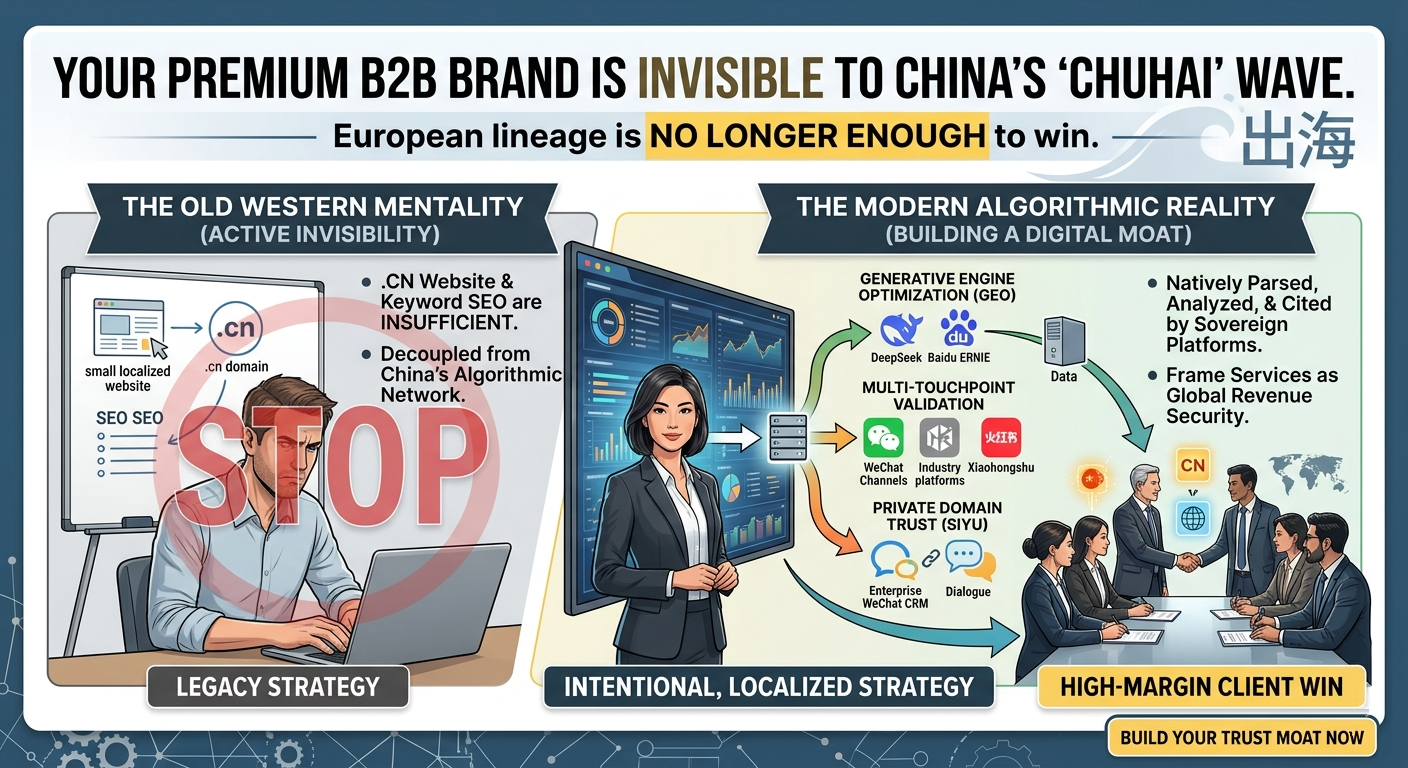
The Paradigm Shift (The Black Box Unlocked)
To understand why traditional B2B marketing strategies fail in China, one must look beyond the “Great Firewall” as a mere passive barrier and view it as an incubator for an entirely independent digital evolution. Chinese B2B buyer behavior and procurement architecture have decoupled from Western frameworks.
The Evolution of the Industrial Search Journey
In the West, the procurement journey for a compliance partner typically begins on Google, transitions through corporate websites, and is validated via LinkedIn. In China, this journey has evolved from a linear, keyword-driven indexing model into a multi-touchpoint, semantic, and highly fragmented Generative Engine Optimization (GEO) and digital trust ecosystem.
When a sophisticated Chinese exporter of medical devices, high-end cosmetics, or nutraceuticals seeks a European market-entry compliance partner, they do not simply type generic keywords into a search bar. They interact with an interconnected matrix of AI-driven search models, vertical business networks, and private data pools.
The buyer journey is deeply shaped by advanced Generative AI architectures, including DeepSeek, Baidu ERNIE, and Tencent Yuanbao. These platforms do not merely match keywords; they evaluate enterprise authority based on semantic networks, technical citations, and systemic corporate reputation.
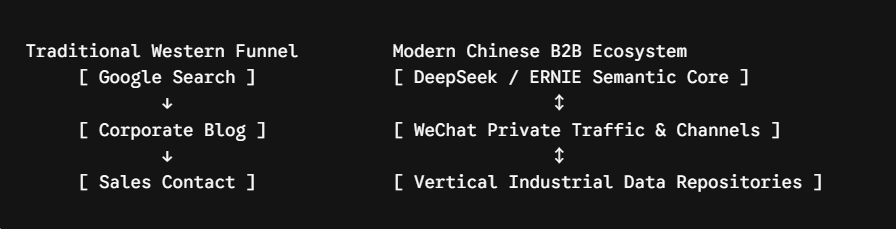
The Anatomy of an Algorithmic B2B Procurement Decision
Consider the modern procurement director at a Tier-1 Chinese medical device manufacturer in Suzhou. Facing tightening EU Medical Device Regulation (MDR) compliance hurdles, their evaluation process unfolds across three distinct algorithmic dimensions:
- The Generative Semantic Layer: The director queries a generative engine (e.g., DeepSeek) regarding complex EU compliance bottlenecks. The AI does not return a list of links; it synthesizes an answer based on real-time, authoritative documentation, regulatory updates, and expert whitepapers indexed within the domestic Chinese digital space. If a Western firm’s content is not structured for generative LLM ingestion within mainland servers, it is excluded from the synthesis.
- The Matrix Validation Layer: Simultaneously, the buyer cross-references insights across vertical B2B ecosystems and professional social platforms like WeChat Channels and Xiaohongshu (which has rapidly transformed into a B2B search engine for industrial design, formulation trends, and compliance insights). They seek video breakdowns of complex legislation, peer recommendations, and case studies of successful cross-border registrations.
- Closed-Loop Digital Trust Networks: In China, trust is verified through decentralized peer networks and private domain traffic (Siyu Liuliang, 私域流量). A brand must manifest itself as an active node within these networks. The traditional static website acts merely as a final repository or legal validation point, not the primary driver of top-of-funnel discovery.
For a premium player like BELAB SERVICES, competing on price against local agencies is a race to the bottom. To win, the firm must shift the battleground from transactional cost to algorithmic authority and asymmetric information trust.
Strategic Remediation: Building “Digital Trust” Across Borders
To bridge the cognitive divide and capture high-margin market share, Western B2B enterprises must execute a dual-track strategy: weaponizing their structural, native Western regulatory access while embedding that advantage natively within China’s unique digital architecture.
The Asymmetric Information Advantage as a Premium Moat
BELAB SERVICES possesses an asset that no domestic Chinese agency can genuinely replicate: direct, native proximity to Western regulatory bodies, European laboratories, and Brussels/Madrid compliance frameworks. Domestic Chinese agencies operate as external intermediaries; they are translators of rules. BELAB is an interpreter and an actor within the jurisdiction of destination.
This is an asymmetric advantage. In an era where the China Chamber of Commerce for Medicines & Health Products Exporters notes surging demands for compliant internationalization, Chinese exporters face massive financial penalties and customs rejections if their certifications fail. The premium positioning of BELAB is justified by framing compliance not as a bureaucratic box to check, but as the ultimate risk-mitigation asset for global revenue.
The Digital Trust Architecture Framework
To translate this structural advantage into measurable market dominance, leadership must deploy a localized Digital Trust Architecture built upon three pillars:
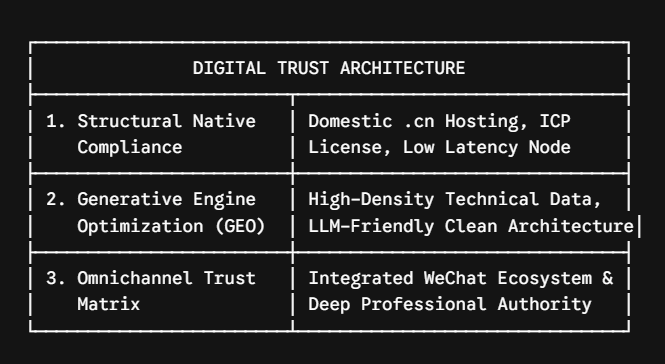
1. Structural Native Compliance & Architectural Infrastructure
A localized website on a .cn domain is merely the baseline entry ticket. True structural compliance requires hosting the entire digital asset within mainland China servers behind the Great Firewall, secured by a commercial ICP license.
This is not just a legal requirement; it is a critical determinant of algorithmic ranking and user experience. Generative engines and search crawlers deprioritize high-latency assets hosted in Hong Kong or overseas. The site architecture must be streamlined, optimized for mobile responsive environments (reflecting China’s mobile-first enterprise culture), and stripped of any blocked Western third-party scripts (e.g., Google Fonts, YouTube embeds) that introduce terminal loading bottlenecks.
2. Generative Engine Optimization (GEO) Blueprint
To be indexed and highly cited by Chinese LLMs (DeepSeek, ERNIE), the corporate website must undergo systemic GEO. This involves publishing high-density, authoritative, and structurally structured technical content. Instead of generic marketing copy, the platform must host detailed regulatory impact assessments, comparative analyses of EU vs. China compliance frameworks, and structured Q&A formats that precisely match the semantic intent of enterprise buyers.
The code must feature clean JSON-LD schema markings, clear semantic hierarchies, and a robust internal link architecture that allows AI web crawlers to map BELAB’s absolute authority over specific regulatory niches (e.g., EU MDR Section 3 Registration Pathways).
3. The Omnichannel Trust Matrix
The localized website must serve as the core engine, but it must seamlessly integrate with China’s primary business communications infrastructure: the WeChat Ecosystem.
BELAB must build a synchronized matrix consisting of a WeChat Service Account, WeChat Channels (for executive video thought leadership), and an integrated Enterprise WeChat (QiYe WeiXin) CRM framework. When a prospective client interacts with a technical whitepaper on the .cn website, the conversion pathway should not be a static email contact form. It must be an instantaneous, friction-free gateway to a senior compliance strategist via an Enterprise WeChat QR code, immediately drawing the prospect into a managed private domain trust network.
Data-Driven Validation
The necessity of this structural upgrade is reinforced by shifting macroeconomic vectors within the Chinese industrial landscape. According to industrial data tracking China’s manufacturing transformation, the country is undergoing an unprecedented “industrial upgrade cycle.” No longer content with low-margin domestic consumption, premium Chinese enterprises across the cosmetics, biomedical, and advanced nutritional fields are internationalizing at scale.
Data from the National Medical Products Administration (NMPA) and international trade audits indicate that while the volume of Chinese health, medical, and beauty exports has risen significantly over the past 36 months, the regulatory rejection rate at European ports of entry due to non-compliant documentation, inadequate clinical datasets, and faulty labeling remains a multi-million-dollar friction point for Chinese boards of directors.
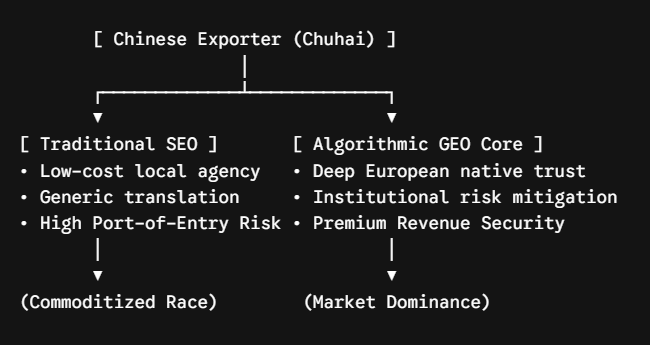
Leading global management consultancies (including McKinsey and Bain) in their executive briefings on Chuhai strategies emphasize that Chinese cross-border enterprises are actively seeking “premium substitution” regarding their service partners. They are moving away from low-cost, transactional local agencies that merely translate templates, and are actively hunting for institutional partners that offer genuine, unassailable global risk mitigation.
In a business ecosystem where a single compliance failure can freeze an entire export line, the procurement criteria have shifted fundamentally from minimizing upfront consulting costs to maximizing global regulatory certainty.
The Long and Short Deliverables: Deliverable A (Website Insight Report)
Section I: Macro Environment Analysis—The Reality of the Chinese Export Pivot
The contemporary Chinese economic narrative is defined by one word: Chuhai (出海). Faced with maturing domestic markets and intense internal price wars, China’s premium corporate sector has elevated international expansion from an exploratory growth initiative to a core, existential mandate. This shift is particularly acute within highly regulated, high-margin consumer and medical categories:
- Cosmetics & Clean Beauty: Emerging Chinese brands are leveraging sophisticated domestic supply chains to target European beauty markets, requiring rigorous adherence to the EU Cosmetics Regulation (EC No 1223/2009).
- Medical Devices: High-end diagnostics, surgical equipment, and digital health enterprises are pivoting heavily toward Europe, encountering the formidable barriers of the EU Medical Device Regulation (MDR 2017/745).
- Nutraceuticals & Food Supplements: Traditional Chinese medicine (TCM) variants and advanced functional foods are scaling globally, requiring navigation through EFSA (European Food Safety Authority) scientific opinions and complex novel food authorizations.
For these Chinese enterprises, the stakes are staggeringly high. Internationalization requires millions of RMB in R&D, clinical validation, and logistical staging. The weakest link in their entire global go-to-market chain is the regulatory bottleneck. A failure to secure compliant European registration does not merely delay launch—it can bankrupt an export initiative.
Section II: The Competitive Landscape—Exposing the Vulnerability of Local Agencies
The domestic Chinese market for regulatory consulting is characterized by hyper-fragmentation and brutal price competition. Thousands of local agencies position themselves as one-stop shops for international certifications. They compete aggressively on Baidu SEM, offer rock-bottom pricing, and promise impossibly swift turnarounds.
However, an objective evaluation of these local players reveals a systemic vulnerability: they are structural outsiders to the Western regulatory apparatus. Their business model relies on secondary interpretations of translated documents, standard templates, and distant, transactional relationships with third-party European consultants. They lack direct, real-time intelligence on how European regulatory bodies (such as the EMA or national competent authorities) evaluate dossiers in real-time.
When a complex compliance crisis occurs—such as a sudden request for additional clinical data under MDR or an unexpected ingredient safety audit under EU cosmetics laws—local agencies frequently stall. They lack the institutional presence to interface directly with Western regulators.
This is the exact strategic beachhead where BELAB SERVICES can execute its premium positioning strategy. By framing its brand identity around the concept of Direct European Jurisdiction Proximity, BELAB redefines the competitive landscape:
| Attribute | Local Chinese Agencies | BELAB SERVICES Premium Framework |
|---|---|---|
| Operational Moat | Transactional intermediary; relies on secondary translations. | Native European presence; direct structural alignment with regulators. |
| Search Positioning | Legacy keyword matching (Baidu SEO/SEM). | Generative Engine Optimization (GEO) & Semantic Network Domination. |
| Trust Mechanism | Price-driven contracts; volume-based processing. | Institutional risk mitigation; private domain trust networks. |
| Value Proposition | Minimizing upfront compliance cost. | Securing global enterprise revenue & eliminating port-of-entry risk. |
Section III: Operationalizing the B2B Algorithmic Playbook in China
To convert this strategic positioning into market reality, BELAB must look past traditional Western marketing tactics and implement a hyper-localized digital infrastructure designed for the Chinese algorithmic ecosystem.
1. Content Architecture for AI Ingestion
The .cn website must be transformed into an institutional knowledge engine. The content strategy must prioritize depth, technical density, and semantic clarity over brevity.
- Granular Whitepapers: Create a continuous stream of highly specialized analysis pieces (e.g., “Deep Dive into the Annex VIII Poison Centre Notifications for Chinese Chemical and Cosmetic Exporters”).
- Structured Technical Q&As: Author comprehensive, multi-layered FAQ directories that address complex regulatory intersections. These must be formatted using clean HTML semantic markers (
<h2>,<h3>, structured lists) that allow domestic LLMs to easily ingest and scrape the data for real-time user query synthesis. - Regulatory Alerts: Implement a rapid-response editorial cycle that publishes immediate, authoritative breakdowns of newly announced EU regulatory changes, providing an instant localized interpretation before local competitors can translate the source materials.
2. Mastering the Generative Optimization Cycle
To ensure that when a B2B buyer queries DeepSeek or Baidu ERNIE about European market access, BELAB is consistently cited as the definitive authority, the firm must execute a strict GEO optimization cycle:
- Citations Optimization: Ensure the brand name, corporate entities, and key subject matter experts are systematically cited across authoritative industry platforms, digital trade publications, and domestic scientific forums within China.
- Co-Occurrence Strategy: Structure all digital PR and content assets so that the term “BELAB” continuously co-occurs with highly specific, high-intent technical terms (e.g., “EU MDR compliance,” “CE marking authority,” “Nutraceutical registration Madrid”). This trains generative models to map BELAB as a core node within that specific semantic cluster.
3. Seamless Ecosystem Integration
A high-performing website in China cannot exist as an island. It must function as the intellectual anchor of a larger, closed-loop WeChat ecosystem.
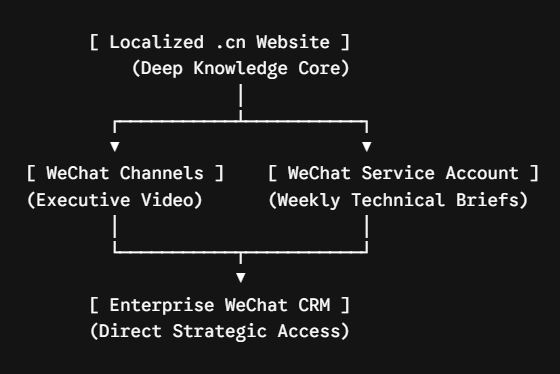
Every insight article, case study, and interactive tool on the .cn domain must feature dynamic entry points into BELAB’s private domain network. Instead of standard corporate emails, integrate customized Enterprise WeChat contact codes linked to specific compliance directors. If an exporter is reading a guide on medical device compliance, the primary call to action must lead directly to BELAB’s senior medical device strategist on WeChat. This eliminates friction, capitalizes on high-intent engagement, and secures the prospect within an instantly modern, conversational B2B sales cycle.
The Big Question
As your board of directors evaluates its global capital allocation, market expansion strategies, and competitive positioning within the world’s most dynamic industrial market, it must look past tactical marketing metrics and confront a fundamental, structural reality.
Ask your board today:
“Are we treating our digital footprint in China as a localized marketing technicality, or do we recognize that our failure to align with China’s sovereign algorithmic ecosystem is actively rendering our premium global authority invisible to the world’s largest wave of exporting enterprises?”
 Unlock 2026's China Digital Marketing Mastery!