 English
 German
 Korea
Korea Spanish
Time-Folding & System Competition: The Real Meaning of China’s Third Dividend for Western Leaders
- On June 2, 2026
- China’s Third Dividend, Western Leaders opportunity
Executive Summary
For the past three decades, Western industrial leadership has relied on a comfortable dichotomy: Western economies owned the intellectual property, design, and brand equity, while China provided the low-cost muscle. However, a profound structural shift is occurring within China’s domestic economy that renders this framework obsolete.
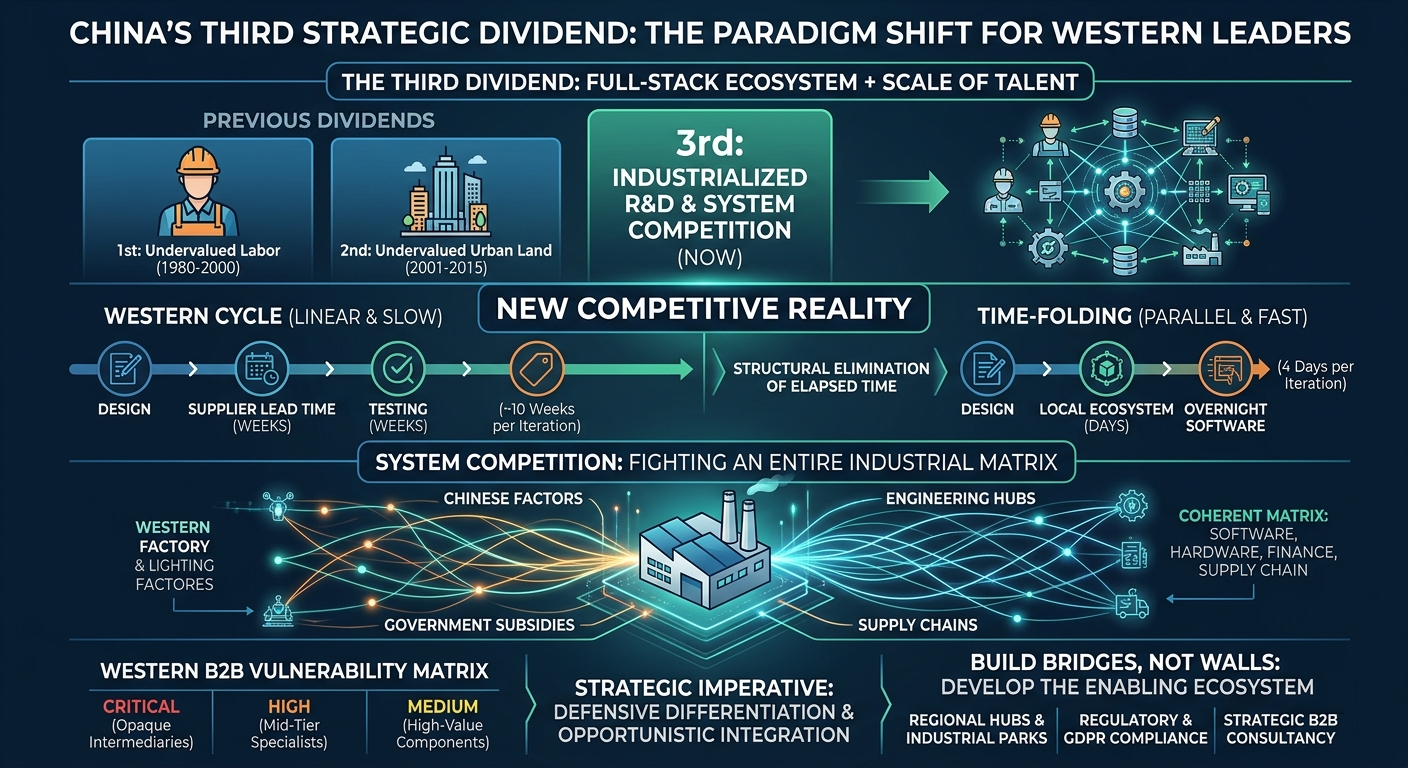
Driven by intense domestic saturation—”nei juan” (hyper-competition)—China is unlocking its Third Strategic Dividend: the integration of the world’s only complete, end-to-end industrial value chain with a massive, hyper-dense pool of over 20 million engineers.
This is no longer a challenge of cheap labor or simple currency valuation. It is a paradigm shift we define as System Competition backed by Time-Folding—the industrialization of the R&D process itself. For Western B2B executives, particularly those presiding over mid-market engineering champions (the Mittelstand), understanding this shift is the difference between strategic resilience and structural extinction over the next decade.
Introduction: The Myth of the “De-Industrializing” Factory
To walk through the corporate boardrooms of Stuttgart, Lyon, or Chicago in 2026 is to hear a comforting narrative. Executives point to macro-data: rising industrial land costs in coastal China, an aging demographic profile, and the highly publicized relocation of low-end textile and assembly operations to Vietnam, India, or Mexico. The conclusion frequently drawn is that China’s era as an industrial disruptor is waning, giving way to a fragmented, fractured global supply chain where the West can reassert its traditional terms.
This is a monumental, potentially fatal mischaracterization.
What Western observers are witnessing is not the decline of China’s industrial power, but its metamorphosis. The low-end, labor-intensive manufacturing capacity is leaving, precisely because it has been fully priced out. What remains, and what is currently being forged, is a highly integrated, self-optimizing industrial ecosystem.
To understand where this leads, we must analyze the underlying mechanics of economic dividends. Every historical era of explosive wealth creation is driven by a fundamental economic principle: the migration of a critical factor of production from a legacy system where it is severely undervalued to a new system capable of pricing its true utility.
China has executed this twice before:
- The First Dividend (1980–2000): Undervalued Labor. China unlocked hundreds of millions of agrarian workers from low-yield commune farming and placed them into global industrial assembly lines. The individual worker did not become ten times smarter overnight; rather, the global market priced their output at a level ten times higher than the domestic agricultural system ever could.
- The Second Dividend (2001–2015): Undervalued Urban Land. Following WTO accession, Chinese cities transformed from administrative containers into high-density nodes of global logistics and service aggregation. The exponential rise in real estate value was not merely a speculative bubble; it was the financial manifestation of geographic aggregation and rapid industrialization.
By 2017, these two dividends had run their course. Labor costs equalized, and urban asset yields flattened. Today, the domestic market is experiencing a profound overcapacity of advanced capabilities. The industrial output of China’s factories and the cognitive output of its university graduates have grown too vast for a single domestic market—even one of 1.4 billion people—to absorb or properly remunerate.
This pressure valve is now bursting outward. The result is China’s Third Dividend: the deployment of full-stack industrial ecosystems and deep engineering talent directly into the global market. The era of China as the world’s factory is over. The era of China as the world’s competitor has begun.
Part I: The Mechanics of “Time-Folding” — The Industrialization of R&D
The traditional Western competitive advantage rests securely on the concept of R&D asymmetry. A European industrial champion hires elite elite scientists, invests heavily in multi-year design cycles, conducts meticulous validation protocols, and releases a highly optimized, premium product every three to five years. This methodical approach is viewed as a structural moat.
The Third Dividend destroys this moat through a capability we call Time-Folding.
When a Chinese enterprise targets an industrial category, it does not approach R&D as an academic or laboratory exercise. Instead, it treats R&D as a scaled manufacturing process. Because the entire industrial spectrum—all 41 major industrial categories classified by the UN—coexists within a 200-kilometer radius in regions like the Yangtze River Delta or the Greater Bay Area, the friction of physical iteration drops to near zero.
Consider the traditional lifecycle of a mechanical component or an electronic subsystem:
- The Western Cycle: Design in Munich. Prototype components ordered from three specialized European suppliers (6-week lead time). Assembly and initial stress testing in-house (4 weeks). Design revision initiated. Total time for iteration one: ~10 weeks.
- The Time-Folded Cycle: Design in Suzhou or Shenzhen. Tooling, PCB fabrication, custom castings, and high-precision machining are sourced, executed, and delivered by local suppliers within 72 hours. Software adjustments are written overnight by dedicated teams of local engineering graduates. Total time for iteration one: 4 days.
Western R&D Cycle (Linear, High Friction)
[Design] -> [Supplier Lead Time: 6 Wks] -> [Assembly/Test: 4 Wks] -> (10 Weeks per Iteration)
Time-Folded R&D Cycle (Parallel, Zero Friction)
[Design] -> [Local Ecosystem: 72 Hrs] -> [Overnight Software Tuning] -> (4 Days per Iteration)
By the time a Western engineering team concludes its first formal field-testing review, a Chinese competitor has iterated through six generations of the product under real-world conditions. They have identified edge-case engineering failures, optimized the bill of materials (BOM), stripped out non-essential production costs, and deployed an over-the-air (OTA) software update to resolve firmware bugs.
This is not a triumph of low wages; it is the structural elimination of elapsed time. When an organization can compress years of development into months, the traditional concept of a “technological lead” evaporates. The Western product may remain fundamentally superior in its initial deployment, but the speed of its competitor’s adaptation curve ensures that parity—and subsequent obsolescence—is reached with astonishing velocity.
Part II: The Asymmetric Reality of System Competition
The second pillars of the Third Dividend are the 60 million individuals who comprise China’s broad engineering and technical talent pool, alongside an academic apparatus producing over 10 million graduates annually.
For a long time, Western observers dismissed this volume by questioning its quality. “China produces volume, but the West produces innovators,” remains a comforting mantra in Western executive suites. This view misreads how scale alters the nature of industrial execution.
When an economy possesses an overwhelming density of specialized technical talent, engineering ceases to be a scarce corporate asset and instead becomes a baseline infrastructure utility. A Chinese industrial company does not hesitate to assign fifty qualified software and mechanical engineers to an obscure, mid-market B2B product line—such as an automated packaging valve or a localized material handling controller—that a European manufacturer would support with a part-time team of three.
This creates an environment of System Competition. The challenge facing Western corporations is not that a single Chinese company is smarter or more creative than they are. The challenge is that Western firms are competing against an entire interconnected industrial system.
In this system, design software, automated manufacturing hardware, financial subsidies for regional development zones, and a hyper-liquid supply chain operate as a single, coherent matrix. When a Western firm fights an emerging Chinese competitor, it is not engaging in a corporate duel; it is an isolated unit attempting to withstand the operational velocity of an entire industrial ecosystem.
Part III: Granular Diagnostics — The Vulnerability Matrix of Western B2B
To evaluate the immediate strategic risk, Western leadership must move past broad generalities and look closely at specific industrial sectors. The impact of China’s Third Dividend is unevenly distributed, creating distinct zones of acute vulnerability, active contention, and temporary safety.
| Sector Category | Key Examples | Primary Risk Vector | Vulnerability Level |
|---|---|---|---|
| The Opaque Intermediary | White-label industrial equipment, contract-manufactured consumer electronics, generic components. | Direct-to-market B2B digital channels, bypass of Western agent networks via AI and GEO. | Critical (Extinction within 24–36 months) |
| The Mid-Tier Specialist | Standardized industrial automation hardware, material handling systems, standard laboratory equipment. | Time-Folded R&D cycles, aggressive feature parity at 40–50% cost reductions. | High (Severe margin compression) |
| High-Value Core Components | Robot reducers (Harmonic/RV), advanced industrial sensors, high-end semiconductor lithography components. | Systemic, state-backed engineering convergence targeting the final frontiers of Western IP. | Medium (Active defense required) |
1. The Immediate Casualties: “The Opaque Intermediaries”
The most acute and immediate existential crisis faces Western B2B brands that function primarily as marketing and distribution layers over Chinese manufacturing backbones. For decades, thousands of mid-market firms in Europe and North America have operated on a simple model: source high-quality components from Zhejiang or Guangdong, apply their historic brand asset logo, route the product through established regional distributor networks, and charge a 300% premium based on trust, localized documentation, and relationship management.
This model is being dismantled by the digital democratization of global procurement. Armed with sophisticated Generative Engine Optimization (GEO) strategies, advanced multilingual digital infrastructure, and direct-to-engineer marketing models, Chinese industrial manufacturers are bypassing traditional Western intermediary networks entirely.
When a design engineer in Lyon or Ohio queries an AI search engine or an industrial procurement platform for a highly specific, custom-machined linear actuator, they are no longer directed exclusively to a local distributor’s catalog. They are increasingly connected directly with the tier-one Chinese factory capable of providing the engineering schematic, generating a customized quote via automated systems, verifying compliance metrics, and shipping the component via global express logistics within days. The Western brand’s historic moat—information asymmetry—has permanently dried up.
2. The Mid-Market Battleground: High-Performance Hardware & System Integration
Move one step up the complexity ladder to mid-tier industrial automation hardware, robotic components, and specialized sub-assemblies. Here, the challenge shifts from pure distribution bypass to intense architectural competition.
Consider a European manufacturer of specialized warehouse automation systems or material handling units. For twenty years, their competitive moat has been the deep domain expertise required to write the proprietary firmware that coordinates their hardware elements.
Today, a Chinese competitor enters the European market not with a cheaper, cruder copy, but with an open-architecture system. This system is pre-integrated with advanced software, utilizes readily available commercial components, and is priced at 40% of the European alternative.
The Chinese firm can accept these economics because their engineering overhead is distributed across a massive domestic base, and their component sourcing is optimized within their local cluster. The Western provider faces an unappealing strategic choice: match prices and destroy their operating margins, or retreat into shrinking niche segments, ceding the broad market volume required to fund future R&D.
3. The Last Fortresses: Advanced Reducers and High-Precision Industrial Sensors
There remains a critical echelon of advanced engineering where Western and Japanese firms maintain clear, functional dominance: high-precision robotics components—specifically Harmonic and RV reducers—and advanced industrial sensors (such as high-end optical, ultrasonic, and safety-critical sensors manufactured by European pioneers).
In these domains, competitive advantage is not secured by digital agility or rapid software iteration alone. It is protected by decades of metallurgical science, proprietary heat-treatment formulations, micro-tolerance machining methodologies, and deeply entrenched safety certifications. A premium Japanese or German rotary vector reducer operates with a level of micro-precision, backlash mitigation, and structural longevity that cannot be easily replicated simply by scaling engineering headcounts.
Yet, Western leaders in these sectors must recognize that this dominance is not a permanent state of nature; it is a time-bound window.
Precisely because these components represent the final bottlenecks in China’s domestic industrial self-sufficiency, they have become the primary targets of intensive, well-funded engineering convergence. Chinese industrial conglomerates, backed by national research consortios and highly incentivized regional development zones, are methodically chipped away at these technological barriers. They are recruiting elite international talent, investing in ultra-precise Swiss and German mother-machine tooling, and leveraging their massive domestic electric vehicle (EV) and humanoid robotics industries as high-volume testing environments to accelerate their learning curves.
The threat to a Western sensor or reducer champion is not that their technology will be matched tomorrow. The threat is that a Chinese competitor will develop a component that delivers 85% of the performance at 30% of the price, while offering a delivery lead time of two weeks compared to the Western manufacturer’s six months.
For a vast segment of global system integrators and mid-tier machine builders, “good enough, cheap enough, and available now” is an incredibly compelling value proposition. This dynamic slowly erodes the Western market share from the bottom up, gradually starving the premium innovators of the revenue density required to sustain their long-term research initiatives.
Part IV: The Rise of the “Enabling Ecosystem” — Strategic Opportunities for Western B2B Service Pioneers
As this tidal wave of Chinese industrial capability moves outward, it creates deep structural friction. A Chinese manufacturing firm may possess world-class engineering and unparalleled supply-chain velocity, but when it crosses the border into Europe or North America, it hits a wall of institutional, legal, and cultural complexity.
They are entering highly regulated environments defined by strict frameworks: GDPR data privacy rules, complex ESG (Environmental, Social, and Governance) compliance mandates, stringent local labor laws, protective union dynamics, and deeply entrenched B2B purchasing behaviors that value long-term personal relationships and local accountability far above digital convenience.
This friction creates a highly lucrative, wide-open frontier for sophisticated Western B2B professional service providers who choose to become the institutional architects of this global migration. The organizations that profit most from China’s Third Dividend will not be those attempting to build futile tariff walls, but those providing the vital cross-border infrastructure that allows this massive industrial power to safely integrate into Western economies.
[The Chinese Industrial Engine]
(High Velocity, Scaled R&D)
│
▼
┌───────────────────── ──┐
│ THE ENABLING ECOSYSTEM │
│ * Specialized Industrial Parks │
│ * Premium Legal & GDPR Advisory │
│ * High-End Strategic B2B Consulting │
│ * Advanced Localized PR Agencies │
└────────────────────────┘
│
▼
[The Western Institutional Market]
(Compliant, Trusted, Localized)
1. Specialized Industrial Development Zones & Regional Hubs
The days of shipping fully assembled industrial products from Shanghai to Rotterdam face increasing geopolitical headwinds, tariff adjustments, and carbon-border mechanisms. To survive, Chinese industrial firms must establish a physical, operational footprint inside the geographic boundaries of their target markets. They require localized manufacturing plants, regional assembly hubs, and European-domiciled R&D centers.
This represents a major opportunity for Western industrial development authorities, regional investment promotion agencies, and private industrial park developers. The regions that win will be those that move past generic real estate offerings and instead provide turnkey, compliant ecosystems.
A Chinese robotics or sensor firm looking to set up an assembly hub in central or eastern Europe does not just want an empty warehouse. They will actively partner with development zones that provide pre-negotiated utility access, streamlined green-channel permitting processes, direct connections to local technical universities, and built-in compliance frameworks that insulate them from local regulatory missteps.
2. Specialized Legal, Regulatory, and GDPR Counsel
The regulatory compliance barrier for an incoming Chinese industrial enterprise is exceptionally high. In the B2B sector, this is amplified when products involve data collection, industrial automation connectivity, or cloud-based predictive maintenance. A Chinese industrial sensor firm or connected hardware provider entering Europe faces a complex maze of product liability laws, CE certifications, and the strict requirements of GDPR. If their hardware interfaces with critical infrastructure, they encounter intense scrutiny regarding data sovereignty and national security architecture.
Western corporate law firms, data privacy consultancies, and regulatory advisory groups that position themselves as specialized cross-border compliance guides face a massive surge in demand. The opportunity belongs to firms that can act as a bridge—professionals who can walk into a corporate boardroom in Shenzhen or Shanghai, clearly articulate the strict operational realities of European regulatory enforcement, and then design the corporate structures, data localization strategies, and contractual frameworks required to protect the client from catastrophic compliance failures.
3. High-End Strategic Cross-Border B2B Consultancies
Product excellence is not brand excellence. This is the central operational blind spot for many Chinese industrial firms leveraging the Third Dividend. They are masters of product optimization, cost structure management, and operational execution. They are often far less proficient at navigating the subtle, relationship-driven world of premium Western B2B marketing, corporate narrative building, and stakeholder management.
A German factory manager or a French aerospace procurement director does not buy an industrial component simply because an algorithmic search engine recommended it or because the price is low. They buy because they trust the long-term viability of the enterprise, respect its institutional heritage, and believe its corporate values align with their own.
Most emerging Chinese B2B firms lack the internal capability to craft these sophisticated, trust-based narratives. They struggle with high-level PR, long-cycle B2B content marketing, strategic positioning on platforms like LinkedIn, and managing complex relations with western industry analysts.
High-end Western B2B consulting firms, elite corporate communications agencies, and strategic marketing advisors who understand how to translate raw engineering capability into lasting corporate trust have an incredibly valuable role to play. The prize goes to those who can help these industrial powerhouses transform themselves from “mysterious foreign vendors” into respected, compliant, and trusted long-term partners within the local industrial ecosystem.
Conclusion: The Strategic Mandate for Western Leadership
Faced with the reality of China’s Third Dividend, Western industrial leaders can no longer rely on defensive legacy strategies. The assumption that geographic distances, cultural differences, or geopolitical tariffs will permanently insulate a business from a highly integrated, scale-driven competitor is a recipe for gradual decline.
The path forward for Western enterprises requires a dual-track strategy of Defensive Differentiation and Opportunistic Integration:
- Relinquish the Defensible Commoditized Ground: If your business model relies on charging a premium for an un-innovative, mid-tier component simply because you possess an established regional sales office, you must accept that your margins are terminal. Prepare to transition that asset or pivot your business model toward complex system integration where your localized value is defensible.
- Aggressively Value-Up the Moat: In fields like high-precision reducers, specialized metallurgy, and advanced sensory technologies, double down on the areas that a scale-driven engineering system cannot easily duplicate. Invest deeply in proprietary material sciences, deep customer-co-development integration, and comprehensive lifecycle service guarantees that tie your product directly into the client’s operational risk management framework.
- Build Bridges, Not Walls: The most successful Western B2B leaders over the next decade will view the outward flow of China’s industrial capability not merely as a threat to be resisted, but as a powerful, high-velocity asset to be leveraged. Whether by integrating advanced Chinese sub-assemblies into your own premium systems, providing the specialized professional services that enable their compliant entry, or forming strategic joint ventures that combine Western brand equity with Chinese R&D velocity, the objective remains the same: Do not attempt to stand directly in front of the factor-repricing flood. Learn to build the infrastructure that directs its immense power.
 Unlock 2026's China Digital Marketing Mastery!