 English
 German
 Korea
Korea Spanish
The GEO Paradigm Shift: Why AI Will Choose (or Ignore) Your Brand
- On August 26, 2026
- AI GEO, GEO Paradigm Shift
Moving Beyond 20 Years of SEO Tactics to Win the Battle for Machine Trust in the Era of Autonomous Decision Engines
Executive Summary:
For the past two decades, corporate digital strategy focused on teaching machines how to understand enterprise value. Over the next decade, market leadership will be determined by whether enterprise systems can force machines to trust enterprise integrity. Generative Engine Optimization (GEO) is not a tactical SEO upgrade—it is an enterprise trust architecture challenge.
History Repeats Itself—The 20-Year Strategic Misstep
Across global C-suite boardrooms, marketing leaders are fixated on a tactical question: “What does the AI want?”
In response, organizations are deploying familiar playbook tactics: scaling AI-generated content volumes, artificially inflating brand entity mentions, manufacturing third-party citations, and engineering prompt paths to align with recommendation algorithms. This behavior mirrors the early 2000s when executives asked: “What does Google want?”
This is a strategic misdiagnosis. When enterprise strategy focuses purely on algorithm manipulation, tactical precision merely accelerates strategic drift. The fundamental executive question is not what AI algorithms prefer today, but rather:
Why should an autonomous AI engine risk its own institutional credibility by recommending your enterprise to a decision-maker?
01 | Re-Engineering the SEO Paradigm: An Ecological Value Exchange
Search Engine Optimization (SEO) was never a zero-sum game of gaming search engines. At its core, SEO represented an economic exchange across a tripartite ecosystem:
Enterprise Data Provision -> Search Engine Indexing -> User Answer Resolution -> Platform Monetization
Sustainable SEO succeeded only when enterprise value aligned perfectly with platform utility. Black-hat optimization techniques failed over time because they degraded platform trust. As we transition from traditional search to Generative Engine Optimization (GEO), this foundational economic principle remains intact, though the stakes have escalated exponentially.
02 | The Shift from Search to Decision Engines
While GEO shares historical parallels with SEO, the underlying task performed by artificial intelligence has undergone a structural paradigm shift:
| Strategic Dimension | Traditional Search Era (SEO) | Autonomous AI Era (GEO) |
| Primary Task | Locate & Index Relevant Webpages | Synthesize Solutions & Execute Decisions |
| Architecture | Search Engines (Information Retrieval) | Answer & Decision Engines (Autonomous Agents) |
| Competitive Arena | SERP Ranking Positions (Visibility) | AI Decision Mediation (Recommendation & Action) |
| Economic Bottleneck | User Attention & Click-Through Rates | Gatekept Transactional Access |
When buyer behavior shifts from navigating web pages to delegating procurement decisions to AI agents, competitive advantage moves from Search Ranking to AI Recommendation, and ultimately to AI-Mediated Decisioning.
03 | Inside the AI Trust Architecture: Credibility Over Volume
Consider the structural dilemma facing modern AI models: When 1,000 competing enterprises generate synthetic, highly optimized PR content asserting market leadership, how does the model select a recommendation?
To mitigate hallucination risks and commercial liability, AI providers have engineered rigorous Trust Architectures. AI engines do not lack content volume; they face a deficit of verifiable Information Credibility.
AI Trust Architecture Evaluation Dimensions:
- Entity Verification: Does the enterprise exist as an authentic, legally operating operational entity?
- Product Authenticity: Are product specifications verified by physical deployments and telemetry?
- Client Validation: Is enterprise claims backed by validated customer feedback and real-world execution?
- Demonstrated Expertise: Does the enterprise contribute original, non-replicated technical frameworks?
- Cross-Source Consensus: Are core brand claims independently verified across uncorrelated data sets?
- Temporal Consistency: Does brand information remain coherent across historical time horizons?
- Data Interrogation: Can enterprise performance data be validated against independent benchmarks?
- Conflict Auditing: Is the information purely incentivized marketing, or verifiable factual evidence?
04 | The Three-Stage GEO Maturity Model
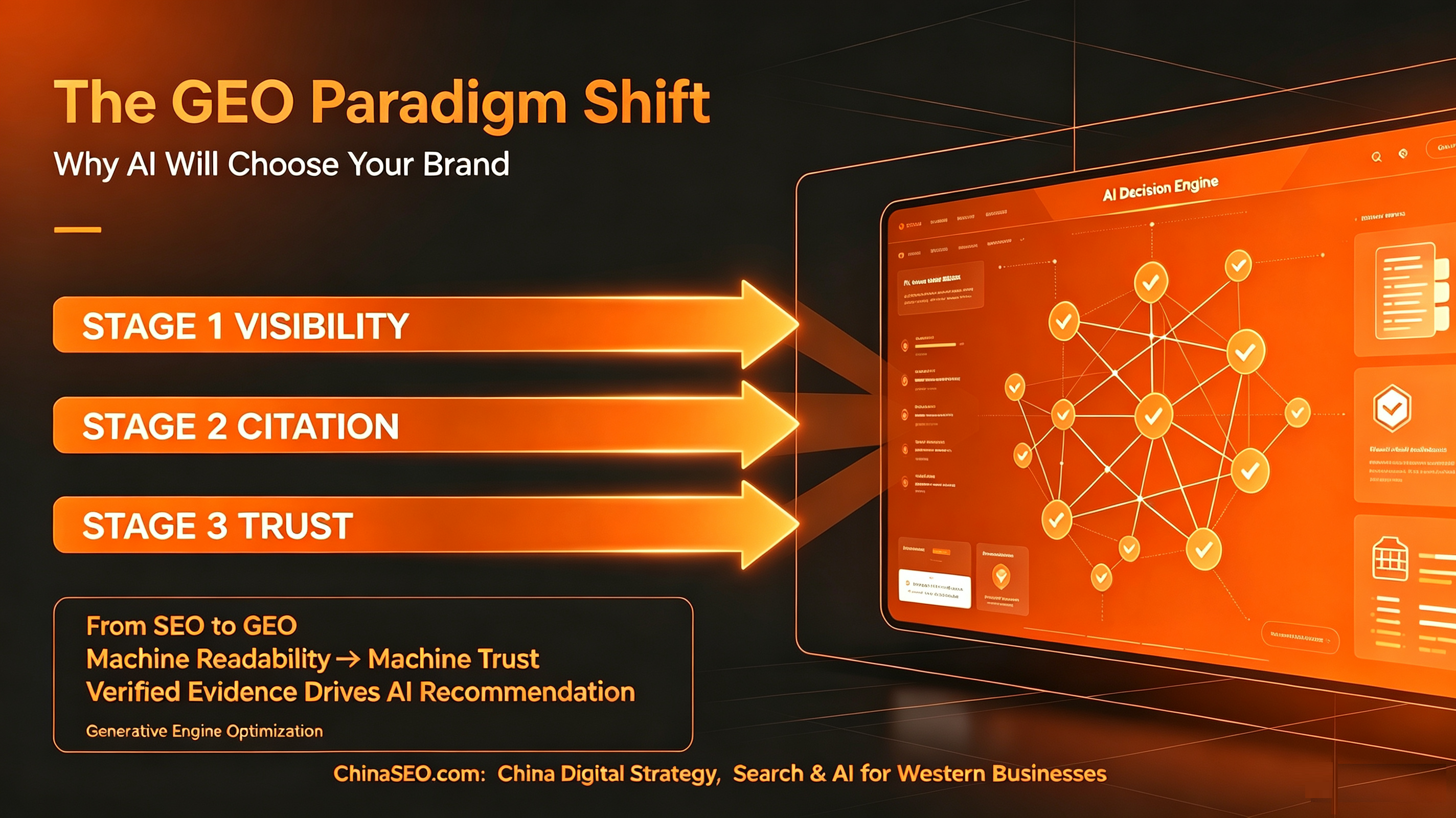
To navigate this transition, C-Suite leaders must evaluate their digital presence against the GEO Maturity Model:
[ STAGE 1: VISIBILITY ] ──► [ STAGE 2: CITATION ] ──► [ STAGE 3: TRUST ]
Machine Discovery Contextual Citation Action Recommendation
• Crawlability & Indexing • Digital PR & Mentions • First-party Evidence
• Schema Markup & Entities • Authority Signals • Independent Verification
• Structured Data Layers • Semantic Relevance • Reputation Integrity
- Stage 1: Visibility (GEO 1.0) — Focuses on discovery via structured data and schema markup (answering “Does AI know you exist?”).
- Stage 2: Citation (GEO 2.0) — Focuses on digital PR, authority signals, and semantic relevance (answering “Is AI using your brand as evidence?”).
- Stage 3: Trust (GEO 3.0) — Focuses on first-party proof points, peer validation, and real-world telemetry (answering “Does AI dare to recommend your solution for transaction?”).
Strategic Takeaway: The ultimate evolution of GEO transforms enterprise marketing from content publication to institutional trust engineering.
05 | The Counter-Defense: Why AI Platforms Will Destroy “Black-Hat GEO”
An inherent tension governs the AI ecosystem:
Enterprise Imperative: Maximize AI Visibility vs. AI Platform Imperative: Maximize Answer Quality
As marketing teams attempt to manipulate AI outputs via synthetic citation networks and prompt manipulation, AI providers are deploying defensive detection systems. This creates an inevitable escalation cycle:
GEO Manipulation -> Synthetic Signal Detection -> Algorithmic De-indexing -> Next-Gen Defense Architectures
Similar to Google’s historical Panda and Penguin updates, enterprises relying on manipulated AI signals face catastrophic de-indexing risk. Sustainable GEO cannot be built on algorithmic loopholes.
06 | Commercial Risk: The Emergence of the AI Commercial Gatekeeper
From a corporate governance perspective, GEO is an essential element of customer access control. As AI transitions from Answer Generation to Recommendation, and finally to Transactional Execution, platforms become primary Commercial Gatekeepers.
Relying solely on external AI channels presents an existential risk: An enterprise may win the AI recommendation while completely surrendering direct customer ownership.
07 | Strategic Execution: The Two-Tiered Enterprise Model
To capture market share while mitigating platform lock-in, executive teams must execute a balanced Two-Tiered Strategy:
TIER 1: AI VISIBILITY (External Network)
Discover ──► Understand ──► Trust ──► Recommend
(Proactively structure corporate data as a high-trust AI node)
Customer Acquisition / Lead Flow
│
▼
TIER 2: OWNED RELATIONSHIP (Internal Infrastructure)
Direct Engagement ──► First-Party Telemetry ──► Client Retention
(Insulate direct customer ownership via CRM, APIs & Client Communities)
Executive Action Plan for C-Suite Leaders:
- Transform Corporate Web Infrastructure into a First-Party Evidence Repository: Shift digital properties from generic marketing copy to high-density, verifiable technical evidence, published case studies, and structured benchmarks.
- Audit Independent Trust Networks: Evaluate enterprise reputation across un-biased channels—such as developer forums, industry benchmark reports, and client audit networks—where AI models cross-examine brand veracity.
- Harden First-Party Data & Direct Access Portals: Implement direct client engagement channels, ensuring client retention remains resilient even if AI platforms shift recommendation parameters.
Conclusion: The Ultimate Lesson of Digital Transformation
The last 20 years forced businesses to optimize for machine readability. The next 10 years will force businesses to optimize for machine trust.
As autonomous AI agents assume responsibility for research, vendor comparison, procurement selection, and commercial execution, mere visibility is insufficient. Winning the enterprise market requires becoming an indispensable, verified node in the AI’s cognitive model of the world—while building direct customer relationships that no third-party platform can disintermediate.
 Unlock 2026's China Digital Marketing Mastery!