 English
 German
 Korea
Korea Spanish
AI Doesn’t Need More Content. It Needs Reasons to Trust You.
- On August 25, 2026
- Black Hat GEO, Machine Trust, Machine-Readable Reputation
01 | The Problem Is No Longer Visibility
Imagine a Chinese procurement executive asking an AI assistant:
“Who are the most reliable European suppliers of precision industrial equipment in China?”
The AI does not offer 100 search results. It returns three names. Your company is not one of them.
What is the true issue here? It is not that your website ranks poorly. It is that your company never entered the buyer’s consideration set.
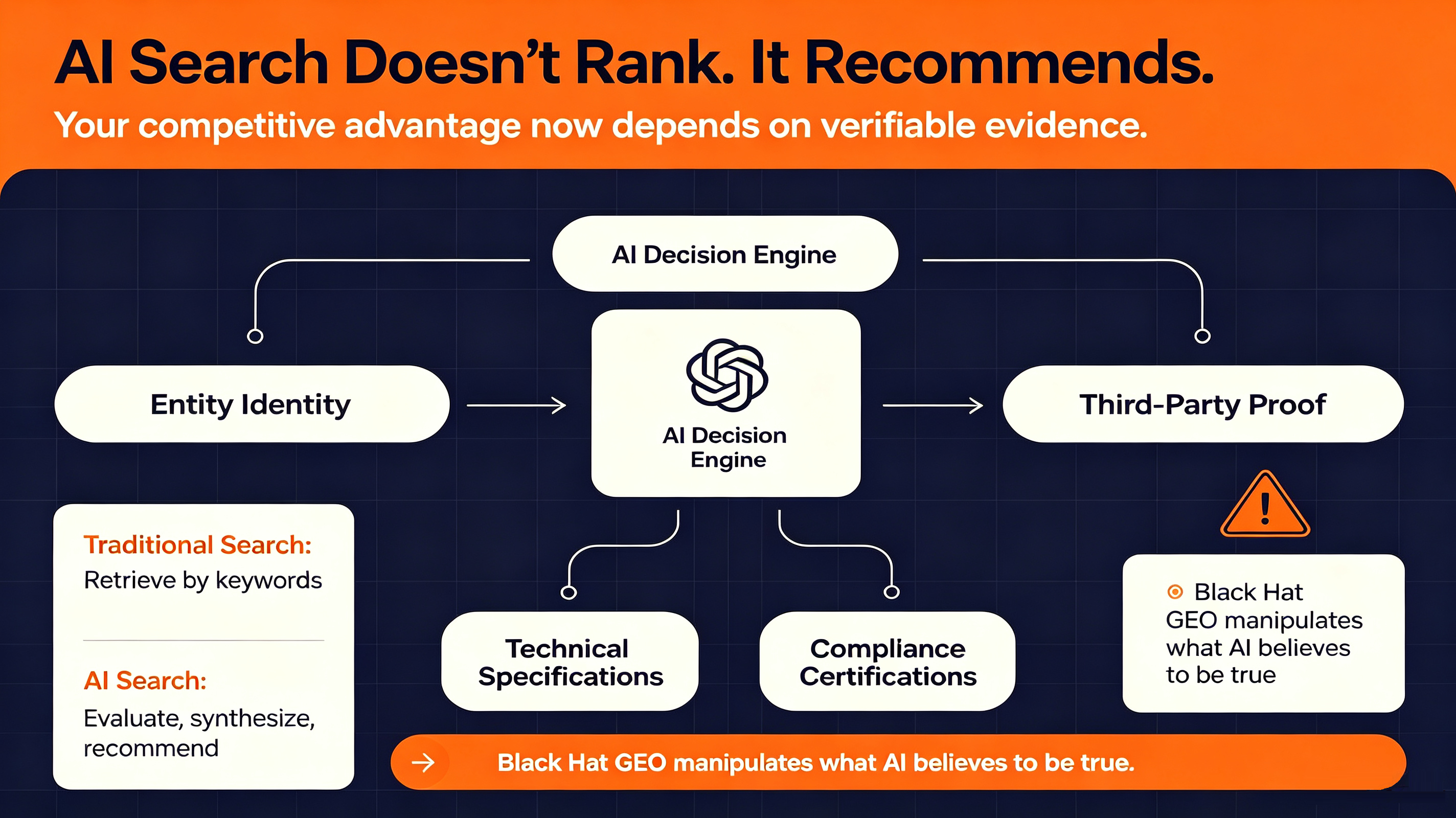
AI is changing the economics of visibility.
- Past: Not ranking = losing traffic
- Present: Not being recommended = losing consideration
02 | Black Hat GEO Is Not Just SEO Spam 2.0
Recent developments in the Chinese digital ecosystem highlight an aggressive shift in manipulation tactics:
- AI-generated content farms
- Fake expert profiles and synthetic reviews
- Entity manipulation and prompt injection
- Artificial mention networks
Traditional Black Hat SEO aimed to manipulate rankings. Black Hat GEO targets a far deeper objective: manipulating what the AI believes to be true.
The new generation of search spam is not trying to manipulate rankings. It is trying to manufacture consensus.
03 | Why AI Has to Fight Back: Search Has Become Recommendation
Traditional Search vs. AI Search marks a structural evolution in user intent and system design:
| Phase | Traditional Search | AI Search |
| Input | Query | Question |
| Process | Retrieve | Retrieve → Evaluate → Synthesize → Recommend |
| Role | Information retrieval system | Decision mediation system |
When a search engine provides ten links, it asserts: “These results match your keywords.” When an AI recommends three specific suppliers, it accepts responsibility for the decision.
The cost of being wrong has increased dramatically. To defend its recommendation engine, AI must evaluate:
- Source credibility and provenance
- Entity identity and consistency
- Verifiable real-world evidence
04 | The Deeper Shift: From Search Visibility to Machine Trust
Corporate discovery has evolved through a three-stage progression:
- SEO (Visibility): Can the search engine find you?
- GEO (Citation): Can AI retrieve and cite you?
- AI-Mediated Commerce (Verification): Can AI verify enough about you to recommend you?
Ultimately, this dictates Decision: Will AI place you into the customer’s consideration set?
Growth requires building Machine Trust alongside traditional Brand Trust.
05 | The New Corporate Asset: Machine-Readable Reputation
Human-readable reputation relies on brochures, PR, events, and case studies interpreted by people. Machine-readable reputation requires structured, cross-verifiable data.
AI evaluates whether corporate information is:
- Cross-verifiable and consistent across platforms
- Formally attributed to verifiable entities
- Backed by third-party evidence and long-term history
Your digital reputation is becoming a data structure before it becomes a marketing message.
06 | China Matters: A Laboratory, Not a Blueprint
China is an unusually compressed laboratory for the AI-mediated economy.
By running AI models inside high-density environments packed with Super Apps, social commerce, and strict regulatory frameworks, China accelerates structural shifts. It exposes a universal question earlier than other markets: Who decides what information AI is allowed to trust?
07 | The Hidden Risk for Western Companies: Asymmetric Citation Risk
Multinational firms often suffer from a severe local-global disconnect:
- Global Footprint: Strong brand reputation, authoritative global website, structured LinkedIn presence, cohesive PR.
- Local Chinese Footprint: Incomplete localized websites, conflicting product specifications across distributors, fragmented third-party data, unverified entity profiles, and agency-generated low-quality content.
The global brand may be strong, while the machine-readable Chinese entity is weak. Your global reputation does not automatically become local machine trust.
08 | The Strategic Response: Stop Optimizing Content. Start Building Evidence.
1. Audit
Evaluate: What does AI currently believe about us? Identify who is creating your digital footprint, screening specifically for low-quality content farms, unauthorized seeding, or synthetic mention networks.
2. Establish
Build a Verified Corporate Knowledge Base containing official identity attributes, exact technical specifications, compliance certifications, verified executive leadership, structured partner nodes, and authentic customer evidence.
3. Connect
Link isolated assets into an interconnected knowledge footprint:
Website ⟷ WeChat Official Account ⟷ Industry Media ⟷ Certifications ⟷ Product Databases
4. Monitor
Shift key performance metrics away from basic rankings and traffic toward AI Citation Share, Entity Accuracy, Recommendation Share, and Factual Consistency.
09 | The CEO Question
Shift the executive line of inquiry away from tactical implementation (“Are we doing GEO?”) toward strategic readiness:
“If an AI system had to recommend three companies in our category tomorrow, would we be one of them—and could the AI explain why?”
Followed immediately by:
“What evidence would the AI use to justify that recommendation?”
10 | The Future: From SEO Agencies to AI Trust Infrastructure
- SEO: Solves Can people find you?
- GEO: Solves Can AI find and cite you?
- Trust Infrastructure: Solves Can AI verify and trust you?
Managing discoverability now requires alignment across Marketing, PR, Data Engineering, Legal, Compliance, and Corporate Communications.
GEO is gradually becoming an enterprise governance problem.
11 | China Is Giving the World an Early Warning
The developments in China do not demand that Western enterprises copy local social tactics. Instead, China is exposing an early version of a structural challenge every AI-mediated market will face.
When AI acts as the primary intermediary for discovery, evaluation, and recommendation:
Who controls the evidence from which AI forms its judgment about your company?
The future of digital competition may not belong to the company that publishes the most content, but to the company whose reality is easiest for machines to verify.
Strategic Synthesis
Black Hat GEO
└─> AI cannot trust synthetic consensus
└─> AI must develop verification mechanisms
└─> Search becomes recommendation
└─> Recommendation creates consideration
└─> Consideration depends on machine trust
└─> Machine trust depends on verifiable evidence
└─> Corporate reputation becomes machine-readable
└─> GEO becomes an enterprise governance issue
 Unlock 2026's China Digital Marketing Mastery!