 English
 German
 Korea
Korea Spanish
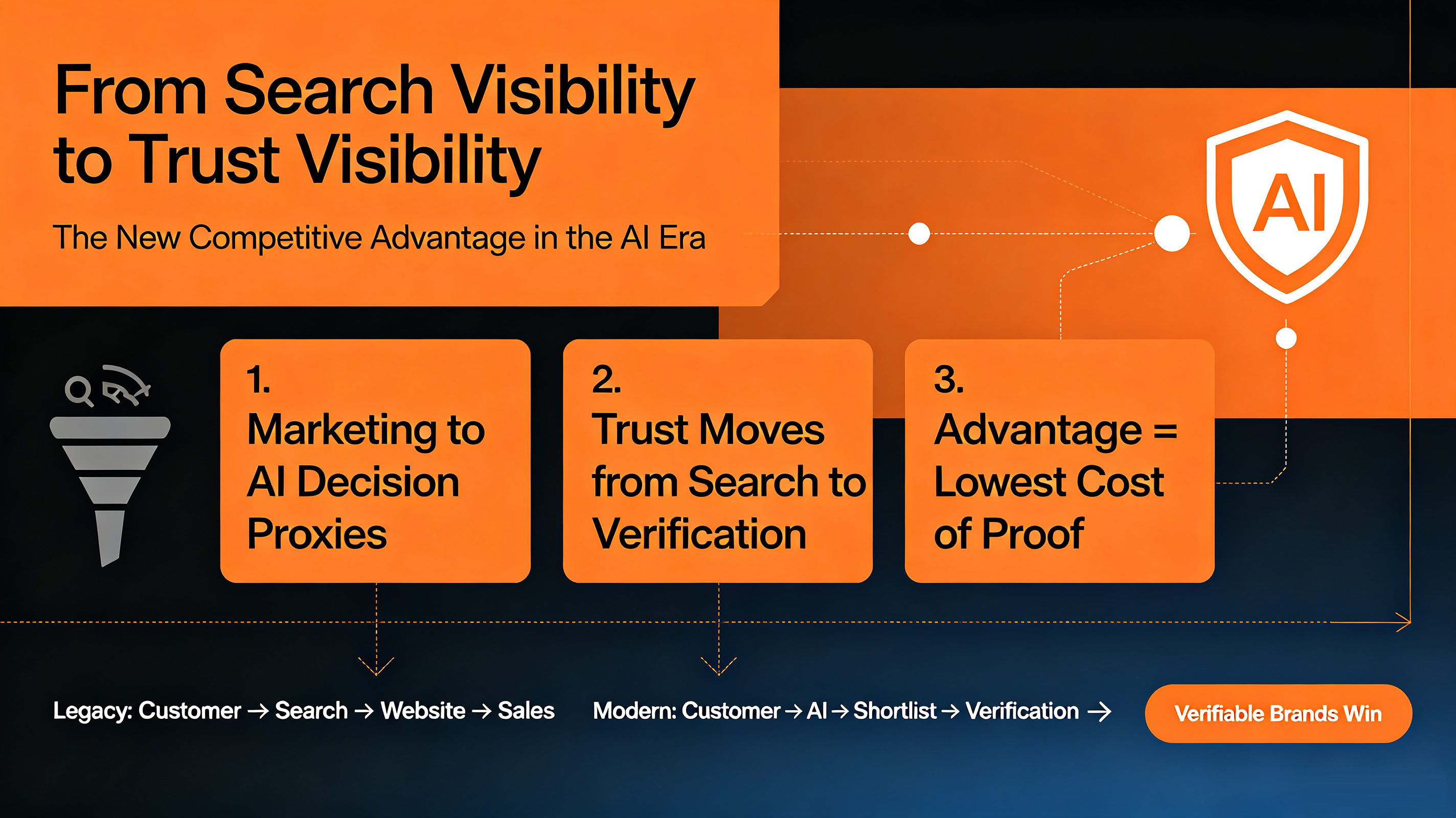
From Search Visibility to Trust Visibility: The New Competitive Advantage in the AI Era
- On August 20, 2026
- Search Visibility, Trust Visibility
For two decades, corporate competitive strategy in the digital realm rested on a single, unchallenged premise: capture human attention at the top of the funnel. We built vast marketing organizations around search engine optimization (SEO), performance media, demand generation, and programmatic content creation to maximize visibility.
That premise is collapsing.
The primary point of friction in global commerce is no longer information retrieval; it is decision arbitration. As artificial intelligence transforms from a conversational gimmick into an enterprise decision proxy, the fundamental mechanics of customer acquisition, brand equity, and market leadership are being rewritten.
This paper outlines a critical strategic pivot for enterprise leadership: the transition from Search Visibility to Trust Visibility, and why the future of market share belongs not to the loudest brand, but to the most rapidly verifiable entity.
1. The Customer Is No Longer Your First Reader
Every CEO understands the traditional customer journey:
Customer → Search Engine → Corporate Website → Sales Team / Purchase
This linear model created the modern playbooks of inbound marketing, conversion rate optimization (CRO), and content farming. However, a profound structural shift has rewired this path:
Customer → AI Decision Proxy → Shortlist → Targeted Verification
Even in complex B2B procurement, high-ticket industrial sourcing, and enterprise technology evaluation, buyers no longer spend weeks sifting through hundreds of “top 10” blogs or vendor-sponsored white papers. Instead, they deploy AI agents, conversational engines, and domain-specific LLMs to perform synthesized market scans.
THE SHIFT IN BUYER BEHAVIOR
LEGACY MODEL: [Customer] —-> [Search Engine] —-> [10+ Vendor Websites] —-> [Sales]
(Manual Synthesis)
MODERN MODEL: [Customer] —-> [AI Decision Proxy] —-> [Shortlist of 2] —-> [Verification]
(Automated Synthesis)
This represents the First Principle of the AI era: Your company is no longer marketing primarily to human buyers; you are marketing to the autonomous systems that evaluate, filter, and advise those buyers.
If your enterprise relies on persuasive narrative alone to win the human reader at the top of the funnel, you will be eliminated long before the human reader ever arrives.
2. The Real Disruption Is Not Search—It Is the Migration of Trust
The business press frequently frames the current market dislocation as a “search engine war”—ChatGPT versus Google, or traditional algorithms versus Generative Search Engine Optimization (GEO). This misses the strategic point entirely.
What we are witnessing is not a search disruption. It is the consolidation and migration of trust intermediaries.
Historically, enterprise commerce relied on three distinct, gatekept trust pillars:
- Search Engines (Discovery): Dictated what was relevant.
- Analysts & Industry Media (Validation): Gartner, Forrester, and specialized press dictated who was credible.
- Sales Networks & Domain Experts (Selection): Advised on what to buy based on specific use cases.
AI architectures aggregate and synthesize all three pillars simultaneously. When an enterprise buyer asks an AI system, “Which enterprise cybersecurity platform best supports zero-trust architecture for a legacy manufacturing infrastructure with sub-10ms latency requirements?” the AI does not return a list of links. It performs Decision Mediation.
It evaluates product parameters, reads peer discussions, parses technical documentation, cross-references analyst reports, evaluates market reputation, and delivers a reasoned recommendation.
THE CONSOLIDATION OF TRUST PILLARS
[Search / Discovery] —┐
[Media / Analysts] —┼—> [ AI DECISION MEDIATION ] —> Decision
[Sales / Experts] —┘
The enterprise threat is not that search volume is declining; it is that the intermediary delivering the final verdict has changed. If your brand cannot pass the automated audit of a neutral decision mediator, your sales team will never get the opportunity to pitch.
3. AI Is Collapsing Information Asymmetry
For decades, significant corporate margin was protected by information asymmetry. Enterprises controlled the narrative around product performance, pricing nuances, edge-case limitations, and competitive comparisons. Marketing departments capitalized on this by deploying three legacy tactics:
- Content Pollution: Generating endless surface-level, keyword-stuffed articles to dominate search engine results pages (SERPs) without providing novel insights or hard data.
- The Promise-Delivery Gap: Masking product limitations behind polished sales collateral, leaving the real friction to be absorbed by customer success teams post-purchase.
- Opaque Positioning: Relying on sales representatives to frame competitive comparisons in high-friction environments where buyers lacked immediate access to granular counter-evidence.
AI collapses this model entirely.
An AI agent does not read your marketing copy with emotional bias; it parses your documentation, developer forums, third-party code repositories, user reviews on platforms like Reddit or specialized industry boards, regulatory filings, and independent benchmarks in seconds.
When information asymmetry disappears, pure persuasion strategy dies with it. Inefficiencies in your product, hidden costs, and unfulfilled marketing promises are instantly legible to machine evaluators.
4. Your Brand Is Becoming Machine-Interpretable Reputation
How does an enterprise define “Brand” in this new paradigm? The strategic definition has evolved through three distinct eras:
THE STRATEGIC EVOLUTION OF BRAND
ERA 1 (Broadcast) : Brand = What you say about yourself.
ERA 2 (Customer-Centric): Brand = What customers remember about you.
ERA 3 (AI / Machine) : Brand = What the information ecosystem can VERIFY about you.
In the AI era, brand equity is no longer an abstract emotional resonance built solely through advertising. Brand is now a Machine-Interpretable Reputation.
When an AI system retrieves information to answer a high-intent commercial query, it searches for high-confidence semantic entities and structured Trust Evidence.
Trust Evidence is not self-authored blog posts. It consists of:
- Rigorous, original research and benchmark studies published by your firm.
- Unbiased third-party validations (independent certifications, audit logs, peer-reviewed technical papers).
- Genuine user sentiment and unvarnished troubleshooting conversations across open technical ecosystems (GitHub, Stack Overflow, specialized subreddits, verified buyer forums).
- High-authority media citations and structured industry press.
If your enterprise is absent from, or negatively represented within, the verified information networks that AI systems crawl and index for Retrieval-Augmented Generation (RAG), you become effectively invisible at the moment of customer decision.
5. Your Website Is Becoming Trust Infrastructure
Most corporate websites are built as psychological traps: designed to capture an IP address, force a gated form download, and trigger an aggressive sales sequence.
This model is increasingly obsolete. Your website is no longer just a marketing brochure; it is your primary Trust Infrastructure.
Its primary audience is two-fold: human buyers seeking rapid proof, and AI agents seeking structured, machine-readable facts. A website designed for the AI era must transition from asking “How do we persuade?” to asking “How do we enable instant verification?”
THE WEBSITE AS TRUST INFRASTRUCTURE
PERSUASIVE LAYER (Legacy) | VERIFICATION LAYER (Modern)
Self-Centered Claims | What We Claim (Clear Positioning)
Gated PDF Whitepapers | What We Can Prove (Hard Data)
Generic Testimonials | What Others Say (Verifiable Case)
Hidden Pricing/Specs | Where We Are NOT the Best Fit
To function as robust Trust Infrastructure, your digital ecosystem must explicitly supply:
- What We Claim: Clear, precise statements of core capabilities and architectural design without fluffy adjectives.
- What We Can Prove: Open-access technical documentation, API specifications, benchmark results, and compliance certifications.
- What Others Say: Direct links to verified customer implementations, third-party code integrations, and external peer reviews.
- Where We Are Not the Best Choice: Explicitly detailing the edge cases or scale requirements where your solution is not optimal.
Counterintuitively, radical transparency is becoming a defensive moat. An enterprise that openly states where its solution fails builds immense credibility with machine decision proxies, which prioritize low-variance, highly consistent data sources over hyper-optimistic marketing copy.
6. AI Does Not Create Trust—It Redistributes Trust
A common mistake among executive teams is viewing AI as a channel to be “hacked”—treating Generative Engine Optimization (GEO) as nothing more than advanced SEO trickery.
This misunderstands the mechanics of machine learning. AI does not create trust; it redistributes existing trust.
AI algorithms aggregate trust that was previously scattered across thousands of human conversations, specialized technical forums, academic papers, analyst summaries, and operational track records. It consolidates this fragmented trust and channels it toward the few market players whose claims are systematically corroborated across the web.
HOW AI REDISTRIBUTES TRUST
- Fragmented Trust Signals
(Forums, Audits, Code, Press, Docs) - AI Decision Synthesis
=> Focused Allocation of Decision Trust to Verifiable Brands
Therefore, the winning strategic question for the CEO is not:
“How do we trick the AI into recommending us?”
The correct strategic question is:
“Why would a rational, cold, data-driven AI arrive at the objective conclusion that our enterprise is the safest, most reliable choice for this specific buyer?”
The former leads to superficial tactics that break with every model update. The latter leads to enduring structural advantage.
7. Competitive Advantage Is Moving From Attention to Verifiability
To understand why your marketing, product, and strategy organizations must transform, we must examine how the primary currency of corporate growth has evolved over successive technology cycles:
| Era | Primary Channel | Core Currency | Strategic Metric |
|---|---|---|---|
| Mass Media | TV / Print | Reach | Share of Voice (SoV) |
| Search Engine | Google / Bing | Visibility | Share of Search (SoS) |
| Social / Performance | Meta / LinkedIn / Ads | Engagement | Conversion Rate / CAC |
| AI & Agentic Commerce | LLMs / AI Proxies / RAG | Verifiability | Share of Recommendation / Share of Trust |
When the primary currency of commerce moves from Attention to Verifiability, the company that wins is not the one with the largest media budget, but the one with the lowest cost of proof.
Consider two competing B2B industrial equipment suppliers:
- Company A spends $5M annually on brand campaigns, programmatic display ads, and SEO agencies producing 200 blog posts per month extolling their “unmatched reliability.” However, their technical specs are buried behind sales gates, their client references are anonymized quotes, and their product documentation is outdated.
- Company B spends $2M on traditional marketing, but invests heavily in publishing 100 open-access, engineer-authored stress-test reports, detailed field failure-rate data, structured API/JSON product catalogs, third-party safety certifications, and real-time integration guides.
When a Fortune 500 procurement officer uses an AI decision proxy to evaluate vendors for a $20M infrastructure upgrade, Company A does not even make the shortlist. The AI cannot verify Company A’s marketing claims, while Company B presents an airtight, machine-readable audit trail of competence.
8. The CEO Agenda: Building an Enterprise Trust Architecture
Transitioning an enterprise from a “Search Visibility” mindset to a “Trust Visibility” framework cannot be delegated solely to a marketing director. It requires cross-functional alignment across Marketing, Product, Legal, Engineering, and Customer Success.
CEOs must mandate a four-part operational transformation:
THE ENTERPRISE TRUST ARCHITECTURE
- AI VISIBILITY AUDIT –> Discover how AI currently evaluates you.
- EVIDENCE LIBRARY –> Convert generic content into hard proof.
- TRUST INFRASTRUCTURE –> Rebuild digital assets for machine validation.
- AI GOVERNANCE –> Unify cross-departmental brand data.
I. Conduct an AI Visibility & Friction Audit
Instruct your strategy team to run a comprehensive diagnostic using major AI engines (OpenAI, Perplexity, Gemini, Claude) using 100 non-branded, high-intent buyer queries typical of your ideal customer profile.
- Where does your enterprise appear in the synthesized recommendation?
- How is your value proposition framed relative to competitors?
- What structural risks, technical caveats, or outdated information are AI models highlighting about your firm?
II. Shift from a Content Library to an Evidence Library
Audit your organization’s marketing and communications budget. Reallocate capital away from high-volume, low-margin content generation toward the systematic buildout of an Enterprise Evidence Library.
- Content Library (Legacy): 50 articles explaining “Why Zero-Trust Security Matters.”
- Evidence Library (Modern): 5 peer-reviewed benchmark papers, 10 third-party penetration test audits, 15 engineer-signed implementation blueprints, and raw uptime data sheets.
III. Modernize Digital Infrastructure for Verification
Upgrade your corporate website and digital repositories from pure persuasion channels into high-fidelity Knowledge Infrastructures.
- Ensure all technical specifications, pricing tiers, compatibility matrixes, and compliance standards are exposed using clear structured data schemas and clean data formats.
- Create machine-interpretable endpoints (
/docs, structured APIs, structured knowledge bases) that allow autonomous agents to verify your enterprise capabilities in real time.
IV. Establish Cross-Functional AI Governance
In most enterprises, information that shapes AI perception is wildly fragmented:
- Marketing owns the corporate messaging.
- Engineering owns the technical documentation.
- Customer Success owns peer reviews and community forums.
- Legal owns compliance releases.
Establish a Trust & AI Reputation Governance Board led by the CMO, CTO, and Head of Product. This body ensures that every digital footprint generated across your enterprise presents a unified, verifiable, and highly accurate dataset to the global information ecosystem.
Conclusion: The New Competitive Moat
For twenty years, corporate leadership prioritized volume, reach, and persuasion. We optimized for the algorithm, captured the click, and relied on sales pipelines to filter reality from marketing promise.
AI has rendered that playbook obsolete.
The next competitive advantage will not belong to the enterprise that communicates the most aggressively. It will belong to the enterprise that can be verified the fastest.
AI will not cause untrustworthy, superficial businesses to vanish overnight. But it will make “untrustworthiness” increasingly impossible to hide.
As an executive team, your mandate is no longer to win the battle for search visibility. Your mandate is to build an unassailable Trust Architecture—one that positions your enterprise as the single most verifiable, dependable answer in your industry, both to the AI that evaluates the market and the human buyer who relies on it.
 Unlock 2026's China Digital Marketing Mastery!