 English
 German
 Korea
Korea Spanish
The Next Competitive Advantage Is Decision Enablement
- On August 20, 2026
- Decision Enablement, marketing decision enablement
Companies do not buy products. Organizations make decisions.
If your CMO is still presenting quarterly metrics based on lead volume, cost-per-acquisition, or MQL-to-SQL conversion rates, your go-to-market engine may be solving for a commercial environment that no longer exists.
For decades, modern marketing has operated on a foundational premise: if you generate sufficient demand, build a compelling brand narrative, and train salespeople to persuade the key stakeholder, revenue will follow.
In complex B2B markets, that premise has quietly broken down.
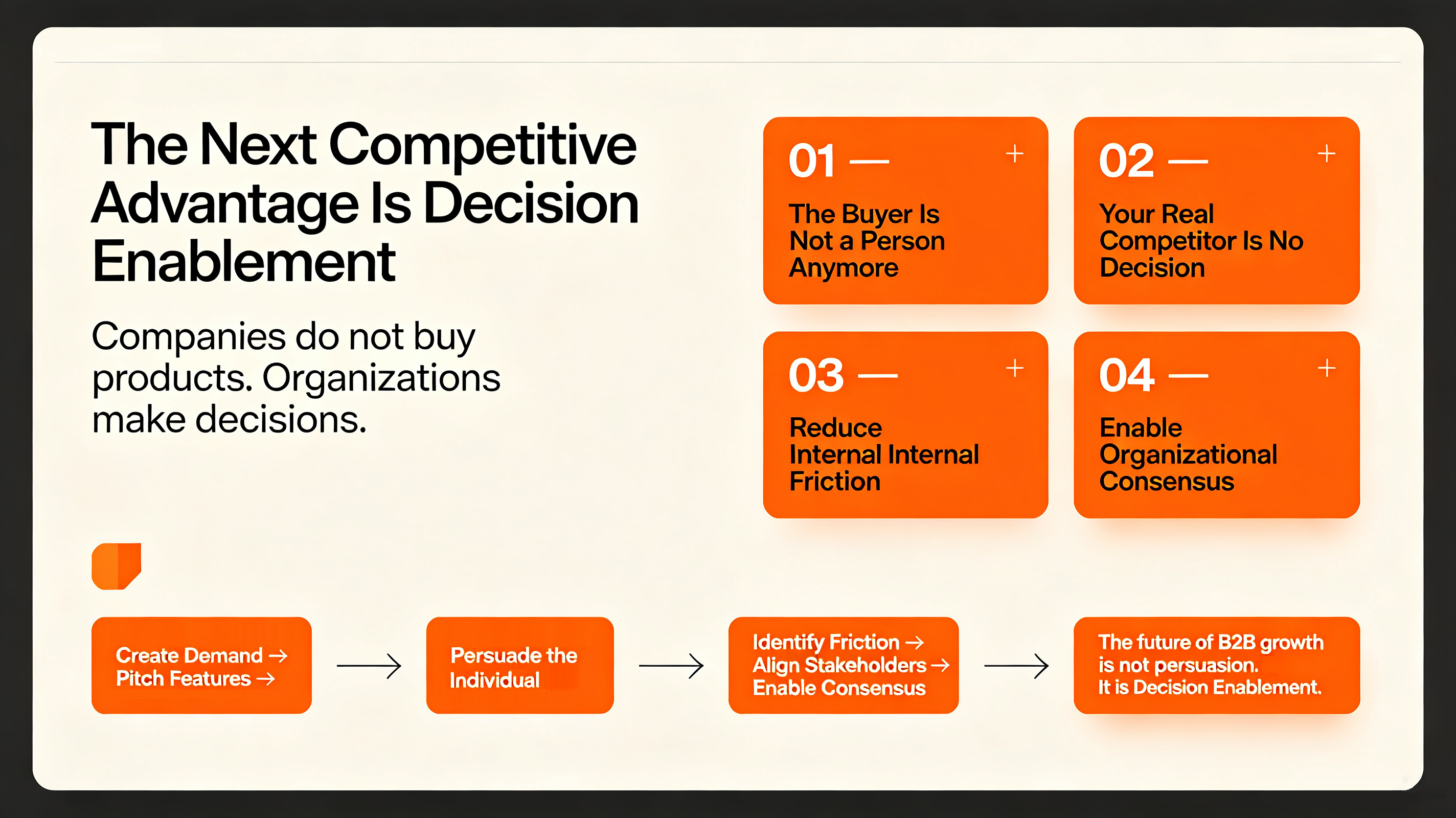
01 — The Buyer Is Not a Person Anymore
The traditional B2B marketing funnel rests on a convenient fiction: the existence of “The Buyer.” We design user personas, build targeted ad campaigns, and craft pitch decks tailored to a singular decision-maker—the VP of IT, the Chief Marketing Officer, or the Head of Procurement.
In reality, complex corporate purchases are almost never executed by an individual. They are governed by a Buying Committee—an ad-hoc, multi-disciplinary coalition of executives, operators, technologists, and risk managers.
The single most critical operational distinction for C-suite leaders to grasp is this:
The customer doesn’t make a decision. The organization does.
When a deal stalls, it is rarely because your product lost a feature comparison or your pricing was 10% too high. It stalls because the customer’s internal team could not reconcile their competing priorities, conflicting incentives, and differing perceptions of risk.
02 — Your Real Competitor Is “No Decision”
Consider a scenario familiar to every executive:
- The client’s problem is acute and well-documented.
- Your solution is objectively superior to alternatives.
- The economic budget exists.
- Your internal Champion inside the client organization is enthusiastic and aligned.
Yet, after six months of promising meetings, the deal silently dissolves into an administrative limbo: “We’ve decided to table this initiative until Q3.”
Why does this happen?
Because in enterprise sales, your primary adversary is almost never a direct market rival. Your primary adversary is organizational status quo bias—driven by a fundamental truth of corporate behavior:
The perceived risk of changing is almost always higher than the perceived cost of staying the same.
For an individual executive, advocating for a major operational change carries immense personal and professional exposure. If the project succeeds, the credit is shared across the division; if the project fails, the career fallout lands squarely on the advocate. When faced with internal friction and ambiguity, the safest personal decision for any corporate stakeholder is inaction.
03 — The Hidden Economics of Organizational Friction
To solve this problem, C-suite leaders must elevate “internal friction” from a tactical sales nuisance to a strategic cost center.
Every complex purchase triggers severe internal Decision Friction across multiple dimensions:
- Information Asymmetry: Technical teams understand the platform mechanics, but cannot articulate financial metrics to the CFO.
- Conflicting KPIs: Operations prioritizes immediate speed to market; Security prioritizes absolute governance and zero-trust compliance.
- Risk Ownership: The business unit captures the operational upside, but the IT department inherits the integration and maintenance burden.
- Budget Ownership: Department A funds the initiative, but Department B reaps the primary efficiency savings.
- Implementation Uncertainty: End users fear workflow disruption and steep learning curves, leading to silent operational resistance.
The commercial equation governing this reality is straightforward:
The more expensive the strategic decision, the more expensive internal consensus becomes.
When enterprise go-to-market strategies ignore this hidden tax, sales cycles elongate, discount pressures escalate, and close rates decay—not due to lack of market demand, but due to internal consensus failure.
04 — Marketing’s New Job: Reduce Decision Friction
This reality requires a structural shift in how CEOs define the core mandate of their marketing organizations.
Historically, Marketing’s primary job was Demand Generation—attracting attention, raising awareness, and filling the top of the funnel.
In complex B2B environments, Marketing’s primary job must become Decision Enablement—reducing operational uncertainty, aligning disparate internal stakeholders, and equipping customer teams to reach a confident consensus.
Traditional Marketing Mandate:
[ Create Demand ] ──> [ Pitch Features ] ──> [ Persuade the Individual ]
Modern Strategy Mandate:
[ Identify Friction ] ──> [ Align Stakeholders ] ──> [ Enable Organizational Consensus ]
When Marketing transitions to Decision Enablement, it ceases to be an expense item focused on lead acquisition. It becomes a strategic function that accelerates capital allocation inside your client’s enterprise.
05 — Stop Mapping Personas. Map the Decision Architecture.
Standard buyer personas describe who people are (demographics, job titles, isolated pain points). Decision Architecture maps how organizations decide.
To unblock complex sales, your organization must understand the specific power dynamics, risk profiles, and value equations across the decision matrix:
| Stakeholder Role | Primary Lens | Core Fear / Risk | What They Need to Approve |
|---|---|---|---|
| Economic Buyer (CEO/MD) | Strategic Advantage & Growth | Capital misallocation, missed targets | Clear alignment with top-line enterprise goals |
| Financial Buyer (CFO) | Capital Protection & ROI | Cost overruns, extended payback periods | Defensive financial models, contractual certainty |
| Technical Buyer (CIO/CTO) | Security & Systems Elasticity | Architectural debt, data breaches, downtime | Comprehensive compliance, integration proofs |
| Operational User (VP Ops) | Execution & Workflow Impact | Team disruption, productivity loss | Minimal retraining, rapid time-to-value |
| Procurement & Legal | Commercial Governance | Unfavorable terms, liability exposure | Market-standard SLAs, risk mitigation clauses |
The critical question for your leadership team is not: “Have we touched every role?”
The critical question is: “Do we understand who has veto power, who bears the implementation risk, and who captures the financial gain?”
06 — Build Multi-Threaded Narratives, Not Multiple Sales Pitches
A common mistake is creating fragmented, isolated sales decks for different departments. This deepens internal divisions inside the customer’s organization.
Instead, companies must deploy Multi-Threaded Narratives: distinct arguments tailored to specific stakeholder concerns, all converging on a single, unified business case.
- To the CEO: How this strategic investment accelerates enterprise market position.
- To the CFO: How capital outlay is derisked with measurable, defensive payback milestones.
- To the CIO: How system integration maintains security posture and operational integrity.
- To the VP of Operations: How immediate execution risks are mitigated without disrupting current workflows.
Different concerns. One business case.
When every stakeholder sees their specific risks addressed within the same overarching narrative, political friction drops, and the internal path to “Yes” clears.
07 — Build “Internal Decision Assets”
Marketing assets should not be designed merely for your team to present to a customer. They must be engineered for your customer to present to their own board, CFO, or risk committee.
The most powerful marketing asset may never be consumed by your sales team. It will be used by your Champion to convince five skeptical colleagues when you are not in the room.
High-performing B2B organizations supply their Champions with specialized Decision Assets:
- Business Value Assessments (BVAs): Transparent, conservative financial frameworks that withstand CFO auditing.
- Risk & Security Matrix: Pre-packaged documentation that answers 90% of IT compliance queries before the first security call.
- Implementation Roadmaps: Step-by-step change-management plans that prove operational feasibility to line managers.
- Executive Briefings: Concise, two-page strategic memos formatted specifically for internal board-level review.
If your Champion has to create their own internal pitch deck to justify your solution, you have effectively outsourced your most important sales meeting to an amateur.
08 — The CEO Audit: Can Your Marketing Help a Customer Buy?
To determine whether your go-to-market strategy is truly built for enterprise decision enablement, evaluate your current operations against these five executive questions:
- Do we know everyone who can kill this deal?
- Audit: Can your sales and marketing teams map the complete decision hierarchy—including indirect blockers in legal, security, and operations—for every active enterprise opportunity?
- Do we know what each stakeholder must believe before approving?
- Audit: Do you have documented, role-specific risk criteria for the CFO, CIO, and end-user, or are you relying on a generic corporate sales deck?
- Can our Champion defend our economic value without us in the room?
- Audit: Do you provide champions with customizable, audit-ready financial and operational tools designed for internal board presentations?
- Do we produce assets built specifically for internal decision-making?
- Audit: What percentage of your collateral is external promotional content versus internal consensus tools (e.g., security whitepapers, ROI calculators, change-management blueprints)?
- Can Marketing measure consensus progression, not just lead generation?
- Audit: Are your marketing metrics anchored to multi-stakeholder engagement within target accounts, or are you still optimizing for single-contact form fills?
9 — The Next Competitive Advantage
For the past two decades, corporate strategy focused heavily on product differentiation: Build a better product, and the market will reward you.
As product categories matured and features homogenized, the battlefield shifted to customer experience: Deliver a friction-free user experience, and customers will stay.
In complex, multi-stakeholder B2B markets, both advantages remain necessary, but neither is sufficient.
The next sustainable competitive advantage belongs to the enterprise that masters organizational consensus.
In complex B2B markets, the winning company is not necessarily the one that persuades the customer best. It is the one that makes the customer’s organization most capable of reaching a confident decision.
The future of B2B growth is not persuasion. It is Decision Enablement.
 Unlock 2026's China Digital Marketing Mastery!