 English
 German
 Korea
Korea Spanish
The AI Decision Layer: What China Reveals About the Next Era of Global Commerce
- On August 19, 2026
- ai decision, AI Decision Layer
Why companies will compete not only for customers, but for the AI agents increasingly deciding what customers buy.
For the past two decades, Western multinationals operating in China executed a playbook built on three core pillars: Search Engine Optimization (SEO) to secure visibility, Direct-to-Consumer (D2C) channels to capture demand, and performance media spend to convert attention into sales.
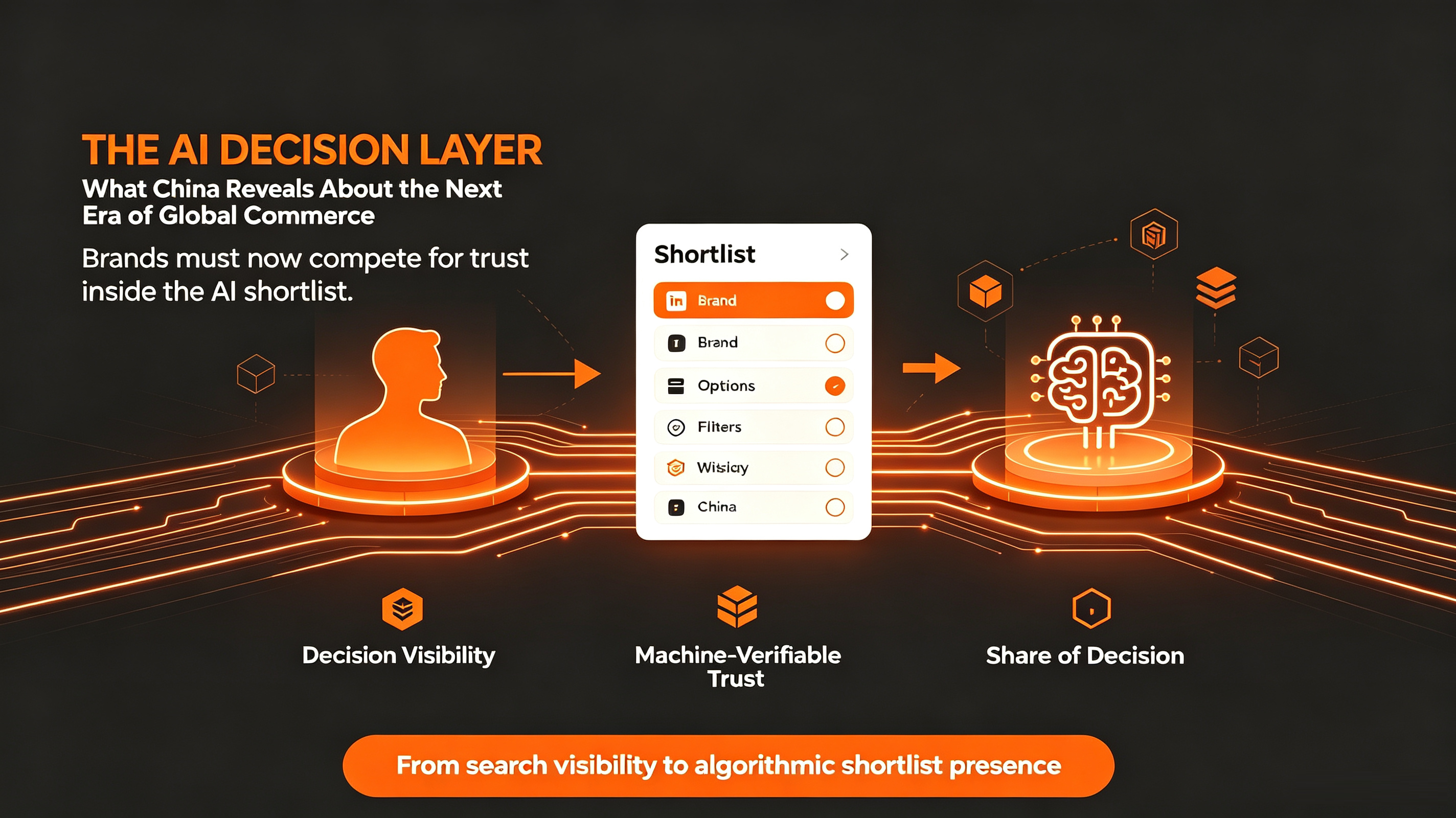
That playbook is no longer sufficient.
While traditional channels remain operational, the mechanism governing how discovery converts into purchase is undergoing a profound structural shift. Consumers in China are no longer relying solely on keyword search queries or sponsored social feeds to navigate options. Instead, they are increasingly inserting conversational AI models—such as ByteDance’s Doubao, DeepSeek, Alibaba’s Qwen, Baidu’s Ernie Bot, and Tencent’s Yuanbao—directly into the research and evaluation phase of the buyer journey.
Recent platform studies from major Chinese tech ecosystems highlight this evolution: AI conversational interfaces do not immediately kill traditional search engines; rather, they serve as a dynamic “decision layer.” Users shuttle fluidly between conversational exploration and traditional platform searches, using AI to filter noise, synthesize options, and construct shortlists before returning to transaction engines to buy.
TRADITIONAL CONSUMER DISCOVERY
User Query ──> Search Bar ──> Keyword Rankings ──> Brand Page ──> Conversion
AI-MEDIATED DECISION LAYER
User Intent ──> AI Agent Filtering & Synthesis ──> Qualified Shortlist ──> Closed-Loop Purchase
│
├── Machine-Verifiable Trust (Data, Standards, Consensus)
└── Rejection of Unverified Marketing Claims
For global executives, China is serving as a stress test for an emerging commercial reality: Your primary audience is no longer just a human scrolling on a screen. It is an AI decision layer evaluating whether your brand is credible enough to make the final recommendation.
1. From Search Visibility to Decision Visibility
The fundamental shift taking place in digital commerce is not merely technological—it is structural. The core transformation is not about search; it is about the migration of decision-making authority.
In traditional search engines, brands competed for positioning—securing top placement on a results page through keyword optimization, bidding, and backlinks. In an AI-mediated environment, the model does not present a list of options for the human to evaluate; it executes the evaluation on behalf of the human.
When an AI agent interprets user intent, compares technical specifications, weighs customer sentiment across platforms, and recommends a product, it acts as a synthesis engine. If a brand lacks machine-readable data, cross-verified authority, or structured proof, it is filtered out long before a human ever views a landing page. The battle has migrated from securing a click to securing a place inside the machine-generated shortlist.
2. China Is the World’s AI-Commerce Stress Test
China is acting as the global laboratory for AI-mediated commerce due to several structural conditions that do not exist to the same degree in Western markets:
- Super-App Integration: Chinese digital life is concentrated within interconnected ecosystems like WeChat, Douyin, and Alipay, where discovery, social proof, and payment reside within unified architectures.
- Closed-Loop Commerce Infrastructure: Native commerce protocols allow conversational AI interfaces to execute transactions instantly without kicking users out to third-party external websites.
- Rapid Infrastructure Adoption: Low inference costs—driven by open-source innovation like DeepSeek and Alibaba’s Qwen—have drastically lowered the cost of deploying agentic AI across enterprise and consumer applications.
- High Enterprise Willingness: Domestic platforms accelerate AI agent integration across supply chains, B2B procurement, and merchant operations at a pace unparalleled in the West.
Because these factors exist simultaneously in China, the integration of AI into consumer and B2B decision-making is maturing faster here than anywhere else. What manifests in China today reveals the friction points, architectures, and strategies that will define global commerce as AI tools mature worldwide.
3. The New Gatekeeper Is the AI Agent
For decades, the gatekeepers of commerce were search engine algorithms, retail buyers, and digital ad networks. The new gatekeeper is the AI agent.
When an enterprise procurement team or an individual consumer uses an AI tool to evaluate vendors, the agent conducts a multi-step analysis:
- Interpret: It decodes nuanced, natural-language prompts, prioritizing specific constraints (e.g., regulatory compliance, ESG certifications, ingredient safety) over generic brand slogans.
- Compare: It crawls structured data, platform reviews, technical papers, and price indices across closed network ecosystems.
- Recommend: It discards low-confidence, unverified options and presents a distilled verdict.
- Negotiate & Transact: Advanced enterprise B2B agents in China are beginning to test automated pricing audits and API-driven vendor negotiations.
If your enterprise strategy relies solely on persuasive copy written for human eyes, your brand risks becoming invisible to the machine agent conducting the initial filter.
4. The New Competition: Share of Decision
Marketing frameworks have progressively evolved alongside channel complexity:
Share of Voice ──> Share of Search ──> Share of Model ──> SHARE OF DECISION
- Share of Voice: Measuring ad spend and brand awareness in mass media.
- Share of Search: Measuring intent via query volume on engines like Google or Baidu.
- Share of Model: Tracking how often an LLM mentions or cites a brand in conversational responses.
- Share of Decision: The percentage of times an AI agent includes your brand in the actionable shortlist when a customer is actively making a buying decision.
The distinction is critical. Share of Model merely asks: “Does the AI know our brand exists?” Share of Decision asks: “When an AI agent is actively advising a buyer or executing a purchase, does it select us as the recommended solution?” Winning Share of Decision requires moving past surface-level media presence and embedding your brand’s core value proposition directly into the evidence networks that AI models trust.
5. The New Corporate Asset: Machine-Verifiable Trust
In the legacy web, brand trust was built through brand reputation, design aesthetics, and high-ranking website domains. In an AI-mediated market, those elements are necessary but insufficient. The primary corporate asset in the AI era is Machine-Verifiable Trust.
AI models evaluate claims based on data confidence, structural consistency, and cross-platform consensus. To build machine-verifiable trust, organizations must optimize across six pillars:
- Generative Engine Optimization (GEO): Structuring brand information so AI engines can parse, index, and cite it accurately.
- Structured Data Schemas: Utilizing JSON-LD and clean metadata across all digital properties to feed unambiguous product attributes directly to crawlers.
- Knowledge Graph Integration: Mapping brand entity relationships, patents, leadership credentials, and product lines across verified public and private repositories.
- Technical Documentation: Publishing granular, machine-readable specifications, clinical studies, or whitepapers rather than superficial marketing collateral.
- Third-Party Validation: Ensuring technical assertions are verified by independent regulatory bodies, industry standard setters, or respected certification networks.
- Structured Social Proof: Cultivating authentic, unstructured user sentiment across key domain ecosystems (e.g., Xiaohongshu, Zhihu, specialized industry forums) that AI models crawl for real-world consensus.
If an AI engine cannot independently cross-verify your performance claims across these structured layers, it assigns a low confidence score to your brand and omits it from the decision shortlist.
6. Why This Changes More Than Marketing
A common executive mistake is treating AI search and recommendations as a localized digital marketing shift. It is not.
Because the AI decision layer alters how products are evaluated, priced, and delivered, it forces a transformation across the entire corporate operating model:
OPERATING MODEL TRANSFORMATION
│ Marketing │ Shifts from campaign ads to GEO and data graphs│
│ Sales │ Adapts to AI-driven B2B buyer shortlists │
│ E-Commerce │ Connects inventory APIs to native agent feeds │
│ Procurement │ Deploys buyer bots to audit vendor data │
│ Customer Support│ Integrates memory-aware agentic workflows │
│ IT & Product │ Restructures product data for machine reading │
│ Corporate Policy│ Enforces strict data governance and compliance│
C-Suite Directive: AI-mediated commerce is not a marketing transformation. It is an operating-model transformation.
When customer acquisition depends on machine validation, product teams must ensure specifications are structured for API access, IT architectures must expose dynamic inventory and compliance data safely, and legal teams must manage the risks of algorithmic brand misrepresentation.
7. Strategic Playbook: What Global Executives Should Do Now
Rather than rushing into ad-hoc “AI marketing campaigns,” C-suite executives should execute a disciplined, five-stage framework:
1. Audit AI Decision Visibility
Map how your brand, products, and key value propositions appear across major domestic and international AI engines (e.g., DeepSeek, Doubao, Qwen, ChatGPT, Claude). Measure your current Share of Decision versus primary competitors on specific high-intent purchasing prompts.
2. Build Machine-Verifiable Evidence
Convert static marketing collateral into structured, machine-verifiable assets. Ensure clinical trials, ESG certifications, technical specs, and TCO metrics are publicly accessible in clean, machine-readable formats.
3. Re-Architect Product and Enterprise Data
Shift brand web properties from human-only browsing destinations into dual-purpose Evidence Layers. Your corporate website will not disappear, but its strategic role will evolve—from a destination for manual human browsing to an authoritative source of truth consumed by both humans and autonomous agents.
4. Establish AI Decision Metrics
Establish cross-functional KPIs that move beyond click-through rates (CTR) and web traffic. Track citation accuracy, AI recommendation rates, sentiment alignment within top models, and machine retrieval latencies.
5. Use China as a Strategic Laboratory
Treat your China operations as an enterprise testbed. The strategies, data architectures, and GEO workflows developed to compete within China’s fast-moving, AI-integrated super-apps will serve as the baseline capabilities required to win globally as Western channels adopt agentic commerce.
8. The Board-Level Question
As executive teams review their multi-year digital strategies, the conversation must evolve beyond basic technology adoption.
The board should no longer ask:
“Are we optimized for AI search?”
Instead, the board must ask:
“If an AI agent constructs the shortlist before a human ever sees our brand, what determines whether we are on that shortlist?”
In the emerging era of global commerce, the ultimate competitive advantage will not merely be being better known by human customers. It will be being better understood—and trusted—by the machines acting on their behalf.
 Unlock 2026's China Digital Marketing Mastery!