 English
 German
 Korea
Korea Spanish
From the Town Square to the Whispered Secret: How AI Precision Is Stripping Brands of Their Public Soul
- On August 14, 2026
- brand marketing, branding
Artificial Intelligence is fundamentally reframing advertising from mass transmission to algorithmic hyper-targeting. While this transition delivers unprecedented tactical efficiency, it introduces a critical structural risk for Western business leaders in China and globally: As advertising becomes hyper-precise, the brand itself risks becoming obsolete.
A brand’s strategic moat is never built solely on immediate demand fulfillment; it relies on broad recognition, cultural resonance, and shared social meaning. When algorithms restrict corporate communication strictly to high-propensity buyers, who remains responsible for building the brand’s equity in the collective public consciousness?
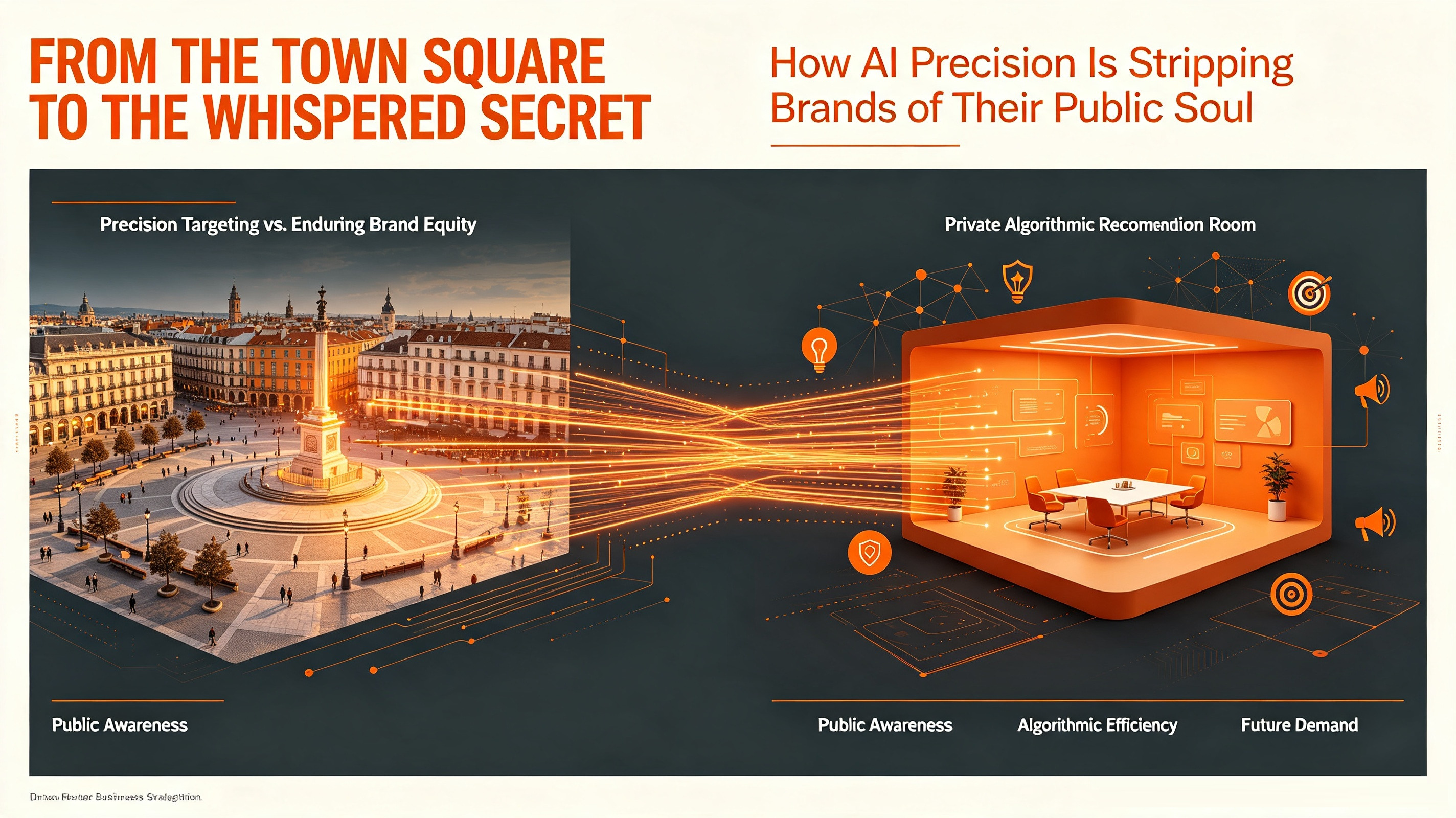
1. The Architectural Shift: From Public Square to Private Room
The Era of Consensus Building
In the foundational era of modern consumer commerce—from Western broadcast television’s prime-time hegemony to early mass-market dominance in emerging economies—advertising operated as a true public utility. Enterprises spent heavily on macro-channels not because network networks possessed granular user telemetry, but precisely because they did not.
They had no way of knowing exactly who would purchase. Consequently, they showed it to everyone.
This created a powerful commercial mechanism: Advertising did not merely seek existing consumers; it manufactured future ones. By asserting presence in the public square, brands established shared social proof and reduced purchasing friction across entire demographics.
The Algorithmic Pivot
Today, the convergence of DSPs, programmatics, and advanced generative AI engines—such as Meta’s Advantage+ and Google’s predictive search architectures—has inverted this paradigm. Modern ad networks operate with granular telemetry:
- Customer Lifetime Value (LTV) projections
- Real-time search query intents and contextual behaviors
- Multi-touch digital footprint tracking
- Micro-moment conversion propensities
As a result, corporate strategy has shifted from “How do we maximize total market awareness?” to “How do we isolate only those ready to transact right now?”
For the CEO, this represents a major operational optimization—yet it masks a dangerous strategic pivot. The enterprise is quietly trading long-term brand equity for immediate conversion liquidity.
2. The Efficiency Paradox: When “Waste” Is Actually Equity
CFOs have long quoted John Wanamaker’s famous dictum: “Half the money I spend on advertising is wasted; the trouble is I don’t know which half.” Modern AI algorithms promise to eradicate that wasted 50%. However, from a corporate strategy standpoint, not all non-converting impression volume is friction; much of it is foundation.
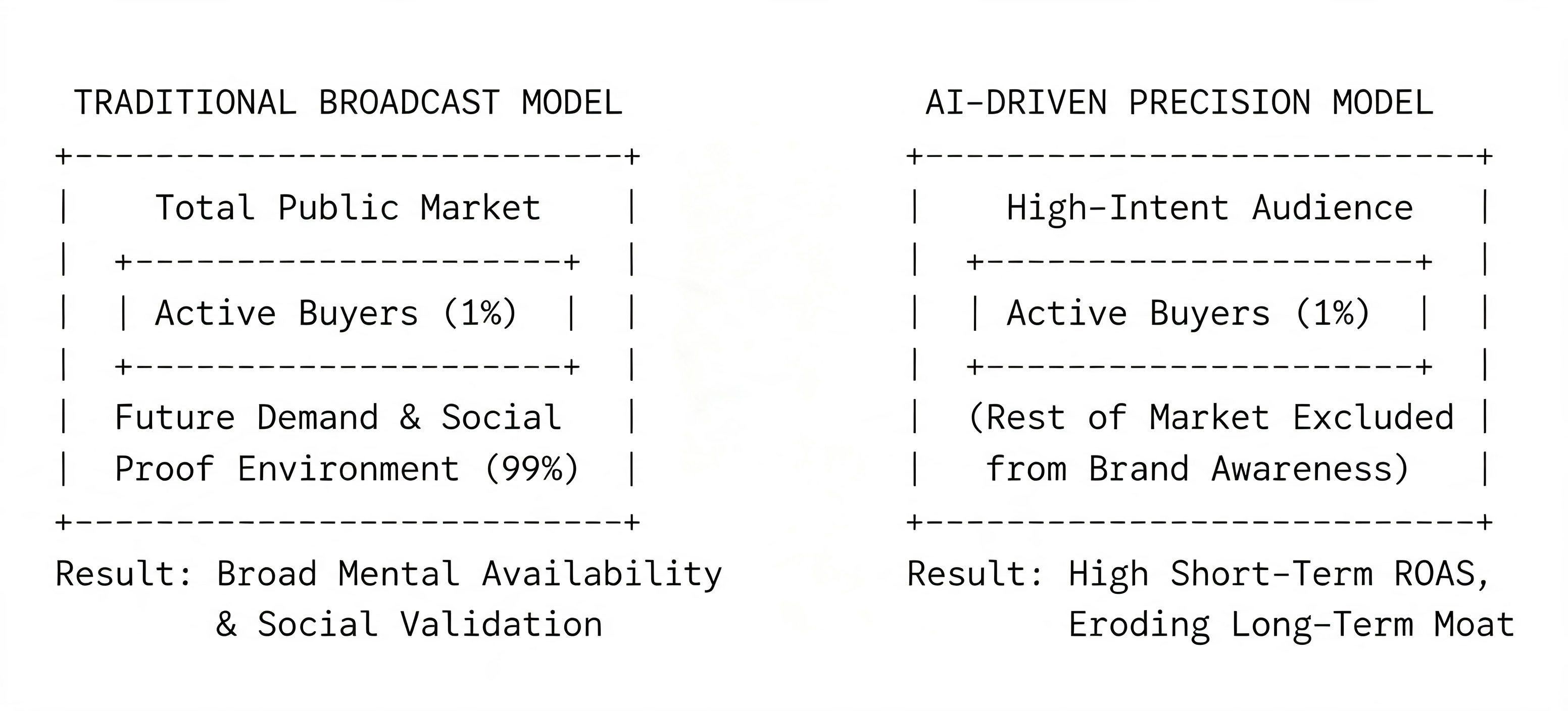
The Limits of ROAS Metrics
Focusing strictly on immediate Return on Ad Spend (ROAS) makes hyper-targeted AI allocation look like an undeniable win. The algorithm strips away low-propensity viewers and concentrates capital on immediate converters.
Mental Availability vs. Direct Attribution
Yet as empirical research from the Ehrenberg-Bass Institute demonstrates, sustainable corporate growth depends on Mental Availability—ensuring a brand is the default choice when a consumer enters a buying frame in the future.
The viewer who does not buy today is often:
- The buyer of tomorrow, whose consideration set is formed long before active intent manifests.
- The market influencer, who validates the purchase decision of others (much like the millions who admire luxury brands like Ferrari without ever buying one, thereby creating the brand’s pricing power).
AI targeting optimizes brilliantly for existing demand, but it lacks the structural mechanics to cultivate future demand. Over-reliance on predictive models creates a yield-management trap: near-term conversion metrics look pristine, while the top-of-funnel customer pipeline quietly dries up, causing long-term customer acquisition costs (CAC) to escalate.
3. The Relevance Fallacy: Market Capture vs. Meaning Creation
Relevance vs. Meaning
In strategic marketing discussions across global technology and consumer sectors, a core tension continually surfaces between two fundamentally different operational goals:
- Relevance (Algorithmic Logic): Answers “What do you need at this exact second?”
- Meaning (Strategic Brand Logic): Answers “Why should this company matter to you over a lifetime?”
The former settles a transaction; the latter secures market position and margin premium.
The Public Nature of Category Leaders
Category-defining enterprises—whether Nike, Apple, or global luxury groups—do not maintain premium margins merely by satisfying transactional criteria. They function as public cultural touchstones. Even consumers who do not currently purchase their products understand precisely what those brands signify.
AI models excel at pattern recognition, intent matching, predictive optimization, and funnel acceleration. However, brand building is not a mathematical prediction problem—it is a value-creation problem. Defining new category standards requires shaping culture, an outcome that cannot be generated solely through dynamic ad assembly.
4. The Data Trap: Behavior Is Not Identity
The Limits of Historical Telemetry
When growth teams present algorithmic profiles to the Board, they are presenting historical behavior, not human intent.
ALGORITHMIC LOGIC: Past Telemetry ───► Predictive Automation
STRATEGIC LEADERSHIP: Human Insight ───► Category Creation
Algorithmic architecture operates on a reactive feedback loop: Past Behavior → Future Prediction.
By contrast, market-defining innovations and brand transformations stem from a forward-looking calculus: Human Insight → Uncharted Category Value.
The Bias Toward Historical Patterns
If an entire sector relies on machine learning models trained on historical interaction data, marketing strategies will systematically optimize for existing preferences. The enterprise becomes extraordinarily efficient at serving yesterday’s market, while missing underlying shifts in consumer values, economic pressures, or lifestyle dynamics.
The division of executive responsibility must remain clear: AI excels at identifying efficiency opportunities; human executive leadership must determine which opportunities are worth pursuing.
5. Algorithmic Homogenization: The Risk of Regression to the Mean
The Systemic Trap of Predictive Creative
Ad networks and content engines systematically reward immediate predictability. Creative assets that deliver statistically consistent Click-Through Rates (CTR) and Conversion Rates (CVR) are automatically prioritized and scaled by the algorithm.
However, category-defining creative campaigns rarely look like safe, predictable options at inception. They introduce friction, cultural dissonance, and novel perspectives. In an early testing phase, unconventional ideas often underperform historical benchmarks because they do not fit existing pattern-recognition models.
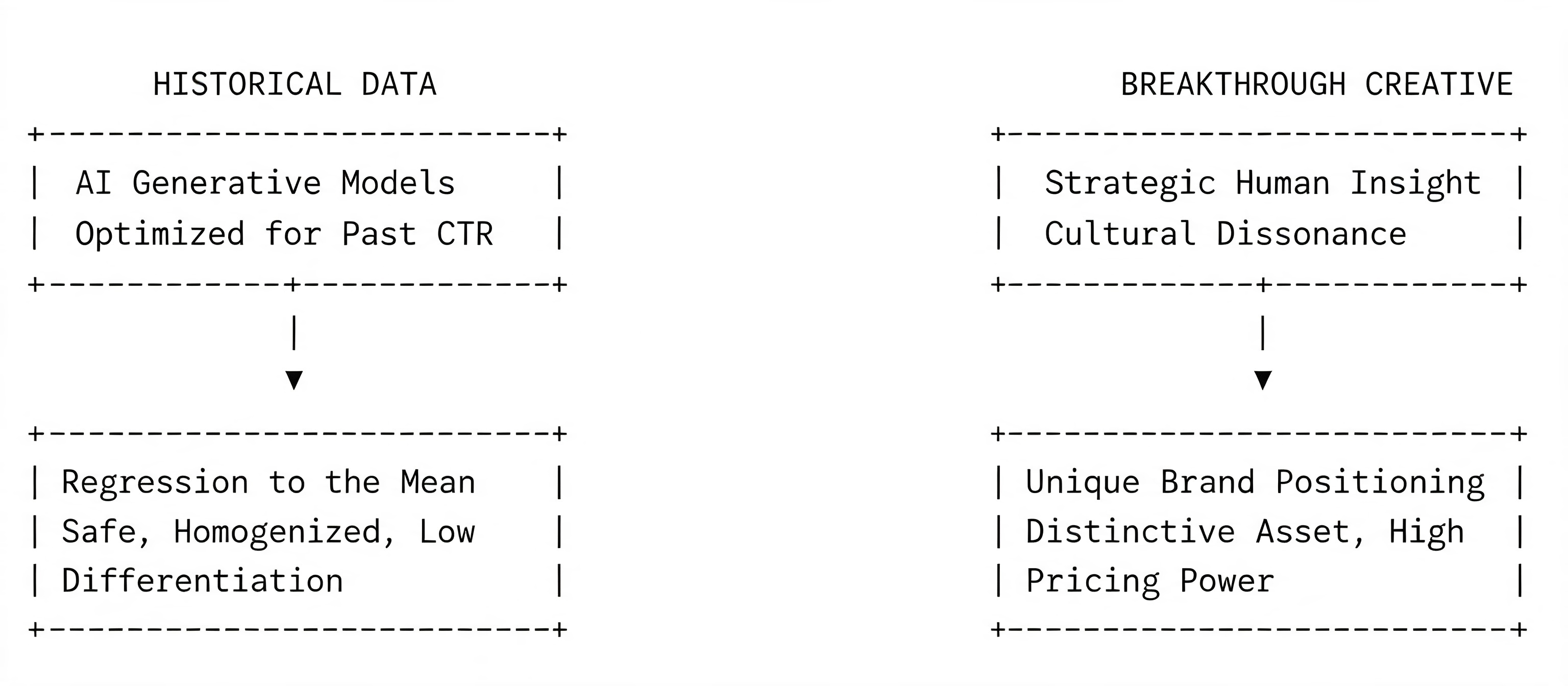
The Threat of Synthetic Homogeneity
When competing firms deploy generative AI tools (such as OpenAI models or Midjourney workflows) to automate creative output based on historic performance data, the broader market experiences synthetic homogenization. Corporate communications become statistically optimized, highly converting, entirely safe—and completely forgettable.
When every competitor possesses automated creative generation, true enterprise differentiation shifts from algorithmic execution to non-average strategic courage.
6. The Structural Threat: Private Recommendation vs. Public Asset
This shift reveals a critical structural vulnerability for modern enterprises.
- Legacy Positioning: “The broader market recognizes and respects our brand.”
- Algorithmic Positioning: “The recommendation engine matches our product to an isolated user.”
Under the latter condition, the enterprise does not hold a market-facing brand asset; it holds a temporary distribution position dependent on a third-party algorithm.
Enterprises continue to invest heavily in Customer Data Platforms (CDPs), Data Management Platforms (DMPs), enterprise CRMs, and autonomous AI agents. Yet, they often discover that despite possessing vast proprietary data, their broader brand equity is deteriorating. The machine knows precisely who the customer is, but the public market no longer knows what the brand stands for.
7. Strategic Re-Allocation: Designing the Dual-Engine Architecture
To navigate this landscape, C-suite leaders must abandon the outdated choice between “brand building” and “performance marketing.” Instead, executives must implement a Dual-Engine Marketing Architecture with distinct operational mandates.
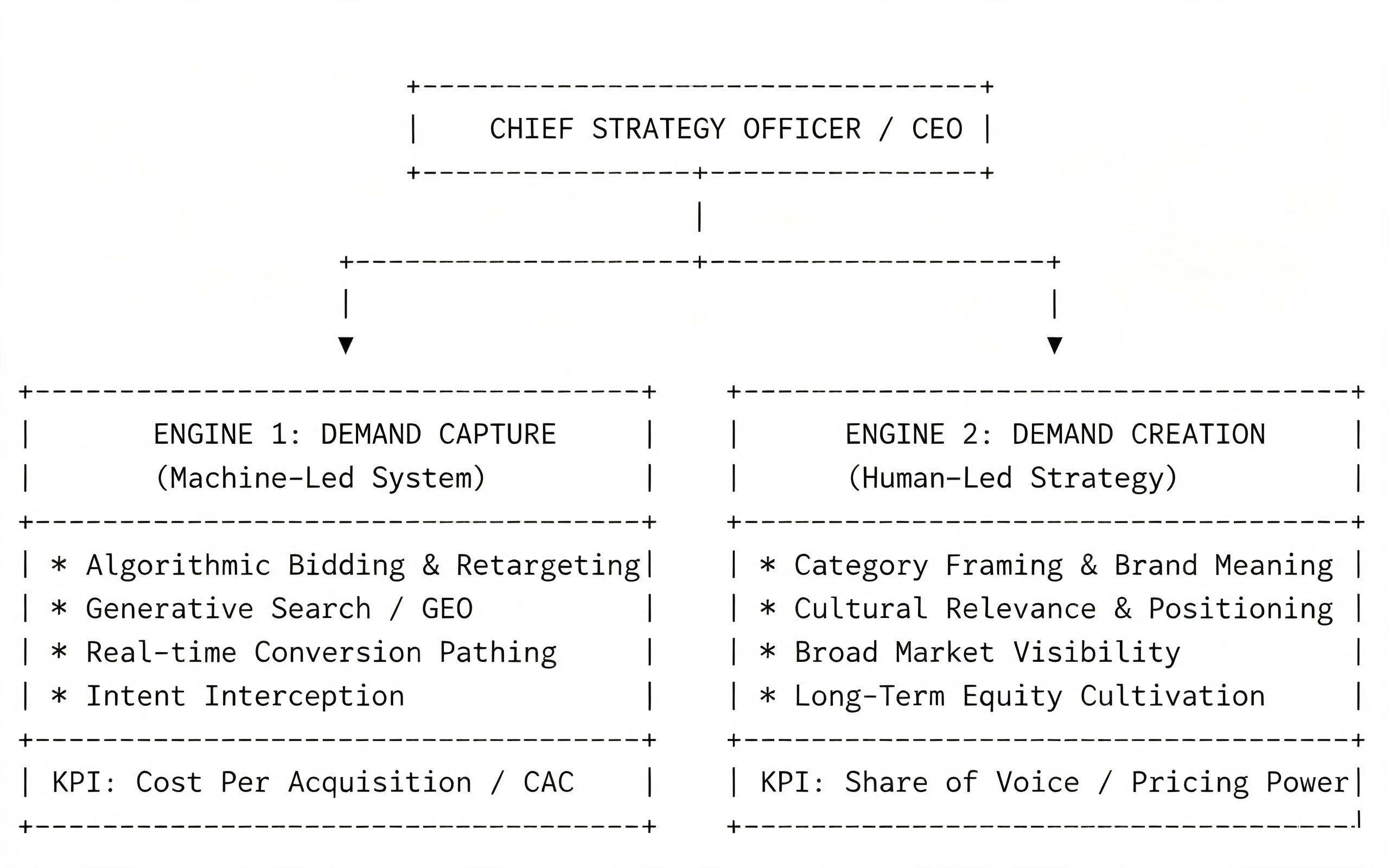
Engine 1: Demand Capture (Machine-Led)
Designed to capture existing market demand at maximum capital efficiency.
- Scope: Intent search, algorithmic recommendation networks, dynamic retargeting, and programmatic conversion optimization.
- Strategic Role: Capitalize on active purchasing intent and maximize immediate transactional yield.
Engine 2: Demand Creation (Human-Led)
Designed to manufacture future market demand and defend pricing power.
- Scope: Positioning, market framing, category definition, narrative strategy, and high-impact public presence.
- Strategic Role: Ensure that when prospective buyers enter a purchasing frame in 6 to 18 months, your enterprise is their default choice.
The primary strategic question for executive leadership is not “Which channel offers the highest immediate ROI?” but rather: “What percentage of our capital is capturing today’s demand, and what percentage is guaranteeing tomorrow’s market share?”
8. Operationalizing the Blueprint: Core Consistency, Localized Expression
Executing this dual strategy requires balancing brand consistency with adaptive delivery.
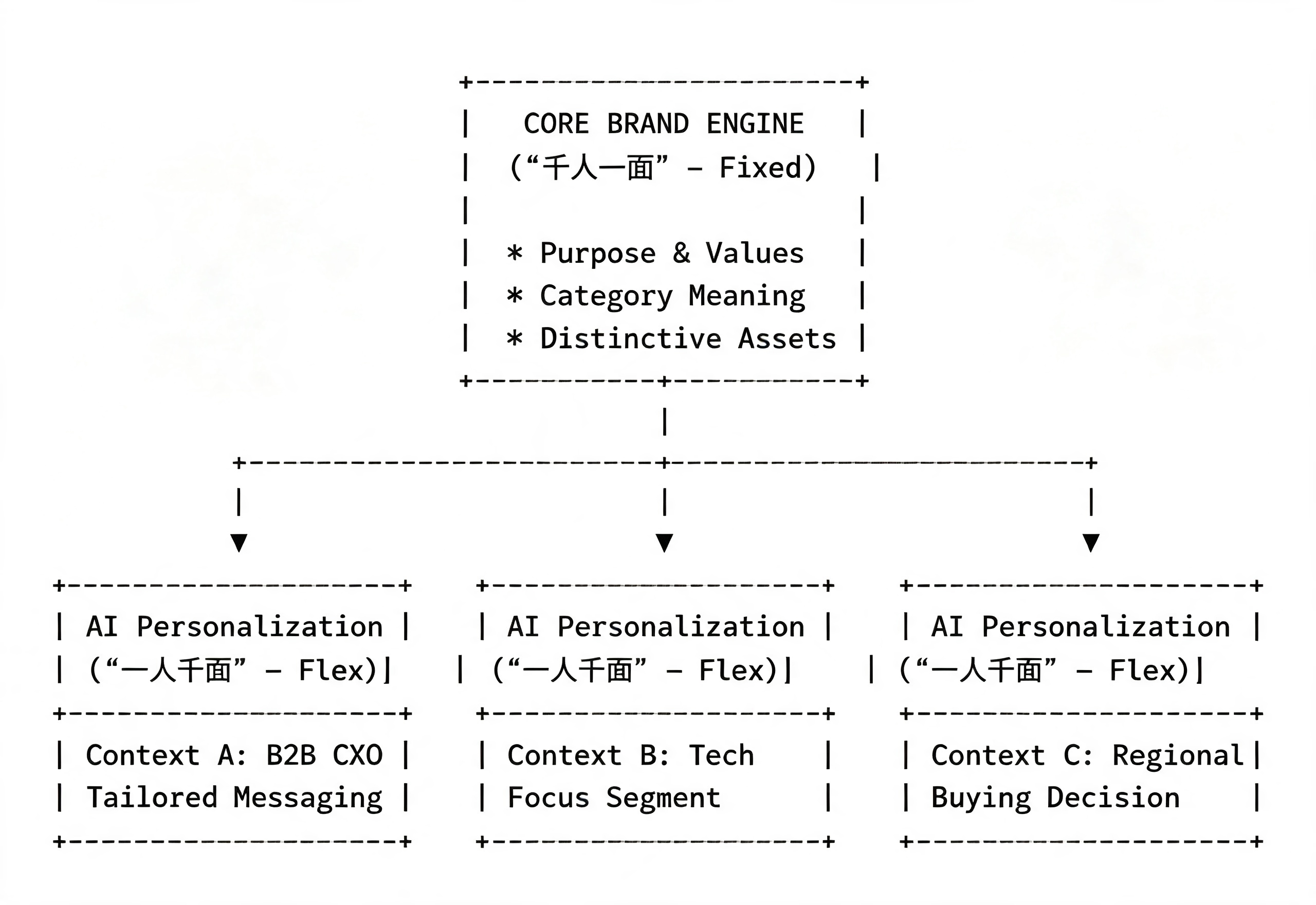
1. Public Core Consistency
Regardless of audience segmentation, core corporate assets must remain uncompromised:
- Core Value Proposition
- Primary Brand Commitments
- Distinctive Asset Governance (Visual & Strategic Identifiers)
- Category Frame of Reference
This immutable core forms the brand’s fundamental structure, ensuring the market receives a coherent value proposition across all touchpoints.
2. Adaptive Algorithmic Execution
Surrounding this core, generative AI systems dynamically adapt contextual delivery:
- Tailoring narratives for specific industry verticals or buying personas
- Optimizing delivery timing and channel selection
- Personalizing value-proposition highlights based on real-time account intelligence
The Structural Risk to Avoid
The primary failure mode occurs when firms allow AI algorithms to adjust the core value proposition itself across different audience segments. When a business presents fundamentally different brand identities to different cohorts, it ceases to own a cohesive market presence. It simply owns a collection of fragmented sales scripts.
9. The Strategic Imperative: Reclaiming Public Attention
As the global market defaults to algorithmic hyper-targeting, hyper-personalized touchpoints are becoming commoditized. In this environment, broad-scale public attention emerges as a powerful, underutilized asset.
Forward-thinking leadership teams understand that corporate positioning cannot be built solely in private, personalized interactions.
A market-leading position requires showing up in spaces where your message is validated by the broader ecosystem—seen by current clients, prospective talent, industry analysts, indirect stakeholders, and future buyers alike.
The central strategic challenge for the CEO is to answer a broader question than algorithmic targeting can address: “When the global market considers this category, why must our firm be the definitive choice?”
10. Executive Conclusion: Balancing Precision with Market Presence
Corporate growth strategy cannot regress to legacy mass-media models. Precision automation, Generative Engine Optimization (GEO), predictive modeling, and programmatic workflows are permanent structural components of modern commerce.
However, C-suite executives must maintain a clear view of strategic boundaries:
Strategic Brand Equity -> “Why we command premium market value.
The most competitive enterprises will master both capabilities: deploying AI to identify and capture high-intent demand efficiently, while maintaining a clear, differentiated brand identity across the broader market.
Relinquishing brand strategy to short-term conversion algorithms leaves an enterprise vulnerable to commoditization. While algorithmic precision can drive efficient quarterly transactions, a strong public brand creates enduring enterprise value.
 Unlock 2026's China Digital Marketing Mastery!