 English
 German
 Korea
Korea Spanish
China’s Digital Shift: What WeChat, RED, and Douyin Signal for the Future of Global Commerce
- On August 13, 2026
- Douyin, RED, WeChat
China’s digital economy is undergoing a structural transition. The traditional era of social media traffic growth—characterized by explosive user acquisition and simple media buying—has officially ended.
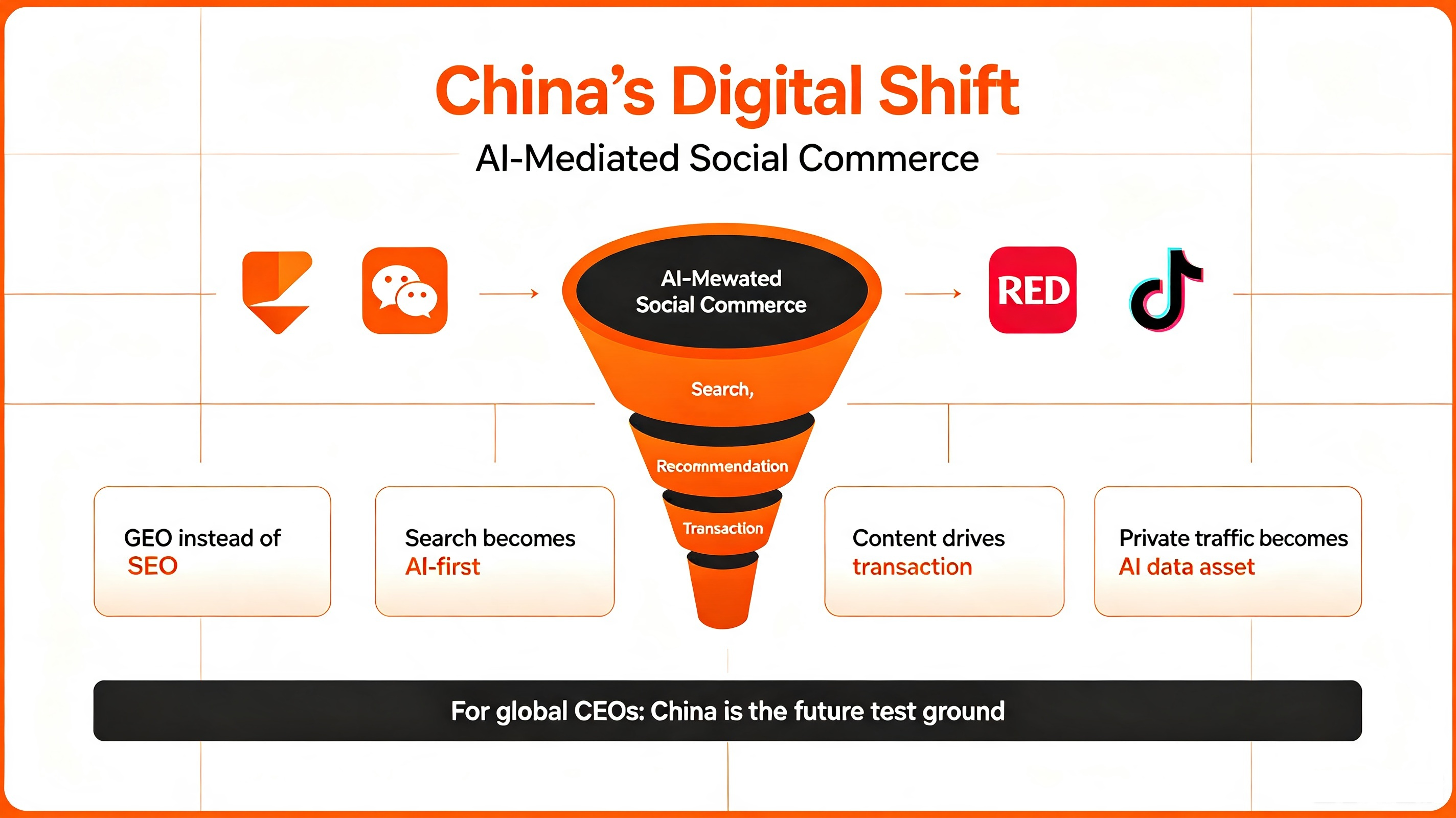
In its place, a new operational regime has emerged: AI-Mediated Social Commerce.
Across China’s three dominant platforms—WeChat (Tencent), Xiaohongshu (RED), and Douyin (ByteDance)—platform mechanics have shifted from surface-level recommendation feeds to deep, intent-driven AI search architectures and structural algorithm changes.
For Western CEOs and board members, China is no longer just a unique, isolated market. It acts as a strategic testing ground for the future of global digital commerce. The AI-first behaviors, Generative Engine Optimization (GEO) dynamics, and unified intent-to-transaction funnels rapidly developing in China today represent the operational blueprint that Western platforms like Meta, Amazon, and Google will eventually adopt.
Key Executive Insights
5 STRATEGIC INSIGHTS FOR THE C-SUITE
- China is the World’s First AI-Mediated Consumer Market
AI recommendation algorithms and embedded LLMs have replaced conventional engines as the primary layer between brands and consumers. - Optimization Has Shifted from SEO/Media Buying to GEO
Winning consumers no longer means ranking first on a search page; it means being recommended by AI models as trusted structured knowledge. - Social Media is No Longer an Awareness Channel—It is the Enterprise Transaction Engine
Search, content discovery, private traffic, and checkout have collapsed into single, closed-loop platform architectures. - Algorithmic Realism Kills Traditional “Aspirational” Branding
Platform algorithms now explicitly reward high-utility, hyper-authentic, and user-validated content while penalizing over-produced, top-down brand storytelling. - First-Party Private Traffic Has Become an AI Data Asset
Private enterprise domain pools in ecosystems like WeChat are no longer just messaging lists; they are the proprietary prompt training grounds for enterprise AI agents.
Layer 1: What Happened? (Recent Platform Catalysts)
Over the past two quarters, WeChat, Xiaohongshu, and Douyin have rolled out major algorithmic updates and AI integrations:
| Platform | Core Structural Update | Key Operational Shift |
|---|---|---|
| WeChat (Tencent) |
Deeper LLM Integration (Hunyuan/Yuanbao) & Search Algorithm Quality Metrics | Evaluates content authority and official account quality directly within conversational AI search. |
| Xiaohongshu (RED) |
Upgrade to CES 2.0 (Community Engagement Score) Algorithm | Weight shifted heavily to Save/Bookmark (4x) & Comment (3x); Search now drives 45%+ traffic. |
| Douyin (ByteDance) |
Full-Funnel “Penetrative” Search | Search volume grew 37%; 82% of initial searches are category/scenario-driven vs brand-driven. |
scenario-driven vs brand-driven.
- WeChat (Tencent): AI Search & Content Quality ScoringTencent has deeply integrated its Hunyuan LLM into WeChat Search. Rather than simply retrieving keywords from WeChat Official Accounts, WeChat’s AI now evaluates account authority, content depth, and domain credibility to answer user queries conversationaly.
- Xiaohongshu (RED): The CES 2.0 Algorithm & High Intent SearchXiaohongshu updated its core ranking engine to the CES 2.0 (Community Engagement Score). Passive metrics like “Likes” have been demoted. The system now heavily prioritizes high-intent actions: Bookmarks/Saves (4 points), Comments (3 points), Shares (2 points), and Likes (1 point). Concurrently, search intent accounts for over 45% of total platform traffic.
- Douyin (ByteDance): “Penetrative” Search Engine OptimizationDouyin transitioned from passive short-video browsing to an active, full-funnel search engine. Active search on Douyin grew by 37%, with 82% of intent starting at generic category/scenario searches before converting into specific brand-level queries.
Layer 2: Why Did It Happen? (Root Causes)
The transformation across all three platforms is driven by four underlying forces:
- Technological Feasibility: Advancements in inference cost reduction (exemplified by architectural shifts across Chinese LLMs) allow social platforms to run real-time semantic analysis over billions of user posts without prohibitive computing costs.
- Economic Reality: China’s digital advertising expenditure has entered a mature, rational phase. C-suites have stopped paying for “vanity impressions.” Platforms are forced to build systems that directly deliver verifiable conversions and high retention.
- Consumer Cynicism & Utility Demand: Chinese consumers have grown immune to polished, top-down brand campaigns and influencer endorsements. The rise of “anti-seeding” content has forced platforms to elevate organic utility and verified reviews over sponsored posts.
Layer 3: Strategic Comparison — China vs. Western Digital Ecosystems
To understand where global marketing is heading, executives must contrast China’s integrated landscape with the fragmented Western model.
| Metric / Dimension | Western Digital Ecosystem (US/EU) | China Digital Ecosystem (2026) | Strategic Implication for Global Firms |
| Search Paradigm | Fragmented (Google Search vs. Amazon vs. TikTok) | Unified & Embedded (WeChat, Xiaohongshu, Douyin in-app AI) | Search cannot be optimized independently of social and commerce. |
| Primary AI Interface | External / Standalone (ChatGPT, Claude, Perplexity) | Native Super-App Integration (WeChat Yuanbao, Douyin Doubao) | AI discovery happens inside where the consumer already interacts and buys. |
| Optimization Focus | Traditional SEO & GEO for web indexing | GEO for structured in-app ecosystems & CES algorithms | Websites are irrelevant in China; structured platform authority is everything. |
| Funnel Speed | Multi-touch, cross-domain attribution (Hours to Days) | Instant closed-loop conversion (Seconds to Minutes) | Delay between discovery and purchase causes massive drop-off. |
Layer 4: How This Reshapes Corporate Competition
1. The Death of “Aspirational” Branding — The Rise of Scenario-Based Utility
Traditional Western playbooks rely on high-production narrative storytelling. In China’s current environment, these campaigns fail to trigger algorithm distribution.
- The Reality: Xiaohongshu’s CES 2.0 algorithm actively boosts content that solves specific consumer scenarios (e.g., “commute-proof makeup” or “small-apartment furniture layout”) rather than generic luxury lifestyle aesthetics.
2. GEO (Generative Engine Optimization) Replaces Traditional SEO
When a consumer asks WeChat or Xiaohongshu’s AI for a product recommendation, the AI model synthesizes top-tier account articles, unstructured user reviews, and structured product data.
- The Reality: If your brand lacks structured, factual, and peer-validated content within the platform’s proprietary data boundary, the AI recommendation layer completely ignores your existence.
Real Enterprise Case Studies
L’ORÉAL (Consumer Goods)
* Strategy: Shifted budget from generic KOL impressions to Xiaohongshu Search-Intent & GEO.
* Tactic: Created expert-led, ingredient-focused content (美妆成分党) targeting scenario keywords.
* Result: Captured 300%+ higher ROI on search ad spend via CES 2.0-aligned utility content.
SIEMENS / BOSCH (B2B & Industrial)
* Strategy: Restructured WeChat Official Accounts into AI-searchable Knowledge Hubs.
* Tactic: Published structured technical whitepapers natively formatted for Tencent’s AI parser.
* Result: 4x increase in lead generation through WeChat’s AI conversational search.
NIKE (Retail & Apparel)
* Strategy: Closed-loop Douyin “Penetrative Search” integration.
* Tactic: Used short-video seeding tied to “category search words” to trigger brand search cards leading directly to instant checkout.
* Result: 37% increase in direct search-driven sales conversion.
Layer 5: Executive Playbook (Actionable Roadmap)
For CEOs, CMOs, and Board Members reassessing their China operations, we recommend a 4-step execution framework:
- PHASE 1: GEO AUDIT (Weeks 1-4)
Audit brand visibility across WeChat AI, Xiaohongshu Search, and Douyin Search engines.
Identify whether AI models cite your official assets or competitor alternatives. - PHASE 2: CONTENT ARCHITECTURE REFACTORING (Weeks 5-12)
Transition agency deliverables from “vanity impressions” to “utility & bookmarking metrics.”
Enforce CES 2.0 targets: Require content agencies to optimize for Saves and Comments. - PHASE 3: PRIVATE-TRAFFIC AI INTEGRATION (Months 3-6)
Connect enterprise WeChat (企微) CRM pools directly to internal LLMs.
Turn customer service representatives into AI-empowered advisors capable of instant processing. - PHASE 4: AGENCY INCENTIVE REALIGNMENT (Ongoing)
Cancel agency contracts tied strictly to CPM/Impressions.
Mandate performance incentives tied to Search-driven ROI, Brand-Word Share of Voice, and GEO.
Strategic Questions for the Boardroom
Before approving your next annual China budget, demand answers to these questions from your executive team:
- On Search: “Are we still optimizing for traditional search terms, or have we audited how platform AI models synthesize and recommend our brand?”
- On Agency KPI: “Are our local marketing agencies delivering vanity views, or are they driving high-utility bookmarking actions aligned with updated algorithms like CES 2.0?”
- On Global Transferability: “What are we learning from China’s integrated social search and commerce that can prepare our European and American business units for the arrival of AI-first consumer journeys?”
 Unlock 2026's China Digital Marketing Mastery!