 English
 German
 Korea
Korea Spanish
Beyond Discounting: Navigating the “Value-Seeking Consumer” Shift in China’s FMCG & Retail
- On August 13, 2026
- china customers, Value-Seeking Consumer
Western boardrooms frequently make a fatal diagnostic error when evaluating China’s consumer market: they mistake value-seeking behavior for price sensitivity.
When Chinese consumers pull back from pure status consumption, MNC executives instinctively reach for aggressive discounting, tactical promotion cycles, or margin-eroding price cuts. This response destroys brand equity, triggers a race to the bottom with agile domestic competitors, and fails to capture growth.
Chinese consumers are not trading down blindly; they are demanding higher functional efficacy, explicit emotional ROI, and sensory superiority for every yuan spent. Understanding this dynamic is not just a tactical imperative for China operations—it is a strategic window into the future of global retail.
The Catalyst: Volume Up, Price Down
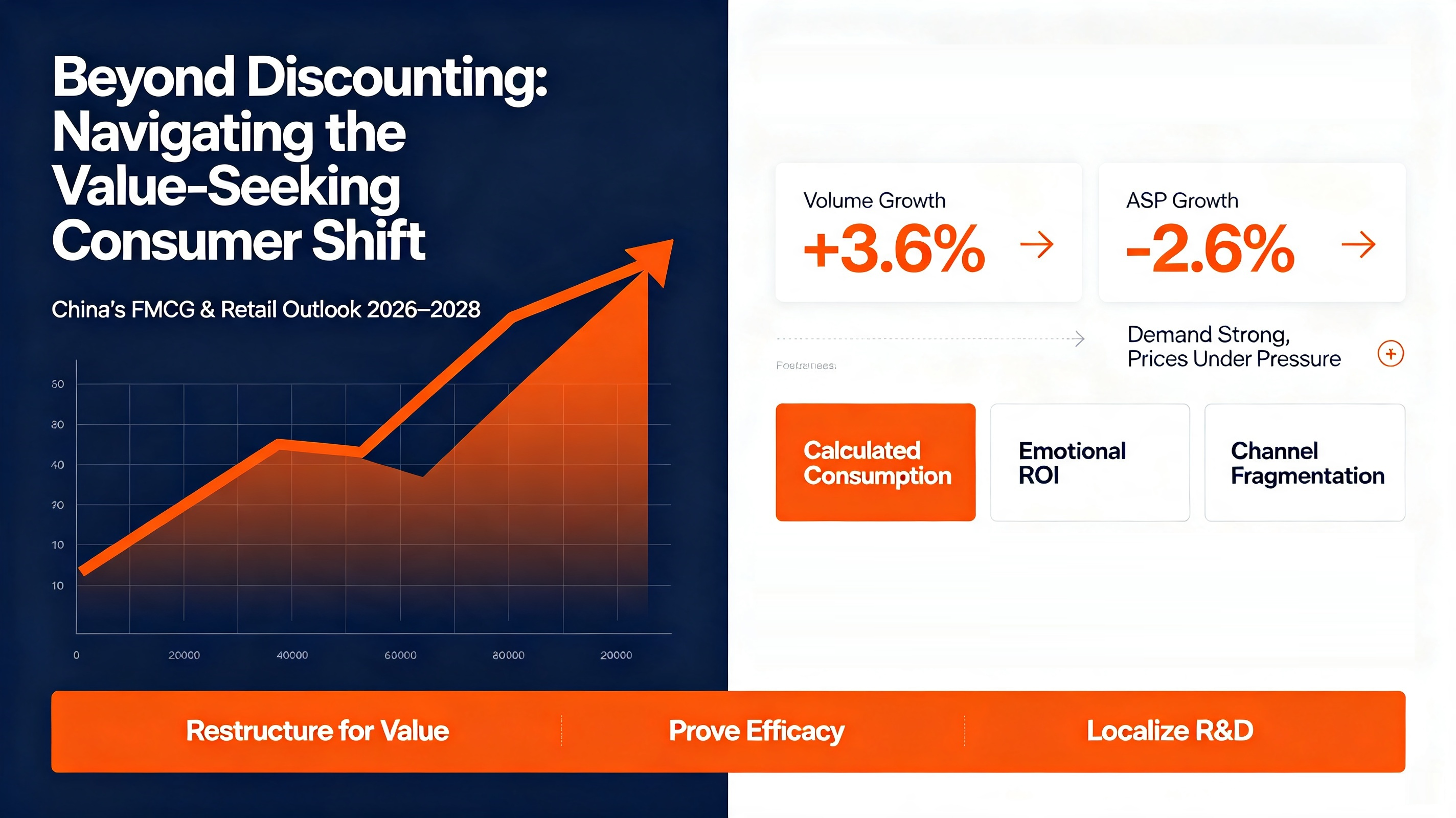
The 15th Bain & Company and Worldpanel China Shopper Report reveals a defining structural shift in urban FMCG spending: volume grew by 3.6% while average selling prices (ASP) declined by 2.6%. Retail sales data from the National Bureau of Statistics (NBS) confirms that overall consumption remains positive, but value growth is being squeezed by price deflationary pressures.
THE FMCG VALUE DIVERGENCE
Volume Growth (+3.6%) ──► Consumer Demand Strong
ASP Growth (-2.6%) ──► Deflationary Price Pressure
This divergence proves that demand has not disappeared; rather, the criteria for unlocking wallet share have fundamentally transformed. While Tier 1 cities experience muted value growth, lower-tier cities (Tiers 4–5) and specialized retail channels—such as membership clubs, snack collection stores, and O2O (Online-to-Offline) delivery—are generating a disproportionate share of incremental volume.
5 Executive Insights on China’s Value Shift
- China is the world’s first “Calculated Consumption” economy. Consumers calculate a precise ROI for every purchase, balancing functional benefits, ingredient transparency, and emotional payoff against cost.
- Discounting is a brand death spiral. Lowering prices without altering product architecture trains Chinese consumers to wait for the next promotion, permanently degrading gross margin structures.
- Emotional resonance beats luxury prestige. Status symbol consumption is declining, but spending on health, personal wellness, micro-indulgences, and lifestyle identity is expanding rapidly.
- Channel power is fragmenting fast. Marketplaces no longer hold a monopoly on discovery. Growth is shifting toward private labels (+57% growth in 2025), direct-to-farm O2O models, and discount specialty formats.
- China is a global preview, not an isolated exception. Slower income growth, aging demographics (over 320 million citizens aged 60+), and single-person households (25% of urban homes) are macro trends now spreading across Europe and North America.
Root Causes: Why China Changed First
The shift toward value-seeking behavior stems from three structural forces that have reached critical mass in China before the rest of the world:
- Algorithmic Price Transparency: Platforms like Douyin, Xiaohongshu, and Taobao give consumers instant, AI-driven price comparison and ingredient decomposition tools. “Smart shoppers” analyze unit costs per gram and active ingredient concentrations before buying.
- Demographic Realignment: With 320 million citizens over 60 and a quarter of urban households living as single individuals, spending priorities have shifted from conspicuous display toward health preservation, convenience, and individual well-being.
- Domestic Agility: Local brands have mastered “fast-fashion FMCG,” moving from consumer insight to shelf in under 90 days with hyper-targeted propositions that deliver 90% of premium brand performance at 60% of the cost.
Case Studies: Premium Margins Without Price Cuts
| Enterprise | Strategy | Operational Execution | Business Outcome |
| Proya (珀莱雅) | Efficacy-driven product architecture | Replaced generic anti-aging claims with scientific “Dual Anti-Oxidant” serums backed by transparent ingredient percentages. | Overtook legacy Western beauty giants to become the #1 domestic skincare brand in China. |
| Uniqlo China | Value-added functional basics | Scaled HEATTECH and AIRism technologies while introducing localized, elevated product fits for Tier 3–5 cities. | Sustained strong margins and store expansion by avoiding broad-market price slashing. |
| Decathlon China | “Emotional ROI” & accessible lifestyle | Positioned stores as outdoor activity hubs for urban families and outdoor enthusiasts rather than mere apparel racks. | Achieved double-digit growth in outdoor and sports categories by offering high utility per yuan. |
| Luckin Coffee | SKU innovation & price architecture | Utilized high-frequency innovation (e.g., Coconut Latte) and targeted app-based coupons to control margin depth per consumer segment. | Outpaced global coffee chains in store count and volume growth while maintaining unit profitability. |
Strategic Playbook for Multinational CEOs
RESTRUCTURING FOR VALUE
- Unbundle Packaging ──► Right-size SKUs per household demographic
- Re-anchor Efficacy ──► Substantiate functional claims with data
- Segment Channels ──► Reserve core SKUs; build club/O2O variants
- Localize R&D ──► Shorten innovation cycles under 120 days
1. Re-engineer Price Architecture, Not Nominal Price
Do not slash MSRP on core SKUs. Instead, introduce differentiated pack sizes, multi-packs for membership clubs, or smaller “trial” formats designed for single-person households. This satisfies value-seeking math without corrupting your baseline pricing.
2. Shift Marketing from Prestige to Proof
Replace high-level lifestyle imagery with verifiable functional claims. Chinese consumers demand ingredient transparency, clinical trial data, and visible sensory results. If a product costs 30% more, the consumer must see a 50% increase in efficacy or sensory experience.
3. Build Channel-Specific Portfolio Firewalls
Stop selling identical SKUs across all digital and physical channels. Develop dedicated SKUs for discount specialty stores, custom multi-packs for membership warehouses (e.g., Sam’s Club, Costco), and high-velocity daily items for O2O delivery.
4. Decouple Global R&D for Local Speed
Western approval cycles of 12 to 18 months are obsolete in a market where 40% of annual FMCG sales come from new SKU launches. Empower local China teams with autonomous product development budgets to iterate within 90-day sprints.
Looking Ahead: 2026–2028 Strategic Outlook
Over the next 3 to 5 years, the value-seeking ethos will solidify into a permanent operating environment in China and expand into Western markets.
As AI agents become the primary interface through which consumers compare, filter, and buy FMCG products, brand preference will no longer be driven by top-of-funnel ad spend. It will depend on algorithmic validation of product efficacy, price-to-value performance, and supply chain transparency.
MNCs that master “functional and emotional ROI” in China today will build the organizational agility required to defend their margins globally tomorrow.
 Unlock 2026's China Digital Marketing Mastery!