 English
 German
 Korea
Korea Spanish
Why the Next Competitive Advantage Won’t Be Better Campaigns – It Will Be Better AI Systems
- On August 6, 2026
- Agent Marketing
From Digital Marketing to Agent Marketing
The evolution of enterprise marketing isn’t just about adopting AI. It’s about redesigning how marketing itself operates.
A Counterintuitive Reality
For twenty-five years, Western boardrooms have operated under a comfortable paradigm: marketing capability is a function of talent, channels, and software stacks. When a brand failed to acquire customers efficiently, the standard prescription was to hire a better Chief Marketing Officer, increase the performance budget, or implement a newer MarTech stack.
That playbook is now obsolete.
The fundamental shift occurring across global business isn’t a channel shift, nor is it an algorithmic update. It is a transition in the execution subject of marketing—the core answer to who actually does the work.
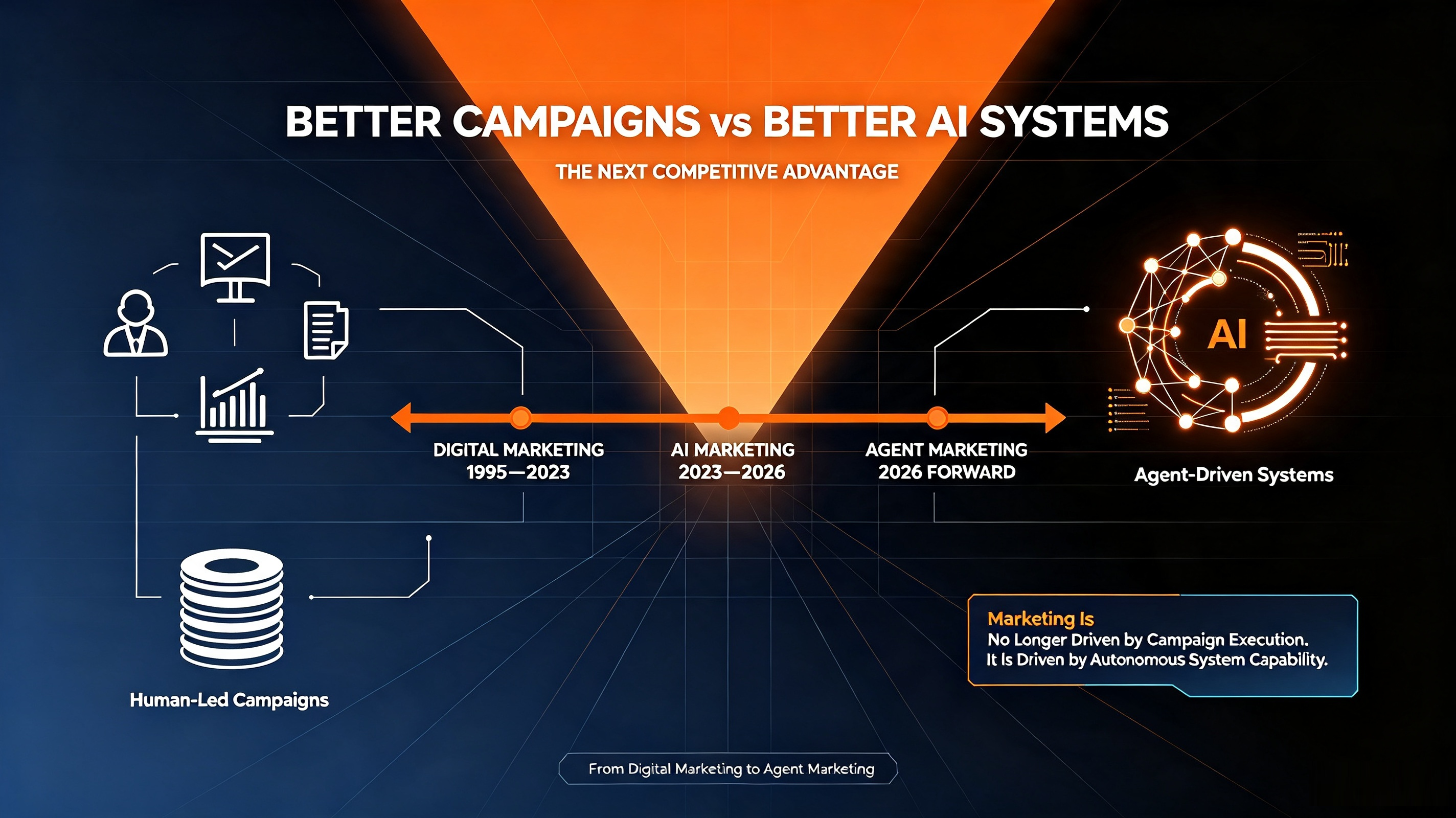
Enterprise marketing has entered its third major epoch. In the Digital Marketing era (1995–2023), humans leveraged digital tools. In the AI Marketing era (2023–2026), humans used AI Copilots to accelerate drafting, design, and data analysis. Today, in the Agent Marketing era, autonomous AI systems execute, optimize, and orchestrate campaigns directly, while human leaders transition to architects, governors, and strategic auditors.
| THE THREE AGES OF ENTERPRISE MARKETING | ||
| EVOLUTIONARY AGE | EXECUTION SUBJECT | CORE COMPETITIVE ADVANTAGE |
| Digital Marketing (1995–2023) |
Human + Software | Channel Mastery & MarTech Stack |
| AI Marketing (2023–2026) |
Human + AI Copilot | Individual Productivity & Speed |
| Agent Marketing (2026 Forward) |
Agent System + Human Oversight | System Architecture, Context & Multi Agent Organizational Efficiency |
The enterprise that wins the next decade will not be the one with the cleverest ad copy or the largest media budget. It will be the enterprise that successfully transitions its marketing department from a group of software users into an integrated Agent Workforce.
The Evolution: Beyond Channels to Execution Subjects
To understand why traditional marketing organizations are stalling, executives must stop viewing digital history as a sequence of platforms (Television → Search → Social → Mobile → AI) and start viewing it through the lens of operational delegation.
Epoch 1: Digital Marketing (1995–2023)
- Execution Dynamic: Humans operate software platforms (Google Ads, Salesforce, HubSpot, WeChat Official Accounts).
- Core Bottleneck: Human bandwidth and analytical cognitive limits.
- Competitive Advantage: Access to capital and top-tier agency/in-house talent.
Epoch 2: AI Marketing (2023–2026)
- Execution Dynamic: Humans utilize Large Language Models (LLMs) as assistants—generating copy via ChatGPT, ideating with Claude, or editing media via Gemini.
- Core Bottleneck: Non-deterministic output, fragmented context, and human-in-the-loop manual triggers.
- Competitive Advantage: Individual employee adoption rates and prompting fluency.
Epoch 3: Agent Marketing (2026 Onward)
- Execution Dynamic: Multi-agent autonomous networks conduct continuous intelligence, research market gaps, execute media buys, optimize Generative Engine Optimization (GEO) rankings, and resolve customer touchpoints in a closed-loop environment.
- Core Bottleneck: Enterprise data unification, context governance, and multi-agent coordination architectures.
- Competitive Advantage: Systemic Operating Architecture.
For the first time in corporate history, the marketing department does not merely hire human employees who use tools. The marketing department builds digital labor that operates the tools.
Structural Divergence: West vs. China
Global business leaders frequently make the mistake of treating enterprise AI deployment as a uniform playbook. In reality, structural market realities have split the Agent Marketing era into two distinct paradigms.
| REGIONAL AGENT MARKETING PARADIGMS | ||
| WESTERN ENTERPRISE PARADIGM | CHINA ENTERPRISE PARADIGM | |
| Primary Focus: B2B Pipeline, CRM, Email, SaaS Workflows | Primary Focus: Private Traffic, Social Commerce, Livestreaming, GEO, Hyper-Personalized Consumer Touchpoints | |
| Core Ecosystems: Salesforce, HubSpot, Adobe, Workday | Core Ecosystems: WeChat, Douyin, Xiaohongshu, Taobao, Baidu Ecosystem | |
| Strategic Driver: Process Optimization & Governance | Strategic Driver: Consumer Connection & Conversion Velocity | |
The Western Model: Process Re-engineering
In North America and Europe, Agent Marketing is primarily anchored in B2B data stacks, regulatory compliance, and programmatic revenue pipelines. Systems built on platforms like Salesforce Agentforce or Sierra emphasize deterministic logic, CRM integration, and auditable trail management.
Strategic Priority: Operational efficiency, compliance risk mitigation, and automated pipeline generation.
The China Model: Connection Re-engineering
In China, the absence of open web search dominant paradigms and the dominance of integrated “Super-App” walled gardens (WeChat, Xiaohongshu, Douyin) have pushed AI Agents directly into the consumer-facing front lines.
Because Chinese e-commerce operates with friction-free payment layers and rapid consumer decision cycles, Chinese enterprises deploy Agents to manage private-traffic customer communities, run automated livestreaming digital avatars, conduct real-time Generative Engine Optimization (GEO) across Xiaohongshu recommendation models, and orchestrate Instant-Retail fulfillment.
Key Executive Insight: Western enterprises are using AI Agents to re-engineer business processes; Chinese enterprises are using AI Agents to re-engineer consumer intimacy.
Multinational corporations operating in Asia cannot simply export their Western CRM agent workflows to Shanghai or Shenzhen. A brand that relies on email workflows in China will fail; winning requires deploying conversational, social-commerce agents that operate directly inside consumer messaging threads.
Restructuring the Marketing Organization
The emergence of the Agent Workforce renders traditional functional hierarchies inefficient.
Historically, marketing departments were divided by execution silos: Content Teams, Performance Advertising Teams, SEO Specialists, and Data Analysts. In an Agent-first architecture, these operational nodes are handled by specialized, context-aware AI Agents running on standardized workflow protocols.
TRADITIONAL MARKETING ORGANIZATION (Legacy)
Chief Marketing Officer (CMO)
- Content Team (Humans)
- Performance Media Team
- Data Analytics Team
AGENT-FIRST MARKETING ORGANIZATION (Modern Enterprise)
Chief Marketing Officer (CMO)
Marketing Operations & Architecture Lead
- AGENT WORKFORCE LAYER
– Campaign Orchestration Agent
– Generative Engine Optimization (GEO) Agent
– Private Traffic / CRM Engagement Agent
– Predictive Media Allocation Agent - HUMAN GOVERNANCE
– Brand Safety & Ethics
– Strategic Positioning
– Creative Direction
– Human Reviewers
In this structure, the role of human marketers shifts entirely:
- From Creation to Curation: Humans no longer draft first pass assets; they set context, evaluate narrative alignment, and approve execution bounds.
- From Operations to Architecture: The most critical marketing hire is no longer a media buyer, but an AI Marketing Architect who understands data orchestration, Model Context Protocol (MCP) integrations, and multi-agent governance.
Strategic Realignment: The Framework
To successfully transition from campaign-focused marketing to system-focused marketing, enterprise leaders must execute five structural realignments.
| THE ENTERPRISE AGENT TRANSITION PLAYBOOK | ||
| INITIATIVE | STRATEGIC IMPERATIVE | |
| 1. Process Re-mapping | Audit all marketing workflows; segregate deterministic agent tasks from human strategic touchpoints. | |
| 2. Brand Context Engine | Build a centralized, persistent Knowledge Base rather than relying on temporary prompt engineering. | |
| 3. Unified Data Layer | Eliminate data silos between CRM, CDP, and ad networks so agents act on complete context. | |
| 4. Organizational Roles | Recalibrate talent acquisition toward System Architects, Knowledge Curators, and Governance Leads. | |
| 5. Human-in-the-Loop | Deploy boundary controls and escalation paths for Governance │ autonomous agent decisioning. | |
1. Re-map Workflows by Execution Subject
Audit every current marketing process. Identify repetitive, multi-step tasks that require data ingestion, pattern recognition, and tool execution (e.g., cross-channel reporting, continuous A/B multivariate ad copy updates, GEO citation tracking). Assign these directly to Agent ownership while reserving human capacity strictly for brand strategy, positioning, and emotional resonance.
2. Construct the Enterprise “Brand Context Engine”
An AI Agent’s output quality is constrained by its persistent memory. Prompting an LLM repeatedly is inefficient. Enterprises must build a structured, dynamic Knowledge Base containing brand voice rules, product taxonomies, positioning boundaries, and real-time customer data. This persistent context allows Agents to operate autonomously without diluting brand integrity.
3. Establish a Unified Marketing Data Layer
Agentic execution requires a single source of truth. If customer purchase history resides in one isolated database, website behavioral telemetry in another, and ad performance data in a third, an Agent cannot complete autonomous optimization loops. Connecting your Customer Data Platform (CDP) directly to agentic execution layers is a prerequisite for system-driven marketing.
4. Recalibrate Talent Priorities
Stop hiring for functional execution skills that software now handles faster. Begin hiring for:
- AI Marketing Architects: Engineers who construct multi-agent API workflows, database connections, and system triggers.
- Knowledge Curators: Domain experts who feed, validate, and refine the enterprise brand context engines.
- AI Governance Leads: Risk managers who monitor agent outputs, brand compliance, algorithmic bias, and consumer privacy.
5. Institutionalize Human-in-the-Loop Governance
Autonomy requires explicit guardrails. Establish deterministic thresholds where an Agent operates independently up to specific financial or operational limits (e.g., reallocating up to $10,000 in daily digital ad spend based on performance conversion triggers) while requiring human sign-off above those parameters.
The Executive Conclusion
For the past twenty years, enterprise leaders focused on building world-class Marketing Teams. Over the next twenty years, market dominance will belong to leaders who build world-class Marketing Systems.
Digital Marketing taught companies how to use software. AI Marketing taught companies how to generate content faster. Agent Marketing demands that enterprises redesign their entire commercial organization.
The winners of the next decade will not be the organizations that adopted AI tools earliest, but those that recognized first that marketing is no longer driven by human campaign execution—it is driven by autonomous system capability.
 Unlock 2026's China Digital Marketing Mastery!