 English
 German
 Korea
Korea Spanish
The Invisible Infrastructure Behind China’s Global Expansion—And the $100B Opportunity for Western Enterprise Services
- On August 5, 2026
- china import services, China's Global Expansion
Why the next wave of Chinese multinational growth is powered by Western SaaS, AI engines, and specialized advisory networks.
Most Western executives still believe Chinese multinationals compete primarily on supply chain dominance, massive scale, and manufacturing cost efficiencies.
That assumption is fundamentally outdated.
The most aggressive Chinese companies going global today—from cross-border giants like SHEIN and Temu to B2B industrial pioneers like BYD and Xiaomi—are not merely exporting products. They are hyper-efficient integrators importing global business capabilities.
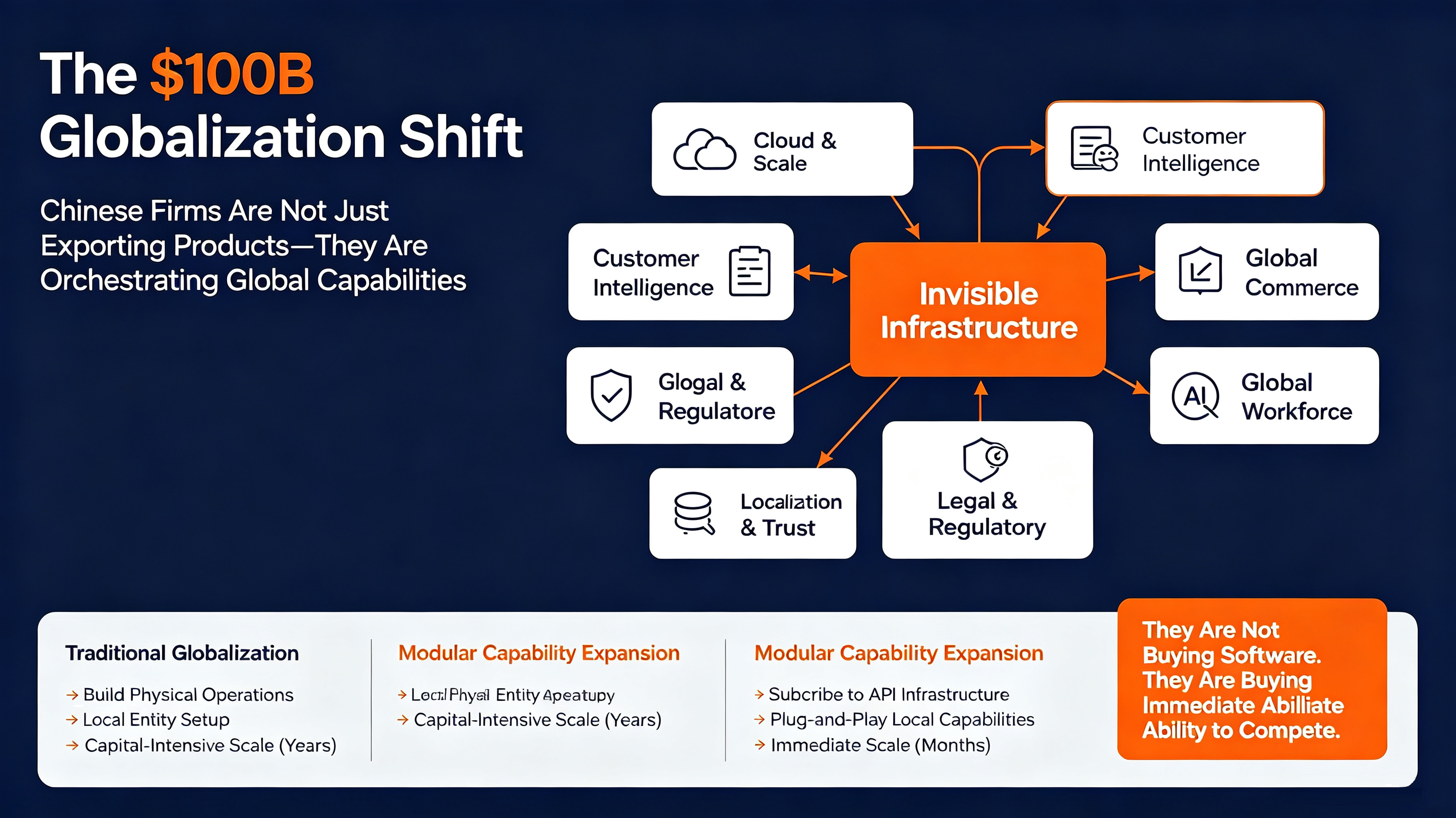
They are subscribing to an invisible, modular infrastructure composed of global cloud architectures, AI intent engines, cross-border fintech, localized compliance frameworks, and Generative Engine Optimization (GEO). By shifting from ownership to orchestrated access, these firms are bypassing decades of traditional international expansion cycles, achieving global scale in months rather than years.
For Western C-suites, this marks a profound shift. The primary competitive threat is no longer cheaper labor or physical capacity—it is a new breed of organizational speed enabled by plug-and-play global capabilities.
[ Traditional Globalization ]
Build Physical Operations ➔ Local Entity Setup ➔ Capital-Intensive Scale (Years)
[ Modular Capability Expansion ]
Subscribe to API Infrastructure ➔ Plug-and-Play Local Capabilities ➔ Immediate Scale (Months)
5 Executive Insights on the Invisible Infrastructure
- Global expansion has transitioned from asset ownership to API orchestration. Chinese firms do not build global logistics networks or localized CRM engines from scratch; they orchestrate best-in-class Western and regional SaaS architectures via APIs.
- Speed is displacing size as the core moat. When enterprise-grade infrastructure—from Stripe’s global commerce to Deel’s workforce compliance—can be rented on demand, the strategic advantage shifts to the firm that can integrate and execute fastest.
- Generative Engine Optimization (GEO) is replacing classic SEO as the primary international discovery layer. Chinese market entrants are rapidly optimizing for AI recommendation engines (Perplexity, ChatGPT, Copilot) to establish immediate digital trust in target markets without legacy brand history.
- The “Factory of the World” is becoming the “Orchestrator of World-Class Software.” By pairing domestic hardware speed with imported Western business capabilities, Chinese enterprises eliminate their historic weaknesses in international governance and brand trust.
- Western service providers face a double-edged sword. Chinese enterprises represent the fastest-growing buyer segment for Western enterprise software, AI tools, and advisory services, but they demand unprecedented ROI, speed, and seamless integration.
The Seven Capabilities Powering the New Multinationals
Rather than purchasing foreign enterprise software as administrative tools, Chinese globalizers view overseas SaaS and advisory services as dynamic competitive engines.
| Service Category | Industry Benchmark | Imported Capability | Strategic Value |
| Cloud & Scale | AWS / Azure / GCP | Global Infrastructure | Immediate enterprise-grade uptime and cross-border data compliance. |
| Customer Intelligence | Salesforce / HubSpot | Customer Data Orchestration | Unifying cross-market CRM and customer journey analytics. |
| Global Commerce | Stripe / Adyen | Frictionless Settlement | Localized payment acceptance and instant currency clearing. |
| Global Workforce | Deel / Rippling | Regulatory HR & Hiring | Onboarding compliant local teams in 150+ countries without foreign entities. |
| Legal & Regulatory | Global Law Firms | Regulatory Access | Navigating complex regional data privacy, ESG, and antitrust barriers. |
| Localization & Trust | Regional Agencies | Cultural & Brand Adaptation | Translating value propositions for local consumer nuances. |
| AI Visibility | GEO / Search Engines | Global Brand Intent | Securing authority in AI answer engines and generative search results. |
They are not buying software. They are buying the immediate ability to compete on global ground.
The Strategic Shift: From Ownership to Access
Historically, entering a new market required establishing physical subsidiaries, hiring local legal teams, negotiating regional payment gateways, and spending years building brand presence.
Today, the capability stack is completely disaggregated:
Enterprise AI & GEO Intent Engines
- Global Commerce (Stripe / Adyen)
- Workforce / HR (Deel / Rippling)
- Cloud & Infra (AWS / Azure)
When an enterprise can subscribe rather than build, capital expenditure drops dramatically, operational agility accelerates, and market testing becomes virtually risk-free.
While Western incumbents often remain constrained by legacy IT setups and regional organizational siloes, Chinese global expansion operates on a modern, composable architecture.
Case Evidence: Capability Integration in Action
- Xiaomi’s Electric Vehicle & IoT Expansion: When expanding its smart hardware ecosystem into Europe and Latin America, Xiaomi did not attempt to replicate localized compliance systems internally. Instead, it paired domestic hardware iteration speeds with localized cloud infrastructure and specialized regulatory advisory to ensure instant GDPR compliance.
- BYD’s B2B Commercial Strategy: As BYD pushes deeper into European commercial fleet markets, its strategy relies heavily on local digital marketing infrastructure, localized CRM orchestration, and regional legal partners to navigate complex EU carbon tracking and supply chain transparency mandates.
- SHEIN & Temu’s Global Commerce Stack: Beyond consumer-facing apps, these platforms rely on cross-border payment rails, localized customer service engines, and targeted generative digital marketing to run millions of micro-campaigns daily.
Looking Ahead: The 3-Year Outlook
Over the next 3 to 5 years, global competition will not be defined by where a company is headquartered, but by how effectively it orchestrates the global capability stack.
- Fast Companies vs. Slow Companies: Scale will no longer shield slow-moving enterprises. Small, hyper-integrated teams utilizing modular AI and global SaaS infrastructure will routinely outperform traditional MNCs.
- The AI Discovery Layer: As consumer and B2B research shifts decisively toward AI search agents, holding legacy market share will offer little protection against challenger brands that dominate AI knowledge graphs.
Global leaders must ask themselves: If your foreign competitors can rent your market’s best business capabilities overnight, where does your true, defensible moat lie?
 Unlock 2026's China Digital Marketing Mastery!