 English
 German
 Korea
 Spanish

The Referral Economy Is Dying. Baidu Just Showed You the Obituary.
- On November 9, 2026
- Answer Engine Optimization, Referral Economy, Search Engine Decline
On October 30, in Beijing, Baidu announced that its search box would stop answering questions and start finishing tasks. Ask it about a Spring Festival trip to Sanya, and you no longer get ten blue links. You get a five-day itinerary, a budget, and a price alert on hotels.
It sounds like a product update. It is not. It is a confession.
For the third time in twenty-six years, Baidu is rebuilding the box that built it. The first rebuild, in 2001, buried the printed Yellow Pages. The second, in 2011, stuffed the homepage with feeds and navigation. This one guts the process outside the box — the entire plumbing of the search business that has run, largely untouched, for two decades.
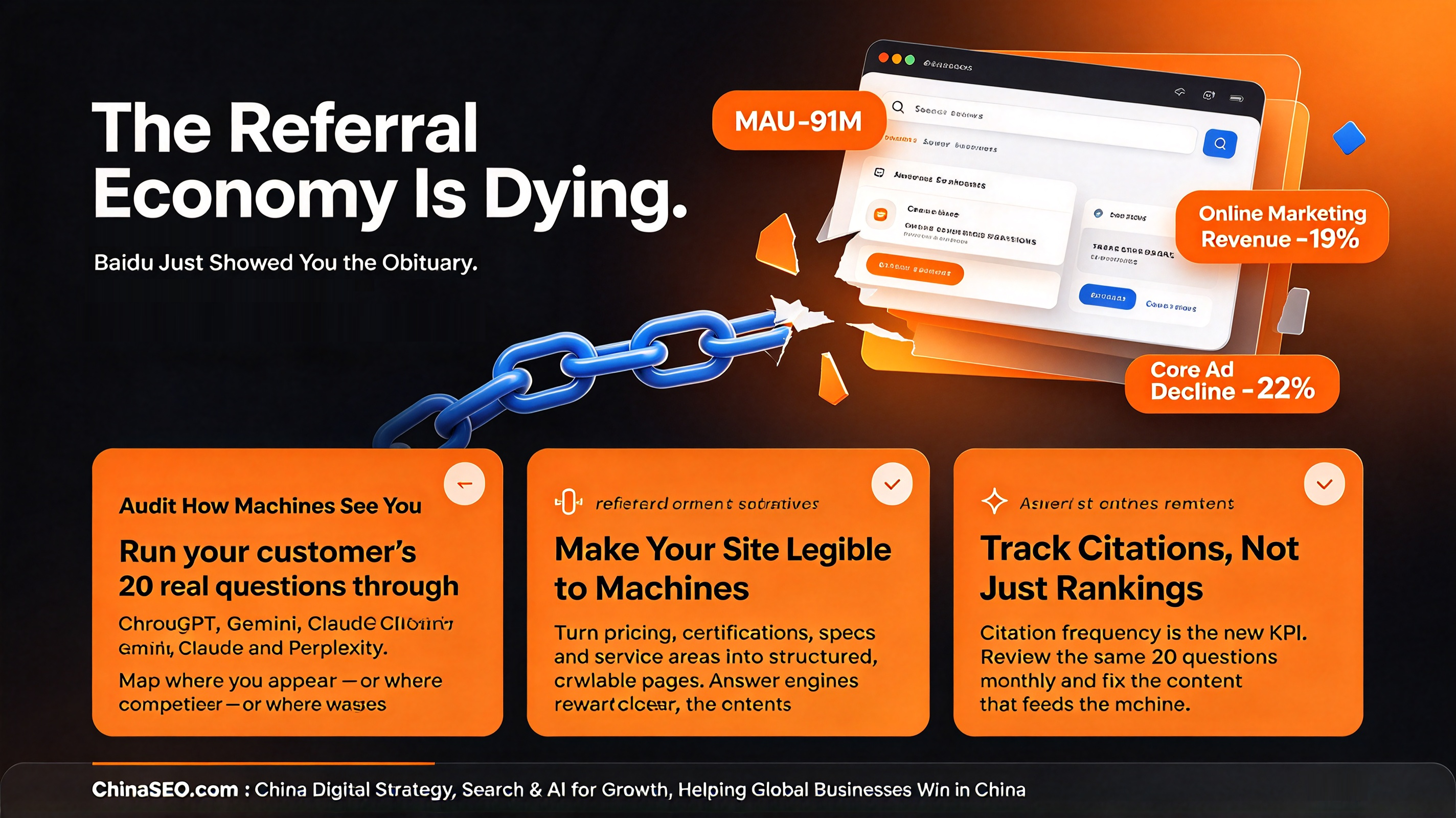
Why now? Because the numbers stopped being polite. In Q2, Baidu App’s monthly active users fell by 91 million year over year, to 644 million. Online marketing revenue dropped 19% to RMB 13.1 billion, and Morgan Stanley expects the core advertising decline to widen to 22% in Q3. Meanwhile, ByteDance’s Doubao has 500 million monthly users, DeepSeek 158 million, Alibaba’s Qwen 122 million — each one siphoning off the habit of “searching.”
But hold on. Before you file this under “troubling news from China,” ask yourself a harder question: whose AI products are doing to your business what Doubao is doing to Baidu?
The Deal That Quietly Got Canceled
Here is the part most commentary misses. For twenty years, the open web ran on an unwritten contract: websites gave content away for free, and search engines sent users back in return. Traffic was the payment. Advertising monetized the payment. Everyone ate.
Answer engines void that contract. The engine now reads your content, digests it, and hands the user a finished answer — who then leaves, satisfied, without ever touching your site. You become a supplier who is never paid. Baidu’s infamous medical ads, built entirely on that traffic-for-content exchange, are likely finished. So is every business model downstream that assumed the referral would always arrive.
Gone is the era when ranking on page one guaranteed a visit. The new unit of competition is not position. It is citation — how often the machine names you, quotes you, recommends you, when your customer never sees a results page at all.
Google’s AI Overviews, Perplexity, ChatGPT search — the same demolition is underway in your market, on your customers, against your funnel. Baidu is simply the canary that already fell off the perch.
What You Do About It — Starting Monday
Three moves. None requires understanding how models work. All require acting before your competitors do.
Audit how the machines see you. Take the twenty questions your customers actually ask — “best industrial pump supplier in Ohio,” “is [your product] compliant with EU regulations” — and run them through ChatGPT, Gemini, Claude, and Perplexity. Screenshot everything. Where do you appear? What is stated about you that is wrong? How many times is a competitor recommended in your place? Most executives have never done this. Most will not enjoy the result. That gap between what you assume and what the answers say — that is your real market position now.
Make your website legible to machines. Your pricing ranges, certifications, product specifications, and service areas are probably trapped in PDFs, images, and marketing prose. To an answer engine, they might as well not exist. Rebuild them as structured, crawlable pages. This is two or three days of execution work for a competent web team, not a transformation project. The bar is embarrassingly low — which is exactly why clearing it early pays.
Track citations the way you once tracked rankings. The old KPI was “where do we rank.” The new one is “how often are we cited, and for what.” Set up a monthly review: the same twenty questions, the same four engines, logged over time. When the answer drifts — a competitor newly recommended, a stale fact resurfacing — you fix the underlying content that feeds it. Agencies will soon sell this as a retainer, the way they once sold SEO. You can buy it later at a premium, or build the muscle now at cost.
The Larger Lesson
Every generation of gatekeepers punishes the incumbents who optimized for the previous one. The Yellow Pages advertisers who dismissed search. The SEO departments who dismissed social. And now, the content marketers who dismiss answer engines as a toy.
Baidu’s tragedy is not that it failed to see AI coming — it invested in AI earlier than almost anyone. Its tragedy is that it waited until users and revenue were both in free fall before touching the box. The warning was in the contract, not the code.
The referral economy is not slowing down. It is being dismantled and rebuilt around a new toll booth, one that pays in citations instead of clicks. You do not get to vote on whether this happens. You only get to choose whether the machine, when your customer asks, knows your name.
Does it?
 Unlock 2026's China Digital Marketing Mastery!