 English
 German
 Korea
Korea Spanish
When AI Makes Production Cheap, What Becomes Expensive?
- On October 9, 2026
- AI competition
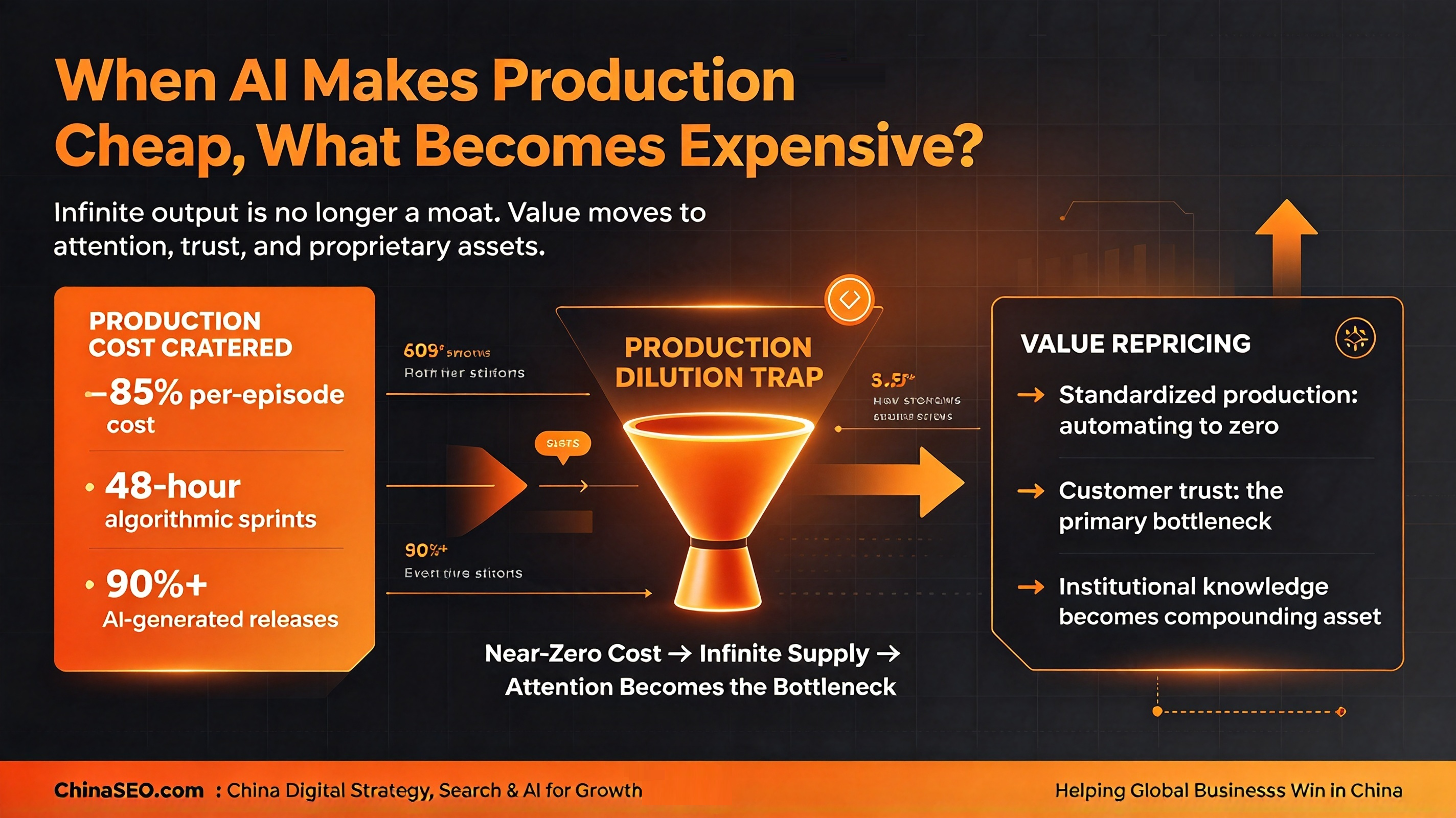
In July 2026, China’s digital media engine crossed a quiet, alarming threshold. A new AI-generated micro-drama went live every 36 seconds. Across WeChat mini-programs, Douyin, and specialized streaming apps, autonomous video pipelines produced more than 90 percent of new releases. Per-episode production costs didn’t just drop—they cratered by 85 percent. Turnaround times shrank from four-week shoot cycles into 48-hour algorithmic sprints.
Yet, as creation costs plummeted toward zero, platform profit margins collapsed along with them.
Current field data paints a bleak picture: out of roughly 77 newly minted AI micro-dramas, exactly one breaks even. User acquisition costs on platforms like ByteDance and Tencent now gobble up 80 to 85 cents of every gross dollar earned.
Welcome to the paradox of infinite production. When generating code, copy, campaign design, and media costs virtually nothing, sheer output capacity stops being a competitive advantage. It becomes a baseline requirement for entry.
THE PRODUCTION DILUTION TRAP
Zero-Marginal-Cost ► Infinite Market ► Customer Attention
AI Production Supply Explosion Becomes the Absolute Bottleneck ► Profit Margins Transfer Entirely to Distribution, Trust & Proprietary Assets
For Western CEOs, founders, and private equity boards, this isn’t a regional dispatch about Chinese entertainment. China is simply the world’s first fully AI-mediated commercial ecosystem—a high-friction testing ground where structural digital shifts play out years before hitting Western boardrooms.
When production gets cheap, value doesn’t evaporate. It gets repriced.
The Infinite Supply Trap
Why does infinite production fail to build enterprise value? Because corporate strategies routinely blur three distinct commercial concepts:
- Production Capacity: How much code, media, or physical product your systems can push out.
- Customer Demand: The fixed, unexpandable capacity of human beings (or buying agents) to pay attention to and process that output.
- Value Capture: How much real economic profit your business keeps after distribution channels, platforms, and buyers take their cut.
In a pre-AI economy, production capacity was your main bottleneck. Building software, filming global ad campaigns, or engineering custom machinery required significant capital expenditure. Scale created a natural protective moat.
Generative tools have obliterated that defense.
- TRADITIONAL ECONOMY (Pre-AI)
High Production Costs -> Constrained Supply -> Value Captured by Producer (Scale Moat) - AI-MEDIATED ECONOMY
Near-Zero Production Costs -> Infinite Supply -> Value Captured by Trust & Proprietary Distribution
When every market participant can instantly generate personalized landing pages, write clean code, and run hyper-localized marketing runs, total market supply expands infinitely. Human attention, however, stays strictly fixed.
Flooded markets drive the price of generic output toward its marginal cost: zero. Economic leverage transfers immediately to whatever sits at the narrowest bottleneck of the value chain.
In an AI-saturated market, that bottleneck is no longer making the asset. It is getting a buyer to notice, trust, and pay for it.
How Value Gets Repriced
Value is moving across corporate balance sheets right now. Examine how enterprise capabilities are being revalued across global operations:
| Enterprise Capability | Market Impact Under Infinite Supply | Strategic Directive |
|---|---|---|
| Standardized Production | Collapsing. Writing basic code, generating standard copy, executing template design. | Automate entirely. Stop paying capital premiums for basic execution. |
| Differentiated Design | Depreciating. Visual novelty is scraped, synthesized, and cloned within days. | Pivot from surface aesthetics toward proprietary, functional utility. |
| Professional Judgment | Appreciating. Spotting edge-case risks, resolving regulatory gray areas, making hard calls. | Codify tacit employee knowledge into structured, institutional software. |
| Verifiable Delivery | Crucial Premium. Physical supply chain control, guaranteed uptime, audited SLAs. | Shift sales messaging from generic claims to machine-auditable track records. |
| Customer Trust | The Primary Bottleneck. Cutting through buyer anxiety in a market filled with synthetic noise. | Build “Trust Infrastructure” that human buyers and AI agents can both verify. |
If your business model still relies on billing clients for the raw labor hours needed to produce standard deliverables—whether in professional services, marketing execution, or custom software—your pricing power is bleeding out.
Market dominance is shifting away from execution velocity toward asset scarcity.
Expertise Alone Won’t Save You
Ask a room of veteran executives how they plan to defend against AI disruption, and you’ll hear a familiar refrain: “AI can churn out generic code or ad copy, but it doesn’t have our 30 years of deep industry expertise.”
That is a dangerous delusion.
Domain expertise trapped inside the heads of senior partners or buried in scattered PDF archives isn’t a protective moat; it’s an unscalable risk.
If you want domain knowledge to act as a genuine barrier to entry, it must move through three clear operational stages:
Level 1: Individual Expertise (Fragile)
Knowledge lives exclusively in key personnel. When a senior lead architect, field director, or partner resigns, your institutional memory walks out the door with them.
Level 2: Organizational Capability (Operational)
The firm converts individual know-how into structured, internal assets—proprietary operating procedures, clean domain data repositories, and custom-tuned internal workflows.
Level 3: Compounding Advantage (Defensible)
You build a real-time feedback loop. Every client engagement, plant floor failure, warranty claim, and customer interaction feeds directly back into your core operational intelligence.
Consider Two Industrial Suppliers
Picture two industrial pump manufacturers bidding on a complex regional wastewater overhaul. Both deploy generative tools to draft engineering proposals.
- Supplier A equips its sales team with standard enterprise AI writing tools. They output a polished, highly articulate 80-page proposal in twenty minutes instead of three days.
- Supplier B plugs its generation tools directly into 15 years of operational telemetry, historical failure logs, maintenance repair records, and real-time site sensor data.
Supplier A delivers a clean, well-formatted document. Supplier B delivers an optimized, risk-mitigated system design backed by verifiable historical operating telemetry, complete with a performance guarantee.
Both used AI to slash turnaround times. But only Supplier B turned raw domain experience into a compounding data asset that a competitor cannot replicate simply by buying an enterprise software license.
Trust in an AI-Mediated Market
Historically, Western B2B trust was forged through consultative sales calls, industry conferences, golf outings, and brand campaigns.
Look closely at China’s digital landscape today, or study the rapid growth of AI search agents like ChatGPT, Perplexity, and Baidu’s Ernie. You’ll spot a fundamental shift: buyers no longer discover suppliers through direct browsing or traditional search results.
- TRADITIONAL DISCOVERY
Customer ──► Search Engine ──► Paid Brand Ad ──► Landing Page ──► Human Sales - CallAI-MEDIATED DISCOVERY
Customer ──► AI Agent (Perplexity/Ernie) ──► Aggregated Evidence / Knowledge Graph ──► Shortlist
An algorithmic layer now sits between your enterprise and your customer. When a buyer prompts an AI assistant to recommend a enterprise vendor, the AI doesn’t evaluate emotional sales pitches. It scans, cross-checks, and parses structured evidence across the web.
If your operational capabilities cannot be machine-verified through clean, structured data, your brand is effectively invisible inside that discovery layer.
Building a modern Trust Infrastructure requires four operational pillars:
- Hard Evidence: Move beyond self-reported brand marketing. Publish machine-readable performance metrics, third-party audit logs, supply chain telemetry, and verified outcome data.
- Structural Consistency: Clean up contradictory brand claims. AI recommendation algorithms actively flag and penalize vendors whose stated technical specifications vary across regional sites, platform accounts, or distributor pages.
- Explicit Context: Define where your solution fails. AI search agents prioritize vendors that specify clear operational boundaries over those making sweeping, generic claims.
- Enforceable Accountability: Publish clear recourse policies, transparent SLAs, and verified customer service performance records.
Publishing volumes of AI-generated content won’t build trust. It simply pollutes your digital footprint with low-signal noise, degrading your authority score inside the recommendation engines that matter.
The Coming Split: Users vs. Institutions
A sharp divide is opening up between companies that merely run AI software and institutions that deploy it to compound structural advantage.
Level 1: Task Efficiency (The Productivity Trap)
You roll out off-the-shelf tools to write copy faster, generate code, or summarize meeting transcripts.
The Trap: Because your competitors buy the exact same software, your initial margin gains are quickly competed away. Industry baseline prices fall, leaving your relative market position completely unchanged.
Level 2: Operational Integration
You embed AI deep within core business functions. R&D, field engineering, legal, and client success operate on a shared semantic data layer. Real-time customer support logs automatically trigger engineering updates.
Level 3: Compounding Institutions
You treat AI as an amplification engine for your unique, non-replicable assets. Every customer interaction, system anomaly, and field report continuously trains your proprietary systems, steadily widening your competitive lead over time.
China’s AI micro-drama boom signals a foundational economic law for the AI era: When production capacity becomes infinite, the ability to merely manufacture goods, code, or content loses its economic value.
The future belongs to leaders who use AI not just to work faster or cheaper, but to turn institutional domain knowledge into compounding assets, build verifiable digital trust, and create defensible advantages that no algorithm can instantly copy.
 Unlock 2026's China Digital Marketing Mastery!