 English
 German
 Korea
Korea Spanish
The Attention Crisis in the AI Era: Why More Content Will Not Win Customers
- On July 15, 2026
- attention crisis, attention crisis AI
How Businesses Can Build Trust and Authority When AI Makes Content Infinite
In the past, companies struggled to create enough content. Content calendars required extensive resources, copywriters were constrained by time, and scaling production was an ongoing operational bottleneck.
Today, generative AI has entirely removed that constraint, allowing anyone to generate unlimited text, code, graphics, and video at near-zero marginal cost. Yet, this explosion of material has exposed a fundamental paradox: content supply is becoming infinite, but human attention remains strictly limited.
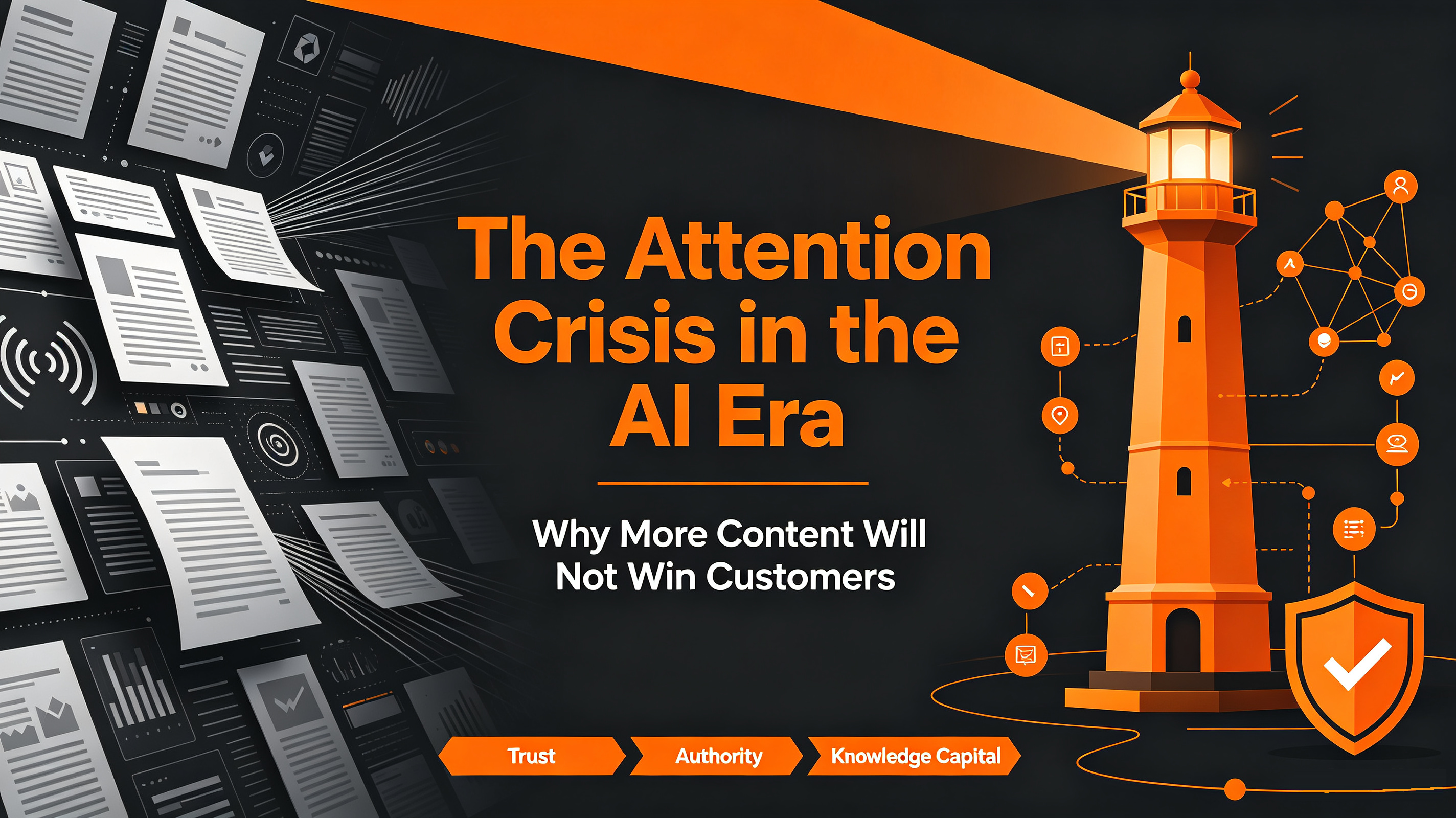
By automating the synthesis of generic summaries, AI has inadvertently made customer decision-making harder rather than easier. Faced with a sea of indistinguishable corporate blogs, white papers, and automated social posts, buyers are experiencing cognitive fatigue and tuning out standard corporate messaging. The biggest marketing challenge in the AI era is no longer content production; it is becoming the trusted choice in an overcrowded, low-trust information environment.
1, From Information Scarcity to Attention Scarcity: The Biggest Shift in Marketing History
Marketing competition has evolved across four distinct strategic epochs, shifting from tangible product characteristics to the intangible digital assets of credibility and attention:
- Stage 1: Product Competition: In the early modern industrial economy, companies competed almost entirely on product quality, specialized physical features, and raw pricing strategies.
- Stage 2: Traffic Competition: The rise of programmatic internet indexing and Google changed marketing forever. Companies competed fiercely for targeted keywords, search engine result rankings, and raw website traffic.
- Stage 3: Content Competition: With the democratization of content Management Systems (CMS) and social platforms, organizations invested heavily in corporate blogs, deep white papers, localized video assets, and multi-channel social media campaigns. This era operated under a singular, foundational belief: “More content creates more digital visibility.”
- Stage 4: Attention and Trust Competition (The AI Era): Today, the traditional content engine is broken. When any organization can tap an LLM to spin up a 2,000-word article in under thirty seconds, everyone can create content. However, very few can manufacture credibility.
When information becomes hyper-abundant, authentic trust becomes the absolute new scarcity. The value of standard, middle-of-the-road information has collapsed to zero, while the premium placed on verified, authoritative execution has soared.
2, AI Has Changed the Customer Journey Forever
The rapid adoption of conversational AI tools has fundamentally broken the traditional, linear B2B buying funnel that Western companies have relied upon for decades.
The Traditional B2B Buying Journey
Google Search ➔ Website Visit ➔ Content Download (Lead Gen) ➔ Sales Conversation ➔ Purchase Decision
The AI-Driven Buying Journey
Business Challenge ➔ AI Research Assistant ➔ AI Evaluates Companies ➔ AI Recommends Options ➔ Human Validates Decision
A critical insight for global CEOs and executives is that customers may discover and evaluate your company completely before they ever visit your website. According to tracking data from the China Internet Network Information Center (CNNIC), the scale of generative AI search users has surged dramatically, fundamentally restructuring the information retrieval logic for decision-makers. In mature digital ecosystems like China, commercial search requests are transitioning rapidly away from blue-link search engines toward direct, synthesized AI answers.
Before ever making contact with your sales team, prospective clients are feeding their deep operational challenges into models like ChatGPT, Gemini, Perplexity, or domestic Chinese counterparts like DeepSeek, Baidu’s Ernie Bot, and Kimi. The critical question for modern marketing leaders is no longer “Are we ranking number one for this keyword?”, but rather: Is your company visible, accurate, and structured appropriately for AI systems to recommend you in their synthesized answers?
3, The Rise of AI Reputation: Your Digital Footprint Becomes Your Salesperson
In the traditional marketing model, the company firmly controlled the narrative via press releases, paid advertisements, and slick corporate collateral. In the AI era, the control of the message shifts entirely. AI engines act as aggregate consolidators, crawling the digital landscape to synthesize independent signals from dozens of external touchpoints.
An engine’s recommendation relies on a comprehensive mesh of digital validation: website domain authority, industry trade publications, expert-authored articles, public customer case studies, third-party review platforms, active professional networks like LinkedIn, and unstructured external references.
To survive this shift, organizations must construct a resilient Digital Trust Infrastructure. This specialized ecosystem is designed not to pitch, but to cleanly answer the core foundational queries that machine learning algorithms look for when mapping a market sector:
- Who are you fundamentally, and what verified authority do you hold?
- What specific technical or operational expertise do you possess?
- What concrete, real-world problems have you successfully solved?
- Why should an risk-averse human customer trust your execution?
The difference between weak and strong digital positioning under this framework is night and day:
- Weak Positioning (AI-Generic): “We provide industrial automation solutions and top-tier engineering services globally.” (AI engines treat this as white noise, as it mimics thousands of scrapable websites).
- Strong Positioning (AI-Credible): “For European manufacturers entering China, we help reduce regulatory compliance and market entry risks through localized digital strategies based on 20 years of China market experience.” (This provides explicit semantic entities, niche focus, and highly distinct context for retrieval models).
4, Why Most AI Content Strategies Will Fail
The prevailing assumption among many executive suites is dangerously flawed: “AI gives us the organizational capability to publish 10x more content, so we should flood our channels.”
This strategy fails because every competitor has access to the exact same commodity technology. When you scale commoditized output, you merely accelerate the velocity of noise. More content does not equal more influence.
| Feature | AI-Generated Content (Commodity) | Experience-Driven Content (Premium) |
| Perspective | Generic, highly predictable, and repetitive | Rooted in original insights and unique data |
| Narrative Structure | Homogenized syntax similar to industry peers | Custom analytical frameworks and methodologies |
| Trust Factor | Low; often lacks real-world contextual validation | High; leverages deep, verifiable industry judgment |
| Core Source | Aggregated web data and existing summaries | First-person case studies and lessons from failures |
This distinction is precisely why search algorithms and AI recommenders have pivoted heavily toward rigorous validation frameworks like E-E-A-T (Experience, Expertise, Authoritativeness, Trustworthiness). While generative AI can rapidly synthesize Knowledge by scraping existing definitions, it cannot replicate first-person Experience. AI cannot fabricate decades of boots-on-the-ground market execution, it cannot genuinely document high-stakes operational failures, and it cannot simulate the nuanced professional judgment required to navigate unpredictable geopolitical or macroeconomic shifts.
5, The New Marketing Asset: Knowledge Capital
While modern enterprise balance sheets meticulously track factories, physical inventory, technology patents, corporate products, and raw headcount, few organizations consciously build and measure Knowledge Capital—the systematically accumulated, proprietary operational expertise that establishes a company as an unassailable industry authority.
For leadership teams, transitioning to a Knowledge Capital model means moving away from generic educational content and focusing heavily on four core proprietary pillars:
- Industry Insights with a Point of View: Avoid generic topics like “China digital marketing trends.” Instead, engineer authoritative, highly localized analyses such as “Why Western B2B companies fail in China digital marketing despite having strong global brands.”
- The Customer Problem Library: Document the exact, highly specific friction points, doubts, and technical edge cases that clients present during deep sales conversations, building clear answers around these precise problems.
- Proprietary Frameworks: Develop custom intellectual models, assessment matrices, and decision tools that help clients structure their thinking (e.g., proprietary market-entry matrices or automated risk-scoring frameworks).
- Case-Based Learning: Shift case studies away from generic marketing fluff and toward rigorous, data-backed technical breakdowns detailing the exact constraints, deployment challenges, and measurable performance transformations achieved.
6, What Should CEOs and Marketing Leaders Do Now?
Transitioning an organization away from superficial traffic generation to deep trust authority requires a deliberate, programmatic roadmap.
Step 1: Stop measuring marketing only by traffic
Legacy marketing frameworks optimize for soft metrics like raw website visitors, superficial impressions, and general social follower counts. The new AI paradigm requires tracking high-intent, structural indicators: brand mentions across major digital platforms, direct AI assistant visibility, qualified incoming consulting conversations, verified trust signals, and direct marketing influence on long-term sales velocity.
Step 2: Build an AI-ready knowledge ecosystem
Re-architect your primary digital footprint. Your corporate website must stop acting as a static digital brochure and transform into a robust knowledge platform. Content should pivot from broad promotional announcements to highly structured, deep problem-solving resources designed for seamless programmatic indexing.
Step 3: Transform internal expertise into external authority
The most valuable knowledge inside a company is usually trapped in the heads of senior engineers, veteran client consultants, founders, and technical sales teams. Leaders must establish internal mechanisms to capture this tacit, hands-on operational knowledge and convert it systematically into structured digital assets.
Step 4: Optimize for AI discovery via GEO (Generative Engine Optimization)
Marketing teams must explicitly prioritize Generative Engine Optimization (GEO). Rather than optimizing for legacy keyword density, your content must be structured to help advanced LLMs read, parse, and cite your data.
As illustrated in the optimization pipeline, GEO requires transitioning data into highly structured formats—such as precise semantic schemas, expert data tables, and explicit contextual answers—allowing generative models to effortlessly extract, cite, and recommend your brand during high-stakes user queries.
Looking back at the trajectory of digital commerce reveals a clear historical pattern across every major technological disruption:
- The Legacy SEO Era: Marketers claimed that achieving a top search rank was everything. The reality? Ranking first does not guarantee business if your landing page fails to establish immediate credibility.
- The Social Media Era: Teams stated that building massive communities was the primary metric. The reality? Followers do not equal trust; large, disengaged audiences rarely translate to sustainable bottom-line revenue.
- The Generative AI Era: Teams now claim that content velocity will allow brands to dominate industries. The reality? Raw content volume does not equal authority; it simply increases the volume of background noise.
Technology continuously alters the communication channels, indexing speeds, and distribution mechanics of the market. It does not change the fundamental, immutable law of commerce: people buy from companies they trust. AI tools are incredibly powerful optimization mechanisms, but they remain conduits. The core asset remains the depth, integrity, and authenticity of your underlying corporate expertise.
Conclusion: The Winners of the AI Marketing Era
The ultimate winners of this next era will not be the corporations that assemble the largest automated AI content factories to pump out endless streams of generic information. The definitive winners will be the agile, expert-driven organizations that:
- Firmly own unique, hard-won, and verifiable industry expertise.
- Proactively build deep, structural trust before sales conversations ever initiate.
- Become recognized as definitive, unassailable authoritatives within their target niches.
- Are consistently recommended by both human experts and AI retrieval systems alike.
AI has made content creation cheap, but in doing so, it has made human trust infinitely more valuable. The future of digital marketing is not about creating more information; it is about becoming the one definitive company that both human decision-makers and AI engines trust implicitly when decisions matter most.
 Unlock 2026's China Digital Marketing Mastery!