 English
 German
 Korea
Korea Spanish
From SEO & GEO to Trust Optimization: Why AI is Becoming Your Customer’s First Sales Consultant
- On July 10, 2026
- AI trust, Trust Optimization
In the digital landscape of 2026, if you are still obsessed with “ranking” or “AI visibility,” you are fighting the wrong war.
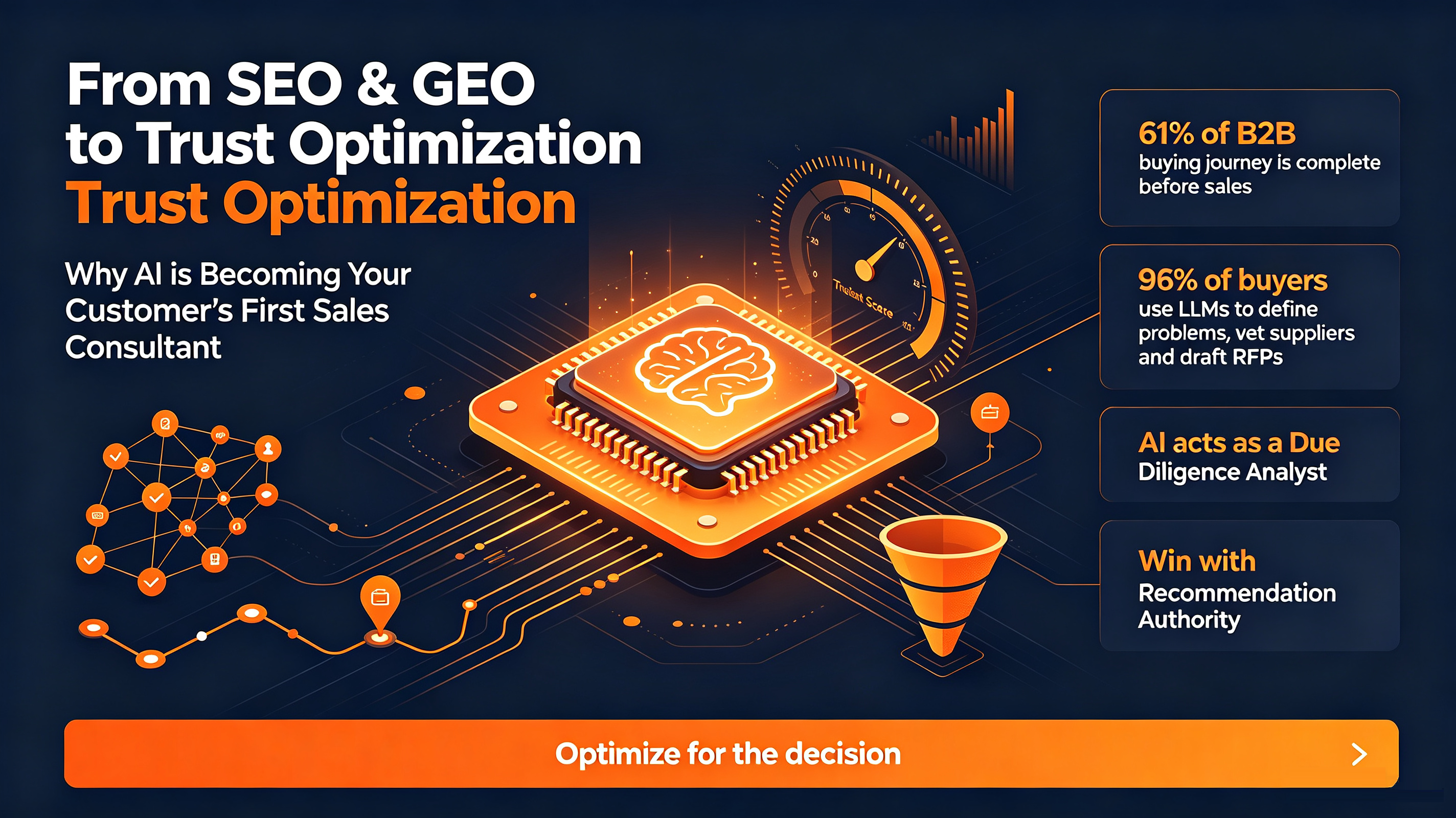
The buyer’s journey has fundamentally collapsed. Industry data from mid-2026 confirms that B2B buyers now complete approximately 61% of their purchasing journey before ever engaging with a sales representative. Even more critical: over 94% of these buyers are now utilizing Large Language Models (LLMs) to define problems, vet potential suppliers, and draft RFPs.
This shift signifies a profound transition: AI is no longer just a search tool; it is acting as a “Due Diligence Analyst.” The perception-building work that was once the domain of your marketing, PR, and sales teams is now being automated by AI. If your enterprise is not actively managing its “AI Persona,” you are effectively leaving your reputation to the hallucinations of algorithms.
1. The Death of the “Sales-Led” Trust
In the past, trust was built through a linear sequence: Website → Case Study → Sales Meeting.
Today, the sequence has been hijacked: ChatGPT/Perplexity → “Is this company reliable?” → “How do they compare to Competitor X?” → “Are there any red flags?” → “Why should I trust them?”
AI is no longer just finding answers; it is forming judgments. When a potential buyer asks an AI to evaluate your firm, they are performing a high-speed, automated audit of your credibility. If your brand is not explicitly positioned as the authority in the model’s “latent space,” you aren’t just invisible—you are potentially being de-prioritized by an agent that has already decided you don’t fit the buyer’s needs.
2. The New Buying Committee: Shared AI Cognition
In the “Google era,” different members of a buying committee (Marketing, IT, Finance, C-Suite) might search separately and arrive at fragmented conclusions.
In 2026, the buying committee is increasingly sharing a single “AI-driven reality.” They are feeding the same prompts into the same LLMs. This creates a Unified Cognition Framework. If your brand narrative is inconsistent or poorly defined, you are not just losing the CEO—you are losing the entire committee simultaneously. Your primary task is now ensuring that the “AI consensus” across the board is favorable to your organization.
3. Trust Optimization: The Next Marketing Frontier
We are moving beyond the eras of SEO (Click-focused) and GEO (Citation-focused). We have entered the era of Trust Optimization (Decision-focused).
The goal is no longer to get mentioned; it is to influence the AI to help the buyer reach a specific decision: Choosing you.
To master this, forward-thinking enterprises are adopting a new “Trust Infrastructure” powered by specialized AI Agents:
- The Trust Agent: This agent simulates thousands of customer inquiries daily—asking the tough questions about your reliability, technical depth, and competitive edge. It outputs a “Trust Report,” showing you exactly how models like Claude, Gemini, or DeepSeek currently perceive your brand versus your competitors.
- The Buying Journey Agent: This agent maps the entire decision cycle. It identifies exactly where in the journey the AI’s answer causes a lead to drop off. Does the AI fail to find your technical documentation? Does it prioritize a competitor because their case studies are better indexed? This allows you to close “trust gaps” in real-time.
- The Competitor Intelligence Agent: Instead of manually tracking competitors, this agent analyzes why they are being recommended over you. It identifies the gaps in your data, citations, and thought leadership that the AI is using to build its recommendation logic.
4. Strategic Imperatives for the Modern Executive
If you want to maintain control of your company’s perception, you must shift your strategy from “Content Production” to “Cognitive Engineering.”
- Stop Feeding the Algorithm, Start Building the Evidence Base: AI prioritizes verifiable facts, industry-standard methodologies, and deep-technical documentation. Your “marketing fluff” is invisible to the AI’s truth-verification processes. Focus on high-authority technical content that serves as “ground truth” for the AI.
- Architect Your Enterprise Ontology: Treat your brand like an entity in a knowledge graph. Ensure your product capabilities, service standards, and comparative advantages are structured, linked, and unambiguous. Don’t let the AI guess your value proposition—define it through rigorous, structured digital data.
- Redefine Your KPIs: Move your team away from “traffic” and “keyword ranking.” Your new core metric should be “Recommendation Authority.” When a prospect asks a high-intent question about your category, how often—and with what level of conviction—is your company placed in the shortlist?
The Bottom Line
AI will not replace your sales team, but it is already setting the stage for their success—or failure. In 2026, the sales call is no longer the place where trust is established; it is where the trust already established by your AI presence is verified.
The companies that win the next decade will be those that treat Trust Optimization as their primary marketing objective. The question is not whether the AI is talking about you—it is whether it is recommending you as the only logical choice.
Are you ready to optimize for the decision?
 Unlock 2026's China Digital Marketing Mastery!