 English
 German
 Korea
Korea Spanish
Why Does Your “Expert” Content Attract Only Competitors? Cracking the 4 Levels of B2B Content Positioning
- On July 8, 2026
- content strategy
If you check your B2B marketing metrics this morning, you might see a paradox that is quietly draining your budget:
Your content team is publishing deeply researched whitepapers, highly granular breakdowns of the latest Google core updates, and cutting-edge GenAI prompt frameworks on LinkedIn. The impression metrics look spectacular, and engagement is up. But when you audit the actual profiles interacting with your posts, your heart sinks—the comments section is a digital echo chamber of fellow marketing managers, agency peers, and technical executioners.
The enterprise buyers, C-suite executives, and procurement heads you actually need to close are nowhere to be found.
According to Gartner’s 2025/2026 Enterprise B2B Buying Behavior Report, modern buyers complete 69% to 95% of their purchasing journey independently before ever engaging with a sales representative. Furthermore, data from the Content Marketing Institute (CMI) reveals that over 44% of decision-makers consume 3 to 5 high-value content pieces before agreeing to a discovery call.
If buyers are so heavily reliant on content to self-educate, why is your expert insight acting like a magnet solely for your competitors?
The answer is simple, yet brutal: You think you are executing content marketing, but you are actually trapped in “supply-side” professional vanity. Algorithms do not have telepathic powers. They cannot read your mind to know who your “ideal customer profile” is; they can only observe content metadata and user interaction patterns. When you output pure technical expertise, the platform hands your traffic to those most likely to engage with the technical nuances: your competitors.
To drive predictable pipeline and capture premium accounts, Western enterprise leaders must completely abandon the traditional “knowledge-base” mindset. You must shift your content paradigm from “Our Expertise (Supply Side)” to “The Buyer’s Decision (Demand Side).” This requires breaking down the four distinct levels of content positioning.
1. The Four Levels of Content Positioning: Which Net Are You Casting?
Content architectures capable of piercing through algorithmic noise and arresting the attention of executive buyers are structured into four layers. Most companies, unfortunately, remain bottlenecked at the bottom two.
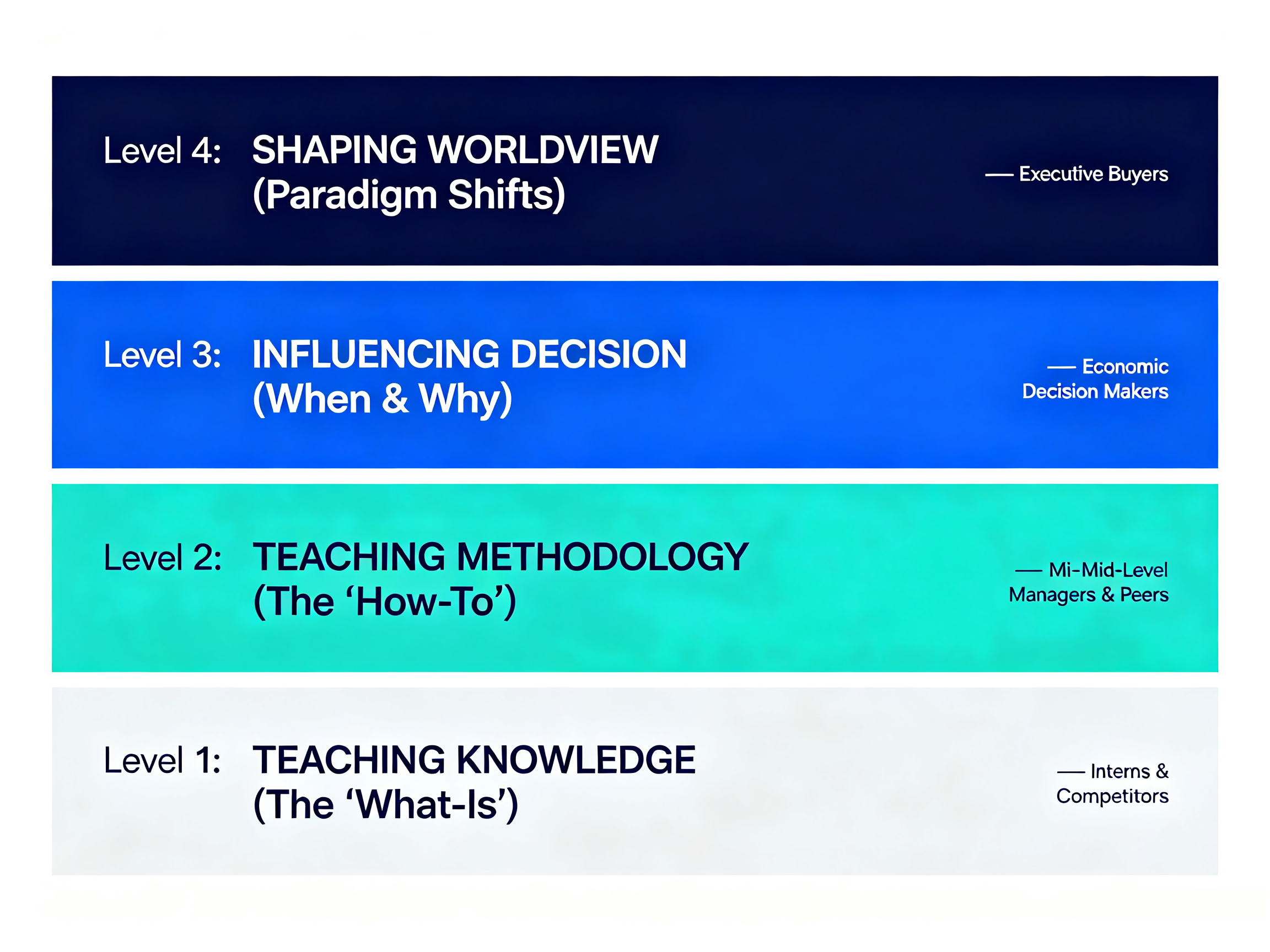
Level 1: Teaching Knowledge (The “What”) — The Industry Encyclopedia
- The Content: Writing assets like “What is SEO?”, “What is Generative Engine Optimization (GEO)?”, or “What is Account-Based Marketing?”
- The Intent: Attempting to prove that you understand a fundamental industry term.
- The Blind Spot: True corporate decision-makers never type “What is SEO” into a search box or a Large Language Model (LLM) interface. The users searching for these definitions are interns, entry-level coordinators, and your peers. This content carries zero commercial moat. In an era where AI can synthesize a 10,000-word wiki in seconds, Level 1 content has plummeted to near-zero commercial value.
Level 2: Teaching Methodology (The “How”) — The Technical Instruction Manual
- The Content: Sharing blueprints like “10 Advanced Meta-Tag Optimization Tactics”, “Python Scripts for Data Cleaning”, or “5 Specific Prompts to Fine-Tune LLMs.”
- The Intent: Displaying execution-level details to prove you know how to perform specific tasks.
- The Blind Spot: This is the epicenter of the trap where you talk about your craft, and the platform hands your traffic to your rivals. Executives care about pipeline acceleration and strategic outcomes, not the exact syntax of your script. The more granularly you explain the “How,” the more the platform categorizes you as a technical executioner. It pushes your work straight to other executioners looking for free technical documentation—turning you into an unpaid industry trainer.
Level 3: Influencing Decision (The “When & Why”) — The Strategic Advisor
- The Content: Shifting the narrative to “When to Invest Heavily in Organic Search, and Exactly When to Abandon It”, “Why Over-Reliance on Paid Performance Media Is Silently Eroding Your Brand Equity”, or “Why B2B Tech Launches Fail Globally (And It’s Not the Product).”
- The Intent: Helping buyers make high-stakes judgments and informing their resource allocation (Influencing the Buying Decision).
- The Breakthrough: At this layer, you finally move to the “Demand Side.” C-suite executives may not understand changing algorithmic nuances, but they care deeply about asset yield, mitigation of operational risk, and opportunity costs. When your content helps them answer “What should I do next under these conditions?”, you transcend the role of a vendor and become a trusted strategic advisor.
Level 4: Shaping Worldview (The Paradigm Shift) — The Market Visionary
- The Content: Challenging entrenched industry dogma with concepts like “The Era of Pure Search Traffic is Dead: Why Generative Engine Optimization (GEO) Will Dictate Digital Market Share Over the Next Three Years”, or “The Autonomous Buyer Paradigm: Why Your Traditional Sales Funnel is Driving High-Value Prospects to Your Competitors.”
- The Intent: Fundamentally restructuring how the reader perceives their own industry and market dynamics.
- The Commercial Value: A recent whitepaper by Forrester emphasizes that content generating a “Cognitive Conflict” holds a buyer’s dwell time 3.4 times longer than standard informational copy. You are no longer reacting to their stated needs; you are teaching them how to frame their problems. Once a buyer adopts your structural worldview, their trust is locked to your methodology. Competitors will find it nearly impossible to dislodge you on price alone.
2. Trend Deconstruction: How AI Search and the “Messy Middle” Alter the Playing Field
Why has transitioning to the “Decision” and “Worldview” layers become a matter of survival in 2026? Two irreversible macroeconomic and behavioral shifts are driving this urgency across global markets:
A. Traditional SEO Compression: GEO Demands Decision-Centric Content
A longitudinal study of over 300,000 keywords by Ahrefs reveals a stark reality: The integration of Google AI Overviews (AIO) has caused click-through rates (CTR) for standard Position One organic links to drop by up to 58%. Furthermore, Gartner forecasts that traditional search engine volumes will experience a massive shift toward conversational AI engines like ChatGPT, Perplexity, and Gemini.
In the legacy search paradigm, users asked “How do I do X?” and received a list of links. In the AI era, buyers ask “What is my best option under these conditions?” and receive a synthesized, single answer with citations (via Retrieval-Augmented Generation, or RAG).
As enterprise AI platforms like Jasper.ai point out: AI models prioritize and cite content that directly answers complex business challenges and offers defensible, data-backed perspectives. If your corporate repository is merely spinning out superficial, encyclopedic blog posts, you will not only lose organic search clicks; you will be systematically filtered out of the LLM indexing layer entirely.
B. Navigating the B2B Buyer’s “Messy Middle”
The “Messy Middle” framework—originally conceptualized by Google and deeply integrated into B2B systems by agencies like The Munro Agency—proves that modern B2B procurement is far from a clean, linear funnel. Buyers iterate endlessly in a loop between Exploration and Evaluation.
During this loop, because an enterprise buying group involves an average of 11+ stakeholders (the CFO watching capital efficiency, the CMO focusing on strategic execution, the CIO auditing data security), buyers suffer from decision paralysis caused by information floods rather than data scarcity. Gartner indicates that while 75% of B2B buyers prefer a rep-free, digital-only experience, this unguided journey frequently results in extreme “buyer remorse.”
Consequently, the vendor that wins the deal is the one providing true Buyer Enablement content—assets that give buyers clear evaluation frameworks to validate requirements and narrow down vendor selection within that messy middle.
3. The Execution Playbook: Building the “Buying Cycle Content” Architecture
Stop designing your content calendar around your product feature list or your services page. You need an architecture calibrated to the Buying Cycle.
Implement the highly effective “95/5 High-Conversion Content Formula” utilized by top-tier B2B agencies:
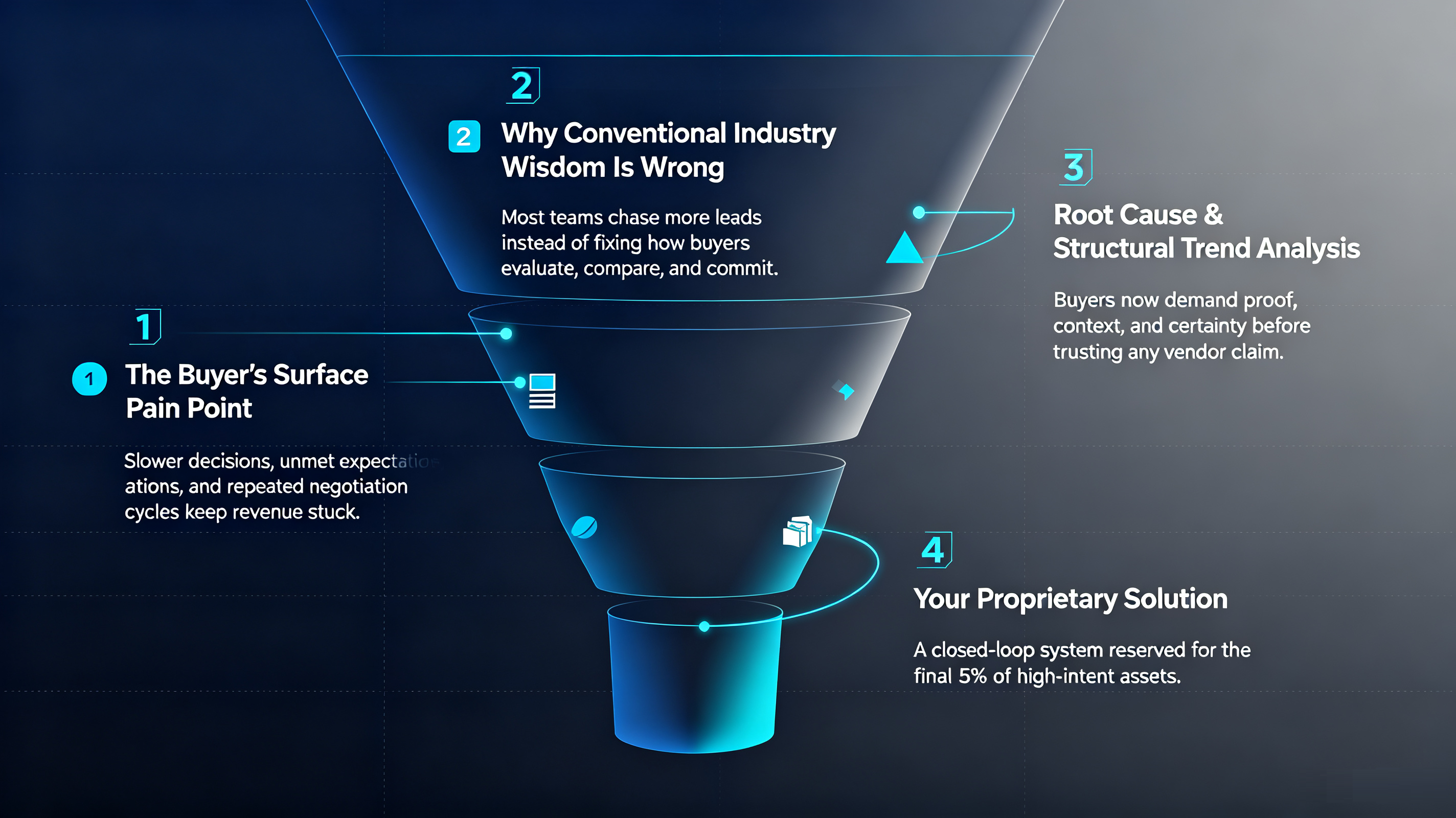
To see this model in practice, let us examine how a B2B enterprise shifts its topics from a “Supply-Side” approach to a “Demand-Side” approach across the purchasing journey:
| Buying Stage | The Buyer’s Internal Monologue (Demand Side) | Failed Supply-Side Topic (Attracts Peers) | Winning Demand-Side Topic (Attracts Executives) |
| 1. Awareness | “Why are our North American and European customer acquisition costs climbing while organic pipeline stagnates?” | Understanding Core Web Vitals and Page Speed Optimization | Why 50% of B2B Organic Traffic Declines Trace Back to “AI Overview Overlays,” Not Site Performance |
| 2. Exploration | “I keep hearing about Generative Engine Optimization (GEO). What makes it different from SEO, and what does it cost to implement?” | A Complete Technical Spec Review of Modern RAG and Indexing Frameworks | The Executive ROI Blueprint: Weighing the Capital Re-Allocation from Legacy SEO to Generative Engine Visibility |
| 3. Requirements Building | “If we overhaul our global digital presence, should we prioritize traditional search, conversational AI visibility, or private community loops?” | Google Algorithms vs. Perplexity Citations: A Technical Deep-Dive | The Chief Marketing Officer’s Guide: Selecting the Right Digital Asset Channels Based on Enterprise Deal Size |
| 4. Validation | “How do I prove to the executive board or private equity backers that approving this major strategic shift is defensible?” | Celebrating Our Agency’s 25 Years of Digital Marketing Excellence | The 2026 B2B Pipeline Whitepaper: How Re-architecting Digital Assets Protects Operating Margins Against AI Disruptions |
4. Strategic Actions for Global and B2B Marketing Managers
If you want to reverse an inbound ecosystem that generates high vanity metrics but zero qualified pipeline, execute these three strategic adjustments immediately:
1. Execute a “GEO and AEO Re-architecture” Across Your Core Assets
Eliminate long-winded, purely conceptual introductions from your corporate blogs and whitepapers.
- Adopt a Citation-First Content Structure: Place your core strategic conclusions within the first 60 to 120 words of an asset. Use clear, unembellished language to allow LLMs (like Perplexity, ChatGPT Search, or Google AIO) to parse, extract, and attribute your answers effortlessly.
- Increase Named Entity Density: Ground your insights with verifiable references to recognized industry reports (e.g., McKinsey, Gartner, Forrester) or validated case studies. Search models rely on these explicit connections to establish your site’s trust footprint.
2. Move Keyword Strategies from “Technical Terms” to “Business Operational Prompts”
When mapping your organic search and editorial calendar, remove generic, high-volume keyword targets. Instead, optimize for longer, intent-rich conversational prompts used by executives trying to solve systemic issues.
- De-prioritize: “B2B Digital Marketing Tactics,” “SEO Best Practices.”
- Prioritize: “Why B2B enterprises must reallocate budget from public acquisition to brand infrastructure during margin compressions,” “How to evaluate marketing attribution parameters when conversational AI hides consumer touchpoints.”
3. Evolve Your Content Department into a “Buyer Enablement Desk”
Take your content creators out of their silos. Embed them with your frontline sales reps, solutions engineers, and customer success specialists. Extract the real, friction-heavy questions that surface during late-stage negotiations—questions regarding risk insulation, implementation timelines, internal change management, and resource allocation.
Always remember: The objective of premium B2B content marketing is never to shout about how much you know. It is to make your ideal buyers stop, read, and realize how deeply you understand exactly what hurts their business.
 Unlock 2026's China Digital Marketing Mastery!